
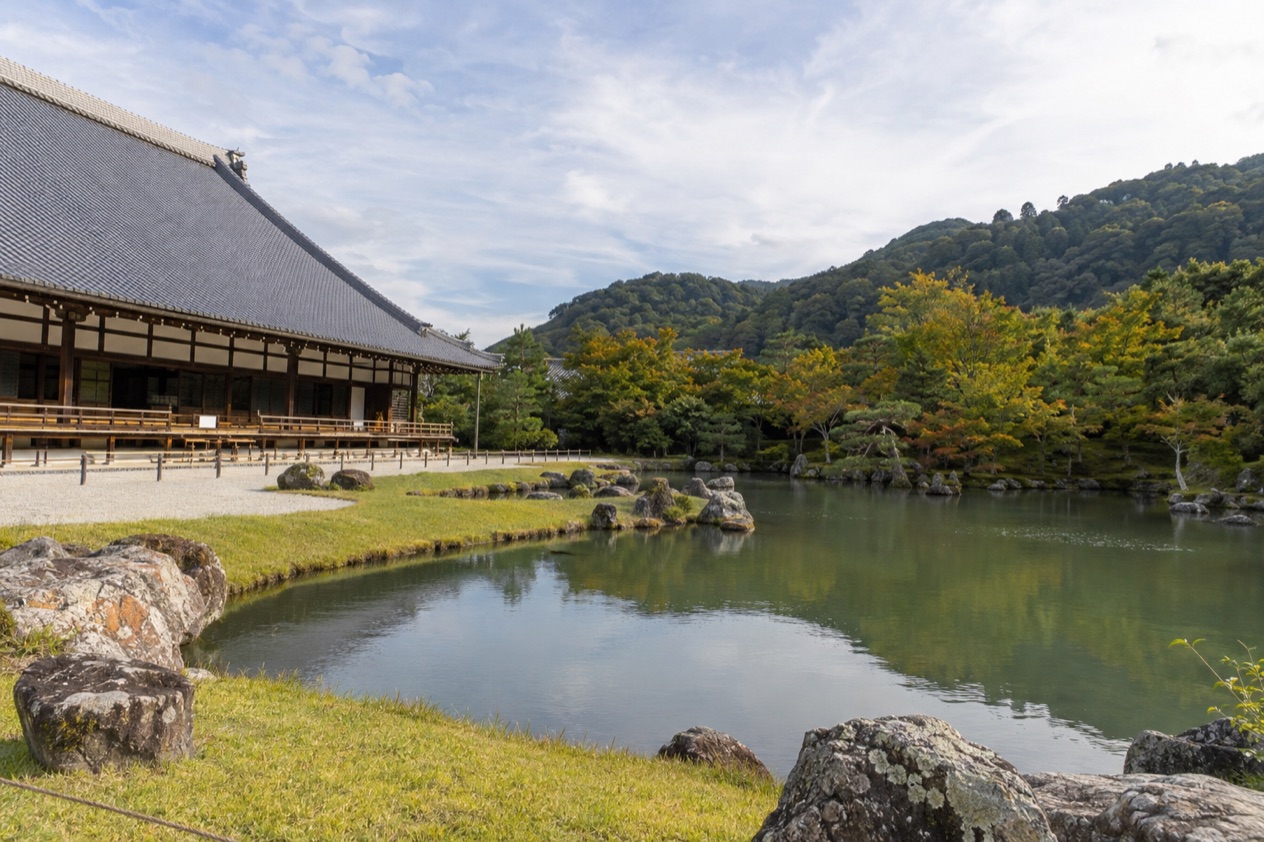
You step through the gate into a temple where the first thing that draws the eye is water: a broad pond, dark and still, with rocks set along its edge like brushstrokes and pine branches leaning over the surface. Behind it, the hall roofs sit low against the greenery. Tenryu-ji is a Zen temple in western Kyoto, and a visit here is a slow walk through a garden, a few halls and a long story.
Is visiting Tenryu-ji worth it?
Yes, especially if you like gardens, Zen history or the quieter side of Kyoto sightseeing, and if you would rather stand in front of one carefully composed landscape than tick off a long list of buildings. The temple rewards people who like to sit, look and let a view settle, as well as travelers who enjoy knowing who made a place and why.
Tenryu-ji was founded by Ashikaga Takauji in 1339, mainly to honor Gautama Buddha, and its construction was completed in 1345. It is the head temple of the Tenryu-ji branch of the Rinzai sect of Zen Buddhism, and it is ranked number one among Kyoto’s so-called Five Mountains, a group of leading Zen temples.
In 1994 it joined the UNESCO World Heritage listing as part of the Historic Monuments of Ancient Kyoto. That is a long résumé, but what you feel on the grounds is the garden first and the résumé second.
What sets it apart from other temples in the city is the pairing of a Zen institution with a garden that is itself designated a Special Place of Scenic Beauty of Japan. Many Kyoto visits lean on gilded halls or on castle rooms built to display a ruler’s power, as at Nijo Castle, with its nightingale floors that chirp underfoot.
Tenryu-ji works the other way. The pond garden, created by the monk Muso Soseki, is the main event, and the ceiling dragon, the imperial tombs and the old gate are the supporting cast that gives it depth.
It also suits a Kyoto trip that already has its share of crowded highlights. Tenryu-ji keeps its own identity through the Zen setting, the pond and the figure of Muso Soseki, whose portraits are among the temple’s Important Cultural Properties.
What to see at Tenryu-ji
Sogen Pond garden
The Sogen Pond garden is the reason people come, and it is the heart of the temple. It is designated a Special Place of Scenic Beauty of Japan, and it was created by Muso Soseki, a Zen master remembered as much for his gardens as for his teaching. In his hands, a garden was a form of meditation made from rock, water, moss and trees.
Look at how the pond is framed. Stones are grouped to suggest a waterfall and a shoreline, trees are placed to open and close views as you move, and the surface of the water doubles whatever stands above it.
The garden changes with the season, with fresh green in spring, deep shade in summer, warm color in autumn and bare branches in winter. Spend time at one spot, then walk on and notice how the same pond becomes a different picture.
Chokushi Gate
The Chokushi Gate is the oldest structure on the temple grounds, and it is representative of the style of the Momoyama period, an era known for bold, confident architecture. The name refers to an imperial messenger, which hints at how closely this temple has been tied to the court since its beginnings.
Take a moment to look at the gate’s timber, its roof lines and the way its weight sits on the posts. Wooden temples in Kyoto have faced fire and rebuilding over the centuries, so an old gate that still stands gives you a rare sense of continuity. It makes a good pause between the world outside and the grounds within, and a good place to notice how the temple’s older and newer buildings differ.
The teaching hall and the dragon ceiling
Inside the teaching hall, the main image is Gautama Buddha, flanked by two guardians. The hall is where the Zen community gathers for teaching and ceremony, and the quiet arrangement of the figures matches the restrained spirit of Rinzai Zen.
Look up. The ceiling carries a decorative painting of a dragon called Unryu-zu, the work of Suzuki Shonen. The name is usually rendered as the Cloud Dragon, and the creature coils across the ceiling as if it were rising out of mist.
In Zen halls a dragon is a traditional guardian figure associated with water and protection, which fits the pond outside. Stand under the painting and shift your position, as its gaze seems to follow you across the room.
Imperial tombs and the temple’s treasures
The tombs of Emperor Go-Saga and Emperor Kameyama lie within the temple grounds, a reminder that Tenryu-ji was never only a quiet retreat but a place linked to the imperial family. Tombs of this kind are sites for reflection, so the usual habit is to stay low-voiced and respectful as you pass.
The temple also holds Important Cultural Properties, including three portraits of Muso Soseki and paintings of Avalokitesvara and of Seiryo Hogen Zenji, also known as Yunmen Daishi. Its document archive includes illustrations and writings such as Shanaingoryo-ezu and Okoshokyokanji-no-ezu. These treasures are part of the temple’s wider story, and knowing they exist adds weight to a visit even when they are not on display.
When to visit Tenryu-ji
A garden temple depends on the season more than most places do, so the month shapes the visit.
| Month | Average high (°F) | Average low (°F) | Precipitation (in) | Days with rain or more (1 mm+) | Sunshine (hours) |
|---|---|---|---|---|---|
| January | 48.4 | 34.7 | 2.10 | 6.4 | 124 |
| April | 68.2 | 48.6 | 4.61 | 9.4 | 177 |
| July | 89.6 | 74.5 | 8.80 | 11.6 | 143 |
| October | 74.1 | 57.9 | 5.64 | 8.2 | 156 |
October, the month of this writing, brings afternoons warm enough for a light shirt and evenings that call for a thin layer. Rain falls on a handful of days, often in showers rather than all-day downpours. The pond is where the autumn mood gathers, with the trees around it beginning their change of color as the season advances.
April is mild, with plenty of sunshine and a little more rain. It suits a long walk around the pond, with new leaves on the trees and fresh green reflecting in the water. Winter is cold, and January can bring snow or sleet on many days, which turns the garden into a dark-and-white ink painting if you are willing to wear warm layers and dress for damp ground.
July is hot and humid, and rain comes on more days than in any other month in the table. A hat, water and an unhurried pace matter, and shade under the garden trees becomes part of the appeal. It is the month when the pond is at its greenest, and a rain shower can make stone and moss glisten.
For time of day, the Japan National Tourism Organization suggests visiting Kyoto’s shrines at less crowded times, such as early morning or late evening when they are illuminated. Tenryu-ji is a temple, so that advice is a general pointer for temple-going in the city rather than a schedule for these grounds.
Tips for your visit
Wear shoes that slip on and off easily, since halls in Japanese temples are usually entered in socks or bare feet, with shoes left at the entrance. Socks without holes are a small courtesy. A light rain jacket or compact umbrella makes sense in any month, and in January a warm layer and gloves help when you sit and look at the pond for a while.
Bring patience more than anything. The garden is something to watch rather than to cover, so sit on a veranda or stop at a bend in the path and look for details: a rock group, a pine branch, the reflection of a roof. A camera helps, but a notebook or a few minutes of silence often shows more of Muso Soseki’s design than a photo does.
Tenryu-ji pairs well with other Kyoto outings that show a different side of the city. Nijo Castle, built in 1603 by Tokugawa Ieyasu, the first shogun of the Edo period, offers a contrast: samurai-era power and nightingale floors against Tenryu-ji’s Zen calm. Kyoto’s traditions, including machiya townhouses, the Gion Matsuri festival and the hanamachi districts where geishas live and work, round out a longer stay.
If you arrive by Shinkansen, Kyoto Station is served by the Tokaido Shinkansen line and is a good base for exploring the city. The station building has a full floor of ramen restaurants, an Isetan department store, a theater and a Granvia hotel, and Kyoto Tower stands a few steps from the main entrance, over 130 meters tall and visible across the entire city.
For families and for anyone with limited mobility, the best approach is to walk the grounds at an easy pace and to take breaks where the garden invites them. Children often enjoy the dragon on the ceiling, so it helps to tell them the name Cloud Dragon before you go in. Linger as long as the group enjoys it, and leave when the mood shifts.
Good to know before you go
Tenryu-ji stands in Susukinobaba-cho, in Kyoto’s Ukyo Ward. Carry a little cash and small change for the day, as many temple visits involve small purchases and offerings. Keep your voice low in the halls and near the tombs, as the place is an active Zen temple rather than a museum.
In summer the heat and humidity can be heavy, so water and a cap are useful. In the rainy months, paths and stone steps can be slick, and the garden is still worth seeing in a shower, when wet rock and moss deepen in color.
Sources
- Wikipedia, Tenryū-ji (https://en.wikipedia.org/wiki/Tenry%C5%AB-ji), checked October 11, 2026
- Japan National Tourism Organization, Kyoto (https://www.japan.travel/en/destinations/kansai/kyoto/), checked October 11, 2026
- Japan Meteorological Agency (JMA), Normal values 1991-2020, monthly (https://www.data.jma.go.jp/stats/etrn/view/nml_sfc_ym.php?prec_no=61&block_no=47759), station Kyoto, elevation 41 m, checked October 11, 2026
To plan your stay
- Best Time to Visit Japan: Cherry Blossoms, Autumn Colors, Weather and Festivals
- Where to Stay in Japan: Ryokan, Temple Stays, Capsule Hotels and the Best Cities to Base In
- Sending Luggage from the Airport in Japan: Hands-Free Travel, Hotel Delivery and Coin Lockers
- Know Before You Go to Japan: Entry, Money, Etiquette and Getting Around