
The first thing you notice is the sound: tires humming over a bridge deck while the wind off the Seto Inland Sea pushes at your jacket and freighters slide through the channel far below. Between the bridges come island roads lined with citrus groves, tiny fishing harbors and shrines tucked behind seawalls. The Shimanami Kaido is a cycling route that hops across the Inland Sea from Honshu to Shikoku, and it suits anyone who wants to cross a stretch of Japan by pedal power and island scenery rather than by train window.
It is a trip of rhythm more than of single sights: a climb onto a bridge, a long glide down, a lunch stop in a harbor village, then another bridge ahead.
Is visiting the Shimanami Kaido worth it?
Yes, if you like the idea of crossing the sea under your own power, and it is especially rewarding for cyclists, walkers and anyone who enjoys a journey where the route is the destination. It is a route you ride rather than a monument you photograph, and the pleasure comes from the sequence: island, bridge, island, bridge, with the water changing color and the boats changing shape along the way.
What sets it apart from other cycling routes in Japan is the way it works as a real connection between two main islands. The Nishiseto Expressway is the only land link between Shikoku and Honshu that can be crossed on foot or by bicycle, and the bikeway is a path that was built into that structure.
It was Japan’s first highway with dedicated cycling infrastructure, and it remains the most popular cycling route in the country. Other long routes exist, such as the Pacific Cycling Road along the Pacific coast or the Tonegawa Cycling Road, but those follow a coastline or a river. This one leaps across open water from island to island.
It also rewards people who do not consider themselves cyclists. Bicycle rental and drop-off locations are available along the route, so you can ride one way and leave the bike behind. Pedestrians can use the crossing too, and mopeds are allowed alongside bicycles. Visitors who prefer a gentler mood will find that the islands themselves, with their orchards, small temples and harbor cafés, reward a slow pace and plenty of stops.
The Inland Sea is a landscape of many islands (depending on how you count, between 700 and 3,000, and over 170 of them inhabited), and the Shimanami Kaido threads through only a few. You come for the connection between them, and for the feeling of moving through an archipelago on the open road.
What to see at the Shimanami Kaido
The route is built around the places where water, bridge and island meet. The best way to see it is as a sequence of settings rather than a list of sights, each with its own look and its own pace.
Onomichi and the ferry crossing
Onomichi, in Hiroshima Prefecture, is where the cycle route begins on the Honshu side. The town climbs a hillside above a narrow channel, with temples scattered up the slope, lanes of old houses, and a harbor that has long been a stopping place for boats on the Inland Sea. It is also known for its own style of ramen, a good thing to hold in mind before a day in the saddle.
From here, cyclists are encouraged to take the short ferry ride between Onomichi and Mukaishima. The reason is practical: it avoids the steep climb that leads up to the Shin-Onomichi bridge. The crossing is also a pleasant way to start, since you glide across the channel with your bike beside you and the town receding behind. On the far side, you are already on the first island of the route.
The great bridges
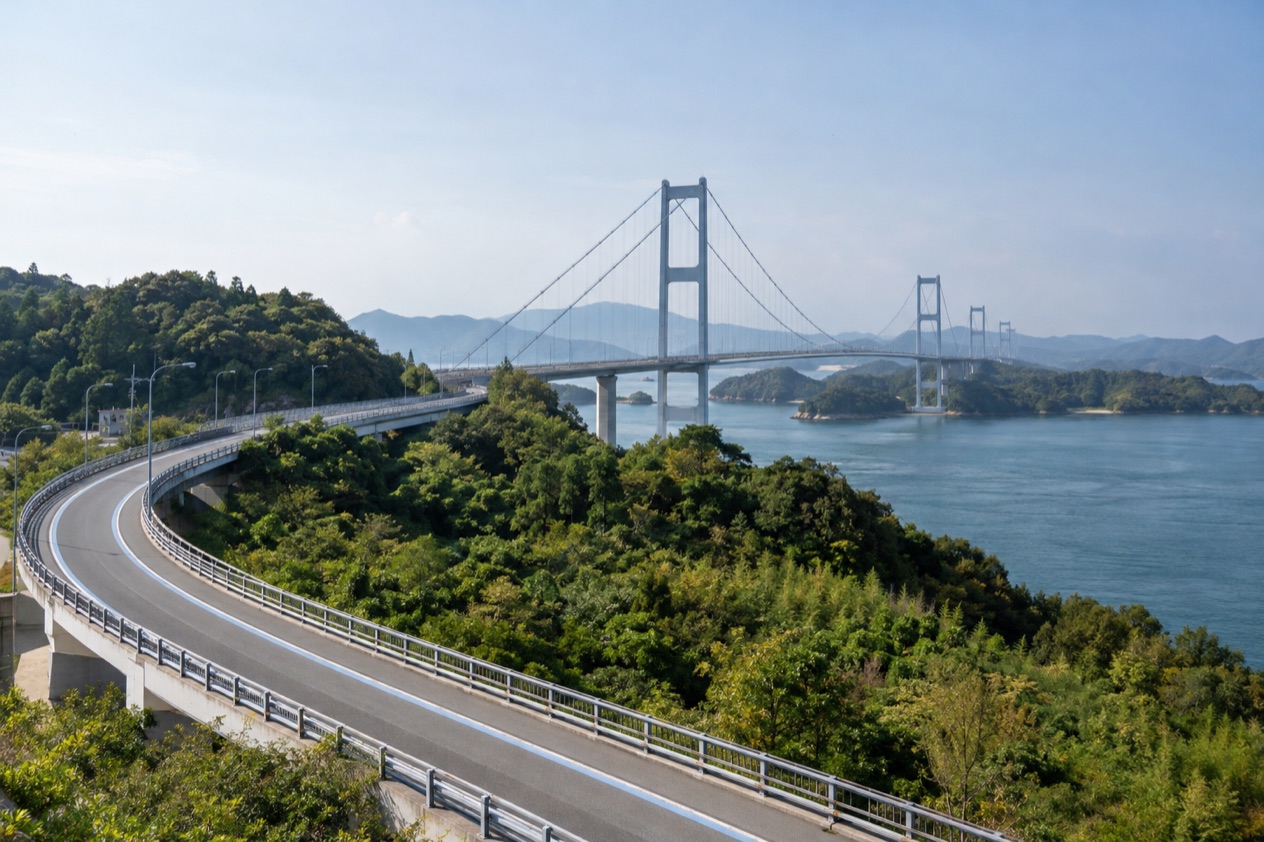
Seven bridges link six islands along the bikeway, and they are the defining images of the trip. Two stand out from the rest.
The Kurushima Kaikyo Bridge belongs to the world’s longest series of suspension bridges, and the Tatara Bridge is the fourth longest cable-stayed bridge in the world. Each crossing has a different personality, from suspension cables sweeping down to the deck to the fan of stay cables that rises from a single tower.
What to look for is the way the structure frames the water. From the deck you see strong tidal channels, ships passing in single file and small islands scattered to the horizon.
Slow down at the middle of a span and look down: the bridge makes the scale of the strait obvious in a way that no photograph quite does. The expressway itself is long and opened on May 1, 1999, and the cycle path follows its crossings.
The islands between the bridges
Between the spans, the route drops onto island roads, and this is where the trip becomes personal. The Inland Sea islands are known for citrus groves, boatyards and small harbors where fishing boats lie against seawalls. Villages tend to cluster around a shrine or a temple near the water, and a stop for a cold drink or a snack often turns into a longer pause, because the views over the channel are good from almost any bench.
The islands also give you a sense of how people live in a sea of islands: ferries that serve small communities, terraced hillsides, orchards behind stone walls and the smell of salt and citrus in the air. Many of these places have a slower rhythm than the cities on either shore, and the route lets you move through them at the speed of a bicycle, which is just right for noticing.
Imabari and the Shikoku end
The route ends at Imabari, in Ehime Prefecture, on Shikoku. Ehime promotes cycling widely, and Imabari is known as a town of towel making, a craft associated with the area for generations. A day of riding often ends here with a meal in town and a look at the harbor, where the long chain of bridges you crossed is a memory of the last hours.
Arriving by bicycle gives the city a different feel than arriving by train. You have crossed a sea to get here, and the sense of having traveled from one island to another under your own power is the real souvenir of the route. Rental drop-off locations along the way mean you can leave the bike behind and finish the day on foot.
Hours, tickets and rules
The Shimanami Kaido works as a public crossing rather than as a ticketed site with a gate. The cycle route links Onomichi in Hiroshima Prefecture with Imabari in Ehime Prefecture, and it is about 43 miles long including the bridge access ramps. Bicycle rental and drop-off locations are available along the route, which lets you start at one end and finish at the other without bringing your own bike.
The route is part of the expressway system, and the same structures that carry cars also carry cyclists. Think of it as a long outdoor trail with a series of bridges, island roads and ferry connections, not as a single attraction with a front door. Your day is set by your own pace and by when you choose to start and stop.
A few rules are worth knowing. Bicycles, mopeds and pedestrians may cross the Shimanami Kaido as well as cars. Children are required by law to wear helmets when cycling in Japan. Electric bikes in Japan are limited to pedal assist only, with a top speed of 15 mph. Cyclists are encouraged to take the short ferry between Onomichi and Mukaishima to avoid the steep climb to the Shin-Onomichi bridge.
How to get to the Shimanami Kaido
The route has two ends, and you can start from either. On the Honshu side, the base is Onomichi in Hiroshima Prefecture. On the Shikoku side, it is Imabari in Ehime Prefecture. Riding from Onomichi to Imabari follows the usual direction described for the bikeway, which runs from Honshu to Shikoku, but nothing stops you from reversing it.
From Onomichi, the route begins with a short ferry ride between Onomichi and Mukaishima. This crossing takes cyclists across the channel and spares them the steep climb that leads up to the Shin-Onomichi bridge. After the ferry you are on the island side, and the bikeway continues from island to island across the series of bridges until it reaches Shikoku.
Because bicycle rental and drop-off locations are available along the route, you do not have to ride back to where you started. That makes it possible to treat the Shimanami Kaido as a one-way journey, hopping between Honshu and Shikoku on your own wheels. Pedestrians and mopeds can cross too, and the same bridges that carry bikes also carry cars on the expressway beside you.
If you are planning a trip across the region, think of the two ends as the two doors of the route. One opens on the hillside town of Onomichi, the other on Imabari. The Seto Inland Sea itself lies between Honshu, Shikoku and Kyushu, and the bikeway crosses a corner of it, so a day on the route is also a day on the water’s edge.
When to visit the Shimanami Kaido
The route is a long outdoor ride, so the weather, the light and your own energy shape the day more than any opening time. Because it is an open path across bridges and islands, the sea breeze and the sun are constant companions. Set your own pace, with time for stops, and let the day run at the speed of the ferries and the harbor villages.
The Inland Sea changes with the seasons. Spring brings fresh green to the island hillsides, summer turns the water a deep blue and the citrus orchards a darker green, autumn softens the light over the channels, and winter leaves the strait a cooler, clearer gray. Each season gives the bridges a different backdrop, and none of them takes away the pleasure of crossing the sea by bicycle.
Because it is a route you ride, the length of the day matters. Others split it over two days, sleeping on one of the islands, which lets you linger in a harbor village in the evening and ride on the next morning.
The route was opened as a place for cyclists and has become one of the country’s most popular long-distance cycling routes. If you prefer to share the road with other riders, you will find you are in good company on almost any day of the year.
Tips for your visit
Bicycle rental and drop-off locations are available along the route, so a one-way ride is possible and you can choose how much of the route to cover. Plan around the ferry from Onomichi to Mukaishima, since cyclists are encouraged to take it instead of the steep climb to the Shin-Onomichi bridge.
Families with children should note that helmets are required by law for children cycling in Japan. If you are riding an electric bike, remember that Japanese e-bikes are pedal assist only and top out at 15 mph, so they help on the climbs but do not turn the ride into a motorbike trip. Bridges and island roads differ in character, and the pace is yours to set.
Combine the ride with the two towns at its ends. Onomichi, with its hillside temples and its own style of ramen, makes a good start, and Imabari, with its towel-making heritage, rounds off the journey. Those with more time in the area can look at other cycling routes in Japan, such as the Akinada Tobishima Kaido, which runs from Kure to Okamura, or the cycling promoted across Ehime Prefecture.
- Start at Onomichi and take the short ferry to Mukaishima.
- Use the rental and drop-off locations along the route if you want to ride one way.
- Keep time for the harbor villages between the bridges, where a cold drink often turns into a long pause.
- Let the crossing itself be the main event, and plan the rest of the day around it.
Good to know before you go
The Shimanami Kaido is a route across open water, so think of the day as an outdoor trip with stretches of exposed bridge and quiet island road. The Seto Inland Sea, which separates Honshu, Shikoku and Kyushu, was designated as one of Japan’s first national parks in 1934, and the islands along the route sit within that wider landscape.
Bicycles, mopeds and pedestrians share the crossing with cars on the expressway, so ride with the same care you would on any shared road. The route ends where you decide it does, with rental drop-off available along the way, and the last thing you see is often a bridge fading behind you over the water.
Sources
- Japan National Tourism Organization, cycling (https://www.japan.travel/en/sports/cycling/), checked October 11, 2026
- Wikipedia, Nishiseto Expressway (https://en.wikipedia.org/wiki/Nishiseto_Expressway), checked October 11, 2026
- Wikivoyage, Cycling in Japan (https://en.wikivoyage.org/wiki/Cycling_in_Japan), checked October 11, 2026
- Wikipedia, Seto Inland Sea (https://en.wikipedia.org/wiki/Seto_Inland_Sea), checked October 11, 2026
- Wikivoyage, Seto Inland Sea (https://en.wikivoyage.org/wiki/Seto_Inland_Sea), checked October 11, 2026
To plan your stay
- Best Time to Visit Japan: Cherry Blossoms, Autumn Colors, Weather and Festivals
- Where to Stay in Japan: Ryokan, Temple Stays, Capsule Hotels and the Best Cities to Base In
- Sending Luggage from the Airport in Japan: Hands-Free Travel, Hotel Delivery and Coin Lockers
- Know Before You Go to Japan: Entry, Money, Etiquette and Getting Around