
You step out of the temple’s entrance hall and the first thing that meets you is the sound of almost nothing: a few shuffling socks on wooden boards, a murmur, a cough. Then the veranda opens onto a long rectangle of raked white gravel with a handful of mossy stones set in it, and people simply sit down and look. Ryoan-ji is a Zen temple in Kyoto, and the visit is built around that single act of sitting and watching a garden.
Is visiting Ryoan-ji worth it?
Yes, if you like the idea of spending a while with one thing rather than ticking off many, and it suits travelers who want to understand what a Zen garden is trying to do. It is a place for people who enjoy sitting, thinking and noticing, less for those who want a lot to climb, photograph or walk through.
Ryoan-ji belongs to the Myoshin-ji school of the Rinzai branch of Zen Buddhism, and it is listed among the Historic Monuments of Ancient Kyoto, a UNESCO World Heritage Site. That heritage matters because the temple is not a showpiece of gold leaf or towering halls. Its fame rests on a rock garden with no trees, no flowers and no water, only stone, gravel and a little moss.
What sets it apart from the other temples you will see in Kyoto is the way you are asked to look. Elsewhere you stroll through a landscape, cross a bridge, climb a hall or follow a circuit around a pond.
Here the garden is meant to be viewed from a seated position on the veranda of the hojo, the residence of the abbot of the monastery. The view is fixed, the frame is the veranda, and your only job is to stay with it.
Kyoto has a cultural heritage that has developed over 1,200 years, and it served as Japan’s capital and the emperor’s residence for over 1000 years. Against that backdrop, with castles such as Nijo built for a shogun and districts where geishas live and work, Ryoan-ji offers the opposite register: restraint. Many travelers pair it with something more ornate for contrast, and the pairing makes each one stronger.
There is also a second side to the grounds that surprises people who come only for the stones. A water garden, Kyoyochi Pond, lies within the temple precincts, so the visit is not limited to the dry garden. Leaving by way of the pond lets you end on greenery and water after the austerity of the veranda.
What to see at Ryoan-ji
The rock garden
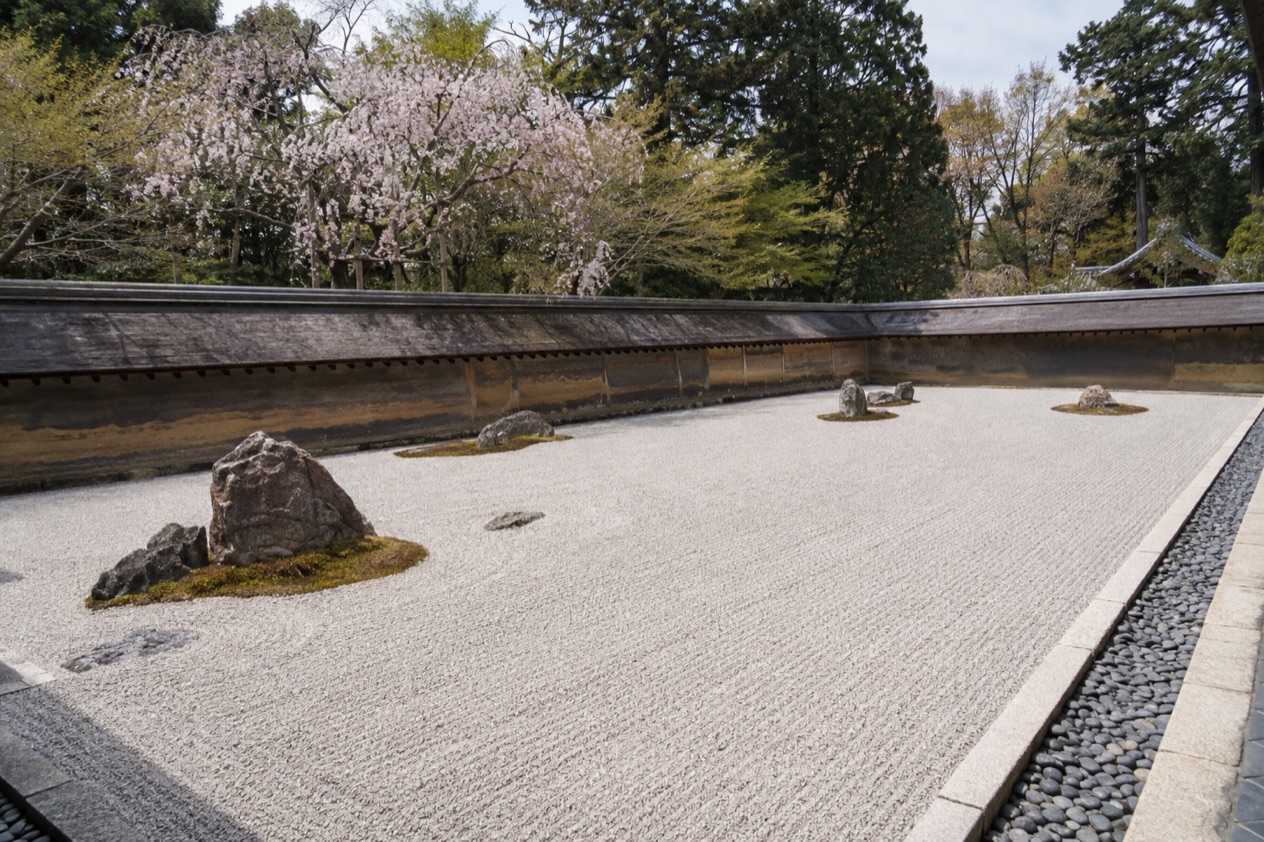
The garden is a rectangle of 248 square meters (2,670 square feet), twenty-five meters by ten meters. Within it sit fifteen stones of different sizes, composed in five groups: one group of five stones, two groups of three, and two groups of two. Moss gathers around the base of each group, and the gravel stretches out between them like an empty sea.
Nobody can say for certain what the garden represents, and that is part of its pull. Some visitors see islands in an ocean, others see mountain peaks rising through clouds, others see nothing figurative at all. Give yourself time to let the first impression wear off and look at the spaces between the groups as much as at the stones.
The veranda and the hidden stone
The veranda of the hojo is where you sit, and it holds a small puzzle. From the viewing veranda it is not possible to observe all fifteen stones from one perspective, with at least one stone always hidden from view. Visitors often try to count, shift along the boards and count again, and the count rarely settles.
Many readers take this as a Zen lesson in itself: you cannot see everything at once, and the whole is never fully in your grasp. Whether or not the designer meant it that way, it gives the quiet a purpose. Move slowly along the veranda and watch how the groups overlap and separate as your angle changes.
The raked gravel
The white gravel around the stones is raked each day by the monks. The lines run in clean parallel furrows, and they curve around each stone group like ripples. It is a reminder that the garden is not a finished object but a practice, renewed daily, and that its stillness is made by someone’s hands.
Look at the surface in different kinds of light. A gray sky flattens the gravel into a pale sheet, while sun picks out every furrow and gives the stones sharp shadows. After rain the moss turns a deeper green and the gravel darkens, a different garden from the same plan.
Kyoyochi Pond and the grounds
Kyoyochi Pond is a water garden built in the 12th century as part of the Fujiwara estate, which means it is older than the temple itself, founded in 1450 by Hosokawa Katsumoto. The estate that came before the temple left its pond behind, and the temple grew up around it.
Walking the pond’s edge after the rock garden gives your eyes something new: reflections, trees, the movement of water. Notice how different the mood is from the gravel court. One garden asks you to subtract everything, the other lets the landscape back in.
When to visit Ryoan-ji
Time of day matters more here than at most temples, because the whole experience depends on being able to sit and look. Visitors to Kyoto are recommended to see shrines and temples at less crowded times, such as early morning or late evening when they are illuminated. For a garden built around stillness, a less crowded moment is worth planning your day around.
As for the seasons, the garden itself does not bloom or turn color, since it has no flowering plants at its center. That is its strength: it looks composed in any month, and what changes is the light, the moss and the weather around it. The pond and the surrounding grounds carry the seasonal mood.
| Month | Avg high (°F) | Avg low (°F) | Precipitation (in) | Rain days | Sunshine (hours) |
|---|---|---|---|---|---|
| January | 48.4 | 34.7 | 2.10 | 6.4 | 124 |
| April | 68.2 | 48.6 | 4.61 | 9.4 | 177 |
| July | 89.6 | 74.5 | 8.80 | 11.6 | 143 |
| October | 74.1 | 57.9 | 5.64 | 8.2 | 156 |
Spring and autumn
April in Kyoto brings highs in the high 60s, with lows in the upper 40s, comfortable for sitting on a wooden veranda with your shoes off. It is also one of the sunnier months of the four, and showers come on about nine days. Sitting still outdoors is pleasant when you are not shivering or sweating.
October is similar in feel, with highs in the mid-70s and cool nights. Rain falls on roughly eight days, so the garden can be seen in sun or in soft gray light. Both months give you a veranda that is comfortable without extra layers.
Summer and winter
July is hot and humid, with highs near 90 and rain on nearly twelve days, and sitting on a veranda in that air is a slower, stickier experience. The upside is the green of the moss and the pond grounds, which look their lushest. Bring patience and expect to move gently.
January is cold, with highs in the upper 40s and lows just above freezing, and the month records snow or sleet on many days. Sitting still in a cold hall suits the mood of the garden, though you will feel the chill in your feet. Winter light on the gravel can be striking, and it is a month to dress warmly for the veranda.
Tips for your visit
Plan to take your time at the veranda rather than rushing through, since the point of the visit is to sit and look. Think of the rock garden as the center of the visit and the pond grounds as the walk that follows. Leaving space in your day lets you sit twice if the first sitting feels too hurried.
Dress for sitting. Because the garden is viewed from the veranda of the hojo, you will spend a good part of the visit in one spot, so layers in cooler months and something light in July matter more than they would on a walking route. Socks in good condition are a sensible thought, since shoes come off at the entrance of a hall like this one.
What to combine it with
Ryoan-ji pairs well with something more ornate from central Kyoto. Nijo Castle, built in 1603 by Tokugawa Ieyasu, the first shogun of the Edo period, offers the opposite mood, with its nightingale floors that make a bird-like sound when walked on, an old security system meant to alert guards of intruders. Seeing a castle and a Zen garden in one day shows how different the city’s inheritance can be.
Kyoto Station is served by the Tokaido Shinkansen line and is a starting point for exploring the city. Its building houses a full floor of ramen restaurants, an Isetan department store, a theater and a Granvia hotel, so a bowl of ramen there suits the end of a day that began in silence. Kyoto Tower stands a few steps from the main entrance, over 130 meters tall and visible across the city.
Families and slower travelers
Children who like puzzles may enjoy the hidden stone: ask them to count the fifteen from different spots and see if anyone can find them all. It turns a quiet garden into a game that fits the setting. Older travelers will appreciate that the main experience is a seat rather than a route.
If someone in your group finds stillness hard, the pond grounds give a place to move. Splitting the visit between sitting and walking keeps both kinds of traveler content. Let the garden be as short or as long as the mood of the group allows.
Good to know before you go
Ryoan-ji is a working Zen temple, so the habits of a temple apply: voices low, phones quiet, and shoes left at the entrance. Carry a small umbrella in the warmer months and enjoy the garden in whatever weather arrives.
Sources
- Wikipedia, Ryōan-ji (https://en.wikipedia.org/wiki/Ry%C5%8Dan-ji), checked October 11, 2026
- Japan National Tourism Organization, Kyoto (https://www.japan.travel/en/destinations/kansai/kyoto/), checked October 11, 2026
- Japan Meteorological Agency (JMA), Normal values 1991-2020, monthly (https://www.data.jma.go.jp/stats/etrn/view/nml_sfc_ym.php?prec_no=61&block_no=47759), station Kyoto, elevation 41 m, checked October 11, 2026
To plan your stay
- Best Time to Visit Japan: Cherry Blossoms, Autumn Colors, Weather and Festivals
- Where to Stay in Japan: Ryokan, Temple Stays, Capsule Hotels and the Best Cities to Base In
- Sending Luggage from the Airport in Japan: Hands-Free Travel, Hotel Delivery and Coin Lockers
- Know Before You Go to Japan: Entry, Money, Etiquette and Getting Around