
MIAMI · THE SAFETY BRIEF · MIAMI-DADE COUNTY
Miami arrives with a reputation attached, and most of it is about crime. The hazards that send visitors home early are duller and more physical: an Atlantic that pulls sideways when the surf is up, a March enforcement plan in Miami Beach that tows non-resident cars at $548, and a hurricane season that occupies half the calendar.
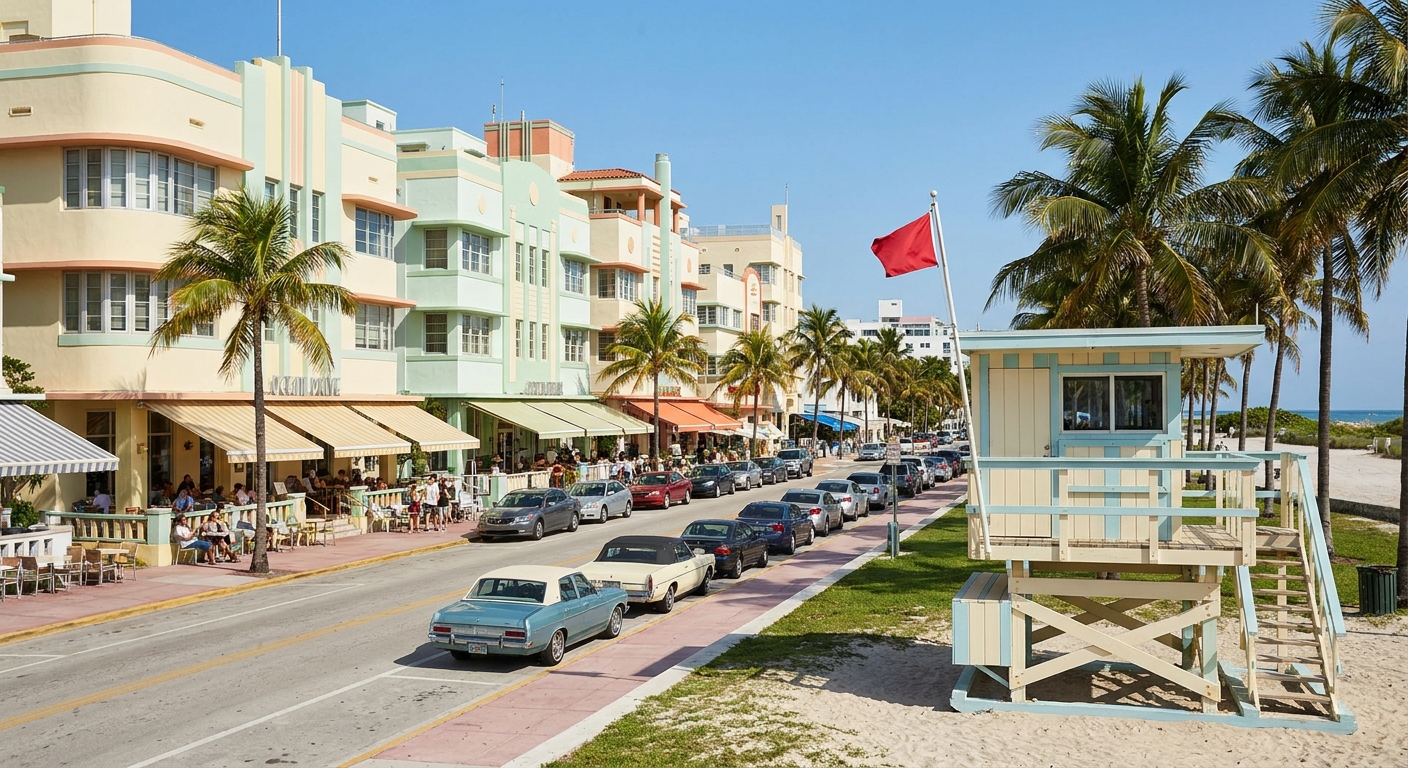
Part of the confusion is municipal. Miami is not one city but several with separate governments, so a warning about “Miami” may describe a place you will never set foot in. And the sand fronting Ocean Drive, Lummus Park, is free, open around the clock and staffed by lifeguards, which makes where you put your towel the most useful safety decision of the week.
SAFETY AT A GLANCE · MIAMI
The ocean, the March traffic plan and the storm calendar are what a Miami week has to work around, and none of the three is a reason to cancel one.
THREE SEPARATE CITY GOVERNMENTS · ATLANTIC RIP CURRENTS · SPRING BREAK 2026 MEASURES
Go for: a guarded stretch of beach, the free trolley instead of a rental car, and a refundable room if you are traveling in the September window.
Think twice before: leaving a car in an Art Deco District garage on a spring break weekend, or swimming away from a lifeguard stand when a red flag is up.
Spring break measures: City of Miami Beach · Storm dates: NOAA National Hurricane Center · Normals: NOAA NCEI, Miami International Airport gauge · full sources at the end
On this page
- Is Miami safe for tourists?Miami, Miami Beach and Coral Gables, three governments
- Spring break rules in Miami BeachTraffic plan hours, $548 towing, garage flat rates
- Beach flags and rip currentsFlag colors and what to do if the water takes you
- Hurricane season dates for MiamiJune 1 to November 30, peak September 10
- Parking and towing in South BeachLot rates, the free trolley, the Metromover
- Statewide risks: alligators, sun, drivingThe Florida safety guide
Every temperature and rainfall figure here comes from NOAA’s 1991-2020 normals at the Miami International Airport gauge, roughly 12 miles inland from South Beach. That thermometer stands beside a runway, not on the sand. And for anything urgent, in all three cities, the number is 911.
Is Miami safe for tourists?
Yes, with ordinary big-city habits and genuine respect for the water. We publish no crime statistics here, and that is a choice rather than a gap: the figures in circulation are county-wide or city-wide, while a visitor’s week happens across about four neighborhoods and one beach. The risks worth planning around in Miami are geographic. Surf, causeway traffic, storm season, and one weekend enforcement plan in March.
Alligators near fresh water, the sun, and how Florida drives in an afternoon downpour are statewide questions, already handled in the Florida safety guide. Practicalities that travel with you rather than belonging to Miami sit in know before you go. The rest of this brief stays inside the county line.
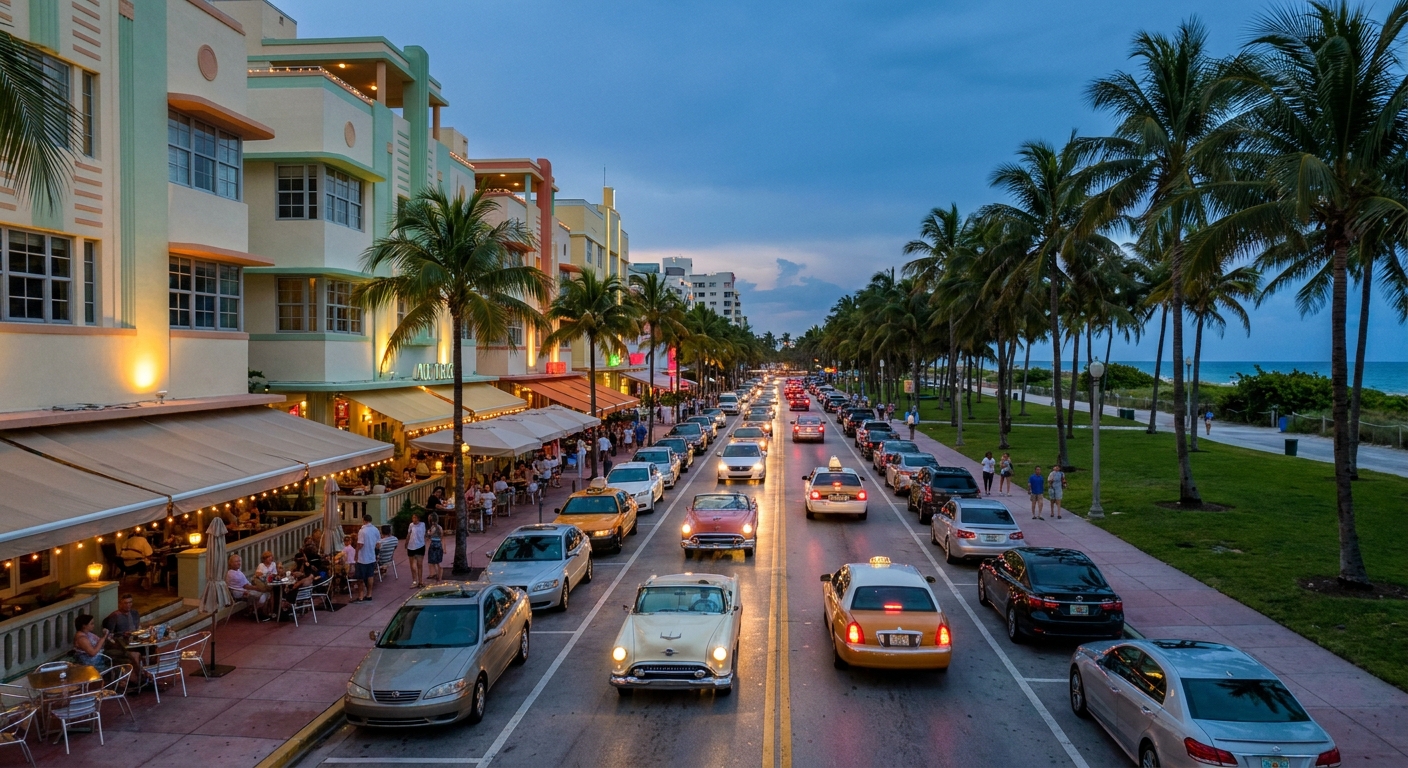
The county line is where readers get lost. The City of Miami counted 442,241 residents at the 2020 census and contains Wynwood, Little Havana and Coconut Grove. Miami Beach, 82,890 residents at the same census, is a separate city on barrier islands across Biscayne Bay, and South Beach is its southernmost neighborhood. Coral Gables is a third municipality, incorporated on April 29, 1925, with its own police force. A headline about “Miami” may belong to any of them.
Spring break in Miami Beach: traffic restrictions, parking and towing
From 6 p.m. each Thursday through Sunday, Miami Beach police run a traffic plan around the South of Fifth and Flamingo Park neighborhoods. The city’s announced high-impact measures reach further than rerouted cars: garage and lot closures in South Beach, restricted beach access, and DUI checkpoints.
Towing is where the visitor pays for misreading a sign. In the Art Deco District, the non-resident rate is $548, double the regular rate, and administrative fees are added on top. A Florida plate on a rental does not make you a resident, and the difference is a night in a good hotel.
The four Art Deco District garages sit between 5th and 16th streets, from Washington Avenue to Ocean Drive, and during spring break they switch to flat rates of $40 to $100. Flat means flat: twenty minutes and ten hours cost the same, so a quick stop to drop bags is priced like a full evening out.
About the curfew rumor, plainly: for 2026 there is no blanket curfew, and the beaches do not close at 6 p.m. A curfew applies only if the police chief determines that incidents require one. The city manager’s line on the season has not softened either. “We are still very much broken up with spring break.”
All of the above describes the measures Miami Beach announced for spring break 2026. The city renews and adjusts them yearly and publishes the coming year’s plan in winter, so treat these numbers as the shape of the thing rather than next March’s contract. If your trip lands in that month, the March guide also carries Ultra at Bayfront Park on March 26, 27 and 28, 2027, and the Miami Open at Hard Rock Stadium from March 14 to 28, 2027, dates given as subject to change.
Rip currents and beach flags in Miami
The flag flies at the lifeguard stand, and it is the only forecast that matters once you are in a swimsuit. Green means calm conditions, yellow a moderate hazard, red a high hazard and strong current, double red that the water is closed to the public. Purple is a separate message about marine pests such as jellyfish, and it can fly alongside any of the others. Lummus Park, the free beach fronting Ocean Drive between 5th and 15th Streets, has lifeguards on duty; most of the sand north of it does not.
Caught in one, the instruction is short. Do not swim against it toward the shore. Let it carry you, swim parallel to the beach until the pull stops, then angle back in, and raise an arm and shout so the stand sees you. From dry land, resist going in after someone. Wave down the lifeguard, or call 911 and keep eyes on the swimmer.
Hurricane season in Miami
The Atlantic hurricane season runs June 1 to November 30 and peaks on September 10, with most activity falling between mid-August and mid-October. Rain follows a different curve: June is the wettest month at the Miami International Airport gauge with 10.51 inches, against 1.83 inches in January, on the NOAA 1991-2020 normals.
For a booking, the season changes one word: refundable. Hotel rates run lowest from August to October and highest from February to April, which is a market pattern rather than an official statistic, and that discount is the season pricing itself. Take the flexible rate, watch the National Hurricane Center in the ten days before you fly, and read the month-by-month verdict before you commit to September.
What no page can tell you is whether your particular week has a storm in it. Season dates are climatology, not a forecast, and a quiet October and a ruinous one look identical on the calendar in advance. Plan the trip on the odds, then let the actual forecast, in the final week, make the actual decision.
Driving and parking in Miami Beach
Beach parking is metered by the hour until the day it is not. The public lot at South Pointe Park starts at $2 an hour and switches to a $20 flat day rate on weekends and public holidays, while the park itself is free to enter. Across the bay on Key Biscayne, Crandon Park charges $7 to park on weekdays and $10 at weekends. Hotel parking is billed separately again, usually alongside a nightly resort fee whose published amounts diverge sharply by source, from about $25 on average up to the $35 to $95 range. Ask the property for its all-in nightly total before you book.
Cars disappear for two reasons. One is the ordinary sign you did not read. The other is the March plan, when garages and lots in South Beach close on schedule and a legal spot on Thursday afternoon becomes an obstruction by Friday night. That is the classic route to the $548 non-resident rate plus administrative fees.
The alternative costs nothing on the island. The Miami Beach trolley is free, runs 8 a.m. to 11 p.m. seven days a week, roughly every 20 minutes, across five routes: South Beach Loop A and B, Middle Beach, North Beach, and the Collins Express down the length of Collins Avenue with limited stops. Downtown and Brickell have the Metromover, also free, with cars every 90 seconds at rush hour and every three minutes off-peak. Its published hours conflict, Miami-Dade listing 5:30 a.m. to 10 p.m. and local guides 5 a.m. to midnight, so check the sign at the station. Between the two, route 120, the Beach MAX, crosses the MacArthur Causeway for $2.25, with fares capped at $5.65 a day.
Keep the car for what the trolley cannot reach: the Everglades, at $35 per private vehicle for seven days, with entrances an hour of driving apart, plus Crandon Park and the longer day trips out of Miami. For a week spent between Ocean Drive, Wynwood and Brickell, a rental is a $548 liability with a windshield. Park it at the airport, catch the first trolley at 8 a.m., and the hardest call of your day becomes which side of Collins Avenue still has shade.
Sources & data for this guide
- Spring break traffic plan, hours, garage and lot closures, DUI checkpoints · City of Miami Beach, relayed by NBC 6 South Florida and Time Out Miami · checked Sep 10, 2026
- Non-resident towing rate ($548, double the regular rate, plus admin fees) · City of Miami Beach, relayed by CBS News Miami · checked Sep 10, 2026
- Art Deco District garages, 5th to 16th streets, flat rates $40 to $100 · City of Miami Beach · checked Sep 10, 2026
- No blanket curfew for 2026, beaches not closing at 6 p.m., city manager quote · WLRN and Fox News, February 2026 · checked Sep 10, 2026
- Framing note: the towing, parking and traffic measures above are the announced 2026 plan · the city republishes each winter · checked Sep 10, 2026
- Hurricane season dates and the September 10 peak · NOAA National Hurricane Center · checked Sep 10, 2026
- January and June rainfall normals (1.83 in, 10.51 in), Miami International Airport gauge USW00012839 · NOAA NCEI 1991-2020 · checked Sep 10, 2026
- Free trolley routes and hours, Metromover frequencies, Metrobus 120 and the $5.65 fare cap · City of Miami Beach and Miami-Dade County · checked Sep 10, 2026
- Metromover hours are contradictory at source: Miami-Dade publishes 5:30 a.m. to 10 p.m., other local guides 5 a.m. to midnight · we could not settle it, confirm at the station · checked Sep 10, 2026
- Municipal boundaries and 2020 census populations for Miami, Miami Beach and Coral Gables · Miami-Dade County municipalities list and US Census 2020 · checked Sep 10, 2026
- Parking rates at South Pointe Park and Crandon Park · City of Miami Beach and Miami-Dade Parks · checked Sep 10, 2026 · rates change
- Everglades entrance fee ($35 per vehicle, seven days) · National Park Service · checked Sep 10, 2026
- Resort fee amounts diverge strongly between comparison sites and hotel categories, from about $25 average to $35 to $95 · we give the range only, never a firm figure · checked Sep 10, 2026
- Hotel rate seasonality (lowest Aug to Oct, highest Feb to Apr) is a market trend, not an official statistic · checked Sep 10, 2026
- Beach warning flag colors follow the standard Florida system and are editorial here · the flag flying at the lifeguard stand is the one that counts