
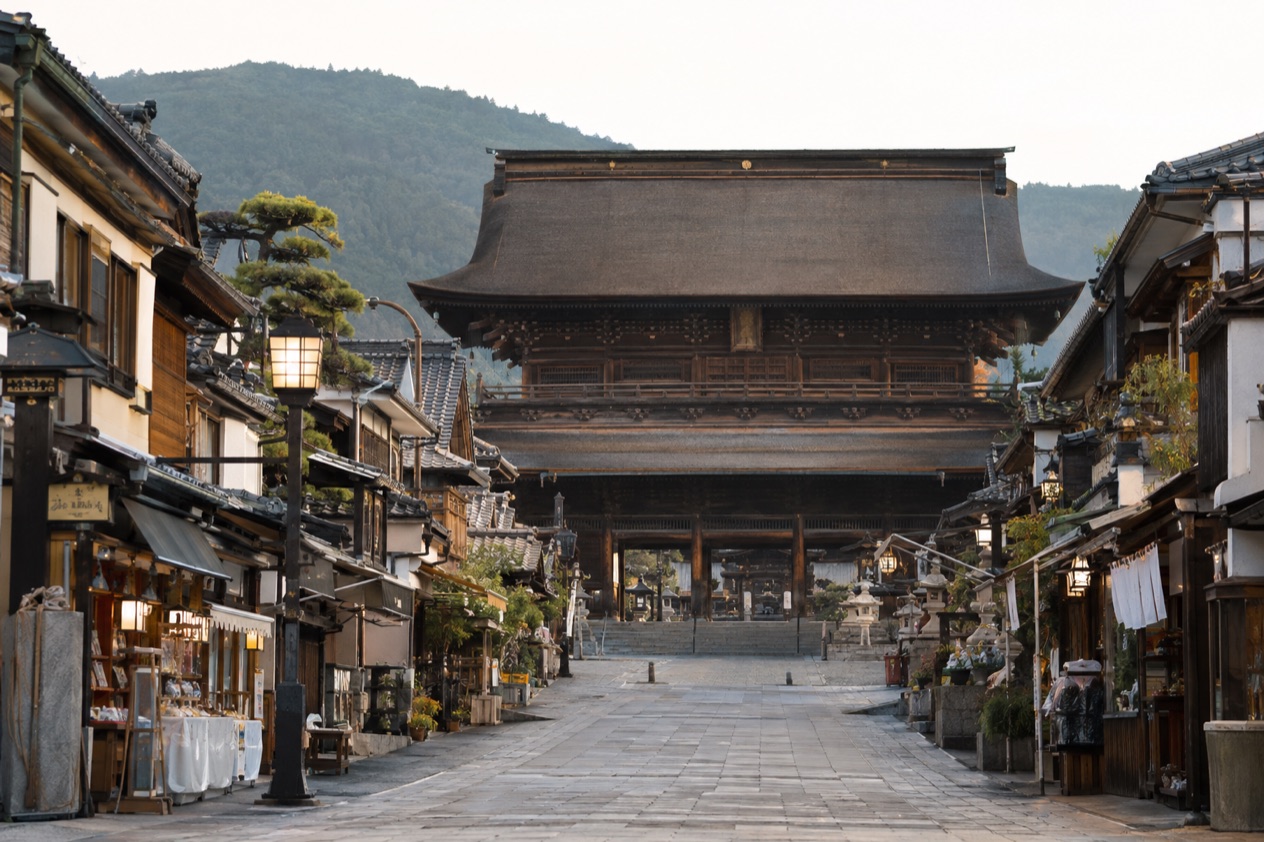
Before the city is fully awake, the bell at Zenko-ji sounds across the town, and pilgrims and residents climb the stone approach toward the great wooden hall. Shops along the lane begin to open and the smell of toasted soba flour and grilled rice dumplings drifts out.
What are the best things to do in Nagano?
The best things to do in Nagano start with its great temple, then move out to the mountains, the hot-spring valleys and the tables where buckwheat noodles and mountain vegetables are the stars. Each of the following is developed further down the page.
- Visit Zenko-ji, the Buddhist temple that gave the city its reason for existing and still anchors daily life.
- Stroll the shop-lined approach to the temple for spice blends, sweets and small crafts.
- See the Olympic venues from 1998, including the M-Wave and Aqua-Wing arenas that remain open.
- Go to Jigokudani Monkey Park in Yamanouchi to watch the macaques of the Yokoyu River valley.
- Eat Shinshu soba, oyaki dumplings and whatever apples or mountain vegetables are in season.
- Spend an evening in an izakaya with local sake, the way the city’s townspeople do.
- Take a day into the highlands of Shigakogen, part of Joshinetsu Kogen National Park.
- Use the city as a base for mountain day trips, with the Hokuriku Shinkansen bringing you in from Tokyo.
Nagano is the capital and largest city of its prefecture, with nearly 375,000 people, and it sits higher above sea level than any other prefectural capital in Japan, at 1,219 feet. That altitude shows in the light, in the clean edges of the surrounding ranges and in the food, which leans on buckwheat, apples and pickled greens rather than seafood.
From Tokyo the Hokuriku Shinkansen reaches Nagano in 1 hour 20 minutes without stopping. From Osaka or Kyoto you take the high-speed train to Nagoya and change to the JR Wide View Shinano express. Since Nagano is the northernmost transportation hub of the region, the same station that receives you is where journeys deeper into the mountains begin.
A rhythm that works well here is a temple morning, a long soba lunch, an afternoon at an Olympic site or a market lane, and an evening of sake. A second day then goes to the monkeys or the highlands. The sections that follow fill in each piece.
Sights and landmarks in Nagano
The sights of Nagano gather around one temple and one Olympic memory, with a handful of smaller stops that fill out a day. The city is a place to move at an unhurried pace, and visitors find that two or three well-chosen stops are enough.
Zenko-ji
Zenko-ji is a Buddhist temple listed as a Japanese National Treasure, established at its present location in Nagano in 642 AD. It is the reason the town grew where it did, and for centuries pilgrims from across Japan have walked to it. The main hall is a massive wooden structure under a deep, layered roof, and you hear the clap of coins and the murmur of prayers before you see the incense smoke.
Part of its character is that it does not belong to one school of Buddhism, which is why it has long drawn people from many traditions. Inside, visitors take the dark passage beneath the hall, feeling along a wall in the blackness toward a metal lock said to link you to the temple’s central image. Outside, the gate, the bell and the long stone path make a sequence worth taking slowly.
The temple suits almost anyone, from travelers who want a first Japanese temple to those who come for the ritual of a morning visit. Come with some patience for the stone steps and take a few minutes at the incense burner, where visitors waft smoke toward the part of the body they hope to heal.
The 1998 Olympic venues
Nagano and surrounding communities hosted the 1998 Winter Olympics, from February 7 to 22, and the Paralympics followed in March. Many facilities remain open, including the M-Wave speedskating arena and the Aqua-Wing arena. They sit in the flatter parts of the city, and a visit gives you the odd pleasure of standing inside a space you may have watched on television.
The arenas are used by locals for sport and events, so what you see depends on the day. If you grew up following winter sports, the stop is worth a detour. If not, it is a short chapter in a city whose real heart is the temple, and it pairs naturally with a lunch break nearby.
The temple approach and old town streets
The street leading up to Zenko-ji is lined with small shops, wooden storefronts and tea rooms, the sort of approach that temple towns build over centuries. You find shichimi, the seven-spice blend that locals sprinkle on soba, along with pickles, sweets, paper goods and incense. Sampling is part of the fun, and a small paper bag of spice makes a light souvenir.
Side lanes hold temple lodgings, little shrines and cafes. The mood is that of a town that has fed and housed pilgrims for a very long time, and that now does the same for travelers. A wander here in the early evening, as lanterns come on, pairs well with a bowl of noodles afterward.
Smaller stops around the city
Around the station and the temple, small museums, shrines and covered shopping lanes give the day its filler. A prefectural art museum and local history displays tell the story of the region, while neighborhood shrines are worth a look for their old trees and stone lanterns. They are the stops to add if rain moves a plan indoors.
Outdoor things to do in Nagano
The outdoors in Nagano means mountains, river valleys and highland national park, reached from a city that sits at 1,219 feet and looks up at ranges on every side. The landscape changes with the season, from green slopes and orchards to leaf color and snow.
Shigakogen and Joshinetsu Kogen National Park
Shigakogen is the local name for the highland part of Joshinetsu Kogen National Park, in the northern part of Nagano Prefecture. It is the largest piece of the mountain country that people talk about when they say the prefecture feels like Japan’s high roof. The terrain is made of forested ridges, lakes, wetlands and long views, with open slopes that serve skiers in winter and walkers in warmer months.
A visit here is about air, trees and a change of scale from the city. It suits travelers who want a full outdoor day rather than a stop. Dress for cooler weather than you feel in town, since high country is colder, and plan the day around your transport since the park spreads across many valleys.
The Yokoyu River valley
The Yokoyu River runs through the valley that holds Jigokudani Monkey Park, in Yamanouchi. The valley is steep and wooded, with steam rising from hot spring sources, and the approach to the monkeys is itself a walk through forest. The river and its bridges give you moments to stop and look at the rock walls.
Onsen towns in the valley offer baths after a walk, and that is the combination travelers want: trail, steam, soak. The details of the park visit are in the day trips section, but the valley deserves a place on any list of outdoor plans.
Orchards, fields and open country
Nagano is apple country, and the hills around the city fill with orchards, rice terraces and vegetable fields. In the right season, fruit stands appear by the road, and farms may open to visitors who want to pick or buy. The scene is rural and tidy, with the mountains as a backdrop.
Ask at the station tourist counter, or simply follow the roadside stands. Come ready for muddy shoes and a bag of fruit.
Gardens, shrine groves and city parks
Within the city, tree-lined temple grounds and small parks offer shade and a place to sit. The grounds of Zenko-ji itself have old trees and stone paths, and neighborhood shrines have their own groves. These are small breaks rather than excursions, and they fit between a meal and the next stop.
Day trips from Nagano
The best day trips from Nagano go into the mountains and valleys of the prefecture, with the snow monkeys at the top of most lists. Nagano is the northernmost transportation hub, which makes it a base for exploring.
Jigokudani Monkey Park
Jigokudani Monkey Park is in Yamanouchi, in the valley of the Yokoyu River, and is part of Joshinetsu Kogen National Park. The park is known for Japanese macaques that gather around hot spring pools, with their red faces and thick coats.
You walk through forest to reach the viewing area, and you may see monkeys soaking, grooming, playing or simply watching you. The scene changes with the season, and you can never promise what the animals will do on a given day. Photographers love the steam and the expressions.
It suits travelers who love animals, photography and a day outdoors. Wear shoes with good grip, and bring a camera with a lens that lets you keep your distance, since the monkeys are wild animals and the park asks that visitors give them space.
Shigakogen highlands
A day in the Shigakogen highlands, part of the same national park, brings you to lakes, forest and wide skies. It is a trip for people who want to be in the mountains rather than looking at them from the city. The roads wind upward and the air changes quickly.
In warmer months you can walk the forest paths and ponds, and in winter the area belongs to skiers. Pack layers and food, since services thin out as you climb. The highlands suit those who enjoy landscape and a slow pace.
Onsen towns of the valley
The hot spring towns of Yamanouchi, near the monkey park, are a natural pairing for a day trip. Wooden inns, public bathhouses and steaming streets give the area a feel of an older Japan. After a morning with the monkeys, a soak is the obvious reward.
Bathing follows long habits: you wash before entering the water, and towels stay out of the bath. If you have tattoos or are unsure of the rules at a given bath, ask at the entrance before you plan around it.
Other options in the region
Beyond these, travelers use Nagano as a base for the mountain shrines and forest paths of the prefecture, the old castle town of Matsumoto, the museum lanes of Obuse and the resort towns that fill the map. Each takes planning around train or bus connections, and some are better as an overnight than as a single day.
What to eat in Nagano
Eating in Nagano means buckwheat noodles first, then dumplings, pickles, mountain vegetables and fruit grown on the hillsides. The cooking is hearty and plain in the best sense, shaped by cold winters and high ground.
Shinshu soba
Shinshu is the old name for the region, and Shinshu soba is the buckwheat noodle that defines it. The noodles are cut thin and served cold on a bamboo tray with a dipping sauce, often with grated radish, wasabi and chopped scallion. Some places serve them hot in broth, but the cold tray is the classic way to taste the grain.
The meal usually ends with a pot of the cooking water, soba-yu, which you pour into the leftover sauce and drink. Many shops around Zenko-ji make their own noodles, and the nutty scent of the flour is part of the experience. Pair soba with tempura of mountain vegetables if you see it.
Oyaki and street snacks
Oyaki is a round dumpling with a thin wheat or buckwheat skin and a filling of seasoned vegetables such as nozawana greens, or sweet bean paste. It is steamed or griddled and eaten by hand, warm from the pan. It is the snack that the region has fed travelers for generations.
Along the temple approach you also find rice crackers, sweets made with local fruit, and grilled skewers. Take them as a walking lunch or a pause between stops, and look for the stalls where you can watch the dumplings being made.
Fruit, pickles and mountain vegetables
Nagano is known across Japan for apples, along with grapes and peaches in season, and fruit appears on tables as dessert, in jams and in juices. Pickles are a staple of the region, particularly those made from leafy greens that are salted and fermented for the cold months.
Sansai, the wild mountain vegetables of spring, show up in tempura and in small side dishes. Fresh wasabi, grated at the table in some restaurants, has a sweeter, brighter bite than the paste from a tube.
Sake, wine and regional dishes
The prefecture has a long tradition of sake brewing, helped by cold weather and clean water, and many bars pour local bottles by the glass. Wine is also made in the region, and some restaurants list it alongside sake.
Among regional dishes you may meet basashi, thin slices of raw horse meat served with ginger and soy, a specialty of the mountain country that suits adventurous eaters. Miso, made locally, flavors soups, grilled rice balls and pickles, and gives dishes a savory depth.
Things to do in Nagano at night
Evenings in Nagano are about food, drink and a slow walk, not about big nightlife. The city is a regional capital, so the pleasures are those of a mountain town after dark: a warm izakaya, a sake bar, a bath and lantern light.
Izakaya and sake bars
An izakaya is a Japanese pub where small dishes arrive in waves, from grilled skewers to pickles, tempura and noodles. In Nagano they feature local ingredients, so you eat the region’s mountain vegetables and pour its sake. Counter seats let you watch the cooking, and sharing is the usual style.
Sake bars pour local brews in small glasses, often as a flight. Staff can explain the differences between dry and soft, warm and cold. It is a pleasant way to understand the area through a glass.
The streets around the station
The area around the station gathers restaurants, bars and shops, and after dark the lanes fill with signs and the glow of windows. This is where you find ramen counters, karaoke rooms and cafes. It is a place to wander with no fixed plan and drop into whatever smells good.
If you want a late snack, noodles are a reliable choice. If you prefer a drink in quiet, small bars tucked into side streets suit a solo traveler or a pair.
Baths and quieter evenings
A hot spring bath is a natural way to end a day of walking, and the area around Nagano has many. Some inns open their baths to day visitors, and the soak at night beneath mountain air is one of the region’s pleasures. For a calmer evening, a tea or dessert stop near the temple approach, or a stroll under the lanterns, gives you the mood of a pilgrimage town after the day-trippers have gone.
Things to do in Nagano with kids
Children in Nagano tend to enjoy animals, open space and anything involving snow or water, and the city offers a few stops built around them. Plan around the altitude and the pace of a mountain town rather than a big-city checklist.
Monkeys and animals
Jigokudani Monkey Park is the obvious draw for children who love animals, since watching macaques near hot spring pools is something they remember. The trip is long, so plan snacks, water and a rest. Children should keep their distance from the monkeys and not offer food.
In the city, Chausuyama Zoo gives younger children a calmer animal outing. It makes a good counterweight to a day of temples.
Olympic venues and active play
The Olympic arenas that remain open, including the M-Wave and Aqua-Wing, give older children a chance to see where athletes competed. Sports-minded kids tend to enjoy standing in the space and imagining the races.
Parks in the city give room to run between stops. Pack a ball or a kite and let energy burn off before the next temple visit.
Temples, food and pacing
At Zenko-ji, the dark passage beneath the hall is the part children talk about afterward, groping along a wall in the dark. The long approach, the incense smoke and the bell are strong sensory moments, and short visits work better than long ones.
Food is another win: dumplings, rice crackers, apples and noodles are friendly to young eaters. Allow for rests, since the stone steps and long days tire small legs, and remember that mountain air can feel cooler than you expect.
Good to know before you go
Nagano is easy to reach by the Hokuriku Shinkansen from Tokyo, and the station is the hub for onward trips into the mountains. Local trains and buses carry you to the temple and beyond, and a day plan usually revolves around the connection you choose.
Typhoon season and the rainy season touch Japan as a whole, so check forecasts when you travel, and bring a light rain layer for temple days. Dress in layers, since mountain air changes quickly and the city sits at 1,219 feet.
Sources
- Japan National Tourism Organization, Nagano (https://www.japan.travel/en/destinations/hokuriku-shinetsu/nagano/nagano-and-around/), checked October 11, 2026
- Wikipedia, Nagano (city) (https://en.wikipedia.org/wiki/Nagano_(city)), checked October 11, 2026
- Wikivoyage, Nagano (https://en.wikivoyage.org/wiki/Nagano), checked October 11, 2026
- Wikipedia, Jigokudani Monkey Park (https://en.wikipedia.org/wiki/Jigokudani_Monkey_Park), checked October 11, 2026
- Wikipedia, Zenkō-ji (https://en.wikipedia.org/wiki/Zenk%C5%8D-ji), checked October 11, 2026