
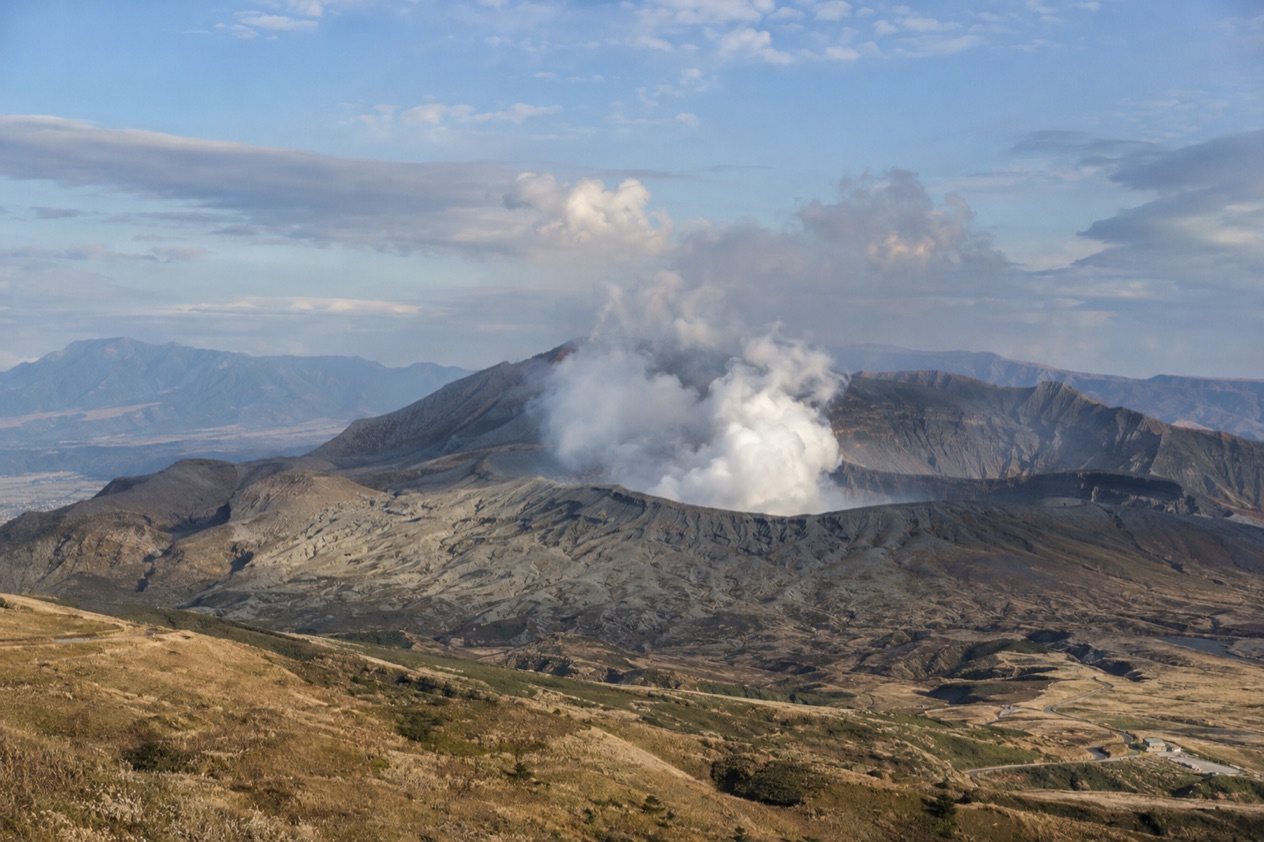
A pale plume rises from the crater of Mount Nakadake and drifts off over a wide landscape of grass, ridges and slopes, with a faint smell of sulfur in the air. Mount Aso is a working volcano in Kyushu, and the land around it has been shaped by fire, pasture and hot water. A visit here means standing at the edge of a crater, walking its slopes and ending the day in a hot spring.
Is visiting Mount Aso worth it?
Yes, if you want to see a volcano that is still alive rather than only read about one, and it suits travelers who like a landscape more than a checklist of buildings. Mount Aso stands in Aso Kujū National Park in Kumamoto Prefecture on the island of Kyushu. It rewards people who enjoy hiking, open scenery, horses, camping and soaking in an onsen afterward.
What sets it apart from the temples, castles and city streets that fill most Japan itineraries is that the main attraction is the ground itself. The crater of Mount Nakadake holds an active volcano that keeps emitting smoke and has occasional eruptions.
Kumamoto Prefecture is nicknamed the Land of Fire in Japan because of this neighbor, and a day here shows you why. Nearby places in the prefecture, such as Kumamoto city with its seasonal festivals, offer a different kind of day, so Aso works best as the outdoor chapter of a Kyushu trip.
The mountain also gives you a choice of pace. You can look into the crater from its rim, spend hours on a trail, or sit by a campfire at the foot of the slopes. Since the volcano’s mood can change, the visit has an element of chance, and that is part of its draw.
What to see at Mount Aso
The active crater of Nakadake
The crater of Mount Nakadake is the reason most people come. Smoke rises from it continuously, and the volcano has occasional eruptions. Only the northernmost crater has been active for the last 70 years, which tells you how the activity is concentrated in one part of the mountain.
A new eruption began here at 11:43 a.m. on 20 October 2021, a reminder that this is a living volcano and not a scenic backdrop. Standing at the crater’s edge, you look into a bowl of rock and mineral color, with steam drifting across the view. The mood changes with the wind and the weather, and you may see the plume bend one way or another over the rim.
A shuttle bus now runs from the Mount Aso terminal to the crater’s edge. It replaced the Mount Aso Ropeway cable car, which closed in August 2014, and the bus has run since February 2018. Anyone planning from older guidebooks should know that the cable car no longer exists.
Takadake and the mountain trails
Takadake is the tallest peak of Mount Aso, rising 5,223 feet above sea level. Its slopes carry a protected botanical ecosystem of Rhododendron kiusianum, a small rhododendron that flowers seasonally. When it blooms, the slopes take on a color that sets them apart from the bare volcanic rock around the crater.
Nearly all the hiking trails on Mount Aso start from the bus stop at the museum, with one exception: the trail to Nekodake. That makes the museum stop the practical starting point for a walk, and it means you can combine a trail with the crater visit by bus. The ridges give you a sense of the scale of the landscape, with the crater below and the grassy slopes falling away in every direction.
Kusasenrigahama and the foot of the mountain
At the foot of Mount Aso you find various campsites and horse riding at Kusasenrigahama. The name refers to a broad grassy plain, and the open pasture is a pleasing contrast to the crater above. Horses graze and walk across the grass, and the setting suits travelers who like their volcano with a slower tempo.
Campsites make it possible to stay close to the mountain rather than see it only on a day trip. After the bare slopes of the summit, this lower ground feels like another landscape altogether, and it gives the visit a gentler second half.
Onsen areas around the volcano
Because Mount Aso is a volcano, there are many onsen hot spring areas around it, among them Uchinomaki, Asoakamizu and Kurokawa. The heat that makes the crater smoke is the same heat that warms the water. An onsen is a bath fed by natural hot spring water, and soaking in one after a day of walking is a classic way to end a visit to a volcano.
Each of the three areas has its own character, and a stay in any of them lets you pair the mountain with a night in a bathing town. Rules about tattoos, towels and bathing order differ from place to place, so each onsen sets its own habits.
Hours, tickets and rules
The mountain itself is a national park landscape, and the visit is organized around the shuttle bus to the crater’s edge and the trails from the museum bus stop. The cable car that once carried visitors up no longer runs, so the bus is the link between the terminal and the rim.
What is certain is how the visit works: the bus runs from the Mount Aso terminal to the crater’s edge, and nearly all trails begin at the bus stop by the museum.
Two points of fact shape any plan. The trail to Nekodake is the one trail that cannot be reached from the museum bus stop. And the volcano is active, with smoke emitted continuously and occasional eruptions, so conditions at the crater are tied to what the mountain is doing.
How to get to Mount Aso
Mount Aso lies in Kumamoto Prefecture on Kyushu, and the prefecture’s capital, Kumamoto, is the large city nearby.
Kumamoto is reached by high-speed train from Kagoshima, Fukuoka and from farther away. The Kyushu Shinkansen serves Kumamoto Station and gives a direct high-speed rail link to Tokyo via Fukuoka’s Hakata station. Kumamoto can also be reached by plane from several major Japanese airports.
One detail matters for rail pass holders: Mizuho services on the San’yo Shinkansen are not valid for foreign tourists traveling with a Japan Rail Pass. On the mountain itself, the Mount Aso terminal is the starting point of the shuttle bus to the crater’s edge, and the bus stop at the museum is the starting point of the hiking trails.
Routes, travel times and fares between Kumamoto and the mountain are not given here, so none are stated. What you can count on is the sequence once you arrive: terminal, bus to the rim, and the museum stop for the trails.
When to visit Mount Aso
The mountain’s seasonal flowering is the clearest calendar marker. The slopes of Takadake carry Rhododendron kiusianum, a protected botanical ecosystem, and its flowering gives walkers a reason to plan around the season. The months of that bloom are not given here, so it is a note to check rather than a date.
The volcano does not keep a calendar. Its crater keeps smoking and has occasional eruptions, and a new eruption began on 20 October 2021. For that reason a visit depends on what the mountain is doing as much as on the month, and the crater area may look different from one trip to the next.
A date worth knowing nearby falls in spring. Honmyo-ji Temple in Kumamoto holds a Nighttime Cherry Blossom Festival on the last weekend in March. A trip to Aso that includes that weekend adds an evening of lit blossoms in the city to a day on the volcano.
Beyond that, the mountain offers different things in different seasons. Walkers go for the slopes and flowers, campers for the grassland at the foot, and bathers for the onsen towns around the volcano.
Tips for your visit
Plan the day around the two ways of seeing the mountain. The shuttle bus takes you to the crater’s edge, and the trails from the museum bus stop take you onto the slopes. If you want both, begin with one and add the other, since nearly every trail except the one to Nekodake starts at the museum stop.
Bring footwear suited to volcanic ground and clothing for changing conditions on an open mountain. The crater emits smoke continuously, so expect the view and the air to be shaped by the plume.
Combine the volcano with what lies at its foot. Kusasenrigahama offers horse riding and the area has various campsites, so a day on the rim can end on the grass. The onsen areas of Uchinomaki, Asoakamizu and Kurokawa give you a hot bath after a day outdoors.
Kumamoto city makes a natural pairing for a longer stay, with its temple festival in March and its rail and air links. Families and travelers with limited mobility will find that the shuttle bus reaches the crater’s edge, while the trails cover the more demanding side of the mountain. Details about guides, parking and access to specific viewpoints are not given here.
Good to know before you go
Mount Aso is an active volcano, so the crater area can change with the volcano’s behavior, and the smoke and occasional eruptions are part of the setting. Pay attention to local signs and announcements when you reach the terminal and the rim.
The cable car is gone and the shuttle bus now does its job, so older descriptions of the ropeway are out of date. Bring yen for the bus, the museum and the onsen, and plan for a day outdoors with food and water, since the summit area is open volcanic country.
Sources
- Wikipedia, Mount Aso (https://en.wikipedia.org/wiki/Mount_Aso), checked October 11, 2026
- Japan National Tourism Organization, Kumamoto (https://www.japan.travel/en/destinations/kyushu/kumamoto/kumamoto/), checked October 11, 2026
- Wikipedia, Kumamoto (https://en.wikipedia.org/wiki/Kumamoto), checked October 11, 2026
- Wikivoyage, Kumamoto (https://en.wikivoyage.org/wiki/Kumamoto), checked October 11, 2026
To plan your stay
- Best Time to Visit Japan: Cherry Blossoms, Autumn Colors, Weather and Festivals
- Where to Stay in Japan: Ryokan, Temple Stays, Capsule Hotels and the Best Cities to Base In
- Sending Luggage from the Airport in Japan: Hands-Free Travel, Hotel Delivery and Coin Lockers
- Know Before You Go to Japan: Entry, Money, Etiquette and Getting Around