
Under the stone walls of Kumamoto Castle, the evening air smells of grilled meat and sweet soy from the little restaurants that stay lit after the sightseers go home. Trams roll along the central streets, and a bear-faced mascot grins from shop windows, bus doors and packets of sweets. This is the main city of Kyushu’s volcano country, a place for travelers who like a castle, a garden, a bowl of rich ramen and the chance to look into a crater.
Where is Kumamoto and what is it like?
Kumamoto is the capital city of Kumamoto Prefecture on the island of Kyushu, and it works as a city with a mountain landscape on its doorstep rather than as a seaside resort.
The prefecture’s nickname in Japan is the Land of Fire, because an active volcano sits nearby. That volcano is Mount Aso, inside Aso Kuju National Park, and its presence colors the whole region: the hot springs, the grassland scenery, the way locals speak of the mountain almost as a neighbor. You feel it in the food and the water, and in the conversations about where to go for a day out.
The pace in town is unhurried. Mornings start in coffee shops and covered arcades, afternoons belong to the castle grounds and the gardens, and evenings gather around izakaya (casual pubs serving small plates) and ramen counters. People who love a city where a castle rises above the main avenues, and where a short list of sights can fill a few relaxed days, tend to like Kumamoto a lot.
It may suit less well anyone who wants a dense list of temples and a geisha district in the style of Kyoto, or a nightlife scene of the scale of Osaka. Kumamoto offers a castle, a landscape garden, a strong regional kitchen and a gateway to the volcano. If that sounds like enough, the city rewards you with a calm, friendly rhythm and a good deal of local flavor.
What is there to do in Kumamoto?
The reasons to come are a hilltop castle, a volcano and its national park, a table full of regional dishes, and a handful of temples and viewpoints that give the city its seasons. What sets Kumamoto apart from its Kyushu neighbors is how close the wild landscape sits to a proper city center, so one base covers both streets and summit country.
Kumamoto Castle
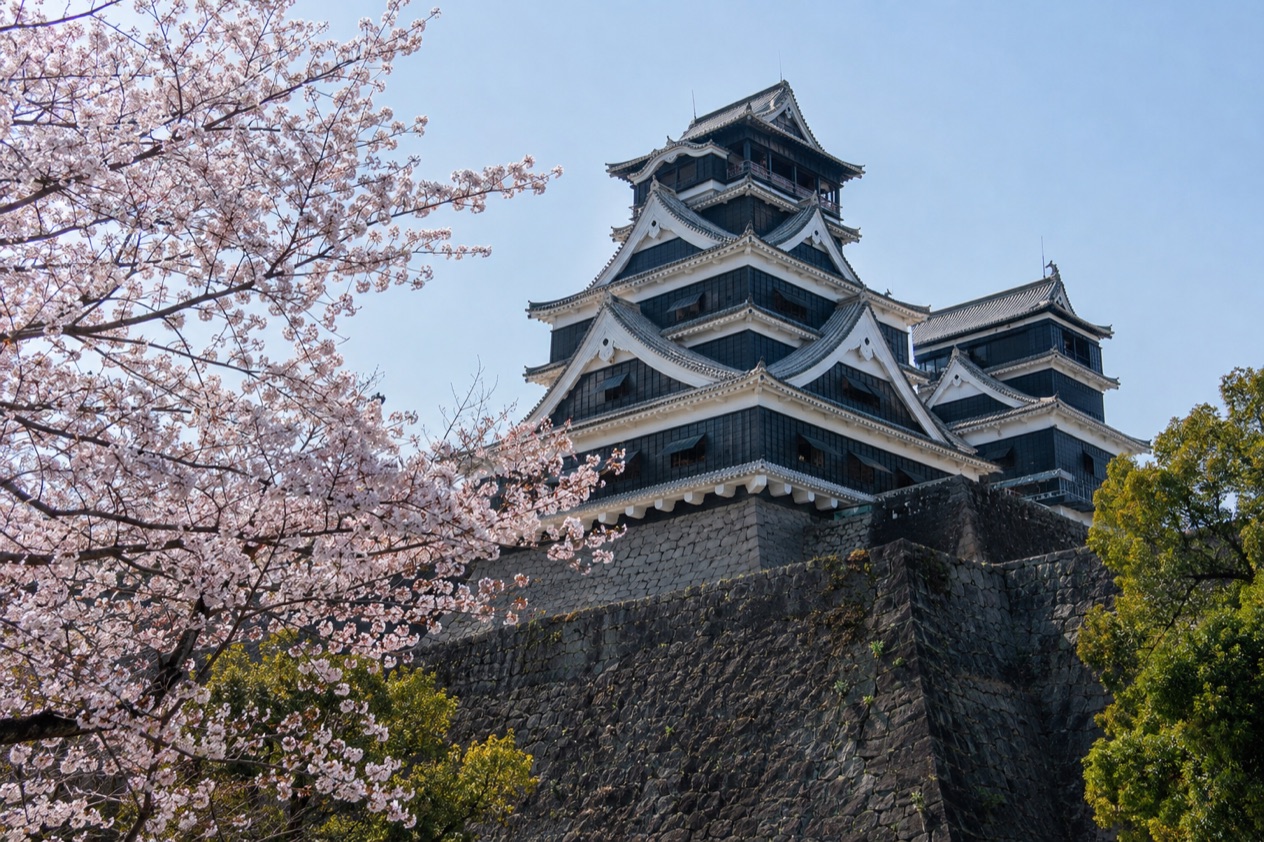
Kumamoto Castle stands on a hill in Chuo-ku, in the middle of the city, and you see it from many corners of downtown before you ever reach it. The walls flare outward at the base and curve upward in the way that Japanese castle builders used to make them hard to climb, and walking the grounds you follow those long stone lines around keeps, gates and grassy terraces.
It suits anyone who likes history told in stone and wood, and it works as the anchor of a first day in town. Take your time on the outer paths, because the views of the donjon change with every turn. Afterward, the downtown streets below are right there for a meal.
Mount Aso and Aso Kuju National Park
Mount Aso lies in Aso Kuju National Park, still within Kumamoto Prefecture, and it is the reason the region carries the Land of Fire name. The landscape around an active volcano is unlike the city: open grassland, steaming ground, and a crater that gives you a real sense of the scale of the forces underneath.
Pairing the volcano with an onsen (hot spring bath) afterward is a familiar rhythm in this part of Kyushu. As with any active volcano, what you can see up close depends on the mountain’s mood on the day, so keep your plans loose.
Local food: ramen, horse sashimi and lotus root
Kumamoto’s table has a few dishes you will not find the same way elsewhere. Kumamoto ramen comes in a pork bone broth often finished with fried garlic oil, and it is ladled over thick, springy noodles. Basashi, thin slices of raw horse meat eaten with ginger and soy, is a regional specialty served in izakaya and traditional restaurants.
Karashi renkon is another local favorite: lotus root stuffed with spicy mustard paste, battered and fried, with a sharp kick that goes well with a cold beer or a glass of shochu. Many of these dishes appear on a single izakaya menu, so one long evening can cover most of them.
Temples, blossoms and a free view from City Hall
Honmyo-ji Temple holds a Nighttime Cherry Blossom Festival on the last weekend in March, when the trees around the temple are lit after dark. If your trip falls then, it makes a lovely evening outing after a day at the castle.
For a view that costs nothing, the fourteenth floor of Kumamoto City Hall looks out over the castle and the downtown area. It gives you a sense of how the castle hill sits in the middle of the street grid, and it helps you orient yourself on your first morning before you set out on foot.
How many days do you need in Kumamoto?
A long weekend is enough to see the city well, and a few more days let you add the volcano country and a wider loop around Kyushu. The city itself is built around a short list of sights, so the question is mostly how much of the surrounding landscape you want to include.
With two or three days, give one to the castle and its grounds, a long lunch of Kumamoto ramen, and an evening of izakaya food downtown. Spend another day on Mount Aso and Aso Kuju National Park, finishing with a bath if you can. A third day can go to a garden stroll, temple visits, the free view from City Hall, and time in the covered arcades.
With more time, you can pair Kumamoto with its neighbors on the Kyushu Shinkansen. Kagoshima and Fukuoka are both linked to Kumamoto by high-speed train, which makes the city a comfortable middle stop on a Kyushu loop. Nagasaki is reached by boat, so a trip that arrives or leaves by sea adds a different kind of day.
The ferry from Shimabara is another way to build in a change of scenery. The final Kumamoto-bound boats from Shimabara depart daily at 20:00, so an outing on the other side of the water needs to be planned around that last sailing. People who like to wander slowly will find a week here pleasant, though the city does not demand one.
Where to stay in Kumamoto
The most practical area for visitors is downtown, around the covered arcades and the streets that lead up toward the castle. Staying there puts restaurants, izakaya and the tram stops within reach on foot, and it lets you head out in the evening for ramen or a drink without thinking about transport at all. It suits first-time visitors, food lovers and anyone who likes to wander at night.
Another sensible base is around Kumamoto Station, where the Kyushu Shinkansen arrives. This area suits travelers who are moving on by train the next day or who are using Kumamoto as a hub for day trips, since the rail connections to Fukuoka and Kagoshima start there. The trams run to a few suburbs near the downtown area, which helps link the station side of town with the center.
If the volcano is the main reason for your visit, you may prefer to stay in the Aso area itself, in Aso Kuju National Park. A night there gives you the landscape of the Land of Fire on its own terms, and a ryokan (traditional inn) with an onsen is a familiar way to round out an evening in hot spring country. It suits travelers who want quiet countryside more than city nightlife.
Travelers split their stay, with a couple of nights downtown and a night in the mountains. That way you get the castle, the food and the arcades on one side, and the crater scenery on the other. The choice comes down to whether you want to eat out in the evening in the city or wake up beside the volcano.
How do you get to Kumamoto and get around?
Visitors arrive by train, plane, boat or long-distance bus, and Kumamoto is reachable in all four ways. The Kyushu Shinkansen serves Kumamoto Station and gives a direct high-speed rail link to Tokyo via Fukuoka’s Hakata station. It also connects the city with Kagoshima and Fukuoka.
By air, Kumamoto Airport is located in nearby Mashiki, and the city is accessible by plane from several major Japanese airports. Long-distance buses run to Kumamoto from Osaka and Kyoto, which gives another route for those traveling overland from the Kansai region. From Nagasaki you can come by boat.
One detail matters for rail pass holders. Mizuho services on the San’yo Shinkansen are not valid for foreign tourists traveling with a Japan Rail Pass. That applies to those specific services, so it is worth knowing when you piece together a journey toward Kyushu.
Once you are in the city, trams operated by the Kumamoto City Transportation Bureau run to a few suburbs near the downtown area, and they give a sightseeing ride through the streets as well as getting you from place to place. The castle, the arcades and the restaurants cluster close enough that walking is part of the visit.
For the volcano and the national park, the trip leaves the city and heads into the mountains of the prefecture, so plan it as its own outing. The ferry from Shimabara returns to Kumamoto, with the last boat at 20:00 each day, which is worth keeping in mind if you cross the water for the day.
When is the best time to visit Kumamoto?
Late March is the best-defined moment of the year, because the Nighttime Cherry Blossom Festival at Honmyo-ji Temple takes place on the last weekend of the month. The temple’s cherry trees are lit in the dark, and the castle and city make a good frame for a spring trip. Blossom timing shifts from one spring to the next, so the festival weekend gives you a fixed date to build around.
Outside that weekend, the city works across the calendar, since the castle, the arcades, the food and the volcano do not depend on a single season. A visit is shaped more by what you want to do: the castle grounds suit time outdoors, and the volcano country suits a day of open scenery. Bring a flexible plan if you are heading up Mount Aso, because an active volcano sets its own terms.
If you are planning around the rainy season or typhoons, look at the forecast close to your dates, since they can bring heavy rain and affect travel. The warm months bring heat and humidity to a city set in a basin, and cooler months suit a hot spring day after the volcano. Whatever the month, the izakaya, the ramen counters and the free view from City Hall stay available.
Good to know before you go
Kumamoto is a city where dinner is the main event, so the evenings are worth keeping free for izakaya and ramen. The region’s nickname, the Land of Fire, is a reminder that this is volcano country, and that Mount Aso is an active mountain whose surroundings can change from one day to the next. Treat the volcano day as a plan with some give in it.
Dress for walking, since the castle grounds, the arcades and the temples are best seen on foot. Shoes come off at the entrance of a ryokan, and the same habit applies to many traditional dining rooms, so socks without holes are a small courtesy. And if you are timing a ferry from Shimabara, remember the last boat back leaves at 20:00.
Sources
- Japan National Tourism Organization, Kumamoto (https://www.japan.travel/en/destinations/kyushu/kumamoto/kumamoto/), checked October 11, 2026
- Wikipedia, Kumamoto (https://en.wikipedia.org/wiki/Kumamoto), checked October 11, 2026
- Wikivoyage, Kumamoto (https://en.wikivoyage.org/wiki/Kumamoto), checked October 11, 2026
- Wikipedia, Mount Aso (https://en.wikipedia.org/wiki/Mount_Aso), checked October 11, 2026
To plan your stay
- Best Time to Visit Japan: Cherry Blossoms, Autumn Colors, Weather and Festivals
- Where to Stay in Japan: Ryokan, Temple Stays, Capsule Hotels and the Best Cities to Base In
- Sending Luggage from the Airport in Japan: Hands-Free Travel, Hotel Delivery and Coin Lockers
- Know Before You Go to Japan: Entry, Money, Etiquette and Getting Around