
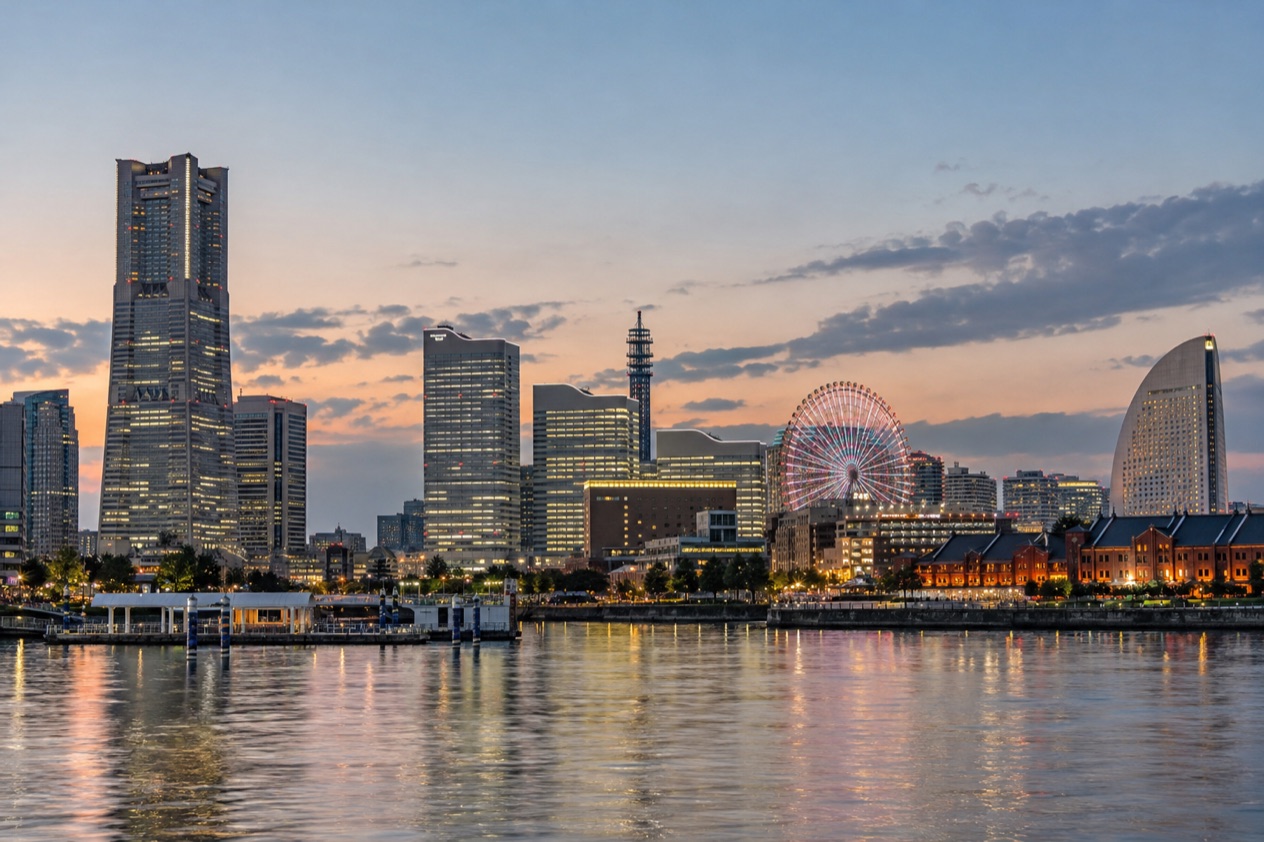
You come up from the station into a wall of glass and steel, with a tall tower at the center and a wide harbor opening beyond it. Then the smell of salt water reaches you, and the masts of an old sailing ship appear between the office blocks.
Minato Mirai is Yokohama’s waterfront district, built for the harbor and for the city’s future. It suits a day of slow wandering, a concert night, or a soak in a hot spring above the bay.
Is visiting Minato Mirai worth it?
Yes, if you like a city district where the main pleasure is moving between the water, the architecture and a few strong landmarks, and where a day can be a loose loop rather than a checklist. It fits travelers based in Tokyo who want a change of scene, anyone curious about how Japan’s harbor cities grew, and visitors who come for a concert and want something to do before the doors open.
What sets it apart from the older, denser parts of Yokohama is its age and its plan. Construction began in 1983, and the district was laid out as a whole, with wide promenades, a skyline you can read from far away and a clear line along the water. Many people work here, about 79,000, so on a weekday the area has the rhythm of a business quarter, and at other times the mood shifts toward shopping, strolling and evening events.
Compared with the older streets around the port, Minato Mirai feels more like a modern waterfront than a historic one. Yet the history is here too, because the Port of Yokohama opened on June 2, 1859, and the ship moored in the harbor today ties the district to that seagoing past. You get the contrast in a single afternoon, glass towers on one side and a sailing ship on the other.
Where it falls short is as a destination for temples, gardens or quiet old lanes. If that is what you are after, Kyoto or Kamakura will serve you better. Minato Mirai pays off when you want a harbor view, a tall building to look out from, a show, and a good meal by the water.
What to see at Minato Mirai
Yokohama Landmark Tower
The Landmark Tower is the building that anchors the skyline, and it is Japan’s third tallest skyscraper. From the streets around it, you use the tower as a compass. It rises over a shopping and dining complex, and its height makes it easy to spot from the promenades along the water.
The tower holds offices, a hotel and an observation level, and the point of going up is to see how the district is arranged: the curve of the harbor, the line of the piers and the way the city runs on toward Tokyo Bay. Look for the ship masts and the Ferris wheel in the foreground, then lift your eyes to the wider bay. On a clear day the view stretches far.
Nippon Maru
Nippon Maru is a four-masted sailing ship, permanently docked at Minato Mirai as a museum. From the quay she looks like something out of another century, with her tall rigging set against modern towers. That contrast makes her one of the most photographed corners of the district.
A ship museum rewards slow looking. Expect to find the details of life on a working sailing vessel, such as the rigging, the decks and the way a crew handled sail. Even from the dock, the hull and masts show how large these ships were. She sits beside a dock basin, which gives you a pleasant place to stand and take in both old and new.
The waterfront promenades and amusement area
The district’s real character comes from its walks along the water. Paved paths run between the piers, the old brick buildings and the newer towers, and the harbor air changes the feel of the whole place. You can drift from shopping arcades to the waterside in a few minutes, then sit on a bench and watch the boats.
The amusement park by the water, with its giant Ferris wheel lit at night, is part of the Minato Mirai picture, and the red-brick warehouses nearby have been turned into shops and restaurants. They are good places for a snack, a coffee or a look at Japanese gifts. Treat this stretch as the connective tissue of your visit, the part where you wander rather than aim.
Pia Arena MM and K-Arena Yokohama
Two music arenas give the district a second life after dark. Pia Arena MM opened in 2020, and K-Arena Yokohama followed in 2023. Both host concerts, so the streets around them fill with fans, merchandise stands and the energy of a show night.
If you have tickets, these venues turn a sightseeing day into an evening with an event at its end. Even if you do not, the pre-show crowds and the glow of the buildings give the area a lively edge you will not find on a quiet weekday.
Yokohama manyo club
Yokohama manyo club is an onsen and hotel that opened in February 1994, and it has a foot bath on the top floor. An onsen is a Japanese hot spring bath, and finding one inside a harbor district is part of the surprise. The foot bath lets you sit with warm water at your ankles while the bay spreads out in front of you.
It makes a restful pause in a day of walking. Soaking tired feet after the promenades and the tower is a pleasant way to close a loop through the district, and it gives the visit a Japanese touch you may not expect from a modern waterfront.
Hours, tickets and rules
Minato Mirai is not one gated attraction but a district of streets, promenades, shopping complexes, a ship museum, an observation tower, arenas and a hot spring. The open-air parts, the waterfront paths and the squares between the towers, are places you simply walk through. The venues inside the district are separate buildings, each with its own character.
The Landmark Tower combines shops, offices and a hotel, so you move in and out of it as you would any large urban complex. Nippon Maru is a museum ship, a visit with a different pace from the arcade strolls around it. The two arenas are event spaces, which means they come alive around concerts rather than for sightseeing in the usual sense.
Yokohama manyo club is both an onsen and a hotel, and its top-floor foot bath is the feature that makes it relevant for a day visitor. Each of these places is its own setting, so think of the day as a sequence of small stops rather than a single ticketed entrance.
The waterfront also rewards simply sitting for a while. Benches and open stretches along the harbor give a place to rest between stops, and the mix of shops and cafés nearby keeps a long visit comfortable. Treat the district as a place to move through at your own speed.
When to visit Minato Mirai
Winter is cool and dry, with sun but cold air off the harbor, and July brings heat and heavy humidity. Because most of the district is a walk between buildings and along the water, the weather shapes your day more here than at a museum-only destination.
| Month | Avg high (°F) | Avg low (°F) | Precipitation (in) | Days with rain | Sunshine (hours) |
|---|---|---|---|---|---|
| January | 50.4 | 36.9 | 2.55 | 5.1 | 193 |
| April | 66.0 | 51.3 | 5.63 | 9.5 | 181 |
| July | 84.9 | 73.2 | 7.19 | 10.3 | 171 |
| October | 71.6 | 60.3 | 9.46 | 10.7 | 137 |
January is cold enough for a warm coat along the water, with dry days and generous sun. A little snow or sleet can fall, and it sometimes falls on several days, so a hot soak at the top-floor foot bath feels especially welcome then.
April is mild, with highs in the mid-60s, and rain arrives on about half the days in the month. Showers come and go, so a light waterproof layer is useful. It is a comfortable month for the promenades and the harbor views.
July is hot and sticky, with humidity high enough that shade and indoor breaks matter. The shopping complexes and the tower give you places to cool off between stretches outdoors. Lows stay warm, so evenings by the water are mild rather than cool.
October is among the wettest months in the table, with rain on more than ten days and fewer hours of sun. Highs remain pleasant, in the low 70s, so it is a month for a rain jacket and a flexible plan. Indoor stops like the tower and the museum ship help when a shower sets in.
Concerts add their own calendar. The two arenas bring crowds on show nights whatever the season, so the mood on the streets depends on what is playing as much as on the weather.
Tips for your visit
Plan the visit as a loop along the water rather than a straight line. Start at the tower, drop to the harbor and the ship, wander the promenades, and finish at the foot bath or at a show. That ordering keeps the walking connected and lets you stop wherever the weather or your energy suggests.
Getting there is straightforward from Tokyo. A JR train or one of several private railway lines runs from central Tokyo to Yokohama Station in about 1 hour, and that station is more central than Shin-Yokohama. From Haneda Airport, the Keikyu line reaches Yokohama Station in 20 minutes, and a shuttle bus covers the same trip in 30.
If you are coming from western Japan, the Nozomi Shinkansen stops at Shin-Yokohama Station. Travel time is 1 hour 25 minutes from Nagoya, 2 hours from Kyoto and Osaka, and 3 hours 40 minutes from Hiroshima. From there you continue to the harbor district by local rail.
Bring comfortable shoes, because the pleasure of the district is in walking its promenades. Add a light layer for the wind off the water, and a compact umbrella for the wetter months. Families will find the amusement area and the ship a natural change of pace from the towers, and the paved waterfront paths suit strollers and anyone who prefers a level surface.
Yokohama sits on Tokyo Bay, south of Tokyo, so it pairs well with a day of other city outings. Kinds of stops that combine well with Minato Mirai are the older port streets, where the story of the harbor began, and an evening show if the arenas have something on.
Good to know before you go
Minato Mirai is a modern city district, with shops, restaurants and hotels around the towers, so you can spend a day there without much planning. Keep a light rain layer on hand in the wetter months, since showers are frequent in autumn. Crowds gather around the arenas on concert nights, and the usual habits for busy city streets apply: keep your belongings close and move with the flow.
Sources
- Wikipedia, Minato Mirai 21 (https://en.wikipedia.org/wiki/Minato_Mirai_21), checked October 11, 2026
- Japan National Tourism Organization, Yokohama (https://www.japan.travel/en/destinations/kanto/kanagawa/yokohama-and-around/), checked October 11, 2026
- Wikipedia, Yokohama (https://en.wikipedia.org/wiki/Yokohama), checked October 11, 2026
- Wikivoyage, Yokohama (https://en.wikivoyage.org/wiki/Yokohama), checked October 11, 2026
- Japan Meteorological Agency (JMA), Normal values 1991-2020, monthly (https://www.data.jma.go.jp/stats/etrn/view/nml_sfc_ym.php?prec_no=46&block_no=47670), station Yokohama, elevation 39 m, checked October 11, 2026
To plan your stay
- Best Time to Visit Japan: Cherry Blossoms, Autumn Colors, Weather and Festivals
- Where to Stay in Japan: Ryokan, Temple Stays, Capsule Hotels and the Best Cities to Base In
- Sending Luggage from the Airport in Japan: Hands-Free Travel, Hotel Delivery and Coin Lockers
- Know Before You Go to Japan: Entry, Money, Etiquette and Getting Around