
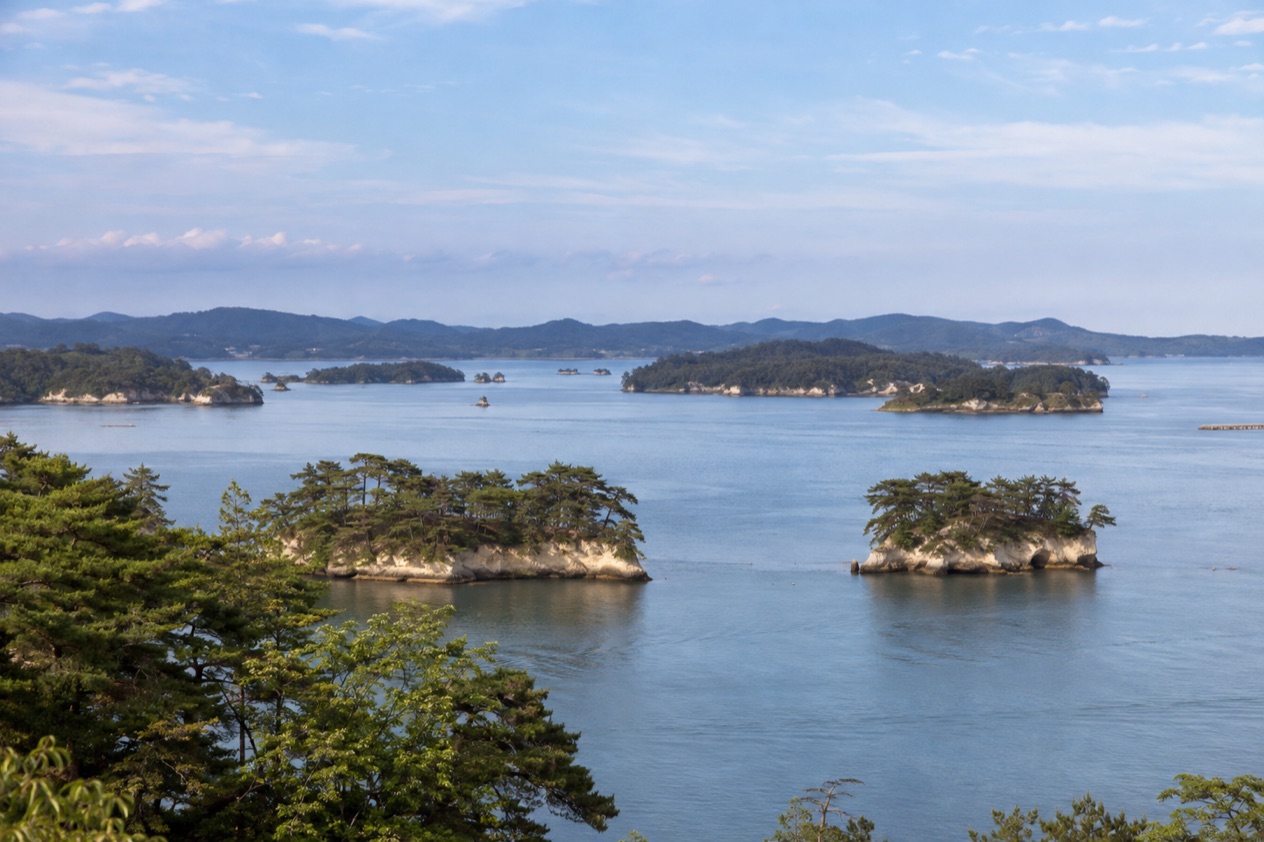
Dark pines lean over the edges of small rock islands, and the water between them is dotted with the white wakes of sightseeing boats. On the shore, oyster stalls send up the smell of grilling shells, and temple roofs show among the trees behind the harbor. Matsushima is a small town on the coast of Miyagi Prefecture, and a visit here is a day of looking at a bay that Japan has long counted among its great views, with a temple walk and a seafood meal alongside.
Is visiting Matsushima worth it?
Yes, if you like your sightseeing slow and built around a landscape rather than a checklist, and especially if you are already in the Tohoku region. Matsushima suits travelers who enjoy boat rides, old temples and a meal of local seafood, and it is a good match for anyone who has seen Kyoto or Tokyo and wants a day by the water.
What sets it apart from other coastal towns is the bay itself. Matsushima Bay is considered one of the Three Views of Japan, a traditional list of scenic sites that people have been reading, painting and writing poems about for generations.
The town does not rely on one single monument. The view, the temples near the harbor, the boats and the oyster beds all belong to the same picture, so you can follow one thread or all of them in a single outing.
It is also a working fishing town. The local economy rests largely on commercial fishing, above all oysters grown in the bay, and that gives the harbor a lived-in feel that a pure sightseeing stop would lack. You see the view and you eat what the view produces.
Travelers who want nightlife, big shopping or a long list of museums will find the town thin on all three. Those who want a place to walk between a temple garden and a pier, with a bowl of something from the bay at the end, will find it fits.
What to see at Matsushima
The town is organized around its bay, and the main sights sit close to the water and the temples behind it. Start with the view and the boats, then follow the temples and the older layers of history.
The bay and the sightseeing boats
The bay is the reason for the visit. Its islands are small and rocky, many of them topped with twisted pines, and they are spread across the water in a way that makes the shoreline look drawn rather than natural. The name of the town is usually read as Pine Islands, which is exactly what you see.
Sightseeing boats leave from the Port of Matsushima and wind between the islands, which lets you see their shapes up close, with gulls following the wake. Look for the way each islet has its own outline, and for how the pines grow almost sideways where the wind reaches them. On land, the shoreline near the port gives you the same scene from a different height, with the boats crossing it.
Zuigan-ji, Entsu-in and Kanrantei
Old cedars shade the approach, and the grounds are the kind of setting where you slow down without being told to. Shoes come off at the entrance of temple halls, as they do across Japan, and voices tend to drop on their own.
Entsu-in and Kanrantei stand in the same town and belong in the same walk. Kanrantei is a tea pavilion that looks toward the bay, which makes it a place where the temple world and the sea view meet. Each of these places has its own style, and visiting all three shows how a Buddhist town and a scenic coast grew up together.
Nishinohama Shell Mound
People lived beside this bay long before temples and sightseeing boats. Nishinohama Shell Mound is designated a National Historic Site of Japan, and it is a reminder that the shellfish of Matsushima were gathered and eaten here in prehistoric times. A shell mound is a heap of discarded shells and other remains, built up over generations, and archaeologists read it as a record of what people ate and how they lived.
Seeing it is a quieter kind of sightseeing than the boats and the temples. It connects the oysters on today’s plates to a long habit of living off the bay, and it gives the town a deeper timeline than its postcard views suggest.
Oyster stalls and the harbor
Oysters are the food of Matsushima. The bay is the place where they are cultivated, and you meet them everywhere near the harbor: grilled in the shell, fried, simmered in hot pots or served raw. Grilled oysters eaten at a stall, with the smoke drifting over the water, are the most direct way to taste the bay.
Look at the harbor, too, where fishing is still part of daily life. A walk along the waterfront, with a shell in hand, takes in the working side of the town that sits beside the postcard view.
How to get to Matsushima
Matsushima is reached by rail, and the town has more stations than its size suggests. JR East’s Tohoku Main Line serves the stations of Matsushima, Atago and Shinainuma, while the Senseki Line serves Matsushima-Kaigan, Takagimachi, Tetaru and Rikuzen-Tomiyama. Two of the names matter most for a day by the water, Matsushima and Matsushima-Kaigan, since they carry the town’s name.
Travelers from outside the region begin in Sendai, the capital of Miyagi Prefecture and the largest city in northeastern Japan. Sendai is described as a base for exploring the Tohoku region, and Matsushima sits in the same prefecture, so it fits naturally into a stay there. Sendai is about 220 miles from Tokyo.
From Tokyo to Sendai
The Tohoku or Akita Shinkansen lines reach Sendai Station from Tokyo in 1 hour 30 minutes. That makes the capital of Miyagi reachable on the bullet train, with the rest of the journey to Matsushima made on the local lines named above.
Long-distance buses are the other option. Daytime and overnight buses run from Tokyo Station and Shinjuku Station and take between 5 and 7 hours to reach Sendai. The overnight services put you in the region by morning, which suits a traveler who prefers to sleep on the way.
Arriving in town
Once you reach Matsushima, the sights are gathered around the port and the temples. The boats leave from the Port of Matsushima, so the harbor is the natural anchor of the day. From there you can move between the waterfront, the oyster stalls and the temple grounds on foot or by the rail stops named above.
The town is spread across a larger area than the center suggests, and its stations are scattered. If you are using the trains, note which of the seven stations you are heading for, because two of them carry the town’s name and are the ones that fit a day by the bay.
When to visit Matsushima
The bay can be enjoyed in any month, since its appeal is the shape of the islands and the pines, and those do not change with the calendar. What changes is the mood. Green pines against blue water read one way in summer light, and another when the air is crisp and the sky is clear.
Seasons on the bay
Oysters are a cold-weather food in Japan, and a winter visit to a bay known for them has a clear culinary reason. Grilled shells taste better when the air carries a chill, and hot oyster dishes make sense of the season. If food is the center of your trip, plan around the cooler months.
Spring and autumn suit the walk between temple grounds and the waterfront, when you want to spend more time outdoors. Summer brings the sea breeze and long days to the harbor. Each season gives the same islands a different light, so there is no wrong month for the view, only different reasons to come.
A summer festival nearby
In summer, Sendai holds the Sendai Tanabata Festival, the largest Tanabata festival in Japan. Streamers and decorations fill the city’s shopping streets, and it is the biggest cultural event in the regional capital. Because Sendai is the usual base for Matsushima, the festival can shape a summer trip to the area.
A day in Sendai with the decorations, followed by a day at the bay with the boats and the temples, makes a trip with two very different moods. The festival belongs to the city rather than to Matsushima itself, so treat it as a companion to the bay, not part of it.
Tips for your visit
Plan the day around the water first and the temples second. The boats, the harbor and the oyster stalls are all at the port, and the temples sit just behind the waterfront, so the two halves of the visit fit into one outing without much backtracking.
What to combine it with
Sendai is the obvious partner. It is the largest city in the Tohoku region, with around a million people, and it is known as Mori no Miyako, the City of Trees, for its many trees and green spaces. The modern city was founded in 1600 by the daimyo Date Masamune, a warlord whose name runs through the history of the region.
Pairing the two gives you a small city of tree-lined streets and a small town of pines and islands. The contrast between them is part of the pleasure, and each makes the other feel more distinct.
What to bring and how to plan
Bring a camera or phone with room for plenty of photographs, since the islands change shape as the boat moves. Comfortable shoes that slip on and off help at the temples, where footwear is left at the entrance of the halls.
Leave room in the day for eating. The oyster stalls and restaurants near the harbor are part of the experience rather than a break from it, and a meal there lets you taste what you have just seen being farmed. A leisurely pace suits the town better than a tight schedule.
Families and mobility
A boat ride gives children something to watch, with gulls, islands and the harbor in motion. The temples offer grounds to wander, and the waterfront gives space to move about. Beyond that, the day is mostly looking and eating.
The town covers a wide area and its highest point is Mount Danyama, so the land is not entirely flat. For anyone planning around mobility, it is worth thinking about how far you will move between the port, the temples and the station you arrive at before deciding how much to attempt.
Good to know before you go
Matsushima is a small town of a little under fourteen thousand residents, and it works best as a relaxed day trip or a stop along a longer journey through Tohoku. Prices are in yen, and having some cash for stalls near the harbor fits the rhythm of a day spent eating by the water.
At the temples, shoes come off at the hall entrances, voices drop, and photographs are taken with the same care you would show in any place of worship. Take the ordinary habits of a careful traveler with you and the day goes smoothly.
Sources
- Wikipedia, Matsushima, Miyagi (https://en.wikipedia.org/wiki/Matsushima,_Miyagi), checked October 11, 2026
- Japan National Tourism Organization, Sendai (https://www.japan.travel/en/destinations/tohoku/miyagi/sendai-area/), checked October 11, 2026
- Wikipedia, Sendai (https://en.wikipedia.org/wiki/Sendai), checked October 11, 2026
- Wikivoyage, Sendai (https://en.wikivoyage.org/wiki/Sendai), checked October 11, 2026
To plan your stay
- Best Time to Visit Japan: Cherry Blossoms, Autumn Colors, Weather and Festivals
- Where to Stay in Japan: Ryokan, Temple Stays, Capsule Hotels and the Best Cities to Base In
- Sending Luggage from the Airport in Japan: Hands-Free Travel, Hotel Delivery and Coin Lockers
- Know Before You Go to Japan: Entry, Money, Etiquette and Getting Around