
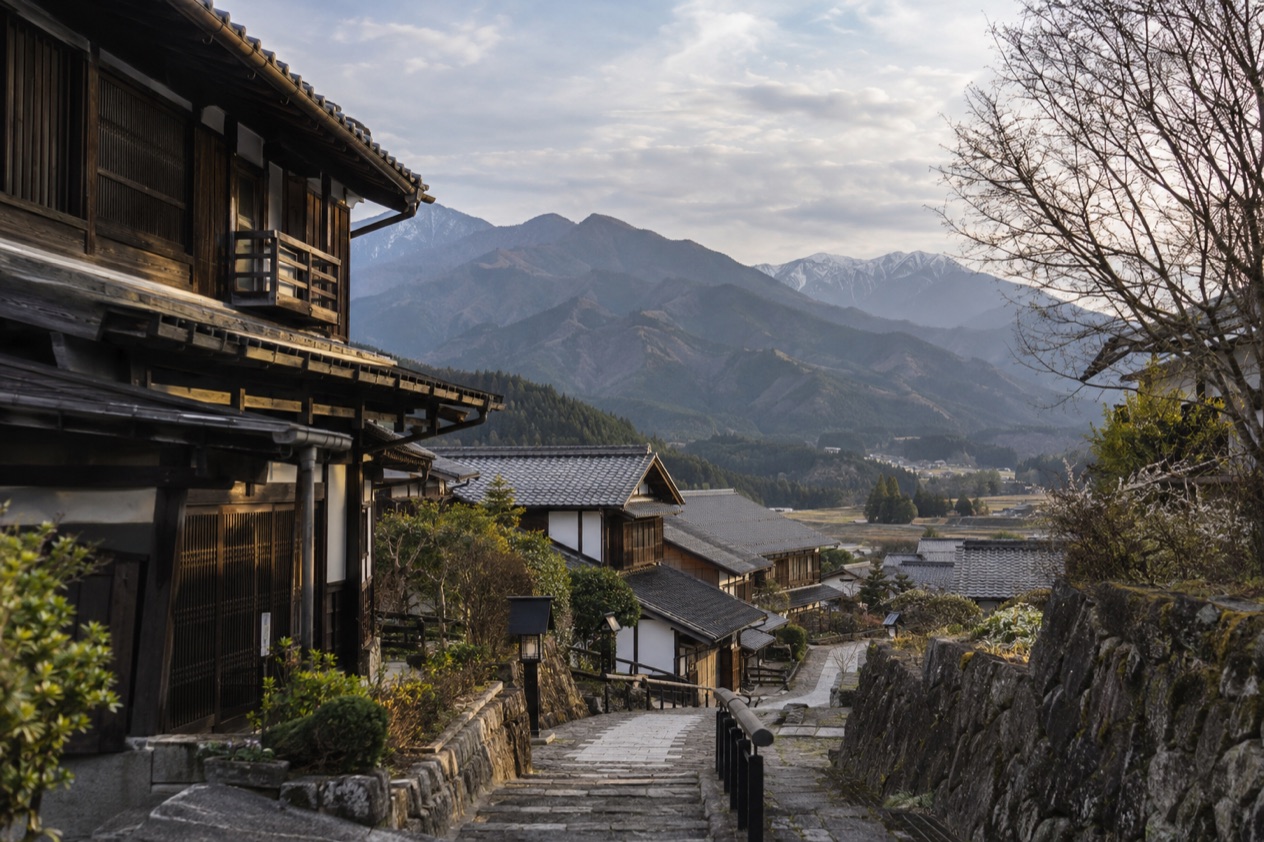
Wooden eaves lean over a stone-paved lane, water turns a wheel somewhere out of sight, and the street tips downhill toward a wall of green mountains. This is Magome, a post town on the old Nakasendo highway that was rebuilt to look as it did when travelers on foot stopped here for tea and a bed. Together with its neighbor Tsumago, it makes a visit built around slow walking, old houses and a stretch of forest road.
Is visiting Magome and Tsumago worth it?
Yes, if you like your travel on foot and your history in the shape of streets rather than museums. These two towns suit people who enjoy wandering, who like the idea of walking a road that merchants, officials and pilgrims once used, and who are happy to let a day move at the pace of a path. They are less suited to anyone who wants nightlife, big sights or a checklist of landmarks.
What sets them apart from other historic towns in Japan is that they are linked by a preserved stretch of the original highway. Magome-juku is a restored Edo period post town in the city of Nakatsugawa, Gifu Prefecture, and the road between it and Tsumago-juku runs through forests and past waterfalls.
You do not just look at an old town. You arrive in one, leave it on a trail, and reach another, which gives the day a shape that a single village cannot.
The setting does a lot of the work. Add the option of a bus between the two towns, and you can shape the day around how much walking you want.
What to see at Magome and Tsumago
The sloping main street of Magome
The heart of Magome is its row of restored houses along the former post road, which climbs and falls between the low and high ends of the town. Because the street runs on a slope, every few steps changes the view: a pair of dark timber facades, a tilted lattice window, a glimpse of valley between two roofs. Many of the buildings now hold small shops, tea rooms and inns, so the walk doubles as a way to taste the place.
Look for the details that make a post town what it was. The stone paving, the narrow frontages, the water channels beside the lane and the overhanging roofs all belong to a design meant to serve travelers who arrived tired and hungry. Stop at a tea room, try a local sweet or a plate of regional noodles if one is on offer, and let the slope set your pace.
Mount Ena and the view above the parking lot
Magome offers a fine view of Mount Ena, which rises 7,185 feet. On a clear day the peak sits above the line of roofs and the green ridges around the town, giving the old street a backdrop that no reconstruction could invent. Clouds can hide it, as they do on most mountains, so treat it as a pleasure when it shows rather than a certainty.
A wider outlook is possible from a vista above the main parking lot at Magome’s upper end, where panoramic views of the surrounding mountains open out. It is a place to pause at the end of the climb, look back over the rooftops and take in the folds of the Kiso mountains that the old road had to cross.
Shimazaki Toson and the Magome of Before the Dawn
Magome was the birthplace and childhood home of the author Shimazaki Toson, who wrote about the Kiso region in his novel Before the Dawn. The book follows the years when the old road and the way of life along it were changing, and reading even a few pages beforehand gives the street a second layer. The houses stop being a set and start being part of a story about a community.
Toson is buried in the town’s small cemetery in Magome, so the writer’s connection to the place is more than a plaque on a wall. For visitors who care about literature, it is a gentle reason to slow down and think about the people who lived on this road long after the travelers had moved on.
The forest path to Tsumago
A quiet portion of the original highway has been preserved between Magome-juku and Tsumago-juku, providing a pleasant walk through forests and past waterfalls. Travelers in the past had to cross an mountain pass between the two towns, and the path keeps that sense of a journey between settlements. Expect tree cover, the sound of water and stretches where the modern world seems far away.
Tsumago-juku sits at the other end, another post town on the same road and a natural companion to Magome. Bus service connects the two, allowing visitors to start at either end of the path. That means you can walk in the direction that suits you, or ride one way and walk the other, and still see both towns in a single outing.
How to get to Magome and Tsumago
Magome-juku lies in the city of Nakatsugawa in Gifu Prefecture, in the Chubu region, the large and varied part of Honshu that sits directly between the Kanto and Kansai regions and includes the major city of Nagoya. That is the geographic frame for the trip: you are heading into the mountains of the middle of the main island, rather than to a big coastal city.
The one link between the two towns that is certain is the bus. Bus service is provided between Magome-juku and Tsumago-juku, so you can begin at either end of the path and return or continue as you prefer.
This also means the walk does not have to be a loop or an out-and-back. You can walk the old road in one direction and let the bus carry you the other way if you like.
For reaching the area from elsewhere in Japan, it helps to know how the country’s rail network is organized. The high-speed shinkansen links Tokyo to much of the Hokuriku Shinetsu region in 2 hours 30 minutes or less, but that region is a separate grouping of prefectures, and the mountain towns here belong to Chubu. Plan the approach around Gifu Prefecture and the Chubu region as a whole, and look up the route to Nakatsugawa and Magome before you set out.
Once you are in Magome, the layout is simple to understand. The main parking lot sits at the upper end of town, the old street slopes down from there, and the path to Tsumago leaves the settlement into the forest. Thinking of the trip as a line from one post town to the other gives you the whole picture.
When to visit Magome and Tsumago
The towns are outdoor places, so the season you choose shapes what you see. In spring the forest around the path turns fresh and green, and the water along the route is full.
In summer the tree cover on the old road gives the walk a shaded, leafy feel, though the mountains can bring sudden rain. Autumn is when travelers imagine the road, with the surrounding hills changing color, and the timing varies from one year to the next.
Winter changes the character of the whole area. The Kiso mountains can hold snow, the rooflines look sharper against a pale sky, and the stone lane of a post town takes on a different mood. If you plan a winter visit, think of it as a walk through a very different landscape rather than a lesser version of the green seasons.
Because there are mountain views and a forest trail at the heart of the trip, the weather matters more here than in a museum town. A clear day lets Mount Ena and the panoramas above the parking lot do their work, while a wet day turns the path and the waterfalls into the main event. Either way, the old street and its restored houses remain the constant.
There is no single date to circle on the calendar. This is a place to choose by the season you want to see, and to keep your plans loose enough that a change in the weather does not undo the day. If you want to start from Tsumago rather than Magome, the bus makes that a reasonable choice whenever you go.
Tips for your visit
Think of the visit as two towns and a path, and give each its due. Magome rewards a slow walk up or down its sloping street, with time for a tea room, a look at the houses and a pause at the view above the parking lot. The forest road between the towns asks for a different kind of attention, with waterfalls and tree cover to notice along the way.
The bus service between Magome and Tsumago gives you flexibility. Walk the whole path if you want to feel the old road underfoot, or take the bus for part of the trip and keep the walking for the stretch that appeals most. Starting at either end is possible, so you can match the direction to your plans for the rest of the day.
If literature interests you, bring Before the Dawn or read a summary beforehand. Toson’s novel about the Kiso region lends the houses and the street a human story, and the small cemetery where he is buried makes the link concrete. Even without the book, the idea that this was a childhood home is enough to change how you look at the doorways.
The Chubu region around you is a big and varied part of Honshu, with Nagoya as its major city, so the visit can fit into a longer trip across the middle of the island.
Good to know before you go
Magome and Tsumago are small settlements, so treat them as places to enjoy at a walking pace rather than to rush through. The old street is a living village with homes, shops and inns, and the usual courtesies apply: keep your voice down in the lanes and take photographs with respect for the people who live there. In the rainy months the forest path will feel different underfoot, so let the weather guide how much of it you take on.
Sources
- Wikipedia, Magome-juku (https://en.wikipedia.org/wiki/Magome-juku), checked October 11, 2026
- Japan National Tourism Organization, the Chubu region (https://www.japan.travel/en/destinations/hokuriku-shinetsu/), checked October 11, 2026
- Wikipedia, Chūbu region (https://en.wikipedia.org/wiki/Ch%C5%ABbu_region), checked October 11, 2026
- Wikipedia, Regions of Japan (https://en.wikipedia.org/wiki/Regions_of_Japan), checked October 11, 2026
To plan your stay
- Best Time to Visit Japan: Cherry Blossoms, Autumn Colors, Weather and Festivals
- Where to Stay in Japan: Ryokan, Temple Stays, Capsule Hotels and the Best Cities to Base In
- Sending Luggage from the Airport in Japan: Hands-Free Travel, Hotel Delivery and Coin Lockers
- Know Before You Go to Japan: Entry, Money, Etiquette and Getting Around