
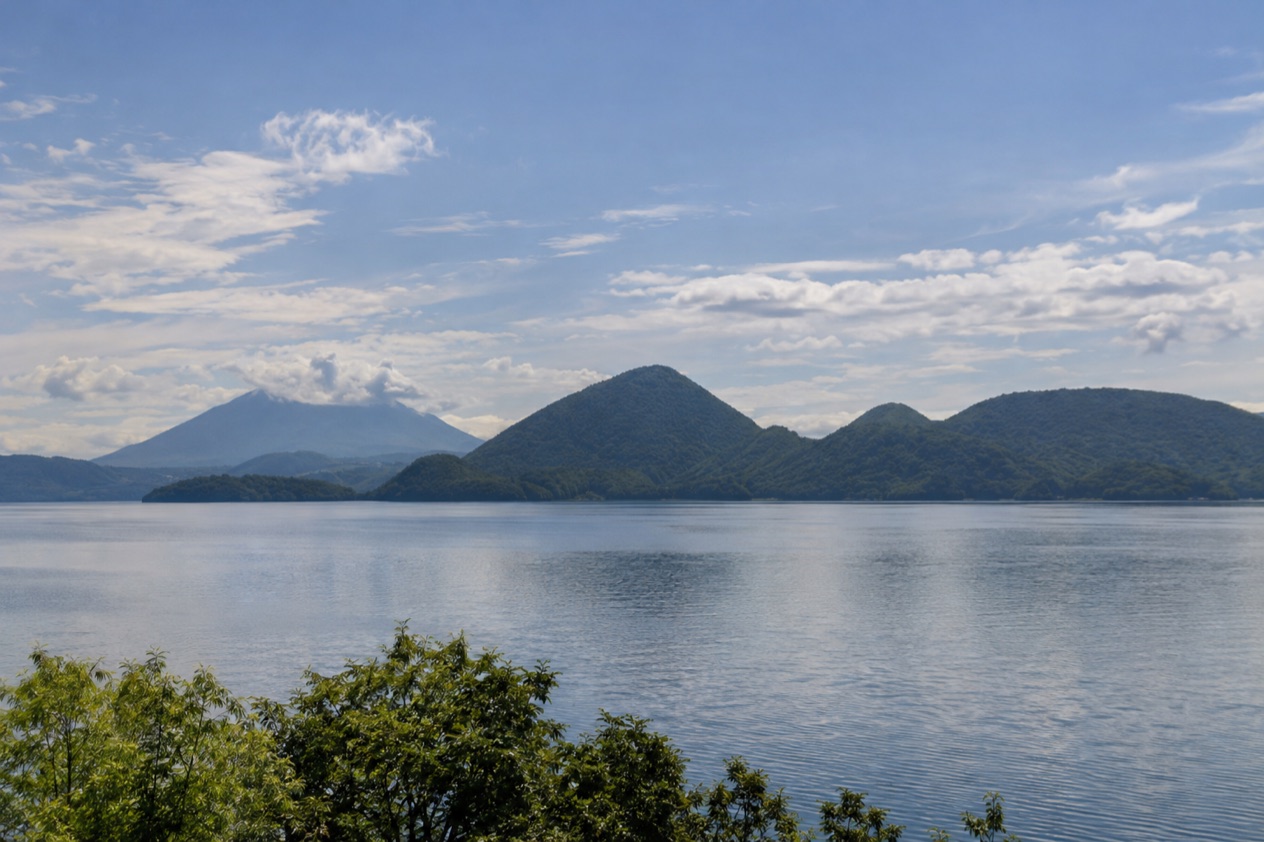
A nearly round sheet of water opens up in front of you, ringed by green hills, with a small wooded island floating in the middle and the bulk of Mount Usu rising on the southern rim. Steam drifts from hot springs along the shore, and the lake itself keeps a deep, even blue. Lake Toya is a visit built around a volcanic landscape, slow walks and a soak in an onsen, on Hokkaido’s southwestern side.
Is visiting Lake Toya worth it?
Yes, for travelers who like to pair scenery with hot water and a gentle pace, and who want a lake that is also a volcano story. Lake Toya sits inside Shikotsu-Toya National Park in Hokkaido, and it is a place to walk the shore, look at the island in the middle and end the day in a bath with a view.
What sets it apart from other Hokkaido stops is the geology you can read in the landscape. The lake fills a caldera, the great bowl left by a volcanic collapse, and Mount Usu, a stratovolcano, stands on the southern rim as a reminder that the ground here is alive. The whole area belongs to the Toya Caldera and Usu Volcano Global Geopark, a member of the Global Geoparks Network, so the craters, the trails and the hot springs are all parts of one story rather than separate attractions.
The lake is also a pleasure to look at. It is said to be the northernmost lake in Japan that never ices, though nearby Lake Shikotsu has a competing claim, and it is the second most transparent lake in the country. That gives the water its clean, deep color in every season, and it makes a stroll along the waterfront rewarding even if you do nothing else.
The setting is mostly spread between two towns. Toyako holds most of the area around the lake, and Sobetsu lies on the eastern side. Between them you find onsen with views, hand and footbaths, and a resort that drew the world’s attention when it hosted the 2008 G8 Summit at The Windsor Hotel Toya Resort & Spa.
It suits couples, nature walkers, anyone building a Hokkaido trip that already includes Sapporo or the ski country around Niseko, and travelers who prefer a lakeside day of baths and short viewpoints over a checklist of temples. If you want city energy or nightlife, it is a quieter kind of stop, built around water, steam and hills.
What to see at Lake Toya
The lake and its shoreline
The lake is the main event. It is almost perfectly circular, roughly 6.2 miles across from east to west and 5.6 miles from north to south, so wherever you stand on the shore you feel the full bowl around you. The color shifts with the sky, from steel gray on an overcast morning to a deep blue under clear skies.
The name comes from the Ainu expression to ya, meaning lakeshore or the land around a lake, which Japanese pioneers adopted in the Meiji era. It is a fitting name for a place best enjoyed from its edges: on a bench by the water, along a promenade, or from the window of a hot spring bath.
Nakajima Island and the Forest Museum
In the middle of the lake lies Nakajima Island, an island within a lake that itself sits inside a caldera. It is wooded and green, and it holds the Toya Lake Forest Museum, which gives the island a quiet purpose beyond its looks.
Seen from the shore, the island is the focal point of nearly every photograph, with the water spreading out on all sides. It is the part of the lake that makes the view feel composed, and it gives your eye somewhere to rest as the light moves across the surface.
Mount Usu and the crater trails
Mount Usu rises on the southern rim of the caldera, a stratovolcano that gives the area its edge. Around the lake, the walking trails include the Nishiyama Sanroku Crater Trail, which takes you through the landscape shaped by eruptions, where the ground and vegetation show how the mountain has changed the land.
This is the part of the visit that connects to the geopark. Walking here, you see craters and recovering growth rather than a postcard view, and it adds a sense of scale to the calm lake nearby. Look for the contrast between bare, shaped ground and the green forest returning around it.
Waterfront Forest Lane and the nature trails
The Waterfront Forest Lane, also called the Takarada Nature Observation Trail, follows the lake through trees. It is the walk to choose when you want the water in view between trunks and branches rather than an open panorama.
Together with the crater trail, it gives the visit two moods: the volcano’s rough, open ground and the lake’s softer wooded edge.
Onsen, footbaths and spring water
Several onsen managed by the town of Toyako offer views of the lake, and there are hand and footbaths nearby where you can sit and warm up in the open air. A soak with the water in sight is the signature pleasure here, and the volcanic ground is the reason the hot water exists at all.
Near the onsen, large vending machines dispense spring water that you can take home. It is a small, local detail, and a good one to notice as you walk between the baths and the lakefront.
When to visit Lake Toya
Lake Toya works in every season, because the lake is said to be the northernmost in Japan that never ices. That means the water stays open and visible even when Hokkaido is deep in winter, and the onsen add their own appeal when the air is cold.
Hokkaido is the northernmost prefecture of Japan, and it is known for seasonal views, outdoor activities such as skiing and trekking, and hot springs. That seasonal rhythm shapes how you might plan a stop at the lake: walking trails and lakeside strolls suit the months without snow, while a winter trip pairs naturally with the region’s ski areas, among them Niseko, known as a winter sports area.
For a day built around trails, choose a time when you want to be outdoors for hours, then end with a bath. For a trip built around soaking, the colder months give the hot water its full meaning, and the open lake in front of you stays a constant. The Sapporo Snow Festival, a winter event in Hokkaido, can sit in the same trip as a lakeside stay for those traveling in the cold season.
Time of day matters in a simple way. Walks along the shore and the crater trail are best given daylight, and the evening is the natural time for the onsen, with the lake going dark beyond the steam. There is no single right month, so let the kind of day you want decide: trails and views, or baths and quiet.
Tips for your visit
Plan a day that mixes walking and soaking. Start with the lakeshore or one of the trails, then finish with an onsen managed by the town of Toyako, so the hot water follows the exercise. Bring shoes that suit uneven ground if you intend to follow the crater trail, and something to dry off with if you plan to use a footbath.
Because Toyako covers most of the lakeshore and Sobetsu sits on the eastern side, think of the lake as a ring with a few areas to explore rather than one point. You can choose a base on either side and look across the water at the other.
To combine it with other stops, Hokkaido’s regions include Sapporo and its surroundings, Asahikawa and northern Hokkaido, Hakodate and southern Hokkaido, and Kushiro and eastern Hokkaido. Lake Toya fits naturally into a trip that also takes in Sapporo, reached by air through New Chitose Airport near Sapporo, with direct flights from Tokyo taking about 1 hour 30 minutes.
If you prefer the train, going from Tokyo to Sapporo takes about 8 hours: the JR Tohoku/Hokkaido Shinkansen runs to Shin-Hakodate-Hokuto, and the limited express Hokuto continues to Sapporo. Nearby, Niseko and its neighboring ski resorts are known as a winter sports area, which makes a lakeside stay a pairing with a ski trip.
For a lakeside meal or a snack, Hokkaido’s local cuisine is part of the region’s draw, so let the day end with something from the area. Bring a bottle if you want to take home some of the spring water from the vending machines near the onsen.
Good to know before you go
Keep some yen with you for the small things that make a lakeside day: a hand or footbath stop, a bottle of spring water to carry home, a snack by the shore. Hokkaido’s weather changes with the seasons, so dress for the month you travel and for hours spent outdoors on the trails. The Waterfront Forest Lane and the crater trail are walks, so give yourself time and daylight, and let the lake, the island and the steam set the pace of the day.
Sources
- Wikipedia, Lake Tōya (https://en.wikipedia.org/wiki/Lake_T%C5%8Dya), checked October 11, 2026
- Japan National Tourism Organization, Hokkaido (https://www.japan.travel/en/destinations/hokkaido/hokkaido/), checked October 11, 2026
- Hokkaido Love, the official Hokkaido tourism site (https://www.visit-hokkaido.jp/en/), checked October 11, 2026
To plan your stay
- Best Time to Visit Japan: Cherry Blossoms, Autumn Colors, Weather and Festivals
- Where to Stay in Japan: Ryokan, Temple Stays, Capsule Hotels and the Best Cities to Base In
- Sending Luggage from the Airport in Japan: Hands-Free Travel, Hotel Delivery and Coin Lockers
- Know Before You Go to Japan: Entry, Money, Etiquette and Getting Around