
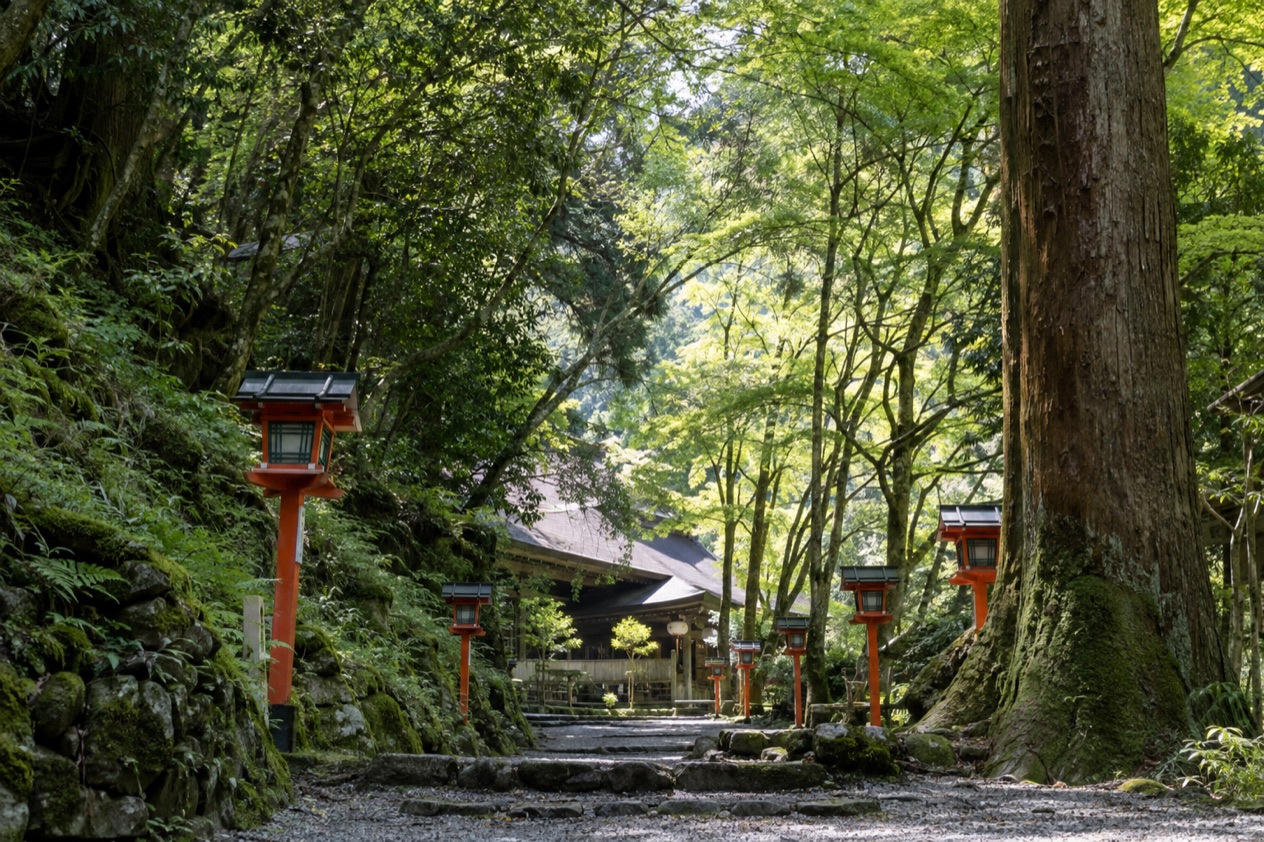
Cedar trunks rise on both sides, the air smells of damp bark and incense, and somewhere above the path a temple bell sounds through the trees. Kurama and Kibune sit in the wooded mountains in the far north of Kyoto, a world away from the lanes of Gion and the crowds at the big temples downtown. This is a visit for travelers who want a day of forest, shrines, mountain legends and a river village, set against the city’s temple circuit.
Is visiting Kurama and Kibune worth it?
Yes, if you like your temples wrapped in forest and your sightseeing with some legend attached. It suits travelers who have already seen Kyoto’s central landmarks and want something that feels like a mountain outing rather than another stroll between shop fronts.
Kurama-dera is not a hidden corner kept for a few. It is an extremely popular temple for Japanese people to visit, and it appears in Lonely Planet Japan as a Kyoto Highlight. What sets the area apart from the temples in the city is the setting. Here the buildings are strung along a mountainside, and the old belief that tengu, the long-nosed mountain spirits of Japanese folklore, and other spirits still live in the woods gives the climb a slight edge of story.
Add Kibune, the neighboring river village known for its shrine and its restaurants, and the day has two characters: the spiritual weight of Kurama, then the lanterns and water sounds of Kibune. People who prefer sights that can be ticked off from a bus window will find less here. People who like to walk, look up into tall trees and take their time will find a lot.
What to see at Kurama and Kibune
Kurama-dera and its mountain setting
Kurama-dera is a temple in the far north of Kyoto, founded in the 8th century AD. Its story begins with the Chinese monk Jianzhen, whose disciple saw in a dream in 772 that Mount Kurama held a spiritual power. That dream is the reason a temple stands on this slope at all, and the place has kept the air of a site chosen for its mountain rather than for a town.
The temple houses some National Treasures of Japan, so alongside the walk there is real art and ritual to look at. Mount Kurama is also believed to be the birthplace of reiki, a type of energy therapy, which draws a different kind of visitor from the usual temple-goer. The temple has its own cable car line, the Kurama-dera Cable, which is part of how the mountain is reached.
Yuki-jinja, the shrine within the temple grounds
On the grounds of Kurama-dera stands a Shinto shrine called Yuki-jinja, founded in the year 940. Temple and shrine side by side is an arrangement you meet often in Japan, where Buddhism and Shinto have lived together for centuries, but seeing it on a forested slope makes the mix easy to read. The shrine’s wooden halls sit among the trees, with the weight of old timber and moss around them.
Look for the details that show age: worn steps, rope and paper offerings, and the small prayer plaques hung by visitors. Yuki-jinja is also tied to the fire festival held in Kurama village in late October, a torchlit event that locals take part in. If your visit falls close to it, expect the village to be in a festival mood.
The tengu legends and the forest paths
It is still believed today that tengu and other mountain spirits live in the area of Kurama-dera. Tengu are usually pictured with red faces, very long noses and feathered robes, and Kurama is where many Japanese stories place them. You will see their faces on masks and carvings around the village, and the mountain’s dark cedars suit the tale well.
A trail leads through the forest between Kurama and Kibune, passing close to the temple grounds. Cedar roots spread across the ground in places, and the light under the canopy shifts from green to near dusk. It is walking through woodland, not a stroll through a garden, and it gives the two villages their link.
Kibune, the river village
Kibune is a village along a mountain stream, known for Kibune Shrine, a shrine tied to water, and for restaurants that in summer set tables on platforms over the river, a style called kawadoko. Stone steps lined with red lanterns lead up to the shrine, and the sound of running water follows you along the lane.
Kibune is where the visit slows down. Whether you arrive by trail or by road, the village is a place for sitting down, eating a meal of seasonal dishes and watching the water. The red lanterns against dark trunks are the picture visitors take home from here.
How to get to Kurama and Kibune
Kurama and Kibune are in the far north of Kyoto, so the trip starts from the city and climbs into the mountains. Kyoto Station is the base to think about first: it is served by the Tokaido Shinkansen line, which connects the city to major cities across Japan. From there you head north through Kyoto toward the mountain villages, and the exact route and timing are worth looking up for the day you travel.
Kyoto Station itself is part of the journey. The building holds a full floor of ramen restaurants, an Isetan department store, a theater and a Granvia luxury hotel, so it makes sense to eat or stock up there before leaving. Kyoto Tower, a few steps from the main entrance, is over 130 meters tall and visible across the city, which makes a useful landmark when you come back and need to find your bearings.
Once you are at Kurama, the temple can be reached by its own cable car line, the Kurama-dera Cable. That gives you two ways to move around the mountain: the cable car, or the forest path that links the temple area with the surrounding villages. Visitors use both, one on the way up and one on the way down.
Because Kurama sits in the far north of the city, plan to treat it as its own outing rather than a quick add-on to a central Kyoto morning. A day that starts at the station, passes through the villages and ends back at the city gives the mountain, the shrine and the river the time they deserve.
When to visit Kurama and Kibune
The time of day matters here as much as the month. For Kyoto’s shrines in general, visitors are advised to go at less crowded times such as early morning, or late evening when they are illuminated. On a mountain site made of forest paths and old wood, those quieter hours are when the setting does its work best.
Each season gives the area a different feel. In Kyoto city, April brings mild afternoons and a fair number of rain days, and the forest turns fresh and green. July is hot and humid, with more rain, and that is the season when river-terrace dining in Kibune fits the weather.
October, the current month, brings cooler air and the gradual change of the mountain leaves, though no exact date of color is given for these villages. January is cold, and Kyoto itself sees many days of snow or sleet, so a mountain visit then means winter conditions.
| Month | Average high (°F) | Average low (°F) | Rain days | Precipitation (in) |
|---|---|---|---|---|
| January | 48.4 | 34.7 | 6.4 | 2.10 |
| April | 68.2 | 48.6 | 9.4 | 4.61 |
| July | 89.6 | 74.5 | 11.6 | 8.80 |
| October | 74.1 | 57.9 | 8.2 | 5.64 |
These are readings for Kyoto city, so the mountains, which sit higher, will usually feel different from the city streets. Late October adds a special date: the fire festival of Kurama village, held around Yuki-jinja, when torches are carried through the streets. If your trip falls then, the village takes on a very different atmosphere.
Tips for your visit
A stop at Kurama-dera, a walk under the cedars, a meal in Kibune and the return trip fill the hours without hurry. Keep the weather in mind: October brings enough rain days that a layer and something for showers belong in the bag, while July asks for lighter clothes and a water bottle in the heat.
The temple’s own cable car line, the Kurama-dera Cable, is there if you want to use it, and the forest path is there if you want to walk. Choosing one or the other, or both, shapes how the day feels. If you are traveling with children or with anyone who prefers to limit walking, think about which parts of the mountain you want to reach and plan around them.
Combine the outing with a morning or an evening in central Kyoto, where Nijo Castle, built in 1603 by Tokugawa Ieyasu, the first shogun of the Edo period, offers a very different sight. Its nightingale floors make a bird-like sound when walked on, an old way of alerting guards to intruders. Seen after a day in the mountains, the castle shows two sides of Kyoto: the forest temple and the shogun’s city.
Kyoto has a cultural heritage that has developed over the past 1,200 years, with machiya townhouses, the Gion Matsuri festival and the hanamachi districts where geishas live and work. A day at Kurama and Kibune adds the mountain side of that story, one rooted in legend, forest and the old belief in spirits on the slopes.
Good to know before you go
Treat Kurama and Kibune as a mountain day: forest paths, stone steps and changeable weather. Showers can arrive in any of the seasons in the table, and in July the humidity adds to the heat. Money, hours and any entry fees for the temple and the cable car are worth confirming for the day you go, since they can change.
Go with the habits of a visitor to a living place: Kurama-dera is a working temple and Yuki-jinja a working shrine, so voices drop under the trees and prayer areas are left to those praying. Kyoto has a long cultural story, and here that story is told in wood, stone and mountain air.
Sources
- Wikipedia, Kurama-dera (https://en.wikipedia.org/wiki/Kurama-dera), checked October 11, 2026
- Japan National Tourism Organization, Kyoto (https://www.japan.travel/en/destinations/kansai/kyoto/), checked October 11, 2026
- Japan Meteorological Agency (JMA), Normal values 1991-2020, monthly (https://www.data.jma.go.jp/stats/etrn/view/nml_sfc_ym.php?prec_no=61&block_no=47759), station Kyoto, elevation 41 m, checked October 11, 2026
To plan your stay
- Best Time to Visit Japan: Cherry Blossoms, Autumn Colors, Weather and Festivals
- Where to Stay in Japan: Ryokan, Temple Stays, Capsule Hotels and the Best Cities to Base In
- Sending Luggage from the Airport in Japan: Hands-Free Travel, Hotel Delivery and Coin Lockers
- Know Before You Go to Japan: Entry, Money, Etiquette and Getting Around