
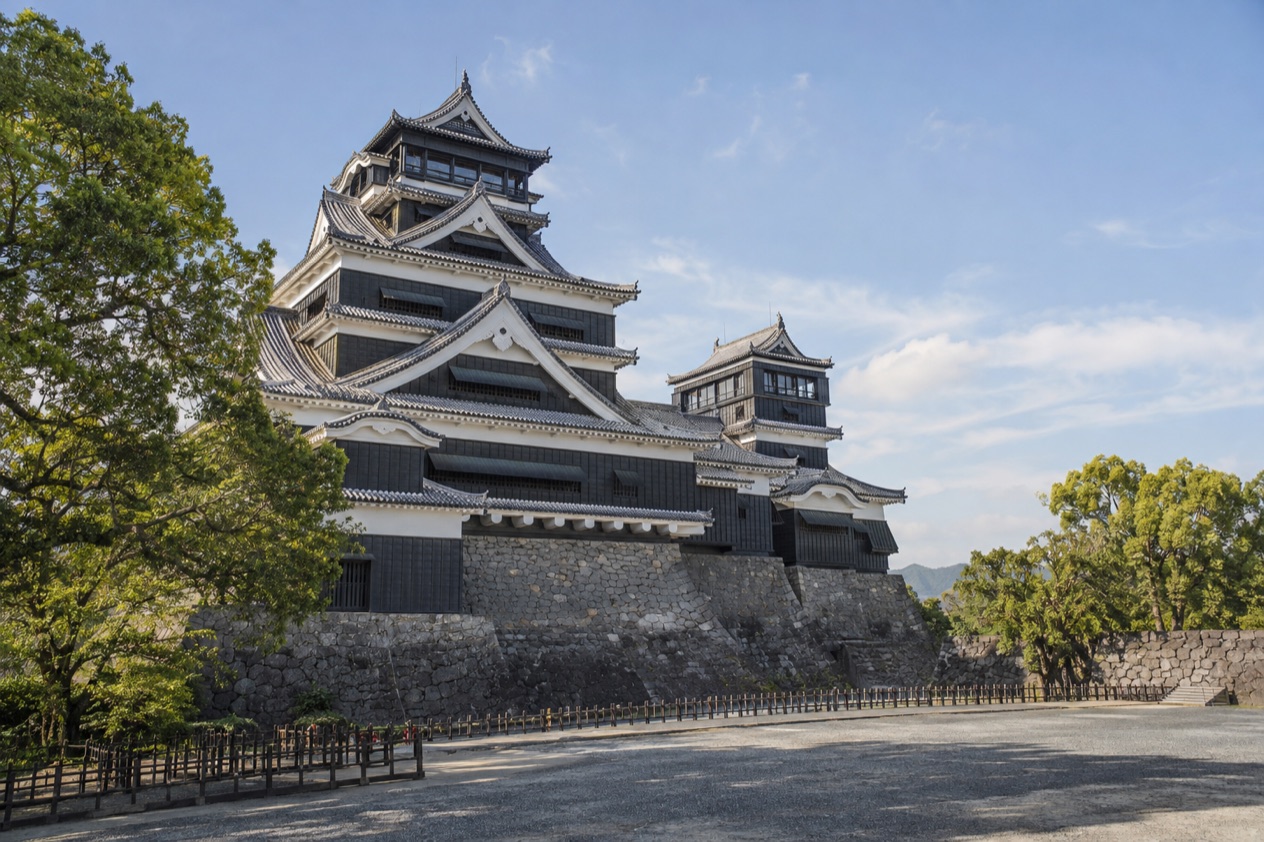
The black keep of Kumamoto Castle rises above the trees on its hill, and the great stone walls beneath it curve upward like the sides of a bowl. Walking up from the city, you pass gates, turrets and long wooden buildings before the keep comes fully into view. This is a castle for people who like to see how a fortress was laid out, and for anyone curious about how a place rebuilds after an earthquake.
Is visiting Kumamoto Castle worth it?
Yes, for travelers who enjoy castles as landscapes of stone, wood and open ground rather than as a single building to photograph. Kumamoto Castle is counted as one of the three premier castles of Japan, alongside Himeji Castle and Matsumoto Castle. It is also a story of survival, since the complex has been rebuilt, restored and damaged again within living memory.
What sets it apart from other castles on Kyushu and beyond is the scale of the grounds. The complex stretches roughly a mile from east to west, so a visit is a long wander through courtyards, slopes and gates, not a quick look at one tower. Thirteen structures here carry the Important Cultural Property designation, and a number of ancillary wooden buildings survive from the original castle.
The keep itself is a concrete reconstruction, which some visitors find surprising. Its value lies in the shape it gives the skyline and in the older walls and buildings around it. If you want a castle where nearly everything is old timber, look elsewhere. If you want a castle with layers of history you can read in the stonework, this is it.
What to see at Kumamoto Castle
The castle keep
The keep stands about 100 feet tall and dominates the hilltop. It was rebuilt in concrete in 1960, so the exterior follows the traditional profile of stacked roofs and dark walls while the structure inside is modern. From a distance the silhouette is what counts, with its layered gables set against the sky.
Look at how the keep sits on its stone base and how the roofline steps upward in tiers. Seen from the lower courtyards, the keep appears and disappears behind turrets and trees, which is exactly how a castle designer wanted an approaching visitor to experience it.
The stone walls and the wide grounds
The walls are the heart of the place. Their lower sections sweep outward and then rise steeply near the top, a profile often described in Japanese as musha-gaeshi, meant to make climbing difficult for attackers. Follow them around the slopes and you notice how each stone is fitted against the next, with small differences in color and cut from section to section.
The whole complex measures roughly a mile from east to west and about three quarters of a mile from north to south. That size means paths rise and fall between gates, lawns and ramparts. The castle’s builder is remembered for designing a stronghold meant to hold out in a long siege, and the ground plan shows it.
The surviving wooden buildings and restored structures
A number of wooden buildings remain from the original castle, and between 1998 and 2008 restoration work rebuilt most of the 17th-century structures. The result is a set of turrets, gates and long storehouse-style buildings in dark timber and white plaster. Standing inside the gates, you see how a samurai stronghold was meant to feel, with narrow passages and walls pressing in on both sides.
On April 14, 2016, at 9:26 pm, a magnitude 6.2 earthquake struck and damaged the castle. The scars of that night, and the work of repair that followed, are part of the story you read in the stones and timbers. Looking closely at the walls, you can sometimes pick out where sections have been carefully put back together.
Hosokawa Gyobu-tei and San-no-Maru Park
Close to the castle, San-no-Maru Park holds the Hosokawa Gyobu-tei, the former residence of the Hosokawa clan. It is known for a Japanese garden, and it shows the other side of castle life, the family home rather than the fortress. A garden walk here suits a slower rhythm after the climbs and open spaces of the castle grounds.
Seen together, castle and residence tell you how a ruling clan lived and defended itself. Look for the way the garden is arranged, with the view framed from the rooms of the house, the way a Japanese garden is meant to be seen from inside looking out.
Hours, tickets and rules
The castle is a large open complex rather than a single building, so a visit is shaped by the grounds themselves: gates to pass through, slopes to walk, courtyards to cross. The structures with Important Cultural Property status, thirteen in all, are scattered across it, and the reconstructed keep stands at the top as the focal point.
Thinking of the visit as a loop through the grounds helps. You move from outer gates inward and upward toward the keep, then back down through the older wooden buildings. The nearby Hosokawa Gyobu-tei in San-no-Maru Park is a separate site with its own garden, and it makes sense to treat it as a second stop in the same area rather than a part of the castle itself.
As for conduct, the habits of any Japanese historic site apply: you move quietly past wooden buildings, keep to the paths, and treat old stonework with care. The stone walls were built to repel climbers, and the damage of 2016 is a reminder of how fragile they can be.
When to visit Kumamoto Castle
Late March has a particular draw. Honmyo-ji Temple in Kumamoto holds a Nighttime Cherry Blossom Festival on the last weekend of the month, which gives a spring trip a second evening destination beyond the castle itself.
Kumamoto Prefecture is nicknamed the Land of Fire because of the active volcano nearby, a reminder that the landscape around the castle is shaped by the same forces that make the region’s hot springs and fertile land. In any season, the open grounds mean you spend most of the visit outdoors, so dress for the weather of the day rather than for a museum.
Autumn and spring are the seasons travelers picture for castle grounds, with leaves or blossoms against dark timber and pale plaster. The strong contrast of the black keep and the stone walls works in any light, and a gray day gives the stone a dramatic look of its own.
Tips for your visit
Wear comfortable shoes, because the grounds are large and the paths rise and fall between the gates and the keep.
Combine the castle with the Hosokawa Gyobu-tei and its garden in San-no-Maru Park, which sit close by. Together they give a picture of both the fortress and the family that lived near it. If you visit in late March, add the evening blossom festival at Honmyo-ji Temple.
Kumamoto is reached by the Kyushu Shinkansen, which serves Kumamoto Station and links the city directly with Tokyo via Fukuoka’s Hakata station. High-speed trains also come from Kagoshima and Fukuoka, and planes arrive from several major Japanese airports. Mizuho services on the San’yo Shinkansen are not valid for foreign tourists traveling with a Japan Rail Pass.
Because the grounds climb and descend between gates and ramparts, travelers with limited mobility or small children should expect slopes and uneven stonework as part of the setting. The older walls and buildings reward a slow pace, and the lower courtyards give a good view of the keep without going all the way up.
Good to know before you go
Kumamoto sits on Kyushu, in a prefecture that lives beside an active volcano, and the castle itself carries the marks of the 2016 earthquake. That history is part of why the grounds feel like a place that has been cared for and rebuilt. Carry some yen for small purchases around the castle and the nearby park, and bring a light layer for the open slopes.
Sources
- Wikipedia, Kumamoto Castle (https://en.wikipedia.org/wiki/Kumamoto_Castle), checked October 11, 2026
- Japan National Tourism Organization, Kumamoto (https://www.japan.travel/en/destinations/kyushu/kumamoto/kumamoto/), checked October 11, 2026
- Wikivoyage, Kumamoto (https://en.wikivoyage.org/wiki/Kumamoto), checked October 11, 2026
To plan your stay
- Best Time to Visit Japan: Cherry Blossoms, Autumn Colors, Weather and Festivals
- Where to Stay in Japan: Ryokan, Temple Stays, Capsule Hotels and the Best Cities to Base In
- Sending Luggage from the Airport in Japan: Hands-Free Travel, Hotel Delivery and Coin Lockers
- Know Before You Go to Japan: Entry, Money, Etiquette and Getting Around