
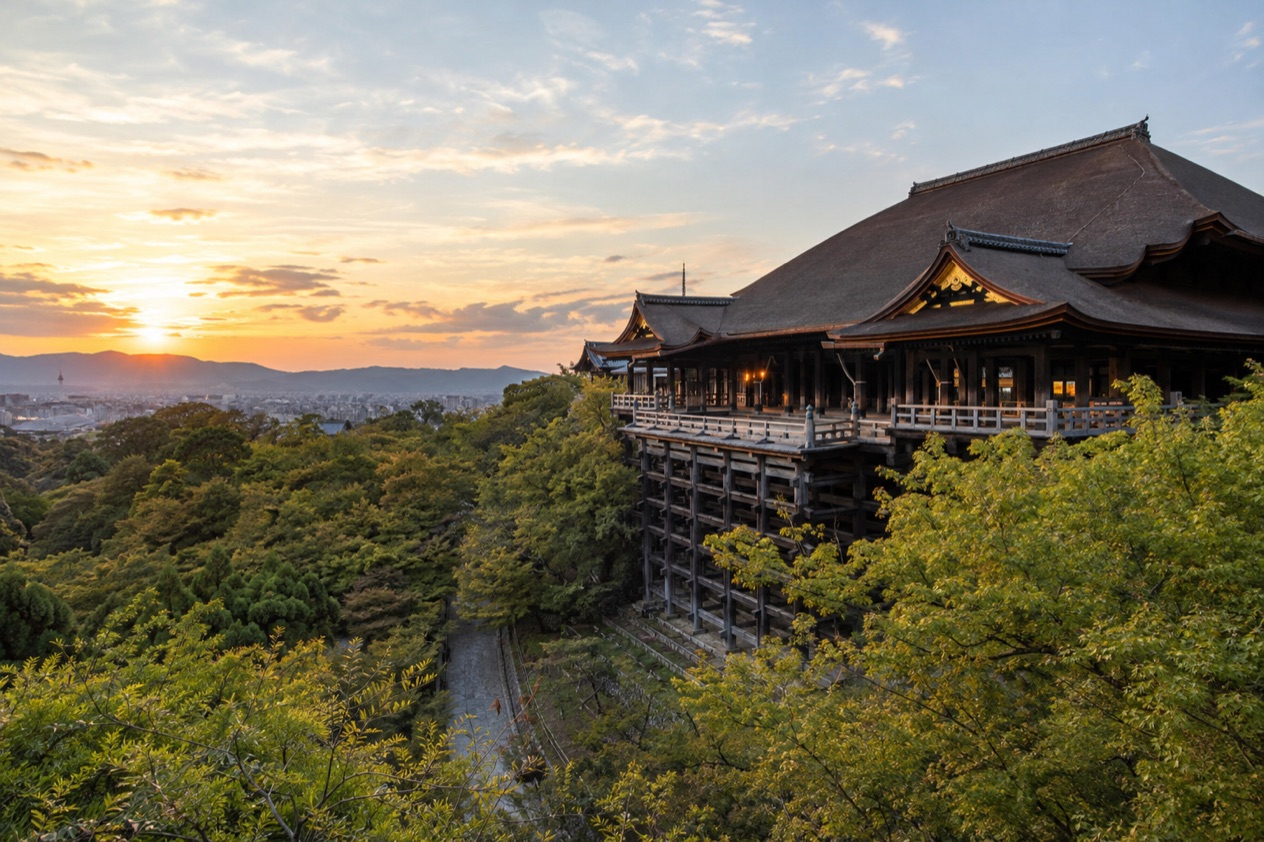
The approach to Kiyomizu-dera climbs through the Higashiyama hills, and somewhere along the way the roofs of the temple start to appear above the trees. Then comes the vermilion gate, the pagoda, and the broad wooden terrace held up on a forest of pillars over the slope. It is a visit of staircases, incense smoke, spring water and a long view over Kyoto, and it suits anyone who wants a temple that is as much a place on a mountain as a building.
Is visiting Kiyomizu-dera worth it?
Yes, for almost anyone spending time in Kyoto, and especially for travelers who like their sightseeing tied to a story, a landscape and a ritual rather than to a single building. Kiyomizu-dera is a working place of prayer first, with a history that reaches back more than 1250 years to a priest who found a pure spring welling up deep in Mt. Otowa. Its name means pure water temple, and the spring is still the heart of it.
What sets it apart from the other temples of Kyoto is the setting. Kiyomizu-dera stands halfway up Mt. Otowa, one of the peaks of the Higashiyama range, so you do not simply enter a compound, you climb into the hillside and look back at the city from the terrace.
Many Kyoto temples are built around a garden or a single hall seen on level ground. Here the architecture, the slope and the forest are one composition, and the main hall seems to lean out into the air.
It is also part of the Historic Monuments of Ancient Kyoto UNESCO World Heritage Site, and the visit has a devotional thread that gives it depth. The principal image is Kannon, the deity of great mercy and compassion, whom people affectionately call Kiyomizu Kannon-san. The temple is known as a Kannon Reijo, a holy place full of Kannon’s compassion, and visitors are encouraged to put their hands together before the statue and offer a prayer of thanksgiving.
It rewards a slow visit more than a checklist. Come for the terrace and the view, stay for the small rituals: drinking from the waterfall, walking through the dark tunnel, watching other visitors pause to pray. If your Kyoto days are few, this is one of the places that gives you the feeling of the old capital, which served as Japan’s capital and the emperor’s residence for over 1000 years, in a single afternoon.
What to see at Kiyomizu-dera
The temple is best understood as a sequence of places on the slope, each with its own reason to stop.
The main hall and its wooden stage
The main hall is the image everyone knows: a great terrace of wooden planks projecting from the hillside, supported from below by a lattice of tall pillars. Standing on it, you look out over the treetops and the rooftops of Kyoto, and in autumn or spring the slope below the terrace becomes a sea of color.
The stage has a curious history. In the Edo period there was a tradition of jumping from it, a leap of faith that people believed would grant a wish if they survived. The practice was prohibited in 1872, and today the terrace is a place for looking, not leaping. Look down at the pillars as well as out at the view, because the construction is half the pleasure.
The Otowa waterfall
Beneath the main hall is the Otowa waterfall, the spring that gave the temple its start. Visitors can drink water believed to have wish-granting powers, and you will see people waiting their turn to hold out a cup toward the streams that fall from the eaves.
It is a good place to watch as well as to join. The scene has a calm rhythm, with hands reaching out, quiet sips and a pause before moving on. Even if you do not drink, the sound of the water under the great timber hall is one of the memorable moments of the visit.
The Tainai Meguri tunnel
The Tainai Meguri is a dark tunnel said to represent the womb of Daizuiku Bosatsu. You move through it in near darkness, guided by a handrail of beads, until a lit stone at the center gives a place to pause. Those who pass through are said to emerge reborn in spirit.
It is a short, strange change of pace after the bright terrace, and a reminder that Kiyomizu-dera is above all a place of Buddhist devotion. Go in with an open mind and a willingness to go slowly.
The Kannon halls and the hillside paths
Kannon, the deity of mercy, is the heart of the temple, and the halls around the main building are where the prayer of thanksgiving takes place. Visitors are encouraged to put their hands together in front of the statue, and watching the quiet routine of others there adds a human scale to the grand architecture.
Afterward, wander the paths that lead down through the trees. From below, the terrace and its pillars look completely different, and the view back up the slope shows how the temple sits against Mt. Otowa.
When to visit Kiyomizu-dera
The most useful rule is about the hour of the day. Visitors to Kyoto are recommended to see shrines and temples at less crowded times, such as early morning or late evening when they are illuminated, and that advice suits a hillside temple where the paths are narrow and the terrace is a place to linger.
The seasons change the mood a great deal, and the weather figures for Kyoto help you pick. These are the readings for the city itself, measured in the valley below the hills.
| Month | Average high (°F) | Average low (°F) | Precipitation (in) | Days with rain or more |
|---|---|---|---|---|
| January | 48.4 | 34.7 | 2.10 | 6.4 |
| April | 68.2 | 48.6 | 4.61 | 9.4 |
| July | 89.6 | 74.5 | 8.80 | 11.6 |
| October | 74.1 | 57.9 | 5.64 | 8.2 |
Spring and autumn
April brings mild afternoons in the high 60s and cool mornings, with a fair amount of sunshine. It is a comfortable month for climbing stairs and standing on the terrace, though showers come on roughly one day in three.
October is warm in the afternoon and cool at night, with a good deal of sun and some rain. The days are well suited to the long walk up the approach and back down through the trees, and a light layer is enough once the sun goes.
Summer and winter
July is hot and humid, with the most rain of the four months and a damp feel to the air. The slope is shaded by trees, but the climb in the heat is tiring, so the cooler ends of the day are more pleasant.
January is cold, with highs in the upper 40s and frequent days of snow or sleet in the city. A snowy morning can be beautiful on the wooden halls, but bring warm layers and shoes with grip for the stone steps.
A date in December
Since 1995, Kiyomizu-dera has held the Kanji of the Year ceremony on 12 December every year. If you are in Kyoto in December, it is a distinctive reason to plan a visit.
Tips for your visit
Wear shoes you can walk in comfortably. The temple climbs a mountainside, with stone steps, slopes and wooden floors, and the approach is part of the visit. Layers help in every season, since the weather in the hills can feel different from the city below.
Planning the time and the route
Give the temple an unhurried block of time, enough for the terrace, the waterfall, the tunnel and a slow walk back down through the trees. Rushing it defeats the point, since much of the pleasure is in pausing at the edges of the main hall and watching the light change over the city.
If you want a less crowded experience, aim for early morning or late evening, when the temple is illuminated, as Kyoto’s visitor advice suggests. The mood is quite different from midday.
Combining it with the rest of Kyoto
Kyoto has more to see than any one visit can hold, and the old capital rewards pairing. Its traditions include machiya townhouses, the Gion Matsuri festival, and hanamachi districts where geishas live and work, and a day that mixes the hillside temple with the streets of the old city gives a fuller picture.
For a contrast in character, Nijo Castle in central Kyoto was built in 1603 by Tokugawa Ieyasu, the first shogun of the Edo period, and its nightingale floors make a bird-like sound when walked on, an ancient security system to alert guards of intruders. It is a samurai-era counterpart to a mountain temple of prayer.
Starting from Kyoto Station
Kyoto Station is served by the Tokaido Shinkansen line, which makes it the starting point for exploring Kyoto and connecting to major cities across Japan. The station building houses a full floor of ramen restaurants, an Isetan department store, a theater and a Granvia luxury hotel, so a meal before or after your outing is easy to find. Kyoto Tower, a few steps from the main entrance, is over 130 meters tall and visible across the entire city, a useful landmark when you are getting your bearings.
Good to know before you go
Treat Kiyomizu-dera as the active place of worship it is. A quiet voice, a pause before the statue of Kannon and a moment of thanks fit the setting, and the water of the Otowa waterfall is something to receive with respect. The Kyoto hills can be wet in the rainy months, so a light rain jacket is a sensible companion on stone steps, and in the colder season warm layers make the long standing and looking comfortable.
Sources
- Kiyomizu-dera Temple, official site (https://www.kiyomizudera.or.jp/en/), checked October 11, 2026
- Wikipedia, Kiyomizu-dera (https://en.wikipedia.org/wiki/Kiyomizu-dera), checked October 11, 2026
- Japan National Tourism Organization, Kyoto (https://www.japan.travel/en/destinations/kansai/kyoto/), checked October 11, 2026
- Japan Meteorological Agency (JMA), Normal values 1991-2020, monthly (https://www.data.jma.go.jp/stats/etrn/view/nml_sfc_ym.php?prec_no=61&block_no=47759), station Kyoto, elevation 41 m, checked October 11, 2026
To plan your stay
- Best Time to Visit Japan: Cherry Blossoms, Autumn Colors, Weather and Festivals
- Where to Stay in Japan: Ryokan, Temple Stays, Capsule Hotels and the Best Cities to Base In
- Sending Luggage from the Airport in Japan: Hands-Free Travel, Hotel Delivery and Coin Lockers
- Know Before You Go to Japan: Entry, Money, Etiquette and Getting Around