
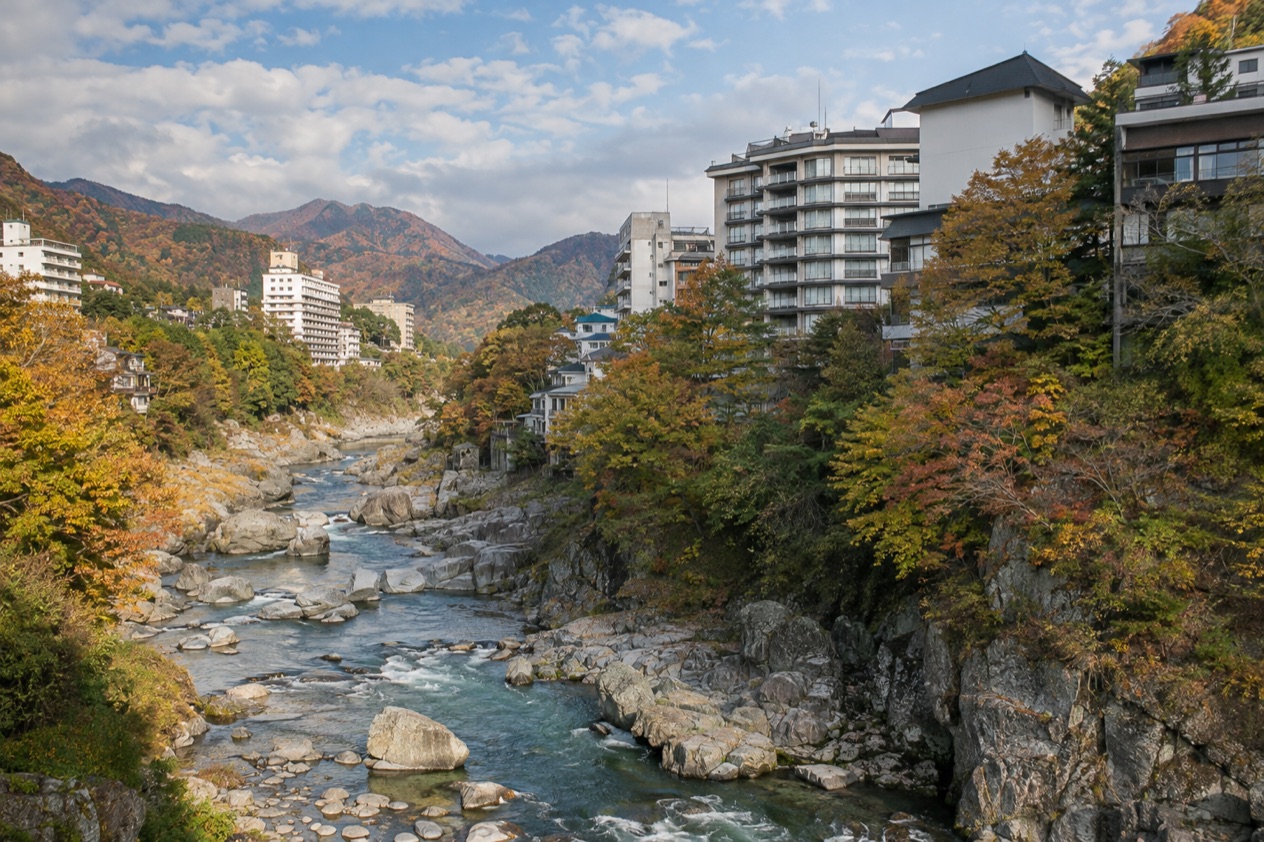
You step off the train at Kinugawa Onsen Station into the smell of mineral steam, with the river running through the middle of town and bathhouses and ryokan (traditional inns) stacked along its banks. Guests wander the streets in cotton yukata robes, towels over their arms, drifting between one bath and the next. This is a hot spring resort in the city of Nikkō, in Tochigi Prefecture, and it suits a night or two of soaking, long dinners and a little theater on the side.
Is visiting Kinugawa Onsen worth it?
Yes, if what you want from Japan is a night in a hot spring town rather than another checklist of temples, and it works especially well for travelers who like to pair a bath with something playful. The resort sits two hours by train from Tokyo, which makes it a way to trade the capital’s pace for steam, slippers and a quiet evening in a robe.
What sets it apart from other onsen towns is the company it keeps. Within reach of the baths are Edo Wonderland Nikko Edomura, a theme park built around the Edo period with ninja and oiran shows, and Tobu World Square, where the world’s landmarks stand in miniature.
Most hot spring villages offer only the water and the inn. Here you can spend a morning among samurai and craftsmen, then spend the evening in a bath with the river audible outside.
It is also a base that reaches toward the rest of Nikko. The shrines in the city are among the great sights of the Kanto region, and a night at Kinugawa Onsen gives a trip there a restful end. Travelers who want nightlife or a long list of museums will find the town narrower. Those who like slow mornings, a good breakfast at the inn and a walk along the water will find it generous.
What to see at Kinugawa Onsen
The river and the bathing district
The town takes its name from the Kinugawa River, which flows through it, and the water is the thread of any visit. Inns line the banks, and the sound of the current mixes with steam rising from vents and bath houses. A walk here is about looking at the rhythm of the place: guests in yukata crossing the street, staff sweeping entrances, lanterns coming on at dusk.
The baths themselves are the main event. Many ryokan keep indoor and open-air baths, and the custom is to wash thoroughly before stepping into the shared water. After the bath comes the meal, often a multi-course kaiseki dinner served in your room or a dining hall, with a futon laid out on the tatami floor afterward.
Edo Wonderland Nikko Edomura
Close to Kinugawa Onsen, this is a traditionally themed culture and amusement park, and it is populated with samurai, ninja, geisha and common folk. Streets are built as an Edo-period town, and the cast moves through them in costume. You find theaters, workshops and games, so the day mixes watching and doing.
The ninja and oiran shows are the draw for visitors. Oiran were the highest-ranking courtesans of the Edo period, known for towering hairpieces, layered kimono and a ceremonial procession on high clogs. Children tend to enjoy the ninja, while adults often linger over the craft workshops. It pairs naturally with a bath afterward, since a day on cobbled streets leaves feet ready for hot water.
Tobu World Square
Tobu World Square is within an 8-minute walking distance from Kinugawa. Inside stand 102 scale models of UNESCO-designated World Cultural and Heritage Sites, complete with 140,000 miniature people.
The tiny figures reward a slow look, since they are posed in crowds, lines and small scenes around each building. It is a good place for travelers who like details, and for anyone planning a longer trip who wants to see the shapes of places side by side. Pairing it with Edo Wonderland gives two very different kinds of make-believe in one stay.
Hours, tickets and rules
The shrines of Nikko keep hours that change with the season. Kinugawa Onsen itself is a town of inns and baths, so its hours are those of each inn and each attraction.
| Site | Open |
|---|---|
| Toshogu Shrine, Nikko | April to October: 08:00-16:30. November to March: 08:00-15:30 |
| Taiyuin-byo, Nikko | April to October: 08:00-16:30. November to March: 08:00-15:30 |
The only rule stated for these two sites is the seasonal change in closing time: the later hour holds from April to October, and the earlier one from November to March. Plan a visit to either one so you are inside well before the afternoon ends.
How to get to Kinugawa Onsen
Kinugawa Onsen is two hours by train from Tokyo. Two railways serve the resort: the Tobu Kinugawa Line and the Yagan Railway Aizu Kinugawa Line, which run in parallel and both stop at Kinugawa Onsen Station. That means the station is the single arrival point, and the walk into the bathing district starts there.
A trip can therefore be built around either station, with the resort for the night and the shrines for the day.
Travelers coming from the Oze area in neighboring Gunma have another route to Nikko: buses run from Oze to Nikko between mid-spring and mid-autumn. In the colder months that bus is not running, so winter journeys follow the rails.
When to visit Kinugawa Onsen
A hot spring town changes its character with the weather. In cold months the pleasure is the contrast between chilly air and hot water, and in milder months it is walking the riverside between baths with a window open. Nikko lies in the mountains of Tochigi, and the higher ground around Lake Chuzenji gives a sense of how the seasons turn there.
At Oku-Nikko, near Lake Chuzenji and much higher than the resort, these are the readings for four months. They describe that mountain spot, not the town, and the valley around Kinugawa Onsen will feel different. Still, they show the shape of the year: snowy winters, a damp, cool spring, a wet and humid midsummer and a crisp, rainy autumn.
| Month at Oku-Nikko | Average high (°F) | Average low (°F) | Days with rain or snow (1 mm or more) |
|---|---|---|---|
| January | 31.5 | 17.8 | 6.4 |
| April | 50.2 | 32.4 | 10.7 |
| July | 71.8 | 58.8 | 16.4 |
| October | 56.7 | 42.3 | 11.1 |
January is the month of snow in the high country, with snow or sleet falling on most days, and a hot bath suits it well. July brings the most rain days of the four and very humid air, so a wet afternoon is a good reason to stay in the inn. Spring and autumn sit between the extremes, and October still sees a little snow or sleet on the heights.
Tips for your visit
Plan at least one night. A resort like this rewards staying, because the evening bath, the dinner and the breakfast at the inn are the point. A day trip from Tokyo is possible with the two-hour ride, but it leaves little time to enjoy either the baths or the parks.
Pack light, since a robe is waiting at most inns, and bring a small towel for the walk between baths. Slip-on shoes help in a town where shoes come off at every entrance. If you plan to see Nikko’s shrines too, remember their seasonal closing times, and give them the morning.
Families with children will find the ninja shows and the miniature people give them plenty to look at. Travelers with limited mobility should ask their inn about stairs and bath access directly, since the town grows along a river bank and each building is different.
Good to know before you go
Kinugawa Onsen is a place to move slowly, and the evenings are for the baths, a meal and an early night. The weather figures for Oku-Nikko are a guide to the mountains of Nikko, not to the resort itself, so pack a layer for cooler hours whatever the month.
Nikko is a city of mountains, shrines and hot springs, and a stay at Kinugawa Onsen fits into a longer trip through Tochigi. Bring a sense of curiosity for baths, bowls and small details, and the town takes care of the rest.
Sources
- Wikipedia, Kinugawa Onsen (https://en.wikipedia.org/wiki/Kinugawa_Onsen), checked October 11, 2026
- Japan National Tourism Organization, Nikko (https://www.japan.travel/en/destinations/kanto/tochigi/nikko-area/), checked October 11, 2026
- Wikipedia, Nikkō, Tochigi (https://en.wikipedia.org/wiki/Nikk%C5%8D,_Tochigi), checked October 11, 2026
- Wikivoyage, Nikko (https://en.wikivoyage.org/wiki/Nikko), checked October 11, 2026
- Japan Meteorological Agency (JMA), Normal values 1991-2020, monthly (https://www.data.jma.go.jp/stats/etrn/view/nml_sfc_ym.php?prec_no=41&block_no=47690), station Okunikko, elevation 1292 m, checked October 11, 2026
To plan your stay
- Best Time to Visit Japan: Cherry Blossoms, Autumn Colors, Weather and Festivals
- Where to Stay in Japan: Ryokan, Temple Stays, Capsule Hotels and the Best Cities to Base In
- Sending Luggage from the Airport in Japan: Hands-Free Travel, Hotel Delivery and Coin Lockers
- Know Before You Go to Japan: Entry, Money, Etiquette and Getting Around