
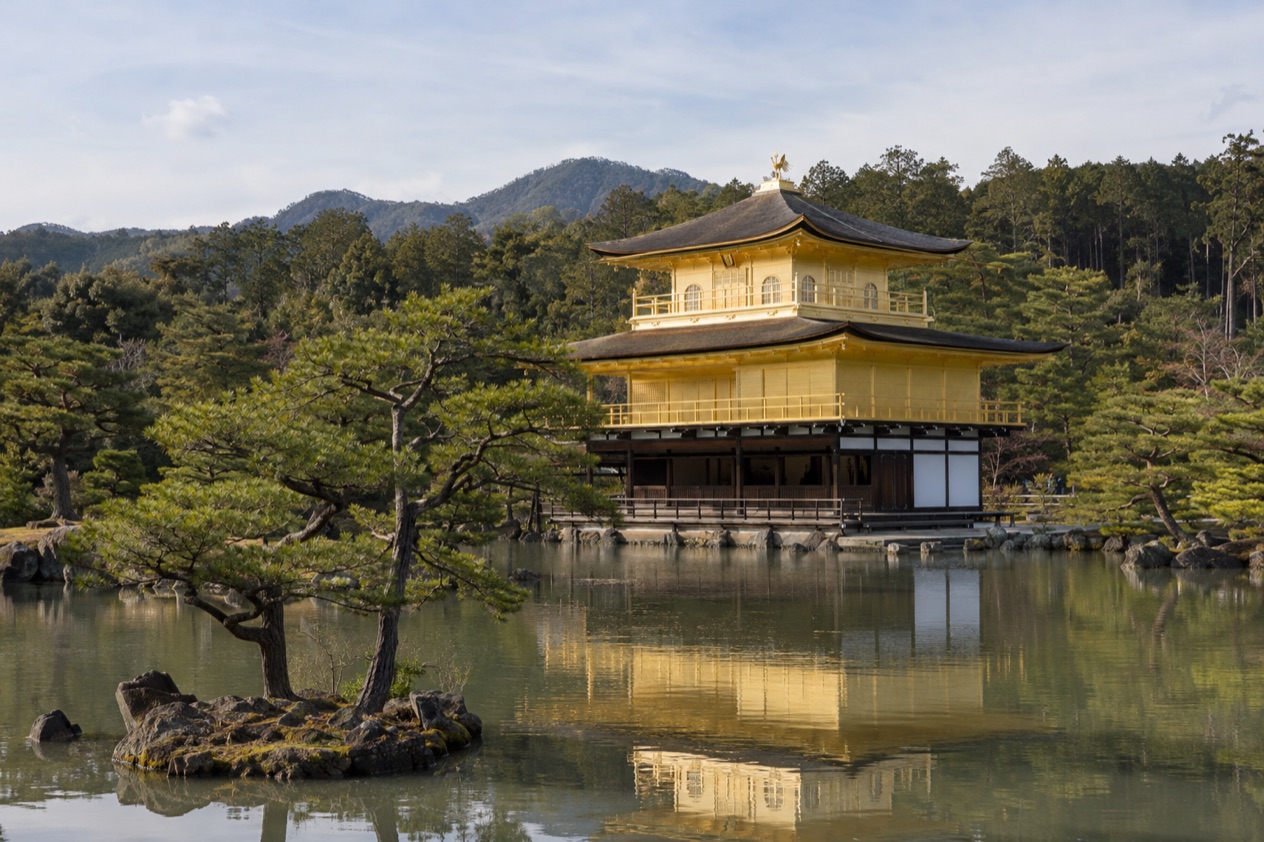
Past the entrance, the trees open and the pavilion appears across a dark pond, its upper floors glowing gold and a second pavilion floating upside down in the water. Cameras go up all along the shore, and for a moment everyone simply looks. Kinkaku-ji is the Zen temple in northern Kyoto that people mean when they say the Golden Pavilion, a visit built around one building, one pond and the garden that frames them.
Is visiting Kinkaku-ji worth it?
Yes, for almost anyone spending time in Kyoto, and especially for travelers who like a place with a strong picture at its center, photographers, and people curious about how a Japanese garden is composed to be looked at. If you prefer temples where you wander through many halls and courtyards, this is a more focused stop, and it works best as one part of a day rather than the whole of it.
What sets it apart from the other temples of Kyoto is the surface. Most of the city’s great wooden halls are dark, weathered and earth-toned, built to blend into hillsides.
Here the top two floors are covered in pure gold leaf, and the whole design is arranged so the building shines against green pines and still water. The temple is officially named Rokuon-ji, and it is one of the 17 Historic Monuments of Ancient Kyoto that make up the city’s World Heritage listing.
There is also a human story that gives the gold a second layer. The pavilion you see was rebuilt after an arson attack destroyed the original, so you are looking at a building that Kyoto chose to bring back, not a relic that simply survived.
Many visitors find that this adds weight to the view. The visit pairs well with the rest of what Kyoto offers, a city whose cultural heritage has developed over the past 1,200 years, from machiya townhouses to the Gion Matsuri festival.
Think of Kinkaku-ji as the shimmering exclamation point in a longer sentence about Kyoto. It rewards you with an image you will recognize from a thousand postcards, and then it shows you details the postcards leave out, like the shape of the roof, the little hall reaching toward the water and the careful way the pond has been shaped.
What to see at Kinkaku-ji
The Golden Pavilion
The pavilion rises three stories, and the two upper ones are covered in pure gold leaf, which is why it catches light so strongly on a bright day and still glows faintly under gray cloud. Look at how the floors differ in style from one level to the next, and at how the building seems to hover at the very edge of the pond rather than sit on it.
The pavilion also serves as a shariden, a hall that houses relics of the Buddha, so it is a religious building as well as a landmark. The version standing today dates from 1955, rebuilt after an arson attack on July 2, 1950 destroyed the earlier pavilion. That history is part of why the gold looks so fresh and so deliberate.
Mirror Pond and the strolling garden
The pond is called Kyoko-chi, Mirror Pond, and the name tells you what it is for. On still days the water doubles the pavilion, so the building appears twice, once in gold against the sky and once softened and rippling below. Watch how the surface changes with the wind and with passing clouds, because the same view can look sharp and graphic one minute and painterly the next.
The setting is a Japanese strolling garden, the kaiyu-shiki-teien style, in which a path leads you around the water and reveals new views one after another. Islands, rocks and carefully placed pines are arranged so that each bend frames the pavilion differently. Take your time at the turns, where the composition shifts from wide reflection to close detail of roof and branches.
The fishing hall and the phoenix
Two details reward a slower look. At the back of the pavilion, a small fishing hall called the tsuri-dono extends toward the water, built so that a small boat could be moored beneath it. Its small fishing hall, or tsuri-dono, allowed a small boat to be moored beneath it.
Then lift your eyes to the roof, where a bronze hoo, a phoenix, stands at the very top. In East Asian tradition the phoenix is a creature of good omen, and here it crowns the building like a final signature. It is small against the sky, so a zoom lens or a patient squint pays off.
When to visit Kinkaku-ji
Kinkaku-ji changes character with the season more than most sights, because the gold sits against a backdrop that keeps shifting. Check Kinkaku-ji’s official opening hours before choosing when to visit. Beyond that, the month you choose shapes the weather and the mood more than anything else.
| Month in Kyoto | Average high (°F) | Average low (°F) | Precipitation (in) | Days with rain | Sunshine (hours) |
|---|---|---|---|---|---|
| January | 48.4 | 34.7 | 2.10 | 6.4 | 124 |
| April | 68.2 | 48.6 | 4.61 | 9.4 | 177 |
| July | 89.6 | 74.5 | 8.80 | 11.6 | 143 |
| October | 74.1 | 57.9 | 5.64 | 8.2 | 156 |
Autumn and spring
October brings mild afternoons and cool evenings, comfortable for the long, slow circuit around the pond. Rain falls on a fair share of days, usually in showers rather than all-day downpours, and the gold looks especially rich against wet green and dark water. The sunshine totals are healthy, so a bright morning is a real possibility.
April is warmer and sunnier, with the garden turning fresh and green. It is also wetter than you might expect, so a light rain jacket belongs in the bag. Bloom and leaf-color timing changes from one year to the next, so treat any seasonal color as a pleasant bonus rather than a promise.
Winter and summer
January is cold, with snow or sleet falling on many days of the month, though the total accumulation is modest. A dusting of snow on the golden roof is the image people dream about, but it is a chance and not a certainty, and you will want real warm layers either way. Sunshine is limited, which makes any bright break feel like a gift.
July is hot and humid, the wettest of these four months, with rain on more than a third of the days. Expect to be sweating at the water’s edge and to appreciate any shade. A hat, water and an umbrella that works against both sun and showers make the visit far more pleasant.
Tips for your visit
Go with the pavilion as your anchor and let the rest of the visit orbit around it. Spend your first minutes just looking, before you reach for a camera, because the way the reflection settles and breaks is part of the experience. Then walk the garden with attention to what changes, the angle of the roof, the position of the phoenix, the shape of the pines leaning over the water.
Bring a camera or phone with room to spare, a layer for the season and sunglasses for the days when light bounces off the gold and the pond together. In wet weather an umbrella is part of the visit, and the reflections often look better for it. Comfortable shoes suit a garden path that you will want to walk slowly.
Pairing it with other Kyoto sights
A good companion is Nijo Castle in central Kyoto, which shows a completely different side of the city. Tokugawa Ieyasu, the first shogun of the Edo period, built it in 1603, and it is known for its nightingale floors, boards that chirp like a bird when walked on, an old security system meant to warn guards of intruders. After the gold and water of Kinkaku-ji, the castle offers samurai-era power and craft.
That contrast is the pleasure of combining them. One sight is about reflection and religious devotion, the other about authority and defense. Together they sketch the two worlds that shaped Kyoto, which served as Japan’s capital and the emperor’s residence for over 1000 years.
Before and after the temple
If you arrive in Kyoto by train, you will likely pass through Kyoto Station, which is served by the Tokaido Shinkansen and holds a whole floor of ramen restaurants alongside an Isetan department store, a theater and a luxury hotel. A bowl of ramen there makes a hearty reset before or after a temple day, and Kyoto Tower stands just outside the main entrance, visible across the city.
For a lighter meal closer to the sights, look for the small noodle shops and tea houses that cluster near Kyoto’s temples, where matcha and sweets such as warabi-mochi suit a break between visits. Travelers with children or with limited mobility should plan the pace of the day around their own needs, since the garden is a walking visit and the rest of Kyoto asks for plenty of time on foot.
Good to know before you go
, and . Weather is the practical variable to plan around, with rain showing up in every season of the table and heat building through summer, so a flexible plan that leaves room to wait out a shower will serve you well.
Sources
- Wikipedia, Kinkaku-ji (https://en.wikipedia.org/wiki/Kinkaku-ji), checked October 11, 2026
- Japan National Tourism Organization, Kyoto (https://www.japan.travel/en/destinations/kansai/kyoto/), checked October 11, 2026
- Japan Meteorological Agency (JMA), Normal values 1991-2020, monthly (https://www.data.jma.go.jp/stats/etrn/view/nml_sfc_ym.php?prec_no=61&block_no=47759), station Kyoto, elevation 41 m, checked October 11, 2026
To plan your stay
- Best Time to Visit Japan: Cherry Blossoms, Autumn Colors, Weather and Festivals
- Where to Stay in Japan: Ryokan, Temple Stays, Capsule Hotels and the Best Cities to Base In
- Sending Luggage from the Airport in Japan: Hands-Free Travel, Hotel Delivery and Coin Lockers
- Know Before You Go to Japan: Entry, Money, Etiquette and Getting Around