
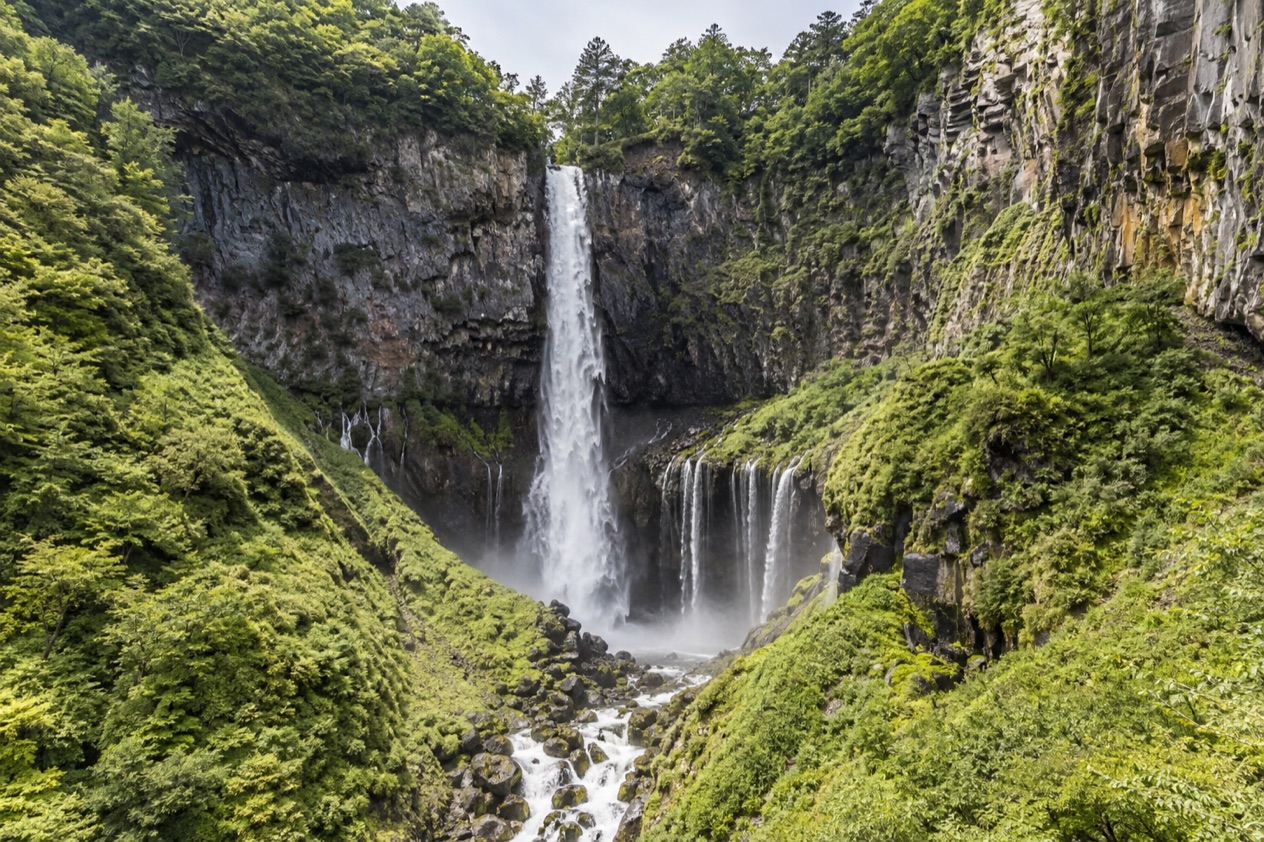
Long before you see the water, you hear it: a steady, low roar rising from a rocky gorge above Lake Chuzenji. Then the viewpoint opens and a single white ribbon drops straight down a dark cliff, with thin threads of water seeping from the rock on either side.
Is visiting Kegon Falls worth it?
Yes, if you like big natural scenery and are already headed to the Nikko area, and especially if you are drawn to autumn color. Kegon Falls suits travelers who want one dramatic sight rather than a long hike, photographers, and anyone building a day around Lake Chuzenji and the mountains above Nikko.
What sets it apart from other waterfalls is the way it falls. The main cascade drops about 318 feet in one clean plunge from the outlet of the lake, over a cliff of old lava.
Behind and beside it, about twelve smaller falls leak through cracks between the mountain and the lava flows, so the cliff face looks stitched with fine silver lines. Many waterfalls are wide or tiered. This one is tall and sheer, and the contrast between the rock wall and the white water is what you remember.
It also carries a reputation that goes beyond looks. In 1927 it was named one of the Eight Views chosen to show Japan and its culture in the Showa period, and it appears on the Ministry of the Environment’s 1990 list of Japan’s Top 100 Waterfalls. That puts it in the company of places Japanese travelers have long considered worth the trip.
The setting adds to the case. Lake Chuzenji sits within Nikko National Park, so a visit to the falls fits naturally with lakeside walking, mountain views and the shrines and temples of Nikko itself.
If waterfalls are not your thing, or if your time in Japan is short and already full of cities, you can leave it out without regret. But for those who want a break from temples and train platforms, the combination of roaring water, cool mountain air and changing seasons makes a convincing reason to go.
What to see at Kegon Falls
The main cascade
The star is the single column of water that drops roughly 318 feet from Lake Chuzenji into the gorge below. The water leaves the lake at its outlet and the Daiya River carries it over the edge, so the volume depends on the season and recent rain. After a wet spell the fall is thick and loud, while in drier weeks it narrows to a more delicate sheet.
Look at how the water hits the pool at the base. A cloud of mist rises and drifts, and in the right light it can carry a faint rainbow. Watch also the dark, layered rock of the cliff, formed by old lava flows, which gives the falls their stark, dramatic backdrop. It is worth standing still for a while rather than snapping one photo and leaving, because the mist and the light keep changing.
The smaller falls in the cliff
People look only at the main plunge, but the cliff around it has its own detail. About twelve smaller waterfalls seep and trickle behind and to the sides, escaping through cracks where the mountain meets the lava flows. They are thin, quiet streams compared with the roaring center, and they give the whole wall a fringed, almost threadlike look.
Try scanning the rock from left to right and top to bottom. In some seasons the trickles are plentiful, and in others only a few show. The contrast between the thunder of the big fall and these soft side streams is one of the quieter pleasures of the place.
Lake Chuzenji above the falls
The falls only make sense once you know where the water comes from. That height is why the air here feels distinctly cooler than in Tokyo or even in the town of Nikko.
Take a few minutes to look at the lake itself, ringed by forested slopes. In autumn the hillsides turn red, orange and gold, and the combination of colored mountain, still water and the falls at its outlet is the picture visitors come for. In winter, snow changes the scene again.
The gorge and its surroundings
Below the drop, the water runs on through a rocky gorge. The walls are steep and dark, and the sound of the falls echoes off them, which is part of why the roar seems to fill the whole valley. Trees cling to the slopes, and the green or colored canopy frames the white water.
Think of the visit as taking in three layers: the lake at the top, the falls in the middle and the gorge below. Together they explain why this spot earned its place among the Eight Views and the Top 100 Waterfalls.
When to visit Kegon Falls
When visitors arrive to see the foliage, traffic on the road from Nikko up to Chuzenji can slow to a crawl. If you come in that season, build in patience for the approach, and treat the drive or bus ride as part of the day rather than a race.
October is a good example of what the mountain is like then. At the Okunikko station near Lake Chuzenji, October highs average in the mid-50s Fahrenheit and lows in the low 40s, so you want a warm layer even on a sunny afternoon.
Rain falls on about eleven days, and humidity is high, so a gray, misty day is as likely as a bright one. Snow or sleet is rare but not absent, at under one day on average.
Spring comes late at this elevation. April at Okunikko averages highs around 50°F and lows just above freezing, with snow or sleet still showing up on several days. It is a month of thawing slopes and cold mornings rather than warm sightseeing, and a coat, hat and gloves are sensible. Sunshine is fairly generous, with long bright spells between the showers.
Summer is cooler than the lowlands but wet. July highs at Okunikko average in the low 70s, with lows near 59°F, which feels pleasantly fresh after the heat of the cities. The trade-off is rain on more than half the days, very high humidity and little sunshine, so expect mist, cloud and the falls running full. A light rain jacket is more useful than sunscreen.
Winter is the cold, white version of the place. January highs at Okunikko hover around freezing, lows sit well below it, and snow or sleet falls on nearly every day of the month. Sunshine is still decent, so the quiet snowy scenery can be bright when the clouds part. This is a season for people comfortable in serious cold, with proper boots and warm clothing.
| Month at Okunikko | Average high (°F) | Average low (°F) | Rain or snow days (1 mm or more) | Sunshine (hours) |
|---|---|---|---|---|
| January | 31.5 | 17.8 | 6.4 | 165 |
| April | 50.2 | 32.4 | 10.7 | 187 |
| July | 71.8 | 58.8 | 16.4 | 110 |
| October | 56.7 | 42.3 | 11.1 | 123 |
The mountain light is lovely when it works, but cloud and mist can hide the cliff, so a flexible schedule helps.
Tips for your visit
Dress for the mountain, not for the city you left that morning. Lake Chuzenji sits high, and the air is cooler than in the town of Nikko or in Tokyo, so a fleece or windproof layer earns its place in the bag in most months. Add a rain jacket in July and in autumn, and warm waterproof boots, a hat and gloves in winter, when snow is regular.
The falls throw off mist, so a lens cloth is useful if you carry a camera, and a phone in a sleeve or pocket stays drier. Shoes with some grip are welcome around wet rock, and in cold months around any patches of ice.
Getting there takes planning. Tobu-Nikko Station is about two hours from Asakusa and Shinjuku, and Nikko itself lies about 87 miles north of Tokyo. From Nikko the road climbs to Chuzenji, and in autumn it can slow to a crawl with foliage traffic. Allow generous time for that stretch if you visit in October or around the color season.
Combine the falls with the rest of the area. In Nikko, Toshogu Shrine and Taiyuin-byo are the temple-and-shrine side of the trip, and the lake and mountains are the natural side. The two make a satisfying contrast for a single day or an overnight stay.
| Site | Open |
|---|---|
| Toshogu Shrine, Nikko | 8:00 to 16:30 (April to October), 8:00 to 15:30 (November to March) |
| Taiyuin-byo, Nikko | 8:00 to 16:30 (April to October), 8:00 to 15:30 (November to March) |
If you are traveling from the Oze area in Gunma, buses to Nikko run between mid-spring and mid-autumn, which shapes when that route is possible. For families and anyone with limited mobility, be realistic about the terrain and the weather. This is a mountain site with wet rock, mist, cold in many months and snow in winter. Think about footwear, extra layers and a flexible pace, and let the conditions on the day guide how much you do.
Finally, give the falls a little time. A rushed look and a quick photo capture the height but not the sound, the mist or the thin side falls in the cliff. Linger long enough to hear the roar and watch the light shift on the rock.
Good to know before you go
The weather at Lake Chuzenji changes more than in the lowlands, and the rainy months of summer bring cloud and mist that can hide the cliff. Typhoon season in Japan can also affect travel plans, so keep an eye on forecasts before heading up the mountain. Carry some yen for small purchases, and treat the usual habits of travel in Japan, such as quiet voices and tidy behavior at viewpoints, as the norm.
Sources
- Wikipedia, Kegon Falls (https://en.wikipedia.org/wiki/Kegon_Falls), checked October 11, 2026
- Japan National Tourism Organization, Nikko (https://www.japan.travel/en/destinations/kanto/tochigi/nikko-area/), checked October 11, 2026
- Wikipedia, Nikkō, Tochigi (https://en.wikipedia.org/wiki/Nikk%C5%8D,_Tochigi), checked October 11, 2026
- Wikivoyage, Nikko (https://en.wikivoyage.org/wiki/Nikko), checked October 11, 2026
- Japan Meteorological Agency (JMA), Normal values 1991-2020, monthly (https://www.data.jma.go.jp/stats/etrn/view/nml_sfc_ym.php?prec_no=41&block_no=47690), station Okunikko, elevation 1292 m, checked October 11, 2026
To plan your stay
- Best Time to Visit Japan: Cherry Blossoms, Autumn Colors, Weather and Festivals
- Where to Stay in Japan: Ryokan, Temple Stays, Capsule Hotels and the Best Cities to Base In
- Sending Luggage from the Airport in Japan: Hands-Free Travel, Hotel Delivery and Coin Lockers
- Know Before You Go to Japan: Entry, Money, Etiquette and Getting Around