
A thin veil of volcanic ash drifts over the harbor, a ferry slides toward the dark shoulder of Sakurajima, and on the sidewalks schoolchildren pass with helmets on their heads. Kagoshima lives with its volcano the way other cities live with a river.
It is a warm, southern port on the island of Kyushu, with a samurai past, a sweet-potato kitchen and a bay that makes every walk end in the same view. It suits travelers who like a city with a strong personality and a landscape that is still being made.
Where is Kagoshima and what is it like?
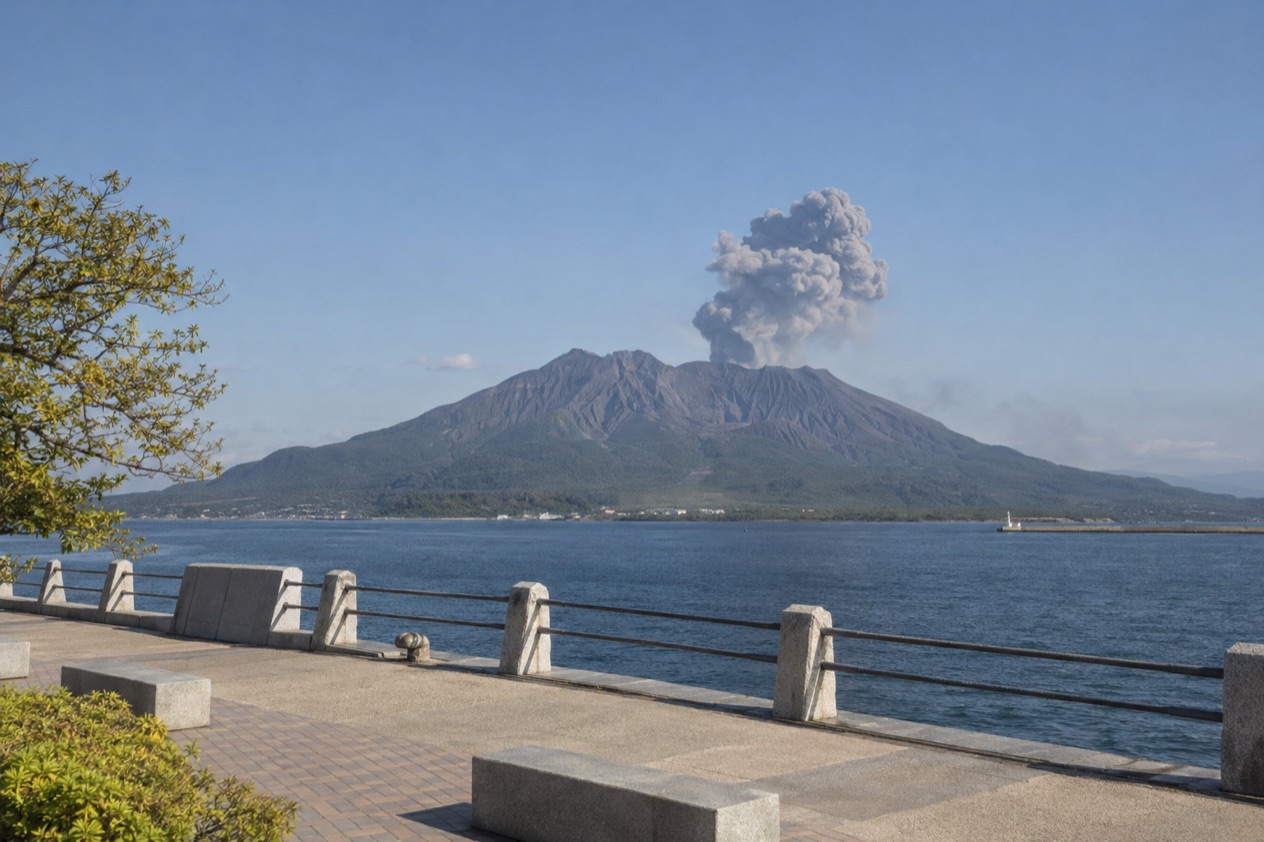
Kagoshima is the capital of Kagoshima Prefecture, on the southern island of Kyushu, a port city wrapped around a bay and watched over by an active volcano. Sakurajima sits so close that the city and the mountain feel like one place. Kagoshima City is only four kilometers from it, and on a clear day the cone fills the horizon from almost every waterfront street.
The city has been nicknamed the Naples of the Eastern world, for its bay, its warm climate and its emblematic stratovolcano. The comparison holds in the mood as much as the scenery: a southern pace, a seafront that people actually use, and a mountain that smokes in the background while everyone gets on with lunch. Palm trees line some of the avenues, and the light has a softness that surprises first-time visitors to Japan.
The volcano is not a postcard backdrop. Sakurajima regularly dumps ash over the city, schoolchildren wear helmets to protect themselves from volcanic debris, and the lava flows of the 1914 eruption joined the former island to the Osumi Peninsula, turning it into a peninsula. Locals talk about ash the way others talk about weather, and shops sell special bags for it. That daily closeness is what gives Kagoshima its character.
The city rewards people who like to settle in: long meals of regional pork and sweet potato, a stroll along the water, a garden, a museum, an hour with a glass of the local spirit. It is a historical city, so there is plenty to read and see about the samurai of the old Satsuma domain, who shaped modern Japan.
Travelers who want a checklist of temples and neon crossings may find it quieter in spirit than Tokyo or Kyoto. Those who want a place with a strong identity usually leave fond of it.
What is there to do in Kagoshima?
The big reasons to come are the volcano, the garden and waterfront views, the food of the old Satsuma region and the history of its samurai. What sets Kagoshima apart from other Kyushu cities is that all four sit within reach of each other, with the mountain tying them together. You can spend a morning on the volcano and an evening over a plate of black pork without leaving the same bay.
Sakurajima, the volcano across the bay
Sakurajima is a short ferry ride from Kagoshima City, and the crossing is part of the experience: the city shrinks behind you while the cone grows ahead, often with a plume rising from the crater. On the peninsula you can walk along lava fields, look at the black rock that spilled out in 1914 and visit viewpoints facing the city across the water. Roadside stands sell things made from the local produce.
Tourists are forbidden to go within 1.2 miles of the crater because it is an active volcano, so the visit is about looking from the lower slopes and the shore, not climbing. The volcano suits anyone curious about geology, photographers and travelers who like to see a landscape in motion. Ash can fall at any time, so a hat and sunglasses are sensible companions.
Sengan-en and the waterfront
Sengan-en is a Japanese garden that offers the best view of Sakurajima. Its ponds, stone lanterns and clipped pines are arranged so that the volcano becomes part of the composition, a smoking mountain standing in for the distant peak of a classical landscape painting. It was laid out for the Shimazu family, the lords who ruled the Satsuma domain, and the grounds still carry some of that confident, unhurried taste.
Back at the water, the Kagoshima City Aquarium stands near the Sakurajima Ferry Terminal. It was established in 1997 along the docks and offers a direct view of Sakurajima, which makes it a good stop for families and for anyone who wants sea creatures and a volcano in the same glance. Together, the garden and the aquarium give the city two very different ways to look at the same mountain.
Satsuma food and drink
Kagoshima cooks with pride. The regional star is kurobuta, black pork, served as tonkatsu cutlets, in rich shabu-shabu hot pots or simmered until it falls apart.
Sweet potatoes, the satsuma-imo that the whole region is built on, appear roasted, fried as tempura and distilled into imo-jochu, the sweet-potato shochu that local izakaya pour with hot water or over ice. Satsuma-age, a fried fish cake with a slight sweetness, is the snack to eat while walking.
For dessert, the city has shirokuma, a mound of shaved ice with condensed milk, fruit and sweet beans, and karukan, a steamed cake of yam and rice flour.
Samurai history and Satsuma crafts
The Satsuma domain was one of the powers behind the changes that ended the samurai era, and Kagoshima still honors its heroes, above all Saigo Takamori, who is remembered in statues, museums and local conversation. The hill of Shiroyama, above the city, is tied to his last stand and offers an overlook of the town and the bay. History here feels personal, as if a neighbor’s grandfather had fought in it.
The same region gave Japan Satsuma ware, a pottery with a distinctive cream glaze and fine crackle, and Satsuma kiriko, cut glass in deep colors. Both are good souvenirs when you want something that comes from this place and nowhere else.
How many days do you need in Kagoshima?
With two full days you can cross to Sakurajima, walk through Sengan-en, spend an evening in the drinking streets and still have time for the aquarium on the waterfront.
The first day fits the volcano and the harbor: the ferry across, the lava fields and viewpoints, then a late lunch of black pork back in the city. The second belongs to the garden and the samurai story, with a climb or taxi up to the Shiroyama overlook and a museum stop if the weather turns. Evenings go to izakaya and a bowl of shirokuma if you are brave enough to order dessert after dinner.
With three or four days, the surrounding region opens up. Ibusuki is known for its sand baths, where bathers are buried in warm volcanic sand beside the sea, a treat that fits a day of rest.
Chiran preserves a street of samurai residences with tidy gardens, and the town’s peace museum tells a very different chapter of local history. Kirishima, where the airport lies, adds mountain scenery and hot springs for those who want to leave the coast.
With a week, the island of Yakushima becomes a trip of its own, a mountain island of ancient cedars and mossy forest that people plan around hiking. Kagoshima is the gateway for it, so a longer visit can pair the city’s warmth with the green of the forest. Travelers heading on to the rest of Kyushu can also continue by the Shinkansen to Kumamoto, a pairing that builds a fuller loop through the island.
Where to stay in Kagoshima
The main choices are the city center, the waterfront by the ferry terminal, Sakurajima itself and the hot-spring towns around the bay. Each gives a different version of the trip, and the right one depends on whether you want nightlife, volcano views or a bath at the end of the day.
The city center, around the Tenmonkan entertainment district, suits travelers who want restaurants, izakaya and shopping close at hand. It is the part of town where the evening happens, with covered arcades, small bars and plenty of places to try black pork and shochu without planning ahead. It works well for a first visit when food is half the reason for coming.
The waterfront near the Sakurajima Ferry Terminal and the aquarium suits people who want the bay in front of the window. From here the volcano is the view, and the ferry crossing is the first thing on the morning list. Families and photographers tend to like it, since the water, the mountain and the aquarium share the same stretch of shore.
Staying on Sakurajima itself is the choice for those who want to sleep at the foot of the volcano, with a bath of mineral water and a ryokan dinner as the end of the day. Ryokan are traditional inns where guests wear a yukata, a light cotton robe, and meals arrive in many small dishes. Past the bay, towns such as Ibusuki and the area around Kirishima serve travelers who put hot springs first and the city second.
How do you get to Kagoshima and get around?
Visitors arrive by plane or by the Kyushu Shinkansen. Domestic flights to Kagoshima depart from Tokyo and take 2 hours, landing at Kagoshima Airport in Kirishima, 22 miles northeast of the city. From the airport you continue into town by road, since the terminal is set apart from the city.
The rail route comes from the north. The Kyushu Shinkansen connects Kagoshima to Kumamoto in 42 minutes, which makes the city a natural end of a trip down the island. Japan Rail Pass holders can use Kyushu Shinkansen services at no charge, except Mizuho trains, a detail worth knowing if you are traveling with a pass.
Within the city, the central areas are small enough that many sights can be reached by streetcar, bus or taxi, and the waterfront is a place to walk. The peninsula is best explored with local transport or a vehicle once you land, since the sights spread along the shore.
A rental car opens up the countryside around the bay, the hot-spring towns and Kirishima, for travelers who like to drive and set their own pace. For the city and the volcano crossing, you can manage without one, and a day of wandering the center on foot, with a ferry ride in the middle, fits the town’s own rhythm.
When is the best time to visit Kagoshima?
Spring and autumn are the natural choices for travelers, when the warm southern climate is gentle enough for gardens, ferry crossings and long walks along the bay. Spring brings cherry blossoms to the parks and the hill of Shiroyama, and autumn suits the garden of Sengan-en and the hot springs. These are the months when sightseeing feels most comfortable.
Summer is hot and humid in a city nicknamed for its warm climate, and early summer brings the rainy season that sweeps across Japan. The heat makes cold desserts like shirokuma more than a novelty, and the sea air is part of the city’s charm for those who do not mind the weather. Winter is milder here than in much of the country, which suits travelers who prefer to explore without heavy coats.
Sakurajima is active in every season, so ash can drift over the city at any time of year. In November the city celebrates the Ohara Festival, a large street dance parade that fills the center with dancers in summer kimono and music, and it is one of the most lively moments on the local calendar. Rooms and tables are tighter during big holiday weeks in Japan, and the festival period is a time when the city feels especially full of life.
Good to know before you go
Kagoshima is a city where a few local habits make the stay smoother. Ash from Sakurajima is a normal part of life, so a light cover for a camera and a hat are sensible companions, and the helmets on schoolchildren remind visitors that the mountain is taken seriously.
Respect the line drawn around the crater, and treat the volcano as the neighbor it is. Keep some yen in your wallet for small restaurants, shrine stalls and the ferry, and take your time over meals, since the table is where the city is most generous.
Sources
- Japan National Tourism Organization, Kagoshima (https://www.japan.travel/en/destinations/kyushu/kagoshima/kagoshima-and-around/), checked October 11, 2026
- Wikipedia, Kagoshima (https://en.wikipedia.org/wiki/Kagoshima), checked October 11, 2026
- Wikivoyage, Kagoshima (https://en.wikivoyage.org/wiki/Kagoshima), checked October 11, 2026
- Wikipedia, Sakurajima (https://en.wikipedia.org/wiki/Sakurajima), checked October 11, 2026