
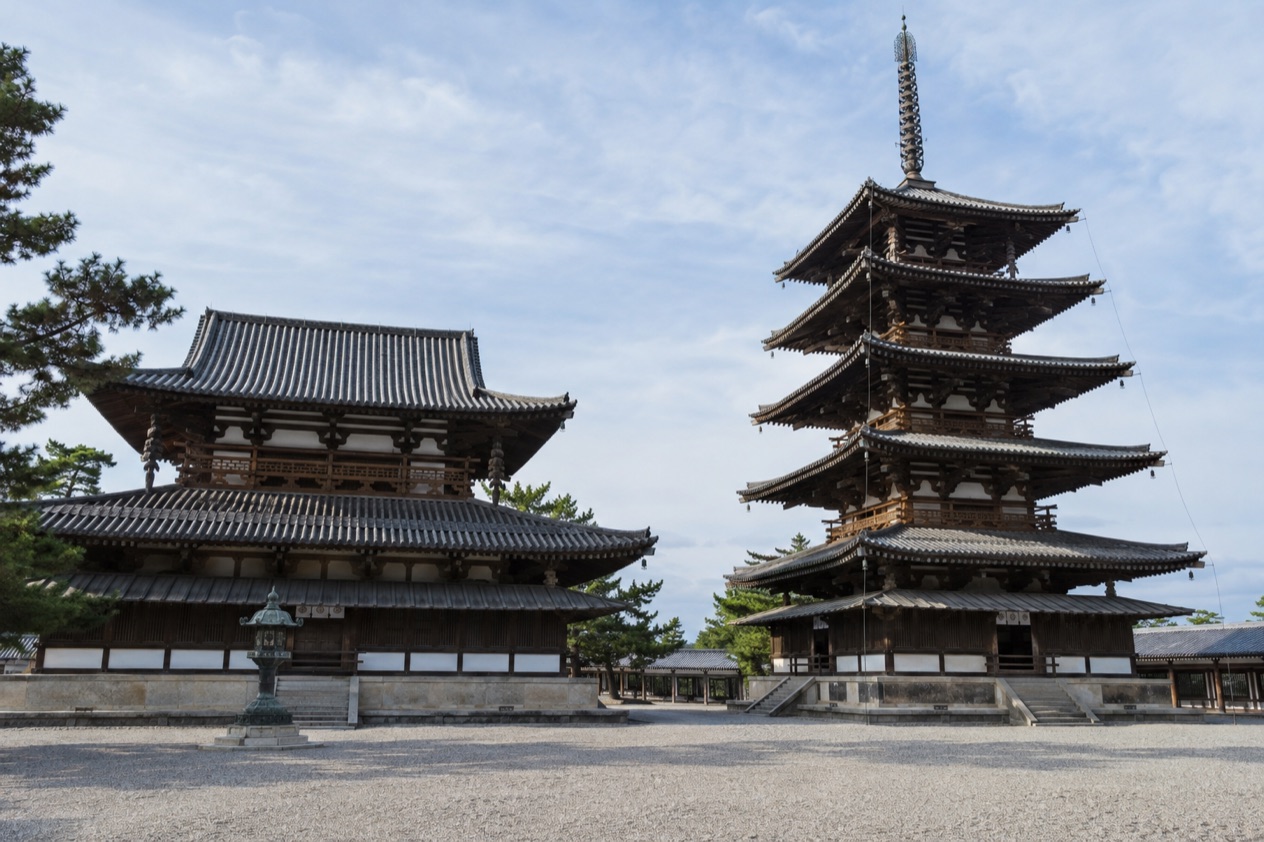
Past the gate at Horyu-ji, the wooden roofs rise one above another, their deep eaves darkened by centuries of weather, and the gravel underfoot crunches in the open courtyard. The first thing the eye finds is the five-story pagoda, standing beside the Kondo, the main hall. This is a visit about wood, Buddhist sculpture and the slow reading of very old architecture, in the countryside of Ikaruga, Nara Prefecture.
Is visiting Horyu-ji worth it?
Yes, for anyone drawn to old architecture, Buddhist art or the beginnings of Japanese temple building, and for travelers who like to see the roots of what they find in Kyoto and Nara later on. Horyu-ji was founded by Prince Shotoku in 607, and its Kondo is widely recognized as the world’s oldest wooden building. That alone makes it a different kind of stop from a city temple rebuilt after fires.
What sets it apart from the other temples around Nara is its scale and its collection. Where Nara Park mixes temples, shrines and tame deer in one wooded setting, Horyu-ji is a self-contained compound, a place to look closely at beams, bracketing and statues. The temple says it is home to over 180 of Japan’s designated National Treasures and Important Cultural Properties, which explains why the halls feel less like a single monument and more like a museum that never left its original building.
In 1993 Horyu-ji, together with Hokki-ji, became Japan’s first UNESCO World Heritage Site, under the name Buddhist Monuments in the Horyu-ji Area. If your interest is the deer, the lanterns and the busy streets of central Nara, this is a separate outing with a different mood. If you want to understand how Japanese Buddhism first took shape in wood, it is the place.
What to see at Horyu-ji
The temple is organized around its two main cores, and walking between them is a large part of the pleasure. Look at the joinery, the way the eaves project, and the weathered grain of the timber, which tells the story better than any sign.
The Kondo, the main hall
The Kondo is the heart of the compound and the reason many people come. It is widely recognized as the world’s oldest wooden building, rebuilt at least 1,300 years ago, and it houses the principal Buddhist images of the temple. Its double roof and the railed upper level give it a stately, layered outline that you can study from the courtyard.
The hall also carries a modern lesson. On January 26, 1949, a fire broke out while the building was being dismantled for repair, heavily damaging it and destroying a mural of the Asuka period, a national treasure. That date is now fire prevention day for cultural properties across Japan, and it gives the old timber a sober weight as you walk around it.
The five-story pagoda
Beside the Kondo, in the Sai-in area, the five-story pagoda stands 32.45 meters (122 feet) tall and is one of the oldest extant wooden buildings in the world. Its five roofs shrink in size as they climb, giving it a calm, tapering silhouette against the sky and the hills.
As is customary for pagodas, there is no access to the interior, so the visit is about the exterior: the proportions, the upturned eaves and the central mass of the structure. It photographs best from the courtyard, where the pagoda and the main hall share one frame.
The Yumedono Kannon
The Yumedono Kannon, also called the Guze Kannon, is a statue shown only at certain times of the year, usually in spring and autumn for about a month each period. If a viewing is part of your plan, it shapes the timing of the whole trip, since the statue is out of sight the rest of the year.
The statue belongs to the Yumedono, the hall at the temple’s eastern area, and viewing it is an event in itself. Even when it is not on display, the surrounding halls and the temple’s wider collection give you plenty to take in.
How to get to Horyu-ji
Horyu-ji sits in Ikaruga, in Nara Prefecture, which is in the Kansai region and easily accessible from Osaka and Kyoto. The city of Nara lies east of Osaka and south of Kyoto and is reached by train from both, so most visitors build the trip around a base in one of those three cities.
From Osaka
From Osaka, the JR Yamatoji rapid train serves JR Nara Station directly. Nara has two main stations, JR Nara Station and Kintetsu Nara Station, and the Kintetsu line offers another way in. From Osaka-Namba Station, the Kintetsu limited express reaches Kintetsu Nara Station in 35 minutes and costs 520 yen more than the regular express, which takes 5 minutes longer.
Those times bring you to Nara itself. Horyu-ji is a further outing from there, so plan the day as two legs: the train to Nara, then onward to Ikaruga.
From the airports and from Kyoto
The closest airports to Nara are Osaka International Airport (Itami) and Kansai International Airport, both in Osaka Prefecture and about one hour and fifteen minutes away by bus and train. From Kyoto, Nara is easily reached by train, and from either city you can treat Nara as the gateway. Nara Park and Naramachi are both accessible from Nara Station and Kintetsu Nara Station, which makes Nara a natural place to pair with Horyu-ji in a single stay, whichever station you arrive at.
When to visit Horyu-ji
Spring and autumn stand out, because the Yumedono Kannon is usually displayed in those seasons for about a month each time. October fits that window, and it is also a comfortable month to walk a wide open courtyard: highs in the low 70s, nights cool, and gravel paths that stay pleasant underfoot.
| Month | Avg high (°F) | Avg low (°F) | Precipitation (in) | Rain days | Sunshine (hours) |
|---|---|---|---|---|---|
| January | 47.7 | 33.4 | 2.06 | 6.2 | 118 |
| April | 67.6 | 47.7 | 3.89 | 9.6 | 173 |
| July | 89.1 | 73.4 | 6.83 | 11.2 | 157 |
| October | 72.7 | 56.3 | 5.30 | 9.2 | 149 |
January is the cold month, with snow or sleet on a good share of days and a chill that makes the open courtyard feel stark. The bare timber has its own austere beauty then, and warm layers matter. April brings mild days and more sun, with showers now and then.
July turns hot and humid, with the most rain of the four months, so the shade under the eaves becomes welcome. October stays damp in the air and brings rain on a number of days, so a light rain layer fits the plan. Whatever the month, the courtyard is open to the sky and gives little shelter between buildings.
Tips for your visit
Bring comfortable shoes for gravel and stone, and a light layer that suits the season: warm in January, a rain jacket in October or April, water and a hat in July. The compound is large and open, so you will be on your feet and under the sky for much of the visit.
Spend your time looking up. The pleasure here is in the roof lines, the brackets and the grain of the wood, and in the contrast between the Kondo and the pagoda that stand so close together. Take a slow loop of the courtyard before you step into any hall, so the buildings make sense as a group.
Pairing Horyu-ji with Nara
Many travelers fold Horyu-ji into a stay in Nara, where Nara Park lies at the foot of Mount Wakakusa and is home to tame deer that visitors can approach and feed with crackers sold along the roadside. The contrast is pleasant: a wooded park with animals in the morning or afternoon, and the quiet geometry of an early temple the other half of the day.
Naramachi is the other part of Nara to pair with it, reached like the park from Nara Station and Kintetsu Nara Station. Together they give a full picture of the area, from old streets to the deepest layers of Buddhist architecture.
Planning around the Kannon
If seeing the Yumedono Kannon matters to you, fit your dates to the spring or autumn viewing period, since it is on display only for about a month each time. Without it, the visit still holds together around the Kondo, the pagoda and the wider collection of treasures.
Good to know before you go
October brings the rain on a fair number of days and the air stays damp, so a compact umbrella earns its place in the bag. Take time to walk slowly, , and treat the old wooden halls with the care their age calls for.
Sources
- Wikipedia, Hōryū-ji (https://en.wikipedia.org/wiki/H%C5%8Dry%C5%AB-ji), checked October 11, 2026
- Japan National Tourism Organization, Nara (https://www.japan.travel/en/destinations/kansai/nara/), checked October 11, 2026
- Japan Meteorological Agency (JMA), Normal values 1991-2020, monthly (https://www.data.jma.go.jp/stats/etrn/view/nml_sfc_ym.php?prec_no=64&block_no=47780), station Nara, elevation 102 m, checked October 11, 2026
To plan your stay
- Best Time to Visit Japan: Cherry Blossoms, Autumn Colors, Weather and Festivals
- Where to Stay in Japan: Ryokan, Temple Stays, Capsule Hotels and the Best Cities to Base In
- Sending Luggage from the Airport in Japan: Hands-Free Travel, Hotel Delivery and Coin Lockers
- Know Before You Go to Japan: Entry, Money, Etiquette and Getting Around