
A bowl of Hakata ramen arrives with steam rising off a cloudy, creamy broth, and the smell of pork bones reaches you before the first spoonful. The noodles are thin and straight, the slices of pork belly lie across the top, and the whole thing disappears quickly. This is a food visit more than a sightseeing stop, built around one bowl in Fukuoka and the small choices that come with ordering it.
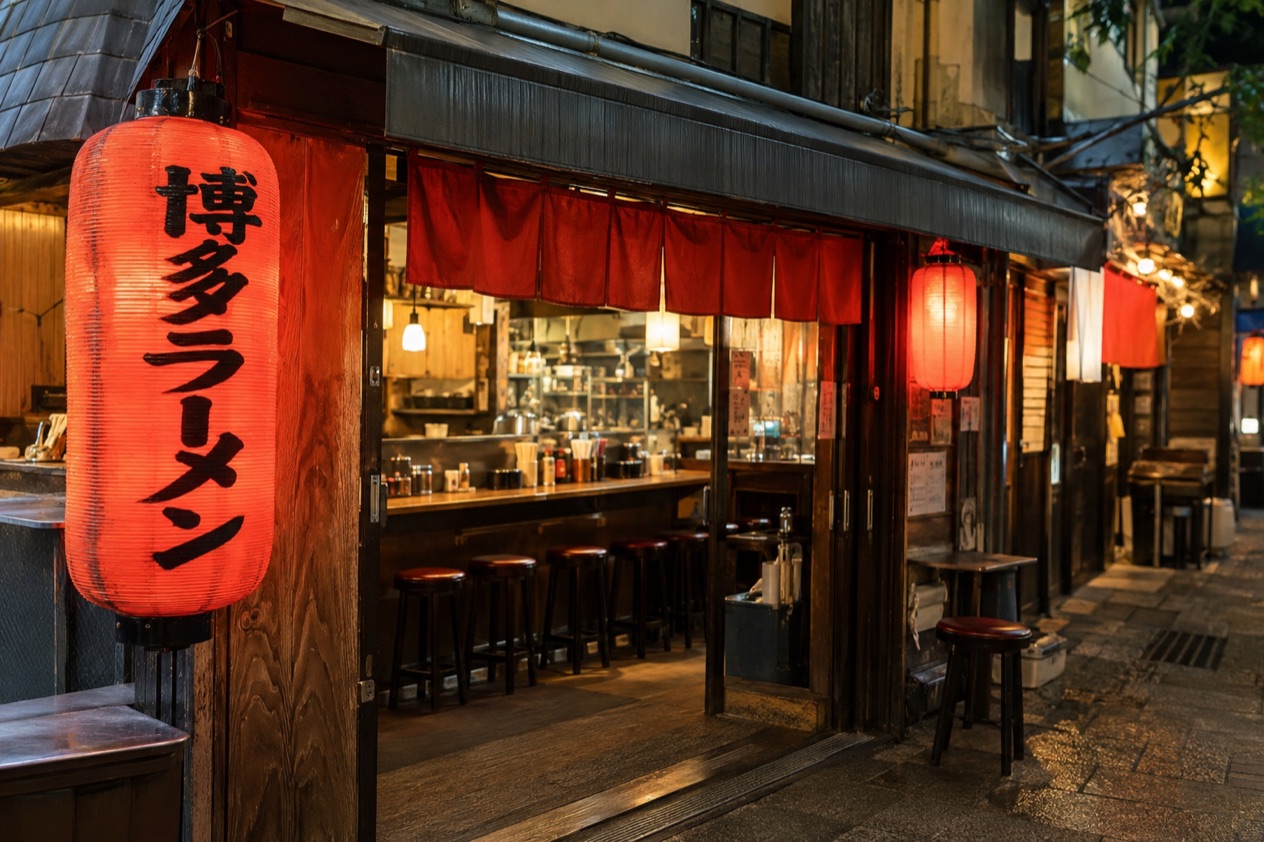
Is visiting Hakata ramen worth it?
Yes, if you like to travel through your stomach: Hakata ramen suits anyone who wants a single dish to organize part of a trip around, and it suits curious eaters most of all. Fukuoka City was selected in the Food category of Lonely Planet’s Best In Travel 2023, and the city’s yatai, the open-air food stalls of Hakata, were chosen for The New York Times’ ’52 Places to Go in 2023′. Tonkotsu ramen is part of that story, since it was invented in 1937 by a yatai vendor, Tokio Miyamoto, in Kurume, Fukuoka Prefecture.
What sets it apart from the ramen you meet elsewhere in Japan is the broth and the way you order. Nearly every region has its own version: miso ramen in Sapporo, salt-flavored ramen in Hakodate, soy-flavored chicken broth with curly noodles in Tokyo, and thick straight noodles in a soy pork broth in Yokohama.
Hakata ramen goes its own way with a rich, milky pork-bone broth, rather thin, non-curly and resilient noodles, and a choice of how firm you want them. Add the refill system and you have a meal that is as much a small ritual as a lunch.
It also fits easily into a larger stay. Fukuoka is a port city on the north coast of Kyushu, a place with a long habit of exchange with the Asian mainland, and its food culture feels like part of that. A bowl of ramen makes a good counterweight to a day of temples, parks and galleries.
What to see at Hakata ramen
The broth: pork bones and patience
The first thing you notice in a bowl of Hakata ramen is the color. Tonkotsu means pork bones in Japanese, and the bones are boiled in water for up to eighteen hours, which is what turns the soup cloudy and milky. The result is a broth with real body, closer to a savory cream than to the clear soups people often picture when they think of ramen.
Cooks build on that base with other ingredients, which can include onion, garlic, spring onions, ginger, pork back fat, pig’s trotters, oil and chicken carcass. Every shop balances them a little differently, and that is why two bowls of the same style can taste distinct. Look at the surface for the shine of the fat and at the walls of the bowl for the pale, opaque color of a long simmer.
The noodles and how firm you like them
Hakata noodles are rather thin, non-curly and resilient, and traditionally they are prepared hard in the center. That is the starting point for one of the most distinctive habits of eating here. Some ramen restaurants in Fukuoka ask how firm you want your noodles, and the vocabulary is worth learning before you sit down.
- Futsu is regular firmness, the middle of the road.
- Harigane, literally wire, is very hard.
- Barikata is al dente, with a clear bite.
- Yawamen is soft, for anyone who prefers a gentler texture.
Thin noodles keep cooking in hot broth, so many diners lean toward the firmer end and let the bowl soften as they eat. Trying a firmer setting once is a good way to understand what the style is meant to taste like.
Chashu, toppings and the refill called kaedama
The traditional topping is chashu, slices of pork belly that sit on the surface and slowly give up their richness to the soup. Spring onions and other garnishes add freshness against the heavy broth, and you will see these touches repeated from one counter to the next while the details shift from shop to shop.
Then comes kaedama, the system that makes thin noodles practical. When you have finished your noodles but still have broth, you can ask for a second serving to drop into the same bowl. Some restaurants in Fukuoka provide it on request, and across tonkotsu ramen shops it is a standard offer. It is the reason people often leave a little broth behind on purpose, waiting for the second round.
Yatai and ramen shops: where the dish lives
The dish began at a yatai, a food stall, and the stalls of Hakata are still part of how Fukuoka eats. They have their own reputation, which is why they ended up on a New York Times list. Sitting at a Hakata stall counter puts you close to the cook and offers a street-level taste of Fukuoka’s food culture.
For ramen specifically, the best quality is usually found in specialist shops called ramen’ya, where the whole business is one dish done well. The spirit is the same in both settings: Specialist ramen shops, or ramen’ya, focus on the dish, while yatai offer a more street-level setting.
Ramen in a wider setting
Ramen itself is a Japanese-Chinese fusion noodle dish, with Chinese-style alkaline wheat noodles served in hot broth. It began in Yokohama Chinatown in the late 19th century, and Rairaiken, the first specialized ramen shop, opened in 1910 in Asakusa, Tokyo. Hakata ramen is one chapter in that longer history, the one written in Kyushu.
If the subject grips you, the Shin-Yokohama Ramen Museum in Yokohama is devoted entirely to the dish. In Fukuoka, though, the real exhibit is the bowl in front of you, and the best way to see how it fits in is to taste it next to what you know from other cities.
Hours, tickets and rules
Hakata ramen is not a ticketed sight. There is no gate and no entrance fee for the dish itself, because it is something you eat in a shop or at a stall, so the practical details belong to each place you choose. What the dish does come with is a set of ordering habits that work almost like house rules.
The first is the firmness question. Where a restaurant offers a choice, you pick among regular, very hard, al dente and soft. Traditional preparation leaves the noodles hard in the center, so the firmer settings are closest to the original idea, while the soft one is there for people who prefer it.
The second is the refill. Where kaedama is offered, you can request another serving of noodles after finishing the first. Ordering it is routine, and it is part of how the dish is meant to be eaten.
Beyond these two habits, the shops themselves set the details, and a ramen’ya is a small business with its own rhythm. Look at what the counter offers, read the short menu, and treat the bowl as the main event.
When to visit Hakata ramen
Any month works for a hot bowl of pork-bone broth, but the weather changes how it feels.
| Month | Average high (°F) | Average low (°F) | Rain days | Sunshine (hours) |
|---|---|---|---|---|
| January | 50.4 | 39.0 | 9.3 | 104 |
| April | 67.8 | 52.7 | 9.7 | 188 |
| July | 88.2 | 76.3 | 11.0 | 172 |
| October | 74.7 | 60.8 | 6.8 | 176 |
Winter is when the dish feels most natural. January days are cool, and the city sees a trace of snow or sleet on some days, so a steaming, fatty broth is exactly what the weather calls for. Layers help when you step between a cold street and a warm counter.
April and October are mild, with enough sunshine to walk between meals. October in particular has the fewest rain days of the four months, which suits a day of wandering the city and ending with a bowl in the evening. The air is cool enough that a hot soup still tastes right without making you sweat.
Summer is a different proposition. July is hot, humid and the wettest of the four, with rain arriving on a good share of days, and a heavy tonkotsu bowl can feel like a test of endurance. It is also the month of Hakata Gion Yamakasa, a big summer event in Fukuoka held in July, so the city has a festival mood that may be worth the heat for some travelers.
Tips for your visit
Go hungry, but go with a plan for two bowls rather than one big one. Because of kaedama, the best approach is to order a regular portion, finish the noodles, and decide then whether you want a second serving. Leaving a little broth in the bowl makes the refill work better.
Learn the four firmness words before you sit down: futsu, harigane, barikata and yawamen. If you are unsure, the regular setting is a safe first try, and the firmer ones are worth testing on a second visit. Many travelers find that the thin noodles taste quite different when they keep their bite.
Pair the meal with the rest of Fukuoka. Ohori Park is the location of one of Fukuoka City’s major art galleries, so a morning among paintings can lead naturally into a ramen lunch. Pairing Hakata ramen with the stalls of Hakata gives you the old and the new sides of the same food culture in one day.
If you are keen on comparing styles, you can line up the dishes you know. Hakata’s milky pork broth sits far from the soy chicken broth of Tokyo or the thick-noodle Ie-kei of Yokohama, and Kitakata ramen, with its thick, flat, curly noodles in a pork and niboshi broth, differs again. Tasting them in sequence over a longer trip turns the bowl into a way of reading the map.
For families, think of the bowl as a hearty, rich meal. Soft noodles, where offered, give younger eaters a gentler texture, and
Good to know before you go
A kaedama refill costs a few hundred yen more, so a second round adds little to the bill. Fukuoka sits a long way from Tokyo, so most visitors arrive having planned the city as its own stop, and a bowl of tonkotsu ramen is a very good reason to stay a night. , and let the rainy summer days push you toward a warm counter rather than an outdoor itinerary.
Sources
- Wikipedia, Hakata ramen (https://en.wikipedia.org/wiki/Hakata_ramen), checked October 11, 2026
- Wikipedia, Ramen (https://en.wikipedia.org/wiki/Ramen), checked October 11, 2026
- Japan National Tourism Organization, Fukuoka (https://www.japan.travel/en/destinations/kyushu/fukuoka/fukuoka-city/), checked October 11, 2026
- Fukuoka City official tourist guide (https://yokanavi.com/en/), checked October 11, 2026
- Wikipedia, Fukuoka (https://en.wikipedia.org/wiki/Fukuoka), checked October 11, 2026
- Japan Meteorological Agency (JMA), Normal values 1991-2020, monthly (https://www.data.jma.go.jp/stats/etrn/view/nml_sfc_ym.php?prec_no=82&block_no=47807), station Fukuoka, elevation 2 m, checked October 11, 2026
To plan your stay
- Best Time to Visit Japan: Cherry Blossoms, Autumn Colors, Weather and Festivals
- Where to Stay in Japan: Ryokan, Temple Stays, Capsule Hotels and the Best Cities to Base In
- Sending Luggage from the Airport in Japan: Hands-Free Travel, Hotel Delivery and Coin Lockers
- Know Before You Go to Japan: Entry, Money, Etiquette and Getting Around