
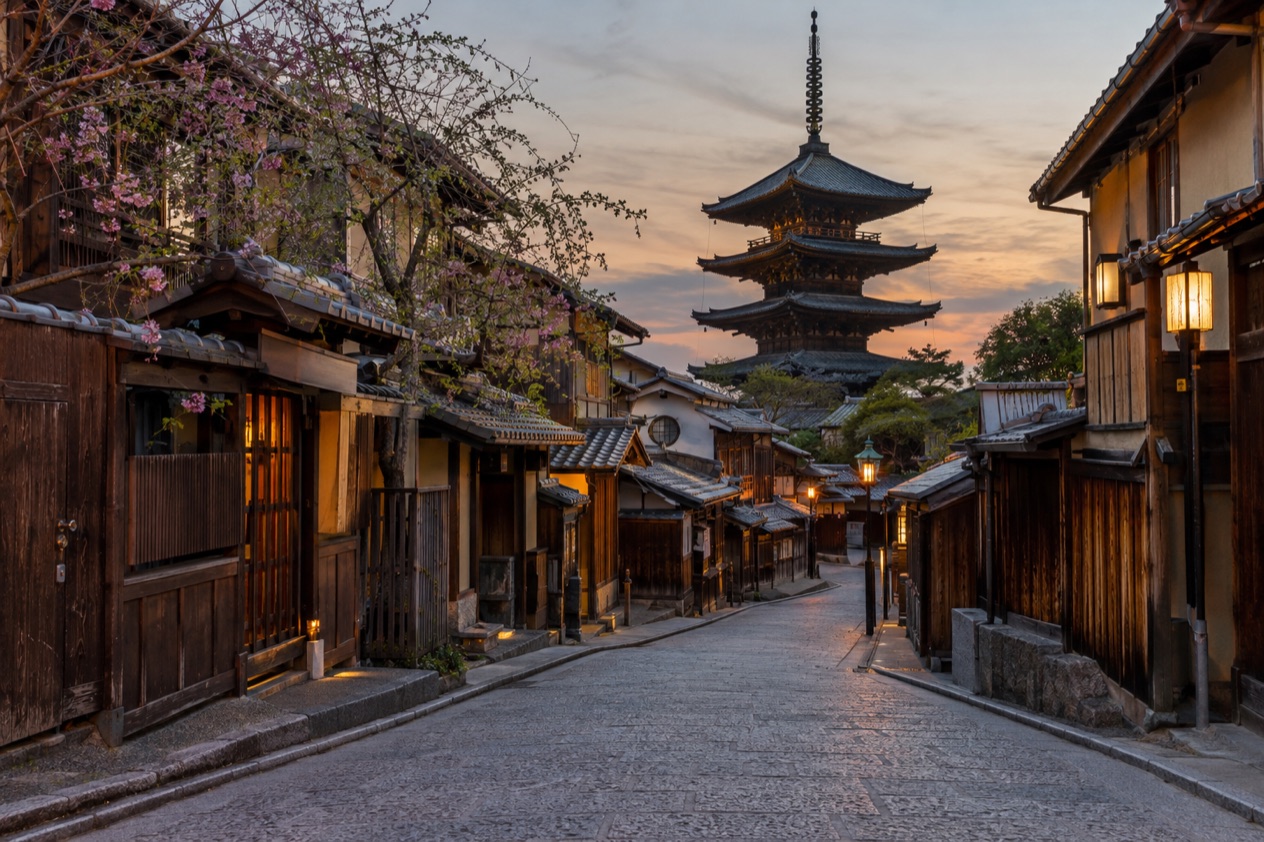
Wooden latticed facades line the lanes of Gion, and as the light fades, lanterns glow over the doorways of teahouses whose sliding doors rarely stand open. A clip of wooden sandals on stone, a glimpse of a kimono turning a corner, and the hush between the old houses set the tone.
Is visiting the Gion district worth it?
Yes, if you like to wander on foot through streets where the architecture and the atmosphere are the attraction, and it suits travelers drawn to Japanese traditions, photography and evening strolls more than anyone hoping for a checklist of big monuments. Gion has no single ticketed sight. What you take away is a feeling for a quarter that has been devoted to entertainment and hospitality for a very long time.
The district began as an entertainment area in front of Yasaka Shrine during the Sengoku period, and the link between shrine and pleasure quarter still shapes the layout. Gion keeps a number of machiya, the old townhouses with narrow frontages and wooden lattices, and some of them work as ochaya, teahouses where geisha entertain guests. Those doors are not open to the casual passerby, so what you enjoy from the street is the setting: dark timber, paper lanterns, small gardens glimpsed through a gap.
What sets it apart from other old quarters in Kyoto is that it is still a working district rather than a preserved set. Gion holds two hanamachi, or geisha districts, Gion Kobu and Gion Higashi, each with its own dances and calendar.
Kyoto’s traditions include the machiya townhouses, the Gion Matsuri festival and the hanamachi where geisha live and work, and Gion brings all three together within a few blocks. A temple district or a castle gives you a monument. Gion gives you a neighborhood, with a river, a shrine and the streets between them.
It also pairs well with the rest of the city, since Kyoto has a cultural heritage that has developed over the past 1,200 years, and Gion is one of the places where that long history still shows in everyday streets. Come with patience for slow walking and a willingness to look rather than to enter, and the district rewards you.
What to see at the Gion district
Hanamikoji Street
Hanamikoji is the street people picture when they think of Gion. It runs from Shijo Street at the north end, where the famous Ichiriki Tei teahouse stands, south to the temple of Kennin-ji. Along the way you pass a continuous row of machiya with dark wooden lattices, small signs, lanterns and discreet entrances.
Look at the details: the carved name plates beside the doors, the bamboo screens, the swept stone thresholds. Hanamikoji lies in Gion Kobu, the larger of the two geisha districts, so this is where the traditions of the hanamachi feel closest. Walking its length from Shijo toward Kennin-ji also gives you a natural line from the bustle of the shopping avenue to the quiet grounds of a Zen temple.
Some machiya here work as ochaya, where geisha entertain guests. You will see the facades, not the rooms, and that is part of the charm: the street keeps its mystery while still being a place you can walk freely.
The Shirakawa River and its cherry trees
The stretch of the Shirakawa River in Gion before it flows into the Kamo River is a preserved area. On the south side stand traditional establishments with their backs and balconies to the water, while on the north side a pedestrian street runs beneath cherry trees. Willows and stone bridges add to the picture, and the water gives the quarter a softer edge than the stone lanes.
In spring the cherry blossoms along the river are lit up in the evening, and the pale petals against the old timber houses are among the most photographed scenes in the district. Outside the blossom season the path is still pleasant for a slow stroll, with reflections of lanterns in the water as dusk settles.
Gion Higashi and the smaller corners
Gion Higashi is the smaller of the two geisha districts and occupies the northeast corner of Gion. It lacks the fame of Hanamikoji, which is exactly why a detour here shows another side of the quarter: fewer landmarks, more everyday lanes, the same dark lattices and the same sense of a working neighborhood.
Each district stages its own dance. Gion Higashi holds the Gion Odori in early November, around the time of the autumn leaves, while the geisha of Gion Kobu perform the Miyako Odori from April 1 through April 30 each year, during the cherry blossom season. These dances are the moments when the hidden world of the hanamachi steps onto a stage.
Yasaka Shrine
Yasaka Shrine, in the Gion district, is the center of the Gion faith, and it is the reason the quarter exists as it does: the entertainment district grew up in front of its gates.
Come to see the vermilion gates and the shrine buildings, which mark the end of the district’s busy lanes with a more sacred note. Visiting shrines at less crowded times, such as early morning or late evening when they are illuminated, is recommended for enjoying Kyoto’s charms, and Yasaka fits that pattern well as an evening stop after a walk down the lanes.
When to visit the Gion district
Gion can be visited in any month, because the streets themselves are the attraction, but the calendar adds reasons to choose a season. Spring and autumn each bring a dance, and the cherry blossoms and autumn leaves frame the river and the lanes.
Time of day
Early morning and late evening are the times recommended for enjoying Kyoto’s shrines when they are less crowded, and the same logic suits the sanctuary at the heart of Gion. In the evening, shrines are illuminated, and the lanterns of the old streets add their own glow. A daytime visit shows the architecture in detail, the grain of the wood and the texture of the lattices, while an evening visit adds mood.
Along the Shirakawa, the cherry blossoms are lit up in the evening in spring, so a walk after the day’s sightseeing fits the season well. Afternoons are a good moment to take in Hanamikoji and the river path before moving on to the shrine as light falls.
Spring: cherry blossoms and the Miyako Odori
April is the month when Gion Kobu stages the Miyako Odori, running the whole month during the cherry blossom season. In Kyoto, April highs average in the upper 60s, with lows in the upper 40s, so a light layer is enough for an evening along the river. Rain falls on a handful of days, usually in showers, and sunshine is generous.
The trees along the Shirakawa, lit in the evening, give the district its most photographed look. It is the season when Gion feels most theatrical, with the dance on stage and the blossoms over the water.
Summer, autumn and winter
July is hot and humid, with highs near 90°F and lows in the mid-70s, and rain on a good share of the days. Kyoto traditions include the Gion Matsuri festival, closely tied to this district and to Yasaka Shrine. Evenings after the heat of the day suit the lanes best.
October brings milder air, with highs in the mid-70s and lows in the upper 50s, and the early part of autumn suits long walks. In early November, Gion Higashi holds the Gion Odori around the autumn leaves, another reason to come as the season turns.
January is cold, with highs in the upper 40s and lows in the mid-30s, and snow or sleet falls on many days though the total stays small. Wooden houses under a dusting of snow are a rare sight, and a warm layer is the only thing you need to add.
| Month | Average high (°F) | Average low (°F) | Precipitation (in) | Days with rain or more (1 mm) | Sunshine (hours) |
|---|---|---|---|---|---|
| January | 48.4 | 34.7 | 2.10 | 6.4 | 124 |
| April | 68.2 | 48.6 | 4.61 | 9.4 | 177 |
| July | 89.6 | 74.5 | 8.80 | 11.6 | 143 |
| October | 74.1 | 57.9 | 5.64 | 8.2 | 156 |
Tips for your visit
Plan Gion as a walking visit, with comfortable shoes for stone lanes and bridges, and let the route follow the streets rather than a fixed list. Start on Shijo Street, walk down Hanamikoji toward Kennin-ji, and then loop back along the Shirakawa to finish at Yasaka Shrine.
What to bring and how to dress
In winter, bring a warm coat and gloves, since January highs stay in the upper 40s and snow or sleet is common. In July, light clothes, a hat and water suit the heat and humidity, and an umbrella is useful because rain falls on many days. In spring and autumn, a light jacket for the evening is enough.
A camera is the obvious companion, but remember that the lanes are home to working teahouses and residents. Keep your voice low, keep to the street and leave the doorways clear.
Dressing up as a maiko
Henshin studios in Gion will dress tourists up as maiko or geisha for a fee. By law in Kyoto, those tourists are required to dress inaccurately so as not to impersonate geisha or maiko. So the experience is a costume for photographs, not a replica of the real thing, and it is worth knowing before you book a session. If you prefer to see the real thing, the seasonal dances are the way: the Miyako Odori in April and the Gion Odori in early November put the geisha of the two districts on stage.
What to combine with Gion
Kennin-ji, the temple at the southern end of Hanamikoji, is the natural extension on foot. The Shirakawa path leads to the water, and Yasaka Shrine closes the loop. Elsewhere in central Kyoto, Nijo Castle, built in 1603 by Tokugawa Ieyasu, the first shogun of the Edo period, has nightingale floors that make a bird-like sound when walked on, and it contrasts well with the lanes of Gion.
Kyoto Station is served by the Tokaido Shinkansen line and is a starting point for exploring the city. The station building houses a full floor of ramen restaurants, an Isetan department store, a theater and a Granvia hotel, and Kyoto Tower stands a few steps from the main entrance, over 130 meters tall and visible across the city. That makes the station a handy place for a meal before or after your time in Gion.
Good to know before you go
Gion is a residential and working quarter, so treat its lanes as someone’s neighborhood: walk, look and photograph from the street without entering private doorways. Rain is part of Kyoto’s calendar, with the wettest stretch in summer, and wooden streets look their best after a shower, so a compact umbrella is welcome. No visitor fee applies to walking the streets of the district.
Sources
- Wikipedia, Gion (https://en.wikipedia.org/wiki/Gion), checked October 11, 2026
- Japan National Tourism Organization, Kyoto (https://www.japan.travel/en/destinations/kansai/kyoto/), checked October 11, 2026
- Japan Meteorological Agency (JMA), Normal values 1991-2020, monthly (https://www.data.jma.go.jp/stats/etrn/view/nml_sfc_ym.php?prec_no=61&block_no=47759), station Kyoto, elevation 41 m, checked October 11, 2026
To plan your stay
- Best Time to Visit Japan: Cherry Blossoms, Autumn Colors, Weather and Festivals
- Where to Stay in Japan: Ryokan, Temple Stays, Capsule Hotels and the Best Cities to Base In
- Sending Luggage from the Airport in Japan: Hands-Free Travel, Hotel Delivery and Coin Lockers
- Know Before You Go to Japan: Entry, Money, Etiquette and Getting Around