
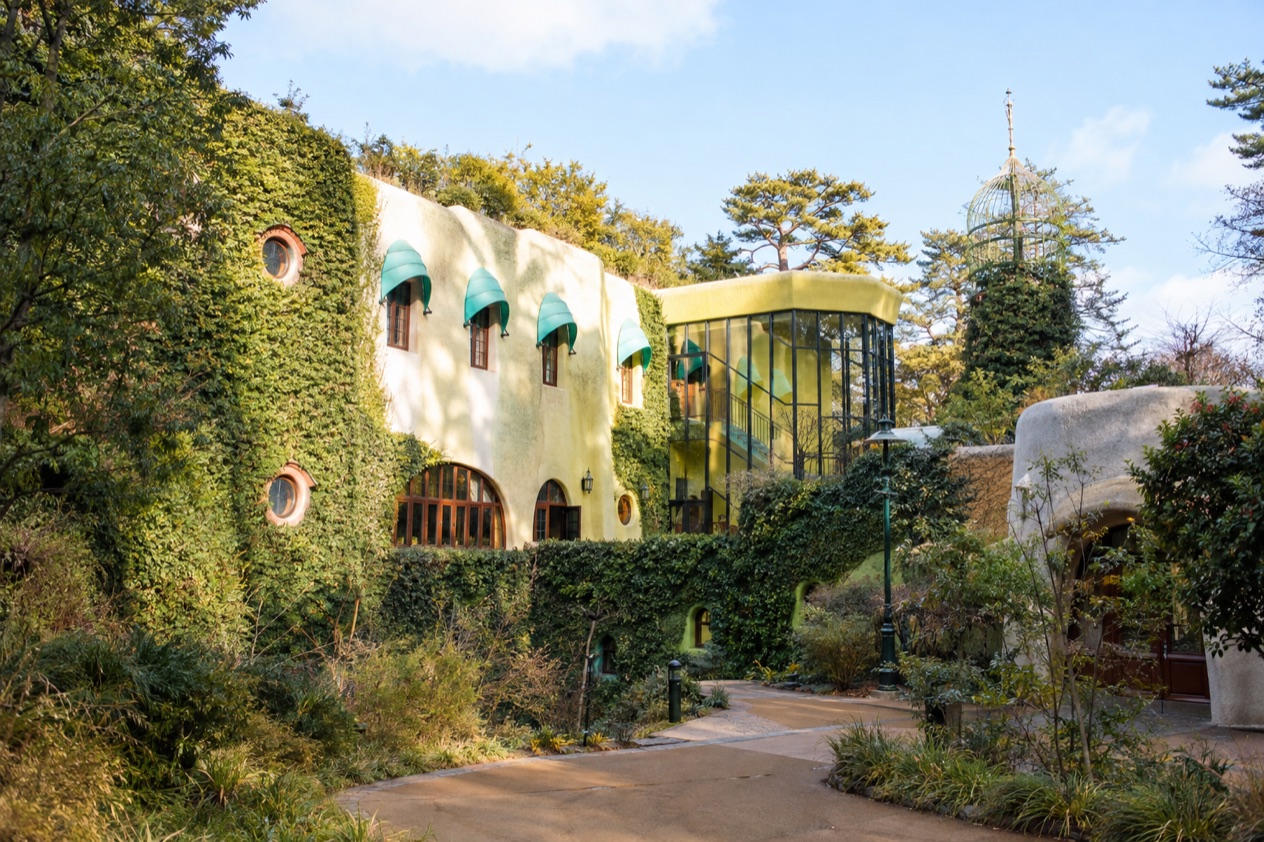
You step out of the station and you are already at the park gate, with Aichi’s wooded parkland around you instead of a wall of roller coasters. Somewhere ahead a house from a Totoro summer, a witch’s bakery and a castle on legs are waiting among the trees. Ghibli Park in Nagakute, Aichi, is a place for walking, looking closely and recognizing scenes from the films, and it suits anyone who grew up with Studio Ghibli.
Is visiting Ghibli Park worth it?
Yes, if you love Studio Ghibli films and are happy to spend a day wandering through settings, buildings and details rather than lining up for thrills, and it works well for families with small children too. The park opened on November 1, 2022, and it was designed on purpose without big rides or headline attractions. Even the Valley of Witches, the newest area, has only two small children’s rides.
That is what separates it from the other anime pilgrimages in Japan. The Ghibli Museum in Mitaka, Tokyo, which opened in October 2001, is an indoor museum of exhibits and animation. The Fujiko F Fujio Museum in Kawasaki is devoted to Doraemon, and Odaiba and Fukuoka have their Gundam statues.
Ghibli Park is different in being a landscape you walk through, spread over about 18 acres, with life-sized buildings from the films set among real trees. It also has its own screen time, since Cinema Orion shows short films that can be seen only there and at the Ghibli Museum.
If you want adrenaline, look elsewhere. If you want to stand inside a film you love, this is the place.
What to see at Ghibli Park
The park is divided into five themed areas: Ghibli’s Grand Warehouse, Hill of Youth, Dondoko Forest, Mononoke Village and Valley of Witches. Each one borrows a different corner of the studio’s world, and the paths between them are part of the visit.
Ghibli’s Grand Warehouse
The warehouse is the largest indoor space in the park and holds the most variety under one roof. Rooms are built as film sets and exhibition halls, with rich, closely observed details that reward slow looking, from props to painted backgrounds.
Cinema Orion is the part not to miss. Its short films can be watched only here and at the Ghibli Museum in Tokyo, so it is a chance to see something you cannot stream at home. Totoro, the studio’s mascot since My Neighbor Totoro in 1988, is never far away.
Hill of Youth
Hill of Youth takes its mood from Whisper of the Heart, a film of narrow lanes, books and a little antique shop with a clock that tells its own story. The area is built around that sense of an old neighborhood climbing a slope, with warm-toned buildings and corners that look as if they came out of a storyboard.
Look at the textures, such as aged wood, stacked objects and window displays. The pleasure here is in matching what you see to the scenes you remember.
Dondoko Forest
Dondoko Forest is the My Neighbor Totoro part of the park, where a rural farmhouse sits among trees much like the one Satsuki and Mei move into. Stepping through the doors and rooms of a house you know from the screen is the most personal moment of the day for many fans.
The forest setting matters as much as the house. The trees, the paths and the way the building sits in the green make it feel like part of a landscape instead of a prop.
Mononoke Village
Mononoke Village leans on the rural, craft-based world of Princess Mononoke, with timber structures and a handmade look. It is a quieter register than the other areas, closer to a village you walk through than a set you watch.
Right beside it is a free playground based on The Cat Returns, open to anyone without a ticket or charge. Children can climb and play there while adults take in the setting, and it is a pleasant pause in the middle of the day.
Valley of Witches
The Valley of Witches opened on March 16, 2024, and it is the area with the biggest visual punch. Its centerpiece is a life-sized replica of Howl’s Moving Castle, four to five stories high, a patchwork of towers, pipes and balconies that rewards walking all the way around.
The area also draws on Kiki’s Delivery Service and other witch stories, and it holds the two small children’s rides. The short film A Night in the Valley of Witches was produced by Studio Ghibli exclusively for Ghibli Park, a detail worth knowing if you like the studio’s rarities.
Hours, tickets and rules
Ghibli Park is not one gate with one price, since it is five areas, some of them indoors and some of them out among the trees. The one part anyone can enter without paying is the playground next to Mononoke Village, which is based on The Cat Returns and costs nothing to use.
| Site | Admission |
|---|---|
| Cat Returns playground, next to Mononoke Village | Free |
The park has no private parking lot for visitors, and that is the main rule to keep in mind when planning how you arrive. Ghibli Park deliberately has no big rides, so there are no ride height or thrill restrictions to plan around. Cinema Orion and the other indoor spaces sit inside Ghibli’s Grand Warehouse.
How to get to Ghibli Park
The park is reached mainly through Aichikyuhaku-kinen-koen Station, and the station sits at the park entrance, so there is no long approach once you step off. The park is in Nagakute, Aichi, in the same prefecture as Nagoya.
There is no private parking lot for visitors, which means plans built around a rental car and a place to leave it do not apply here. Think of the station as the way in, and build the rest of the day around that gate.
Nagoya is the natural city to stay in or pass through. It is the capital of Aichi Prefecture, on the Pacific coast in central Honshu, and the fourth-largest city in Japan after Tokyo, Yokohama and Osaka. Chubu Centrair International Airport, on an artificial island south of central Nagoya, is Japan’s third major international gateway and is described as 30 minutes south of the city center.
If you are coming from Tokyo, remember that the Ghibli Museum is in Mitaka, Tokyo, while Ghibli Park is in Aichi. They are two different places with different things to see, and the museum does not stand in for the park or the other way round.
When to visit Ghibli Park
Any season can work, because so much of the park is outdoors that the weather shapes the day more than the calendar does.
| Month | Average high (°F) | Average low (°F) | Precipitation (inches) | Days with rain | Sunshine (hours) |
|---|---|---|---|---|---|
| January | 48.7 | 34.0 | 2.00 | 5.2 | 174 |
| April | 68.2 | 49.5 | 5.02 | 9.4 | 200 |
| July | 88.5 | 74.3 | 8.32 | 12.0 | 166 |
| October | 73.9 | 58.6 | 6.48 | 9.0 | 169 |
October is mild, with afternoons that are comfortable for walking between areas, though rain falls on a fair number of days, so a gray hour is part of the picture. April is cooler in the morning and warms through the afternoon, with more sun than any other month in the table. In January the days are cold, and snow or sleet falls on a number of them.
July is hot and humid, with the most rain days of the four months. A park of forest paths and open ground is something you feel through the weather, so a hot, damp July day is a different visit from a cool April one. For the Valley of Witches, the newest area, open since March 16, 2024, any month works as long as you dress for it.
Tips for your visit
Plan a day that is mostly on foot, because the five areas are spread over about 18 acres of parkland and the pleasure is in moving between them. Shoes you can walk in and a layer you can add or remove suit the Aichi weather in any of the months above.
With children, the free Cat Returns playground beside Mononoke Village gives a place to run around, and the two small rides in the Valley of Witches are the only rides in the park. Since there are no big rides, there is nothing to tempt a younger child toward something too big, and the park is as much about looking and exploring as about doing.
Because there is no private parking lot, the station is the way in for almost everyone, so plan around it. Leave time for Cinema Orion, whose short films are shown only here and at the Ghibli Museum in Tokyo.
Combining the park with Nagoya
Nagoya is the natural base for a few extra days. It is known for Atsuta Shrine, Nagoya Castle, Higashiyama Zoo and Botanical Gardens and the Port of Nagoya Public Aquarium, and Chubu Electric Power MIRAI TOWER rises in the city center too.
The NAGOYA Sightseeing Pass is described as a great-value way to enjoy the major attractions, including Nagoya Castle, MIRAI TOWER, the aquarium and the zoo. During the Nagoya Castle Autumn Festival, admission to the Honmaru Palace runs until one hour before the gate closes, a useful detail for an October trip.
Other anime stops in Japan
If you are building a longer anime trip, the Edo-Tokyo Open Air Architectural Museum inspired some scenes in Spirited Away, and the Fujiko F Fujio Museum in Kawasaki shows Doraemon sketches and artwork. In Odaiba, Tokyo, the 20-meter Gundam Unicorn transforms four times daily with lights and music, and Fukuoka has a life-size ν Gundam statue of nearly 25 meters.
Good to know before you go
Ghibli Park is a day of walking among five areas, with a free playground and a short film or two for a rest between them. Aichi has a wet side to its year, with rain on many days in July and October, so a day here can mean a few showers. Nagoya, the large city in the same prefecture, is the base for the airport and the rest of the trip, and from there the park is reached through its own station at the gate.
Sources
- Japan National Tourism Organization, anime and manga (https://www.japan.travel/en/guide/japanese-anime-and-comics/), checked October 11, 2026
- Wikipedia, Ghibli Park (https://en.wikipedia.org/wiki/Ghibli_Park), checked October 11, 2026
- Wikipedia, Studio Ghibli (https://en.wikipedia.org/wiki/Studio_Ghibli), checked October 11, 2026
- Visit Nagoya, the Nagoya city guide (https://www.nagoya-info.jp/en/), checked October 11, 2026
- Wikipedia, Nagoya (https://en.wikipedia.org/wiki/Nagoya), checked October 11, 2026
- Wikivoyage, Nagoya (https://en.wikivoyage.org/wiki/Nagoya), checked October 11, 2026
- Japan Meteorological Agency (JMA), Normal values 1991-2020, monthly (https://www.data.jma.go.jp/stats/etrn/view/nml_sfc_ym.php?prec_no=51&block_no=47636), station Nagoya, elevation 51 m, checked October 11, 2026
To plan your stay
- Best Time to Visit Japan: Cherry Blossoms, Autumn Colors, Weather and Festivals
- Where to Stay in Japan: Ryokan, Temple Stays, Capsule Hotels and the Best Cities to Base In
- Sending Luggage from the Airport in Japan: Hands-Free Travel, Hotel Delivery and Coin Lockers
- Know Before You Go to Japan: Entry, Money, Etiquette and Getting Around