
In early February, shrines in Fukuoka fill with the dry rattle of roasted soybeans and shouts of “Oni wa soto! Fuku wa uchi!” as people try to chase out the year’s bad luck.
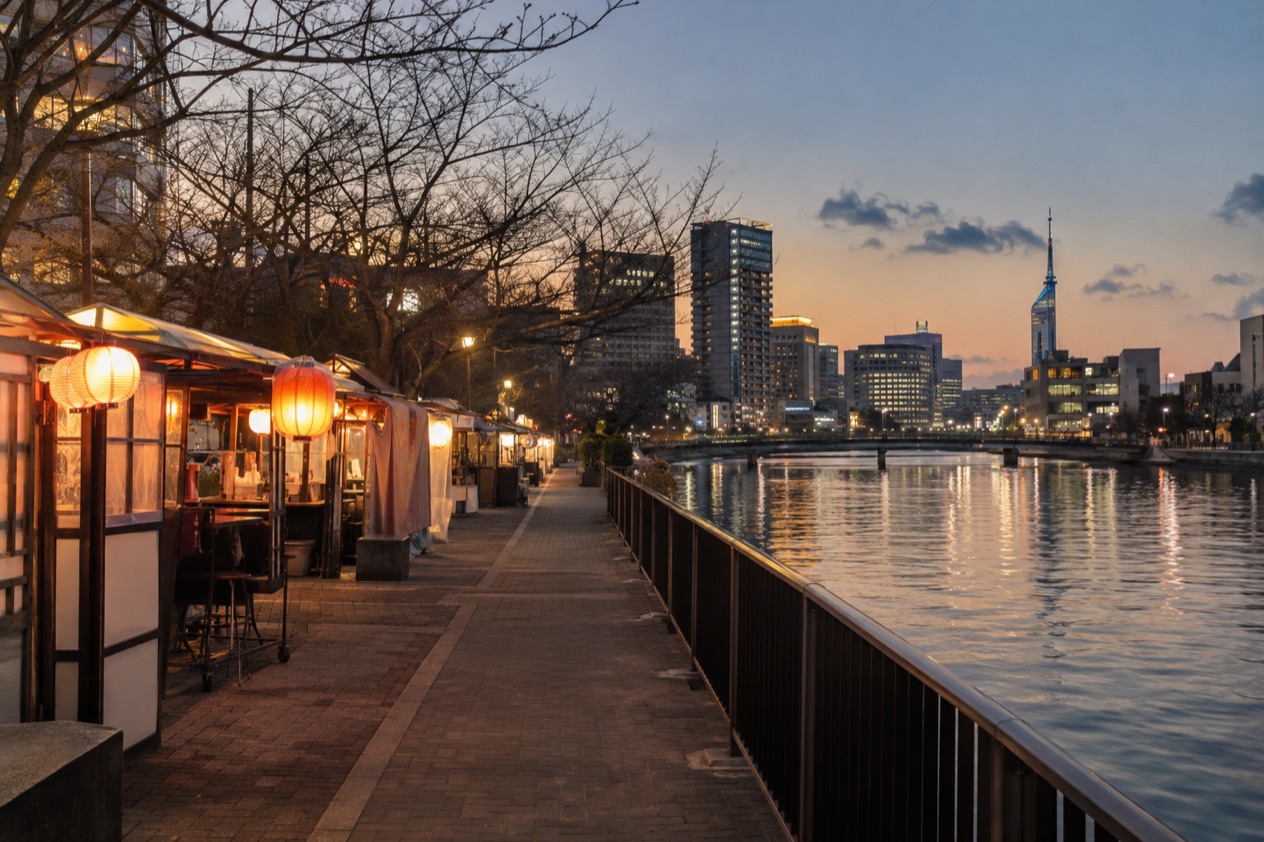
Plum trees begin to open along shrine paths while steam rises from ramen counters and from the cloth-covered stalls on the riverbank. February in Fukuoka is a month for hot bowls, plum blossoms and a city waking toward spring, for travelers who like to eat well and walk in cool air.
What is the weather like in Fukuoka in February?
February in Fukuoka is cold but mild by winter standards, with gray spells and bright ones, and a little more sun than in January.
| Month | Average high (°F) | Average low (°F) | Precipitation (in) | Days with 1 mm or more of precipitation | Hours of sunshine | Daylight on the 15th |
|---|---|---|---|---|---|---|
| January | 50.4 | 39.0 | 2.93 | 9.3 | 104 | 10 h 09 min |
| February | 52.9 | 39.9 | 2.75 | 8.8 | 124 | 10 h 58 min |
| March | 59.0 | 45.0 | 4.08 | 10.1 | 161 | 11 h 55 min |
Afternoons in the low 50s call for a warm coat but not for the heaviest winter gear. The nights stay just above freezing on average, so the cold you feel after dinner on a riverside walk is a damp, bracing one rather than a hard frost. Layers work better than one thick garment, because a heated train, a department store or a ramen shop can feel very warm after the street.
Rain comes on fewer than nine days in the month, usually as steady gray drizzle or short showers, and the total is lower than in either neighboring month. Snow does appear, with several days of snow or sleet, yet the whole month adds up to only 0.4 inch, so it is a passing flurry and not something to plan around. A compact umbrella and shoes that handle wet pavement are the sensible gear.
The light is the quiet gain of February. Days are almost an hour longer than in mid-January, which gives you room for a temple in the morning and a stroll before the stalls light up in the evening. The sea along Hakata Bay is a winter sea, good for looking at from the waterfront and not a place to plan a swim.
What to do in Fukuoka in February
The month opens with Setsubun, the day that marks the turn toward spring in the old calendar, and it closes with plum blossoms and a city that still eats like it is winter. Fukuoka is a port city on the north coast of Kyushu, and that shows in the seafood and in the way the city looks outward across the water to the Asian mainland.
Setsubun and the bean-throwing
The main ritual of Setsubun is mamemaki, where roasted soybeans called fukumame are thrown out the front door or at a family member wearing an oni (demon) mask, with the shout of “Oni wa soto! Fuku wa uchi!”, meaning devils out and fortune in.
At home, it is a game that children love, with one parent playing the demon. At shrines and temples, priests and invited guests toss beans and small gifts to the people who gather, and Kushida Shrine in Hakata is one of the places in the city where you can watch the tradition.
After the throwing comes the eating. It is customary to eat one roasted soybean for each year of your life plus one extra for good luck in the coming year, counted the traditional way, a system called kazoedoshi.
Supermarkets and convenience stores sell small bags of beans with paper oni masks around Setsubun, and it is a fun souvenir to take home. Even if you only watch from the edge of a shrine courtyard, you hear the shouts and see the masks, and you catch the playful side of a Shinto and Buddhist calendar.
Plum blossoms and Dazaifu
Before the cherry trees, there are plums. Prunus mume, the Japanese plum, typically flowers from January until late February in East Asia, so February is its time, with small white and pink blossoms opening on bare branches.
The plum is a flower of the cold, and it is traditionally seen as the first sign that spring is on the way. The fruit does not ripen until the early summer rains, around June and July, so now you are here for the flowers alone.
Dazaifu Tenmangu is the shrine most often linked with plums in this part of Kyushu. It is dedicated to Sugawara no Michizane, venerated as the patron of scholarship, and February falls in exam season, so you often see students and parents writing wishes on wooden plaques.
Plum trees stand on the grounds, and the walk from the shrine’s approach through its gate and pond bridges is the heart of the visit. A day trip here fits a cool, gray February day, since you spend most of it outdoors among the trees, the vendors and the small tea shops.
Yatai, ramen and winter pots
February is the right month for Fukuoka’s food stalls. The yatai of Hakata were chosen for The New York Times’ 52 Places to Go in 2023, and Fukuoka City was selected in the Food category of Lonely Planet’s Best in Travel 2023.
These are small open-air counters with a few stools, set up in the evening by the river in areas such as Nakasu and Tenjin. Hakata ramen, with its milky pork-bone broth and thin noodles, tastes best when your hands are cold and steam fogs your glasses.
Beyond ramen, winter is the time for hot pots. Motsunabe, a pot of beef or pork offal with cabbage and garlic chives, and mizutaki, a chicken pot with a clear, clean broth, are Fukuoka classics, and both turn a cold evening into the point of the day.
Mentaiko, the spicy cod roe the city is known for, shows up with rice, in omelets and in pasta. Sit at a stall counter, order a few skewers and let the neighbors tell you what to try next.
Ohori Park and the art gallery
Ohori Park is a good place for a cool-weather walk. It centers on a large pond with a path around it, and the winter air gives the water a pale, glassy look and thins out the summer crowds of joggers and picnickers. The park is also the location of one of Fukuoka City’s major art galleries, which makes it a natural stop when the sky turns gray and you want a few indoor hours without leaving the green.
If you want to add one more stop, the ruins of the old castle stand nearby, with stone walls and bare trees that suit the season. Set a slow pace, stop at a park café for something hot, and use the gallery as your rain plan.
Cherry blossoms are still a month away, since the first bloom at Fukuoka usually falls around the end of March, so February is for plums and for planning. Snow festivals and ski runs belong to Hokkaido and the mountains of Nagano, where the peak season is January and February. In Fukuoka the month is about food, shrines and walking, and that is plenty.
A two-day itinerary for Fukuoka in February
Day 1 is the Hakata side of the city, on foot and by subway. Begin with Setsubun in mind: head to Kushida Shrine in the morning, where bean-throwing and masks may be on the calendar if you arrive at the start of the month, and wander the temple streets nearby. Make lunch a bowl of Hakata ramen at a shop counter, where the heat and the noise are part of the pleasure.
Spend the afternoon indoors and out around the station and the canal area, with a coffee break and a look at the shops. When the daylight starts to go, walk toward Nakasu and the river.
The yatai stalls open in the evening, and dinner is a few skewers, a bowl of noodles or a small pot of motsunabe at a counter. If rain sets in, stay under cover in the shopping arcades and let dinner be at an indoor izakaya (a casual pub).
Day 2 is for plums and green space. Go out to Dazaifu in the morning for the shrine and its plum trees, with a snack of the town’s local sweets from a tea stall. Return to the city for a late lunch, maybe a chicken mizutaki set or a plate of mentaiko with rice.
In the afternoon, walk around Ohori Park’s pond and step into the art gallery, the best rain card of the trip, then look over the old castle grounds if the sky allows. Finish in Tenjin, the shopping and dining district, where more yatai set up in the evening and the underground arcades keep you out of the wet. One last bowl of ramen is a fair way to end the stay.
Is Fukuoka busy in February?
February sits between the winter holidays and the cherry blossom rush, and in Fukuoka it feels like a month with an ordinary city rhythm and no big seasonal spike.
The city’s big draws fall elsewhere on the calendar. The Hakata Dontaku festival is held on May 3 to 4, and Hakata Gion Yamakasa is a big summer event in July. The cherry trees do not reach their first bloom here until around the end of March, so the spring blossom season is still ahead. February’s own events are small and local, like Setsubun at the shrines and plum blossoms at Dazaifu.
The big winter-travel pull of the month is snow country. Hokkaido and the high mountains of Nagano reach their peak season in January and February, when snowfall is most frequent, and the Sapporo Snow Festival fills seven days of the month with sculptures at Odori Park, Susukino and Tsudome. None of that happens in Fukuoka, which sees only a trace of snow, so the city’s pace is the pace of everyday life: office workers at lunch, students at the shrines and locals at the stall counters.
For a visitor, that means the month is about the city itself. You see the Setsubun ritual as a neighbor does, and you eat among people who live here, not among a crowd of seasonal visitors.
What to pack for Fukuoka in February
Pack for cool, damp days that you spend mostly outdoors, with warm places to duck into for lunch and dinner.
- A warm coat and a layer or two underneath, for riverside evenings at the food stalls.
- A compact umbrella, since rain falls on some days in the month.
- Waterproof walking shoes for wet shrine paths and gravel at Dazaifu.
- A scarf and gloves, because stall counters and shrine courtyards are open to the air.
- A small bag for souvenir soybeans and sweets from the shrines.
- Shoes that slip off easily, for the temples and restaurants where you remove them at the entrance.
Good to know before you go
February is outside the rainy season that comes with early summer, the plum rain called meiyu, so the month’s wet days are the cold gray kind. Setsubun falls in the first days of the month and is a family and shrine tradition, not a day off for everyone.
The New Year closures, when many restaurants and attractions shut, are over by now, and the city is back at its normal rhythm. Plum blossoms are at their end by late February, so go early in the month if they matter to you.
Fukuoka in February vs January and March
Moving a few weeks earlier brings January, a shade colder and grayer, with more days of snow or sleet and less sun. The plum blossoms are just starting, the food stalls are as good as ever, and the New Year closures at restaurants and attractions may still be fresh in memory. If the pot of motsunabe is the main goal, January works well, and the city has the same winter feel.
Moving a few weeks later brings March, which is clearly warmer, with more sun and the most rain of the three months. The plum season is over by then, and the cherry trees are close to their first bloom, which usually falls around the end of March, with full bloom a week or so after. Evenings at the stalls become easier to enjoy, and the daylight stretches out.
Choose February for Setsubun, the plum blossoms and a winter city with its own rhythm. Choose January for the deepest cold and the quietest streets. Choose March if you want to catch the start of the cherry season and milder walking days.
Is February a good time to visit Fukuoka?
Yes, for travelers who come for food, shrines and slow city walks, and who do not mind a coat and an umbrella.
February suits anyone who wants to eat hot ramen at a stall, watch a Setsubun ritual and see plum blossoms before the cherry crowds arrive. It is less right for anyone who wants cherry blossoms, beach time or ski slopes, since those belong to March, summer and Hokkaido or Nagano. On arrival, head for the river in the evening, find a stall with a free stool and order whatever the person beside you is eating.
What marks February in Fukuoka is the mix of old ritual and warm food, with beans flying at the shrines by day and steam rising from the stalls at night.
Sources
- Japan Meteorological Agency (JMA), Normal values 1991-2020, monthly (https://www.data.jma.go.jp/stats/etrn/view/nml_sfc_ym.php?prec_no=82&block_no=47807), station Fukuoka, elevation 2 m, checked October 11, 2026
- Computed from the date and the latitude of the place (sunrise equation, solar elevation -0.833 degrees), October 11, 2026
- Wikipedia, Setsubun (https://en.wikipedia.org/wiki/Setsubun), checked October 11, 2026
- Japan National Tourism Organization, festivals and events (https://www.japan.travel/en/see-and-do/festivals-and-events/), checked October 11, 2026
- Sapporo Snow Festival official website (https://www.snowfes.com/english/), checked October 11, 2026
- Wikipedia, Sapporo Snow Festival (https://en.wikipedia.org/wiki/Sapporo_Snow_Festival), checked October 11, 2026
- Japan National Tourism Organization, winter in Japan (https://www.japan.travel/en/guide/winter-guide/), checked October 11, 2026
- Japan National Tourism Organization, skiing and snowboarding in Japan: regions, resorts, seasons (https://www.japan.travel/en/sports/snow/), checked October 11, 2026
- Wikipedia, Climate of Japan (https://en.wikipedia.org/wiki/Climate_of_Japan), checked October 11, 2026
- Japan National Tourism Organization, flowers by season: cherry blossom, plum, wisteria, hydrangea, where and when (https://www.japan.travel/en/see-and-do/flowers/), checked October 11, 2026
- Wikipedia, Prunus mume (https://en.wikipedia.org/wiki/Prunus_mume), checked October 11, 2026
- Japan National Tourism Organization, skiing guide (https://www.japan.travel/en/guide/skiing/), checked October 11, 2026
- Wikipedia, List of ski areas and resorts in Japan (https://en.wikipedia.org/wiki/List_of_ski_areas_and_resorts_in_Japan), checked October 11, 2026
- Japan National Tourism Organization, weather and seasons in Japan (https://www.japan.travel/en/plan/weather/), checked October 11, 2026
- Japan Meteorological Agency, cherry blossom first-bloom dates 2021-2026 and 1991-2020 normal (https://www.data.jma.go.jp/sakura/data/sakura003_07.html), checked October 11, 2026
- Japan Meteorological Agency, cherry blossom full-bloom dates 2021-2026 and 1991-2020 normal (https://www.data.jma.go.jp/sakura/data/sakura004_07.html), checked October 11, 2026
- Fukuoka City official tourist guide (https://yokanavi.com/en/), checked October 11, 2026
- Wikipedia, Fukuoka (https://en.wikipedia.org/wiki/Fukuoka), checked October 11, 2026
- Wikivoyage, Fukuoka (https://en.wikivoyage.org/wiki/Fukuoka), checked October 11, 2026
- Japan National Tourism Organization, Fukuoka (https://www.japan.travel/en/destinations/kyushu/fukuoka/fukuoka-city/), checked October 11, 2026