
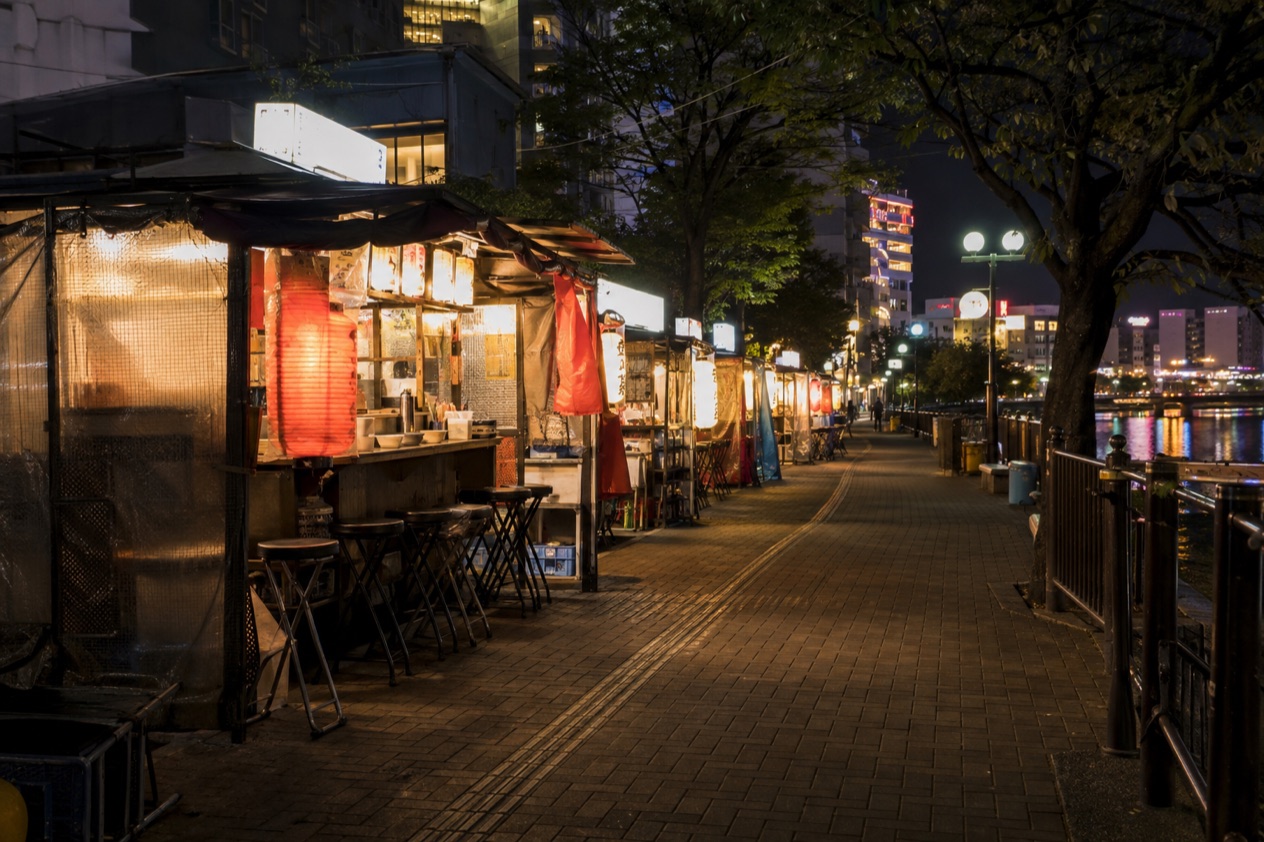
As the light fades over Fukuoka, carts roll onto the sidewalks, lanterns come on, and steam starts rising from pots of pork broth. Within a few minutes a bare stretch of pavement turns into a row of tiny open-air restaurants, each with a counter, a handful of seats and a cook who is already working. The yatai of Fukuoka are an evening outing built around ramen, small plates and a drink, and they suit travelers who like to eat shoulder to shoulder with strangers.
Is visiting the Fukuoka yatai food stalls worth it?
Yes, if you want a meal that is also an evening’s entertainment, and it suits curious eaters, solo travelers and couples most of all. A yatai is a small mobile food stall, and in Fukuoka the stalls are part of how the city eats after dark. You sit close to the cook, watch the broth and the grill, and end up talking with whoever is on the next stool.
Recognition from outside has followed. Lonely Planet put Fukuoka in the Food category of its Best In Travel list, and the New York Times chose the Hakata yatai for its 52 Places to Go, both for 2023. Neither is the reason to go, though. The reason is the experience of eating on a sidewalk under a canopy, with a bowl in front of you and the city moving past a few feet away.
What sets Fukuoka apart from similar places nearby is that the tradition is still running here. In Kumamoto Prefecture, just south of Fukuoka, a single yatai called Wakasa held the last license in the prefecture, and it closed in May 2025 after half a century of service. In Fukuoka City the stalls remain a living part of the evening, concentrated in the Nakasu and Tenjin districts, so a visit is a chance to see a street-food culture that has disappeared elsewhere.
It is not a place for a long, formal dinner or for anyone who wants a private table. Seating is shared, the cooking is done in front of you, and the menu is short. That is much of the charm, and it is why travelers fit a yatai stop in as one part of a night out rather than the whole of it.
What to see at the Fukuoka yatai food stalls
The visit divides into the stalls themselves, the two districts where they gather, and the food and drink that fill the counters. Each gives you a different angle on the same evening.
The stall itself
A yatai is a pushcart turned into a restaurant, small enough to be wheeled out and pulled away again. Look at how much is packed into it: a cooking surface, pots, a rack of bottles, a counter with stools and a cloth or canopy overhead, with lanterns or signs announcing what is on offer. The cook usually stands in a tight space inside the counter, facing the guests, so every order is made within arm’s reach of the people eating it.
The setup is part of the show. The stalls appear in the early evening on the walkways and are taken down late at night or in the early morning hours.
Nakasu and Tenjin
Nakasu and Tenjin are the two districts that form the contemporary hub of Fukuoka’s yatai culture. The two feel different after dark. Nakasu is a nightlife district, with signs reflecting in the water and people moving between bars, and the stalls sit among that glow. Tenjin is a major commercial district, so the yatai there come after a day of shopping and office life has wound down.
Walking from one cluster to the other lets you compare stalls before you commit. Look at the faces along the counters, the menus posted on cloth or boards, and the smells drifting into the street. Choosing where to sit is half the fun, and it costs nothing to stroll along the row and see which lantern draws you in.
What the counters serve
Ramen is the dish people come for, and Fukuoka is a city known for its pork-bone style, with a milky broth and thin noodles. Yatai vendors serve more than ramen, though. Gyoza and tempura are on the list, and the stalls also pour beer, sake and shōchū, the distilled spirit that is a regular in Kyushu drinking.
A good way to eat here is to build a small meal across the evening. Start with a few plates and a drink, share a conversation with your neighbor, and finish with a bowl of noodles. Many stalls specialize, so reading what the cook is actually preparing tells you more than any sign.
A tradition with rules behind it
The stalls you see are not an accident of the street. Fukuoka is a port city on the north coast of Kyushu, and its closeness to the Asian mainland has meant cultural exchange for centuries, which is part of why its food culture feels so open. The yatai are a thread of that urban history, kept alive by local licensing that shapes who may run a stall.
That is also why the Kumamoto story matters when you stand at a counter in Fukuoka. The stalls here exist because the city and its cooks have kept them going, and each evening’s service is a small piece of living heritage.
Hours, tickets and rules
There is no gate and no ticket. The yatai open after sunset and close in the early morning, so the evening is the whole point, and you pay only for what you order at the counter. The stalls are placed on public walkways rather than inside a building, which is why they appear and disappear with the day.
| Site | Open |
|---|---|
| Yatai stalls, Nakasu and Tenjin | After sunset until the early morning |
One rule shapes the whole scene. A 1994 law in Fukuoka prefecture states that a yatai must be passed to a direct descendant or closed when the operator retires. It explains why new stalls are not simply added over time, and why each one you sit at carries some family or personal history.
When to visit the Fukuoka yatai food stalls
Go in the evening. The stalls are set up in the early evening and run after sunset into the early morning, so any time from dusk onward puts you in front of an open counter. Because the stalls are outdoors on the walkway, the temperature and the weather matter more here than at a restaurant with walls, and the season you pick shapes the whole experience.
| Month | Average high (°F) | Average low (°F) | Precipitation (inches) | Days with rain |
|---|---|---|---|---|
| January | 50.4 | 39.0 | 2.93 | 9.3 |
| April | 67.8 | 52.7 | 4.65 | 9.7 |
| July | 88.2 | 76.3 | 11.78 | 11.0 |
| October | 74.7 | 60.8 | 3.72 | 6.8 |
October has the fewest rain days of the four months in the table, with evenings that stay mild enough to sit at an open counter in comfortable clothes. April is also a pleasant month for sitting out, though the nights are cooler and showers are around on many days. In both, a light layer is enough for a long evening outdoors.
July is a different proposition. It is hot, humid and the wettest of the four, and rain falls on a good share of the days, so an evening at an open-air stall means warm air, damp heat and the possibility of a shower. Hakata Gion Yamakasa, the big summer festival held in July, fills the city with energy, and the stalls add a food stop to that atmosphere.
January brings cold nights, and since the stalls are open to the air, a hot bowl of noodles tastes especially welcome. Sleet can show up in the month, and the rainy days are frequent, so plan on warm clothes. For people the cold is part of the charm, because steam rising from a pot and a warm drink on a winter night are exactly what the yatai were made for.
Tips for your visit
Dress for being outdoors, since a stall is a counter under a canopy and not a room. In cooler months bring a jacket and maybe a scarf, and in July bring something light and a way to cope with the humidity and a passing shower.
Travelers pair a yatai stop with time in Nakasu or Tenjin before or after, wandering through the district and returning to a stall for a final bowl. Because the stalls close in the early morning, there is no pressure to eat at a set time, and an unhurried evening works well.
A daytime in Fukuoka can fill the hours before the stalls open. Ōhori Park in the city holds one of Fukuoka’s major art galleries, which makes it a pleasant daytime stop before an evening of eating. Fukuoka is also the fastest-growing city in Japan, so the contrast between the energy of its streets and the small scale of a yatai is part of what you notice.
The stalls are small and open to the street, with stools at a counter, so they suit solo travelers and couples well. Families and travelers who need more room or easy movement may find a cramped counter harder, and it is sensible to look at the space before sitting down. Whatever your group, a friendly attitude to your neighbors at the counter is part of the custom.
If a stall is full, walk on. The rows of lanterns mean there is almost always another counter nearby, and a short wander is part of the experience. Treat the evening as a loop through the district rather than a single destination.
Good to know before you go
Fukuoka is a place where an evening on the street is part of the plan, so a relaxed, curious pace suits it. Beer, sake and shōchū are usually available at the stalls, so enjoy them in the spirit of the counter, with moderation and good manners toward the people beside you. Rain is a real possibility in several months, particularly July, so a compact umbrella is a sensible companion for an outdoor dinner.
Sources
- Wikipedia, Yatai (food cart) (https://en.wikipedia.org/wiki/Yatai_(food_cart)), checked October 11, 2026
- Japan National Tourism Organization, Fukuoka (https://www.japan.travel/en/destinations/kyushu/fukuoka/fukuoka-city/), checked October 11, 2026
- Fukuoka City official tourist guide (https://yokanavi.com/en/), checked October 11, 2026
- Wikipedia, Fukuoka (https://en.wikipedia.org/wiki/Fukuoka), checked October 11, 2026
- Japan Meteorological Agency (JMA), Normal values 1991-2020, monthly (https://www.data.jma.go.jp/stats/etrn/view/nml_sfc_ym.php?prec_no=82&block_no=47807), station Fukuoka, elevation 2 m, checked October 11, 2026