
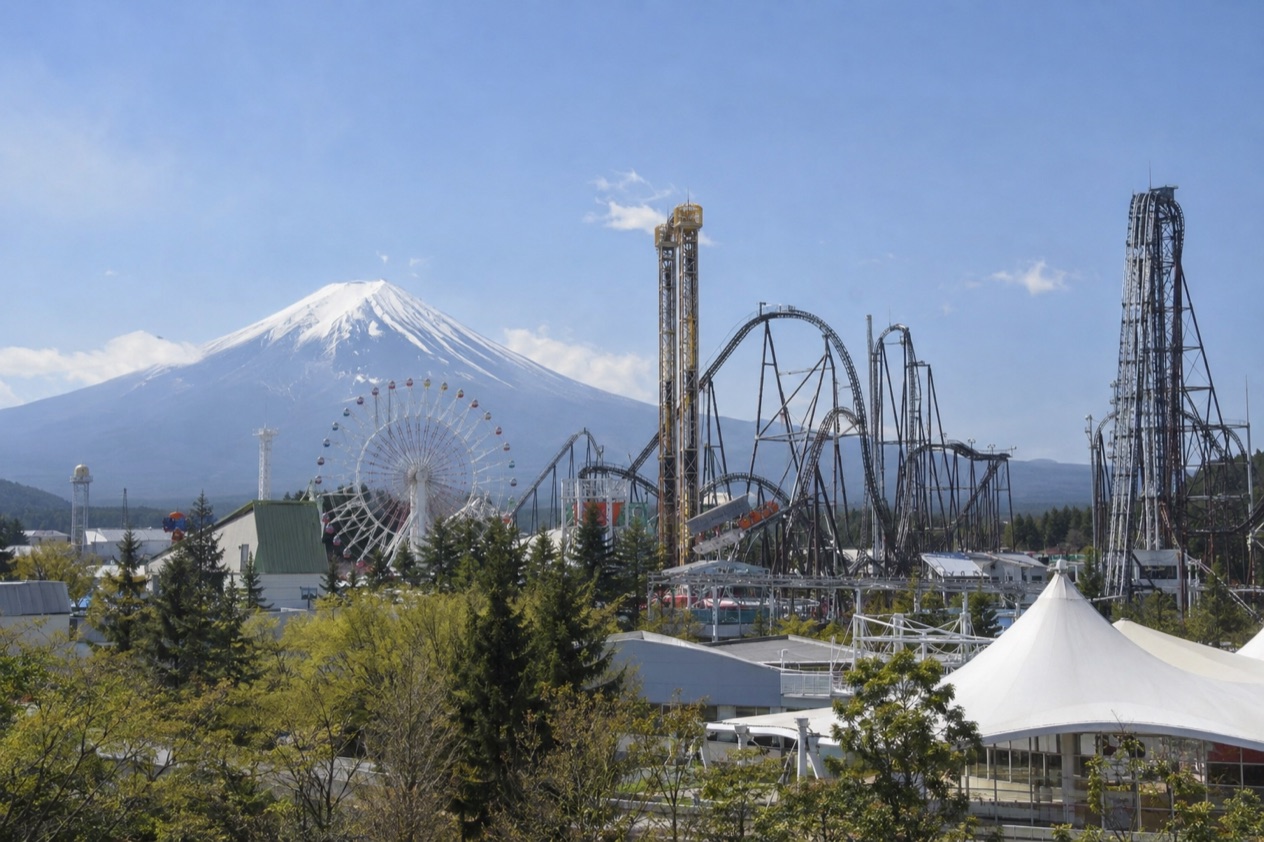
The first thing that reaches you at Fuji-Q Highland is the sound: a rising clatter of coaster wheels, then a ripple of screams that fades as the cars drop out of sight. Past the gates, the rides stand against the mountain itself, with the bulk of Mount Fuji filling the sky behind the steel. This is an amusement park for people who like their thrills loud, their haunted houses long and their scenery enormous.
Is visiting Fuji-Q Highland worth it?
Yes, if you like roller coasters, haunted attractions or anime, and especially if you are traveling with children who love trains. The park suits teenagers and adults chasing adrenaline, families split between big rides and gentle ones, and anyone who wants a day at the foot of Mount Fuji that is not about temples or hiking.
What sets it apart from the other places around the mountain is the mix. The lakes, hot springs and trails nearby are all about looking, soaking and walking.
Fuji-Q Highland is about being shaken, startled and, in the case of the smallest visitors, hauled around by a cheerful blue engine. It is a theme park built around the extreme, with six roller coasters, two haunted attractions, a children’s land and attractions drawn from well-known Japanese manga and anime.
It also has a sense of place that most amusement parks lack. Rides and lines are framed by the mountain, and on a clear day the view over the top of a lift hill is part of the ride.
If you are building a trip around the Fuji area and want one day that feels completely different from the rest, this is that day. If roller coasters leave you cold and you have no children in tow, the surrounding lakes and mountain scenery will probably serve you better.
What to see at Fuji-Q Highland
The park is organized around its thrill rides, with the calmer attractions and the themed areas spread around them. Coasters dominate the skyline, and the haunted houses and character zones fill the spaces between.
Fujiyama and Eejanaika, the headline coasters
Fujiyama is named for the mountain it stares at, and it is a tall, fast, classic-style coaster that makes a long run of hills and drops. Eejanaika takes a different approach. Its name comes from a Japanese phrase that roughly means “Isn’t it great?”, and its seats rotate and flip as the train moves, so you spend a good part of the ride facing the ground or the sky.
| Coaster | Height (m) | Top speed (km/h) |
|---|---|---|
| Fujiyama | 79 | 130 |
| Eejanaika | 76 | 126 |
Both are the kind of rides people talk about for the rest of the trip. Fujiyama rewards anyone who likes speed and airtime, while Eejanaika is more disorienting than any ordinary loop-and-drop coaster. Watching a few trains go around before you commit gives you a good feel for which suits you.
The haunted attractions
Japan has a long tradition of the obake yashiki, the haunted house, and Fuji-Q Highland treats it as a main event rather than a sideshow. The park has two: the Haunted Hospital and the Hopeless Fortress. Both are walk-through experiences in which sets, sound and costumed performers do the work of frightening you.
The hospital setting draws on a well-loved Japanese horror theme, with dim corridors, flickering light and things that move when you are not looking. The fortress goes for a different kind of dread. Go in a group if you want company in the dark, and go alone only if you enjoy being the one who gets startled most.
Thomas Land
Thomas Land is the children’s area, built around Thomas the Tank Engine and his friends. It gives younger visitors a place of their own, with gentler attractions in bright colors, and it lets a family with mixed ages stay in one park without anyone being bored or terrified.
Parents who grew up with the books or the television series tend to enjoy it as much as the kids. It also makes a natural pause between rounds on the big coasters, with the mountain still visible behind the little engines.
Anime-themed attractions
Fuji-Q Highland has attractions themed after GeGeGe no Kitarō, Naruto and Attack on Titan. GeGeGe no Kitarō is a long-running series about yokai, the spirits of Japanese folklore, which suits the park’s taste for the eerie. Naruto follows a young ninja, and Attack on Titan is the dark story of humans walled in against giants.
If you know these series, the attractions turn the park into a fan outing, with familiar characters and scenes to recognize. If you do not, they still work as well-staged rides and shows, and they give you a small window into the manga and anime culture that Japan exports worldwide.
Hours, tickets and rules
Fuji-Q Highland operates year-round, so a visit does not depend on a summer season or a winter closing. The park opened on March 2, 1968, which makes it a long-established name in Japanese amusement parks, and over the decades it has built its identity around record-minded coasters and horror.
Because the park stays open through the whole year, what changes from month to month is the weather on the day, not the existence of the park. Winter days at the foot of Mount Fuji are cold, while summer days are warm and humid, and the rides run in both. The mountain view also shifts with the seasons, from a snow-capped cone in colder months to a darker, greener slope when it is warm.
Because rides are the point of the visit, it helps to know which ones you want before you arrive and to plan your day around them, rather than wandering and hoping. The haunted attractions, the big coasters and Thomas Land each make a different kind of stop, and a day divides naturally among them.
When to visit Fuji-Q Highland
Any month works for a park that never closes for the season, so the choice is about the weather you prefer to ride in. At Kawaguchiko, on Lake Kawaguchi, the climate across the year looks like this:
| Month | Average high (°F) | Average low (°F) | Precipitation (in) | Days with rain or snow |
|---|---|---|---|---|
| January | 41.9 | 21.7 | 2.40 | 4.9 |
| April | 61.0 | 38.7 | 4.18 | 8.5 |
| July | 81.0 | 64.4 | 7.02 | 11.7 |
| October | 64.9 | 47.7 | 9.06 | 10.1 |
January is cold and bright, with plenty of sunshine and snow falling on some days. It is a month for a warm coat, gloves and a hat, since you spend a lot of the day outdoors waiting and riding. The reward is crisp air and a mountain that looks its most dramatic.
April is cooler than comfortable for a T-shirt but milder than winter, and snow is rare by then. Layers work well. July is warm and humid, with showers on many days, so a light rain jacket earns its place in the bag. October, the month we are in now, brings mild afternoons and cool mornings, but it is also the wettest of the four months in the table, with gray, damp days that can hide the mountain.
If seeing Mount Fuji behind the coasters matters to you, the cloud cover of the day decides it more than the month does. Winter has the most sunshine of the four months shown, while July and October have far fewer hours of sun.
Tips for your visit
Dress for the weather rather than for the rides. Comfortable walking shoes, a layer you can add or remove, and a light rain shell in wetter months cover most situations.
A park with six coasters, two haunted attractions, a children’s land and several themed attractions takes time to enjoy properly, and rushing through defeats the purpose. Decide first whether your group wants the big rides, the haunted houses or the gentler areas, and build the day from there.
Families and mixed groups
Thomas Land gives younger children their own area, while older siblings or parents tackle the big coasters. This is the park’s clearest strength for families. One adult can stay with a small child at Thomas Land while the other rides, and then the two swap, which keeps everyone happy.
The haunted attractions are meant to frighten, so think about who in your group will enjoy that and who will not. A teenager may love the hospital, while a younger child might prefer the anime attractions or the engines.
Combining the park with Mount Fuji
The park sits near the base of Mount Fuji, which is a UNESCO World Heritage site and the highest mountain in Japan. Travelers pair the park with other time in the Fuji area. If you are thinking of climbing, note that the official climbing season ends on September 10th, so by October the trails are past the season.
In winter, the Yoshida, Subashiri and Gotemba trails are closed from the 5th station to the summit, and the Fujinomiya Trail is closed from the 6th station up. Climbers are strongly advised to check the latest information on the Official Website for Mt. Fuji Climbing, which provides information so that every climber can return safely. For an October visit, the park is the better fit for the mountain’s lower slopes.
Good to know before you go
Bring a payment method you trust and a bit of patience for the weather, which in October means damp, mild days with a fair chance of rain. Treat the rides and haunted attractions as part of the day’s fun, and use ordinary common sense with your belongings in a busy park. Wet weather is common in the Fuji area in autumn and summer, so a compact umbrella or jacket is a sensible companion.
Sources
- Wikipedia, Fuji-Q Highland (https://en.wikipedia.org/wiki/Fuji-Q_Highland), checked October 11, 2026
- Japan National Tourism Organization, Mount Fuji guide (https://www.japan.travel/en/fuji-guide/), checked October 11, 2026
- Official website for Mt. Fuji climbing, about the climb (https://www.fujisan-climb.jp/en/about/), checked October 11, 2026
- Japan Meteorological Agency (JMA), Normal values 1991-2020, monthly (https://www.data.jma.go.jp/stats/etrn/view/nml_sfc_ym.php?prec_no=49&block_no=47640), station Kawaguchiko, elevation 860 m, checked October 11, 2026
- Japan Meteorological Agency (JMA), Normal values 1991-2020, monthly (https://www.data.jma.go.jp/stats/etrn/view/nml_sfc_ym.php?prec_no=49&block_no=47639), station Fujisan, elevation 3,775 m, checked October 11, 2026
To plan your stay
- Best Time to Visit Japan: Cherry Blossoms, Autumn Colors, Weather and Festivals
- Where to Stay in Japan: Ryokan, Temple Stays, Capsule Hotels and the Best Cities to Base In
- Sending Luggage from the Airport in Japan: Hands-Free Travel, Hotel Delivery and Coin Lockers
- Know Before You Go to Japan: Entry, Money, Etiquette and Getting Around