
The approach to Dazaifu Tenmangu is lined with shops where grills turn out umegae mochi, little azuki bean cakes stamped with a plum flower, and the smell of toasted rice cake follows you toward the gate. Beyond it come ponds, a bridge and old plum trees spread across the grounds. This is a shrine visit built around a scholar who became a god, and around the plum trees that tell his story.
Is visiting Dazaifu Tenmangu worth it?
Yes, for anyone who likes a shrine with a story, a garden feeling and something good to eat on the way in, and especially for travelers already spending time in Fukuoka who want a different kind of day from the city’s food stalls and shopping streets.
The shrine honors Sugawara no Michizane, a court scholar and poet who is worshipped as Tenman-gu’s deity of learning. That gives the place a purpose you can see: students and parents come to ask for success in exams, and the wooden wishing plaques hung near the main buildings carry hopes for school, tests and new beginnings. You do not need to share the wish to enjoy watching it.
What sets it apart from other shrines in the region is the plum. The grounds hold 6,000 ume trees, and they belong to 167 varieties, so the shrine works as a living collection as much as a place of worship. Michizane loved plum trees, and the link between the man and the tree runs through everything you see here, from the crest on the lanterns to the pastry in your hand.
Shrines in Japan often ask you to look at one grand hall. Here the visit spreads out. You walk past water, cross a bridge, pause under a tree with its own legend, and later step into a treasure house.
It suits curious travelers, families with school-age children who like a story, photographers and anyone who enjoys a seasonal walk. If you want a single dramatic monument and nothing else, the layout may feel more gentle and wandering than you expected.
One thing to know about the present moment: the honden, the main sanctuary building, is undergoing renovation expected to take about three years. The rest of the precinct, with its ponds, trees and treasure house, remains the heart of the visit, and the story of the place does not depend on one building.
What to see at Dazaifu Tenmangu
The visit unfolds as a sequence: a shop-lined path, water and a bridge, a legendary tree, the sanctuary buildings, and a treasure house. Each part tells a piece of the same story about a gifted man and the plum blossom he loved.
The approach and the umegae mochi
The path to the shrine is part of the experience. Along it, shops sell umegae mochi, a grilled azuki bean cake stamped with the pattern of a plum tree flower. The outside is crisp and lightly toasted, the inside soft and sweet, and it is eaten warm, often standing right by the grill.
Besides the mochi, the shops along the way sell plum-themed sweets, small charms and souvenirs tied to the scholar god. Browsing here sets the mood, because the plum motif starts well before the shrine gate does. Eat one cake on the way in and decide on the rest after your walk through the grounds.
The ponds and the bridge
Past the entrance, the grounds contain two ponds and a bridge, and the water slows the pace of the visit. The bridge arches over the pond, and walking across it is a small ritual of its own, a passage from the busy path into the shrine’s quieter inner world. Koi and turtles often drift below, and trees lean over the banks.
The larger pond is traditionally described as shaped like the Japanese character for heart, which gives the setting a gentle symbolism. Look for the stone lanterns and the way the buildings reflect on the surface. In rain the ponds look darker and the greens deepen, which suits the place well.
Tobiume, the flying plum
Directly to the right of the honden stands a plum tree called Tobiume, the flying plum. The legend says that when Michizane was sent away from the capital, he wrote a poem to the plum tree in his old garden, saying he missed it. The tree, moved by the verse, is said to have flown through the air to join him in exile here.
It is the tree to look for among the thousands, and it is the one people photograph and touch with their eyes before anything else. Even outside blossom time, the story gives the spot weight. In late winter, when the plum flowers open, this is where the legend is easiest to feel, with pale petals against the dark wood of the shrine.
The honden and the auxiliary shrine
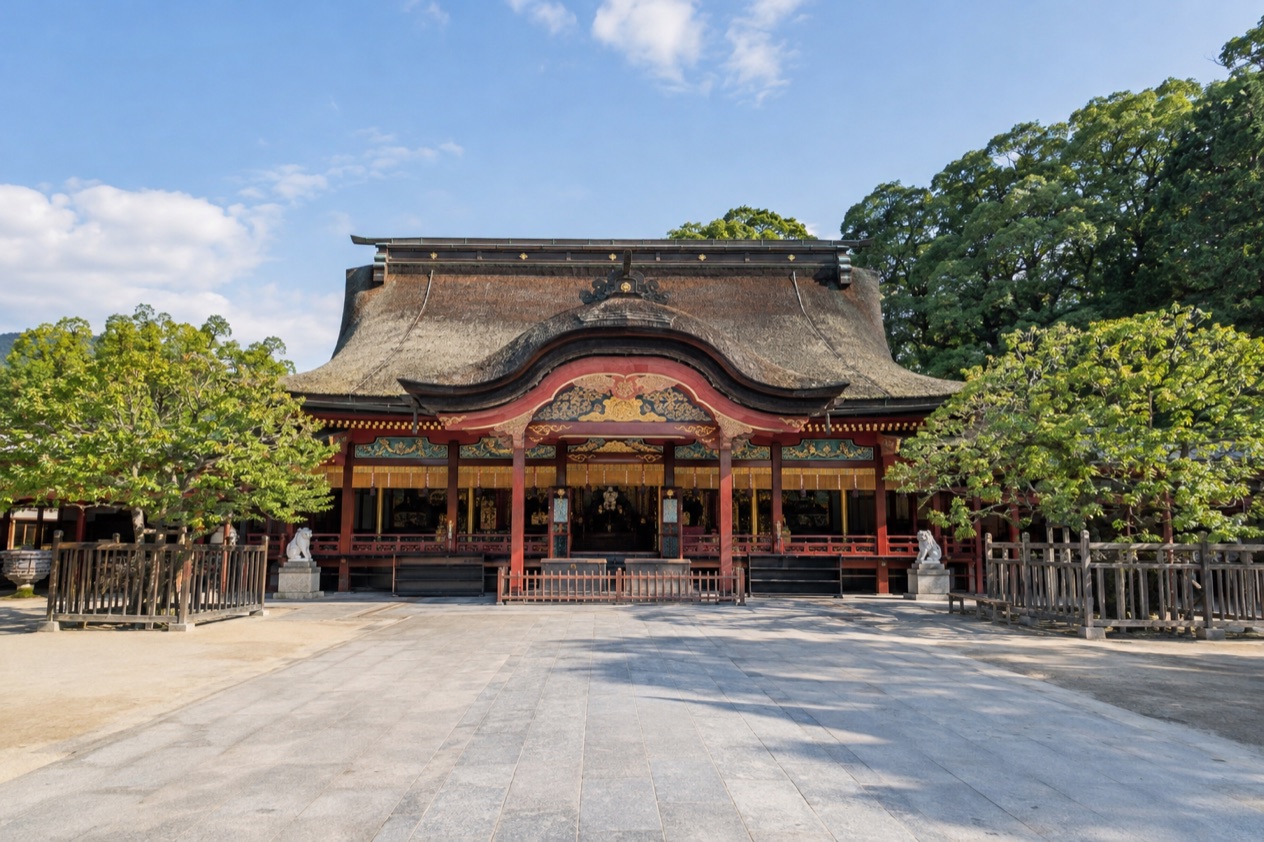
The honden is the main sanctuary, where the deity is enshrined, and it is the building the renovation concerns. Expect scaffolding or work areas in place of the full view you may have seen in photographs, since the work is expected to take about three years.
The auxiliary shrine honden is an Important Cultural Property, a designation that marks it out among the smaller buildings. It rewards a slow look at the roofline, the carving and the weathered wood. Visitors tend to stop at the offering box, bow, clap and leave a wish, and the same gestures here are the ones you will see at shrines across the country.
The treasure house
The grounds also hold a treasure house, where objects connected to the shrine and to Michizane’s memory are kept. It suits travelers who like objects and history, and it gives a place to step out of the weather when the sky turns gray.
When to visit Dazaifu Tenmangu
Late winter into early spring is the season the shrine is built around, when the plum trees come into flower, though the exact timing shifts from one winter to the next. With 6,000 trees of 167 varieties, the flowering unfolds in stages, so a visit in the weeks around it brings blossoms of different colors and shapes rather than one single moment.
| Month | Average high (°F) | Average low (°F) | Precipitation (inches) | Days with rain |
|---|---|---|---|---|
| January | 50.4 | 39.0 | 2.93 | 9.3 |
| April | 67.8 | 52.7 | 4.65 | 9.7 |
| July | 88.2 | 76.3 | 11.78 | 11.0 |
| October | 74.7 | 60.8 | 3.72 | 6.8 |
January and the plum season
January in Fukuoka is cold and gray, with a good number of days of snow or sleet, though only a light total. A coat, gloves and a warm layer are sensible for a long walk among bare branches. This is the month when the first plum buds may appear, and cold air does not take away from a visit that is built around a tree that flowers in winter.
April, July and October
April is mild, with more rain than January and a fair amount of sunshine, a pleasant time to stroll between the ponds with the plum flowers over and fresh green in the trees. July is hot and humid, and it is the wettest of these months, so expect heavy showers and a damp walk. It is also the month of Hakata Gion Yamakasa, the big summer festival in Fukuoka, which can give a trip a second purpose.
October, the month of this writing, sits among the drier months of the four, with comfortable highs in the mid-70s and plenty of sun. It is a good month for an unhurried walk around the ponds and the bridge, with shade under the old trees and no need to rush from one building to the next.
Tips for your visit
Dress for the season and for walking: comfortable shoes suit the grounds, and an umbrella earns its place in July or on a gray day in April. In January, layers matter more than anything, since you spend long stretches outdoors among the trees.
What to bring and how to pace the day
Bring a camera, a small bag and an appetite. The sweets along the approach are part of the visit, so it helps not to arrive full. The precinct includes several structures, ponds, a bridge and a treasure house, so give yourself room to wander rather than treating it as a single stop. Pausing at the water and under the plum trees is the whole point.
Anyone traveling with children can turn the legend of the flying plum into a small game, finding the tree and the bridge and the ponds in turn.
Pairing it with Fukuoka
Fukuoka is a port city on the north coast of Kyushu, and it pairs naturally with a shrine day. The Yatai food stalls in Hakata were chosen for The New York Times’ 52 Places to Go in 2023, and Fukuoka City was picked in the Food category of Lonely Planet’s Best In Travel 2023, so an evening of ramen, grilled skewers and local dishes rounds off a day among plum trees well.
For a quieter counterpart, Ohori Park in Fukuoka is the location of one of the city’s major art galleries, which makes a good rainy-day or afternoon stop. Fukuoka has had cultural exchanges with continental Asia throughout its history because it sits close to the Asian mainland, and that long conversation with its neighbors is part of why a scholar-god shrine like this one has such depth.
Families and mobility
Families will find plenty to hold a child’s attention, from the grilled cakes to the turtles and the legend of the tree that flew. The grounds are wide and take in water, a bridge and several buildings, so think about the stamina of everyone in your group before you set out. Anyone with a mobility concern should plan the day around the parts they most want to see.
Good to know before you go
Carry some yen for the shops along the approach, where the cakes, sweets and small charms are sold, and for any offering you wish to leave. Japanese shrine etiquette is a matter of habit: a bow at the gate, a quiet voice near the buildings, and care when taking photographs near worshippers. July brings the heaviest rain of the seasons covered here, so carry something waterproof if you come then, and keep in mind that the rainy season and typhoon season can change plans in the warmer months.
Sources
- Wikipedia, Dazaifu Tenmangū (https://en.wikipedia.org/wiki/Dazaifu_Tenmang%C5%AB), checked October 11, 2026
- Japan National Tourism Organization, Fukuoka (https://www.japan.travel/en/destinations/kyushu/fukuoka/fukuoka-city/), checked October 11, 2026
- Fukuoka City official tourist guide (https://yokanavi.com/en/), checked October 11, 2026
- Wikipedia, Fukuoka (https://en.wikipedia.org/wiki/Fukuoka), checked October 11, 2026
- Japan Meteorological Agency (JMA), Normal values 1991-2020, monthly (https://www.data.jma.go.jp/stats/etrn/view/nml_sfc_ym.php?prec_no=82&block_no=47807), station Fukuoka, elevation 2 m, checked October 11, 2026
To plan your stay
- Best Time to Visit Japan: Cherry Blossoms, Autumn Colors, Weather and Festivals
- Where to Stay in Japan: Ryokan, Temple Stays, Capsule Hotels and the Best Cities to Base In
- Sending Luggage from the Airport in Japan: Hands-Free Travel, Hotel Delivery and Coin Lockers
- Know Before You Go to Japan: Entry, Money, Etiquette and Getting Around