
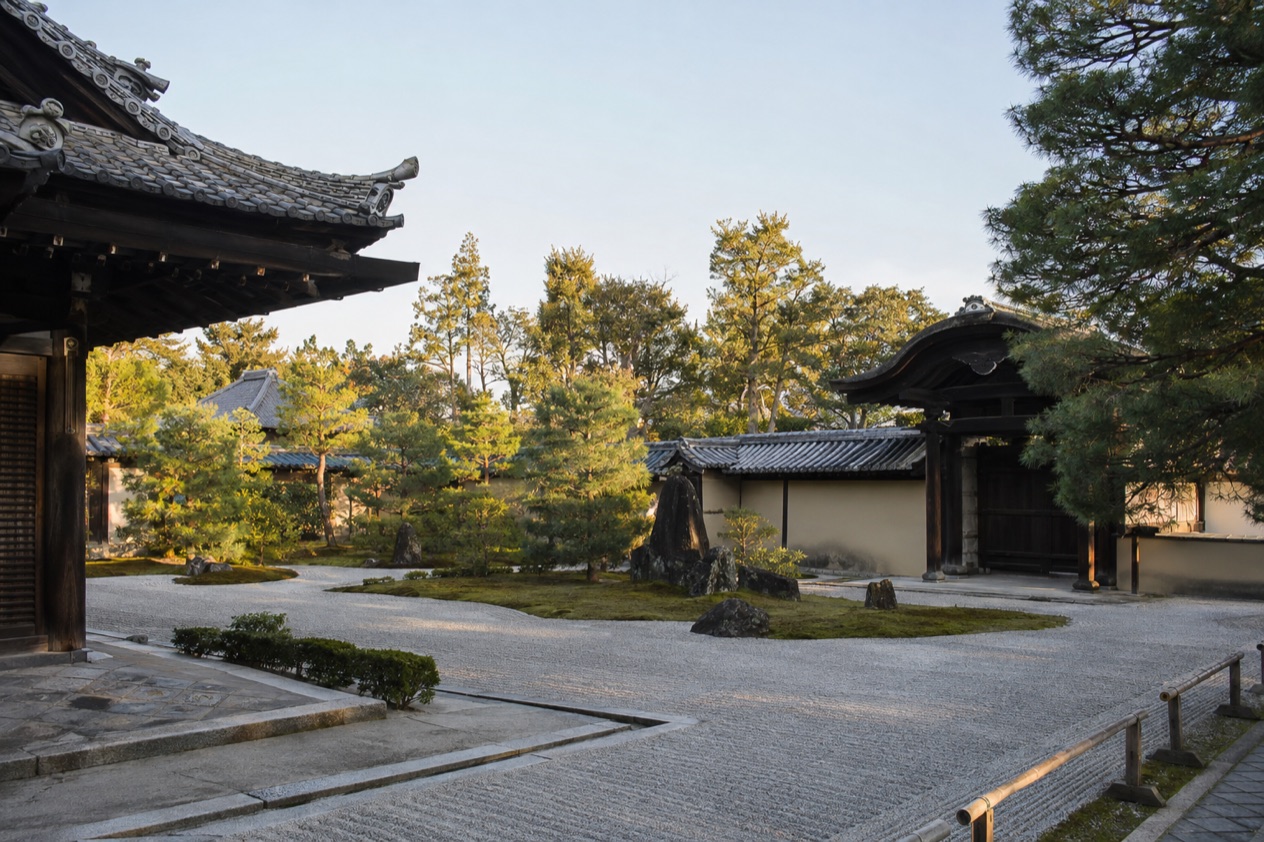
Walking into Daitoku-ji, you leave Kyoto’s street noise behind and pass between long earthen walls, tiled roofs and pine branches that lean over the paths. Gravel crunches underfoot, and the big wooden gates and halls stand set back among the trees. This is a Zen monastery complex made of a main temple and a cluster of smaller temples, a place for slow wandering and looking.
Is visiting Daitoku-ji worth it?
Yes, if you like Zen Buddhism, gardens, tea culture and architecture, and you are happy to take a place as it is rather than tick off a single headline sight. Daitoku-ji suits travelers who enjoy seeing how a large temple community is laid out, with gates, halls and lanes linking one compound to the next.
What sets it apart from the other temples on a Kyoto itinerary is that it is not one building but a small world. The grounds cover more than 57 acres, and the main temple itself is not open to the public.
The experience is therefore about the lanes, the walls, the gates seen from outside and whichever sub-temples you can enter, since many are also closed to visitors. Daitoku-ji asks you to explore and choose.
It also carries a strong link to the tea ceremony, through Sen no Rikyu, the tea master tied to the Sanmon gate. If Kyoto for you means gardens, tea and Zen rather than gold-leaf pavilions, this is a stop that rewards that interest.
Kyoto’s cultural heritage has developed over the past 1,200 years, according to the Japan National Tourism Organization, and Daitoku-ji shows a thread of that history in wood, stone and moss rather than in a single monument. Come with curiosity and a taste for detail, and you will leave with a clear picture of what a Zen temple precinct feels like.
What to see at Daitoku-ji
The visit is built around the gates and halls of the main temple, the abbot’s quarters and a handful of sub-temples whose names recur in every description of the complex. Because the main temple and many of the sub-temples are closed to the public, think of this as a walk through a monastery district, looking closely at what stands in the open.
The Sanmon gate
The Sanmon is the two-story gate, and its story is layered. The lower level was completed in 1529, and the upper level was completed by Sen no Rikyu in 1589. Rikyu is the tea master who shaped the Japanese tea ceremony, so the gate links the monastery directly to the world of tea.
A well-known tale says that Rikyu placed a statue of himself on the upper level, and that this angered the warlord Toyotomi Hideyoshi, who passed beneath it. Whatever the details, look at the deep eaves, the heavy timber and the way the gate frames the path behind it. It is a good place to slow down and take in the proportions before going deeper into the grounds.
The Butsuden, the Hatto and the main temple buildings
At the heart of the complex stand the Butsuden, the main hall, rebuilt in 1665, and the Hatto, the lecture hall, rebuilt in 1636. Alongside them are the Kyozo sutra repository, built in 1636 as well, and the Shoro bell tower, rebuilt in 1583. The bathhouse was rebuilt in 1622, a reminder that a Zen monastery is a working community with practical buildings as well as halls for ritual.
The main temple is not open to the public, so these structures are something to appreciate as part of the layout: the straight lines of the roofs, the dark timber and the open gravel around them. The Chokkumon gate, also called the Imperial Envoy’s gate, was moved to its current location in 1640, and its name hints at the imperial ties of the temple.
The Hojo, the abbot’s chamber
The Hojo was the abbot’s residence and reception space. It was rebuilt in 1635, and it is a National Treasure. Buildings of this kind typically have sliding paper doors, tatami rooms and verandas that look onto a garden, and they show how a senior Zen priest lived and received guests.
If you can see it, pay attention to the simple lines, the wooden veranda and the way the rooms are designed to open toward the garden. It is the kind of building where the small details matter more than any grand gesture, which fits the Zen spirit of the whole complex.
Daisen-in, Juko-in and Shinju-an
Daitoku-ji operates about twenty-two sub-temples, and the most significant are Daisen-in, Juko-in and Shinju-an. Each is a small temple with its own gate, halls and garden, almost a separate world inside the walls. Daisen-in is widely associated with a dry landscape garden, where raked gravel and arranged stones suggest mountains, rivers and the flow of time.
Juko-in and Shinju-an are tied to the monastery’s tea and Zen traditions. Many of the sub-temples are not open to the public, so the part of the visit you can enter depends on which ones receive visitors. Even from the lanes, the entrance gates, the moss-edged walls and the clipped trees give each compound its own character.
Hours, tickets and rules
Daitoku-ji is not a single ticketed attraction with one set of hours. The main temple is not open to the public, and many of its sub-temples are also not open to the public, so access is a matter of which compounds you approach. The grounds are a monastery district, and the buildings that can be entered are the smaller temples that receive visitors.
Because each sub-temple operates on its own, the rhythm of a visit differs from a place with a central gate and a ticket booth. You wander the lanes, look at what stands in the open and step into the compounds that welcome guests. The site is large, so there is room to choose a few places and take them slowly rather than rushing through all of them.
The rules stated for the site are short and clear. The main temple is closed to visitors, and many sub-temples are closed to visitors as well. Beyond that, treat the grounds as an active religious precinct, where shoes come off at the entrance of halls and voices drop inside the compounds, as at any Zen temple.
When to visit Daitoku-ji
The Japan National Tourism Organization recommends visiting Kyoto’s shrines and temples at less crowded times, such as early morning or late evening when they are illuminated. For a monastery complex of this size, an unhurried start to the day suits the setting, with its long walls and wooded lanes.
As for seasons, each has a different mood. Autumn brings mild days in Kyoto, with golden light on tiled roofs and the gardens turning toward their colors. Spring is soft and green, with rain in some stretches.
Summer is hot and humid, and the shade of the pines and the covered verandas matter more. Winter is cold, and snow or sleet shows up on more days than rain, so a visit then may bring a chance of a dusting over the roofs and gravel.
| Month in Kyoto | Average high (°F) | Average low (°F) | Precipitation (inches) | Days with rain of at least 0.04 inch | Hours of sunshine |
|---|---|---|---|---|---|
| January | 48.4 | 34.7 | 2.10 | 6.4 | 124 |
| April | 68.2 | 48.6 | 4.61 | 9.4 | 177 |
| July | 89.6 | 74.5 | 8.80 | 11.6 | 143 |
| October | 74.1 | 57.9 | 5.64 | 8.2 | 156 |
In practice, the cooler months are the easiest for a long day of walking between compounds, with a light jacket in the morning and shirt sleeves by afternoon. July asks for a hat, water and a slower pace, and the damp air makes the covered corners welcome. January suits travelers who like a crisp, bare landscape and do not mind wearing layers outdoors.
Rainy days have their own charm in a Zen temple, when wet stones darken, moss glows and the sound of water drips from the eaves. Just bring a compact umbrella and shoes that slip on and off easily.
Tips for your visit
Wear shoes that come off and go on without fuss, since entering a hall or a sub-temple means taking them off. Add socks without holes, and in cooler months a layer you can shed indoors. Grounds this large reward comfortable footwear for walking on gravel and stone paths.
Plan to choose a few places rather than all of them. With about twenty-two sub-temples and many closed to the public, the visit works best when you pick a handful and give each time.
Start with the Sanmon gate and the lanes around the main buildings, then move to a sub-temple with a garden where you can sit and look. Sitting on a veranda facing raked gravel is, for people, the heart of a Zen temple visit.
Daitoku-ji combines well with other Kyoto sights that show a different side of the city. Nijo Castle in central Kyoto was built in 1603 by Tokugawa Ieyasu, the first shogun of the Edo period, and its nightingale floors make a bird-like sound underfoot.
Going from a Zen monastery to a shogun’s castle shows how varied Kyoto’s heritage is. The city also carries traditions such as machiya townhouses, the Gion Matsuri festival and the hanamachi districts where geishas live and work.
For arriving in the city, Kyoto Station is served by the Tokaido Shinkansen line, and its building holds a full floor of ramen restaurants, an Isetan department store, a theater and a Granvia hotel. A bowl of ramen there makes an easy way to end a day of temple walking.
With families, keep expectations simple: gravel paths, steps into halls and a setting that asks for lowered voices. Children who like exploring gates and spotting details tend to enjoy a monastery of this scale. For travelers who find uneven ground tiring, the gravel and stone steps are worth planning around, and a slower pace through fewer compounds works well.
Good to know before you go
Daitoku-ji is a working Zen monastery, so dress modestly, keep voices low and follow the habits of the place: shoes off at the entrance of halls, and respect for spaces that are closed. Carry yen for any small purchases, and bring a light rain layer, since Kyoto sees showers in every season. A visit usually blends with a stroll through the neighboring streets and a meal afterward.
Sources
- Wikipedia, Daitoku-ji (https://en.wikipedia.org/wiki/Daitoku-ji), checked October 11, 2026
- Japan National Tourism Organization, Kyoto (https://www.japan.travel/en/destinations/kansai/kyoto/), checked October 11, 2026
- Japan Meteorological Agency (JMA), Normal values 1991-2020, monthly (https://www.data.jma.go.jp/stats/etrn/view/nml_sfc_ym.php?prec_no=61&block_no=47759), station Kyoto, elevation 41 m, checked October 11, 2026
To plan your stay
- Best Time to Visit Japan: Cherry Blossoms, Autumn Colors, Weather and Festivals
- Where to Stay in Japan: Ryokan, Temple Stays, Capsule Hotels and the Best Cities to Base In
- Sending Luggage from the Airport in Japan: Hands-Free Travel, Hotel Delivery and Coin Lockers
- Know Before You Go to Japan: Entry, Money, Etiquette and Getting Around