
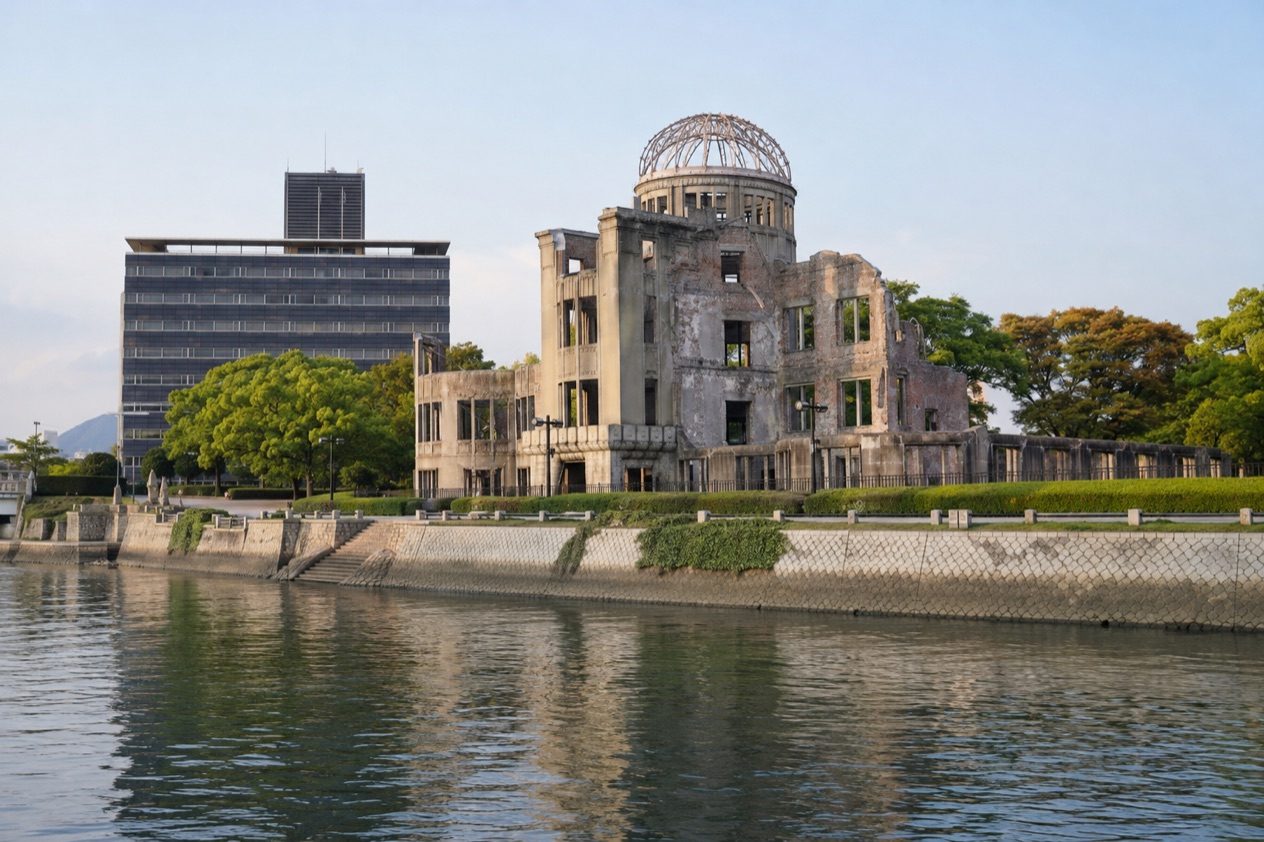
You come around a corner in Hiroshima and the river opens up, and there it is across the water: a skeleton of a dome, its steel ribs bare against the sky, brick walls torn open and held in place. Nothing around it is ruined, which is what makes it so hard to look away from. This is a visit of standing, looking and thinking, set inside the Peace Memorial Park, and it suits travelers who want Hiroshima to mean more than a stop between trains.
Is visiting the Atomic Bomb Dome worth it?
Yes, for almost anyone who is in Hiroshima, and especially for travelers who want to understand what happened here on August 6, 1945, at 8:15 in the morning. The Dome is a building you look at rather than tour.
There is no ticket line to stand in and no interior to explore, because visitors cannot enter it and can only view it from the outside. What you take away comes from the building itself and from the quiet it asks of you.
It also differs from the other places people line up for in the region. Miyajima Island gives you a red torii gate standing in the sea, deer, and a shrine registered as a World Heritage Site in the same year as the Dome. Okunoshima has its rabbits.
Hiroshima Prefecture as a whole offers the Seto Inland Sea, wooded mountains and clear waters. The Dome belongs to another register altogether. It is the one place in the prefecture where the subject is memory, and it keeps its weight beside the shrines and the scenery.
The structure survived because the explosion happened almost directly overhead, and its vertical columns resisted the downward force. That detail changes how you read it. The walls are not a picture of general destruction.
They are the one frame that happened to hold, and the city later chose to keep it as it was. In 1966 the Hiroshima City Council adopted a resolution to preserve it permanently, and the UNESCO World Heritage listing followed in December 1996.
The place has also drawn visitors who shape how people remember it. Barack Obama was the first sitting U.S. president to visit the Memorial, on May 27, 2016. The leaders of the 49th G7 summit came on May 19, 2023. For an American traveler, that gives the visit a particular resonance, and it is reason enough to make the time rather than skip it for a more cheerful day on the water.
What to see at the Atomic Bomb Dome
The Dome from across the river
The classic view is the whole building seen across the water, with the river in front of it and the sky showing through the iron frame at the top. Look first at the bare ribs of the dome, then drop your eyes to the walls below, where stone and brick are cracked and stained. Windows are empty, floors have collapsed, and fragments hang where they were left.
What strikes most people is how much has been done to keep the ruin steady without making it look repaired. The building is held as it was found, which is the point. Stand for a while rather than photographing and moving on. The shape reads differently as you shift a few steps along the bank.
A walk around the outside
Since you cannot go in, the visit is a slow walk around the outside, and it rewards that pace. From the side you see how the dome sits on a square body, how the wall fragments lean, and how the structure stands against modern buildings in the background. The contrast between the two is part of what the site says about the city that rebuilt itself around it.
Look at the bases of the columns and the way the remaining brickwork is exposed. Those vertical columns are what kept the frame upright when the force came straight down. It is a plain engineering fact, and it makes the building feel less like a symbol and more like a witness.
The Peace Memorial Park around it
The Dome stands within the Hiroshima Peace Memorial Park, and the adjacent park shares its World Heritage designation. Together they form a single place for reflection. The Dome is the part that stayed standing, and the park is the part that was created afterward, so that you can move from one to the other in the same visit.
Give the park its own time rather than treating it as a corridor to the Dome. Its paths, monuments and open ground are where many visitors sit, read, and take in what they have seen. Hiroshima’s municipal government holds the annual Hiroshima Peace Memorial Ceremony at the Memorial, which tells you how much the place is part of the city’s daily life as well as its history.
The river and the lanterns of August 6
The river in front of the Dome has its most moving evening on August 6. During the ceremony that day, thousands of people write peace messages on lanterns. The lanterns are lit at sunset and floated along the river passing in front of the Atomic Bomb Dome, so the water carries small lights past the ruin.
If you are here on another day, the riverbank still makes a fine place to stop. You can picture the scene by looking at where the water bends past the building. The lantern tradition gives the river a second meaning, and it is worth knowing when you stand on the bank on an ordinary afternoon.
Hours, tickets and rules
The Atomic Bomb Dome is a monument seen from the outside, so a visit does not run on a ticket counter and a timetable the way a temple or museum does. It stands in the Hiroshima Peace Memorial Park, and the experience is simply arriving, looking and walking around it. There is no interior route to plan and no tour to schedule around the building itself.
That shapes how you use your time. You decide when to come and how long to stay, and the building is there as you find it. The park around it is the setting for the annual Hiroshima Peace Memorial Ceremony, which the city’s municipal government holds at the Memorial, so on that day the surroundings are given over to the ceremony.
The one firm rule concerns entry. Visitors cannot enter the Atomic Bomb Dome in Hiroshima, and it can only be viewed from the outside. Plan the visit around that, with the riverbank and the park as your viewing places.
When to visit the Atomic Bomb Dome
The date that matters most is August 6. The Hiroshima ceremony takes place that day, and in the evening thousands of lanterns carrying handwritten peace messages are lit at sunset and floated along the river in front of the Dome. It is the most meaningful moment to be there, and it is a different kind of visit from a regular day.
For the rest of the year, the weather decides how the walk feels. Hiroshima’s own figures show four distinct seasons around the Dome, and since the visit is an outdoor one, they matter. Winter is cold, with some snow and sleet. Spring is mild and gets more rain. Summer is hot, humid and the wettest. Autumn is mild and fairly sunny.
| Month | Average high (°F) | Average low (°F) | Precipitation (inches) | Days with rain | Sunshine (hours) |
|---|---|---|---|---|---|
| January | 49.8 | 35.6 | 1.82 | 5.5 | 139 |
| April | 67.6 | 50.2 | 5.55 | 8.8 | 192 |
| July | 87.6 | 75.4 | 11.02 | 10.6 | 173 |
| October | 74.7 | 58.8 | 4.30 | 6.2 | 179 |
January is cold enough for a heavy coat and gloves, and a visit that month can include snow or sleet on a good number of days. Dress in layers, since you will be standing outside rather than moving between warm rooms.
April brings mild afternoons, with rain on some days. October is the most comfortable of the four months in the table, with warm afternoons, cool evenings and a good amount of sunshine. July is hot and humid, with the heaviest rain, so expect to be sweating by midday and to want a light rain jacket close by.
Tips for your visit
Bring what suits the month you come. A hat and water for July, a warm layer for January, and a light rain jacket for April or July. Since you are outside, comfortable shoes help for the walk around the Dome and through the park. Beyond that, the visit asks for very little equipment and a good amount of attention.
Allow yourself time that is not tied to a schedule. The Dome itself is a look from outside, but the park around it invites more than a glance, and many people end up staying longer than they planned. Plan the day so that nothing presses you to leave right after you arrive.
Getting to Hiroshima
Hiroshima is reached by shinkansen, about four hours from Tokyo and 90 minutes from Osaka. That puts the Dome within reach of a long day from Osaka, though a night in Hiroshima gives the visit room to breathe. Staying in the city also lets you see the river and the park at more than one point in the day.
What to pair it with
The natural companion is the Peace Memorial Park, which shares the Dome’s World Heritage designation and sits right beside it. After that, the mood can lighten with a plate of Hiroshima’s local version of okunomiyaki, the savory griddle dish the city is known for, which appears among the notable places and tastes mentioned for Hiroshima. Look for it in the city’s okonomiyaki restaurants.
Miyajima Island makes a second outing for another day. It is known for its deer and for Itsukushima Shrine, with its red torii gate standing in the sea. Okunoshima is another excursion, where visitors must not chase or pick up the wild rabbits and should provide appropriate food in a safe place. Both offer a very different mood from the Dome.
Good to know before you go
Treat the Dome as a memorial. People come to it to reflect, so voices tend to drop and photographs are taken without fuss. Dress for the weather, since the whole visit is outdoors.
July brings the most rain and humidity of the months in the table, so a rain layer is useful then, and January calls for warm clothes. Hiroshima’s lanterns, ceremony and riverbank are most affecting when you arrive without a rush and leave the afternoon open.
Sources
- Wikipedia, Hiroshima Peace Memorial (Genbaku Dome) (https://en.wikipedia.org/wiki/Hiroshima_Peace_Memorial_(Genbaku_Dome)), checked October 11, 2026
- Japan National Tourism Organization, Hiroshima (https://www.japan.travel/en/destinations/chugoku/hiroshima/), checked October 11, 2026
- Visit Hiroshima, the official guide (https://visithiroshima.net/), checked October 11, 2026
- Japan Meteorological Agency (JMA), Normal values 1991-2020, monthly (https://www.data.jma.go.jp/stats/etrn/view/nml_sfc_ym.php?prec_no=67&block_no=47765), station Hiroshima, elevation 4 m, checked October 11, 2026
To plan your stay
- Best Time to Visit Japan: Cherry Blossoms, Autumn Colors, Weather and Festivals
- Where to Stay in Japan: Ryokan, Temple Stays, Capsule Hotels and the Best Cities to Base In
- Sending Luggage from the Airport in Japan: Hands-Free Travel, Hotel Delivery and Coin Lockers
- Know Before You Go to Japan: Entry, Money, Etiquette and Getting Around