
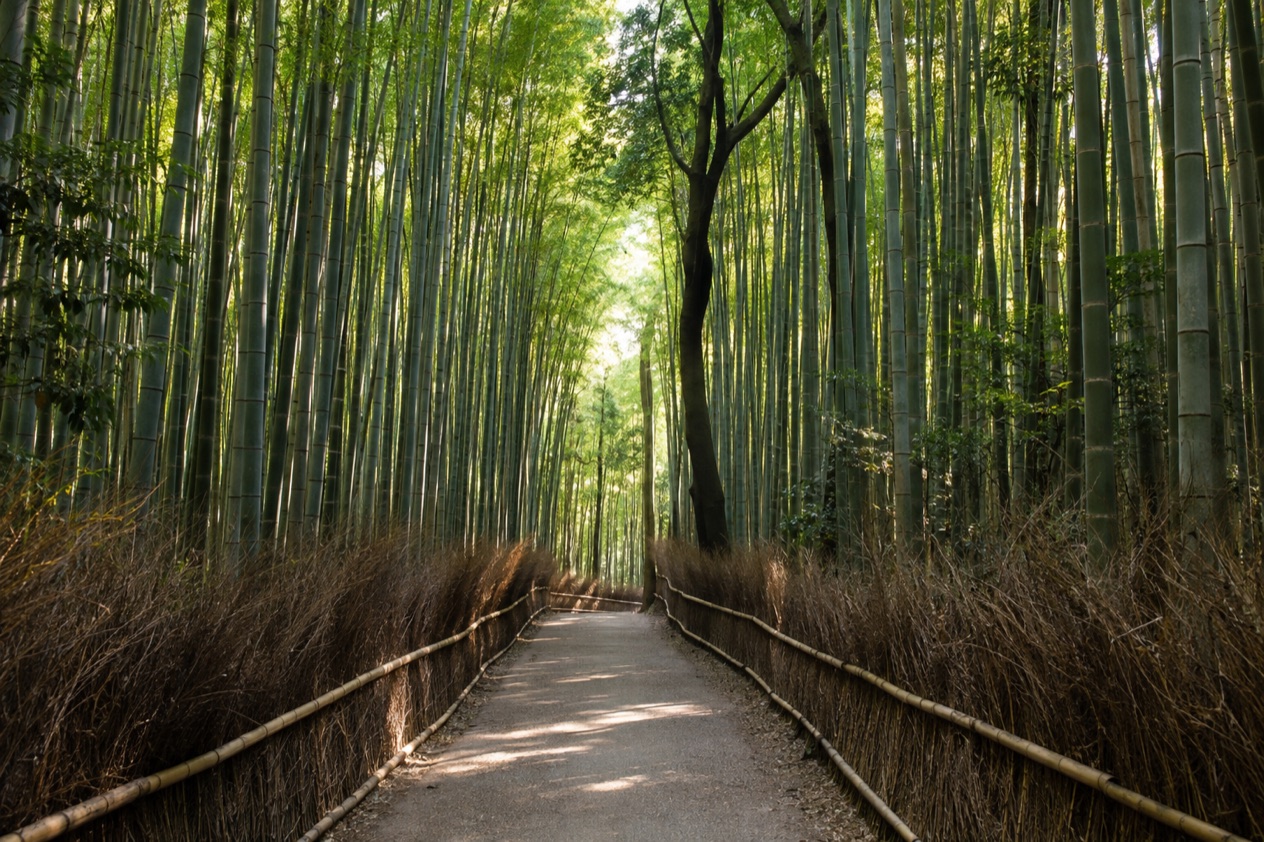
Stalks of bamboo rise on both sides of the path, and the light that reaches the ground comes down green and filtered. Overhead the stems creak and clatter against one another whenever the wind moves through them. The Arashiyama Bamboo Grove, also called the Sagano Bamboo Forest, is a walk among tall canes in the western part of Kyoto, and it fits easily into a day spent among the temples and the river of Arashiyama.
Is visiting the Arashiyama Bamboo Grove worth it?
Yes, if you like atmosphere more than monuments: the grove has no gate to admire and no hall to enter, and its pleasure is the walk itself, among green stems that sway and knock together in the breeze. It suits photographers, couples, first-time visitors to Kyoto and anyone who wants a change from stone, wood and gold after several days of temples.
What sets it apart from the other sights nearby is that it is a landscape rather than a building. Kyoto’s heritage has grown over some 1,200 years, and most of what travelers come for is a shrine, a castle or a teahouse.
Here the subject is a plant, and the experience is one of sound, light and movement. The canes sway, the leaves whisper, and the color changes with the weather. A bright day gives a luminous green, while a gray or damp one makes the path darker and more hushed.
The grove is also one stop in a district with a lot to see. Arashiyama is known for Tenryu-ji, a Zen temple, for Togetsukyo Bridge across the river, for a hillside monkey park and for villas with gardens that turn red in autumn. Seen alone, the bamboo is a short pleasure. Seen as the anchor of an Arashiyama day, it becomes a good reason to travel out from central Kyoto and to take the neighborhood at a slow pace, with a lunch, a river view and a temple garden around it.
A word of realism helps too. The grove is a well-known place, and a path of this kind is shared with other walkers, so the photographs of an empty green tunnel come from patient timing. Visitors who treat it as a stroll rather than a trophy tend to enjoy it more, noticing the sound of the stalks, the smell of damp earth and the way the path bends.
What to see at the Arashiyama Bamboo Grove
The bamboo path itself
The heart of the visit is the path through the tall stalks. The canes grow close together and reach far overhead, so the walk feels enclosed, with the sky reduced to a green-tinted glow. Listen as much as you look. When the breeze rises, the stems knock softly and the leaves rustle high above, a sound that people remember longer than the view.
Look for the way the light changes along the path, and for the lines of the stalks, which make strong vertical frames for photographs. The place is known under two names, Arashiyama Bamboo Grove and Sagano Bamboo Forest, and you will see both on signs and maps.
Tenryu-ji and its garden
Tenryu-ji is the main temple of one of the 15 branches of the Rinzai school, a major Zen Buddhism sect in Japan. Tenryu-ji is a natural companion to the grove because both are in the same district. Zen temples of this kind are known for gardens arranged for slow looking, with ponds, stones and trimmed trees set against a backdrop of hills.
Take your time on the veranda and in the garden, and notice how the planting changes through the year, from blossom in spring to red leaves in autumn. It is a good place to sit for a while after the movement of the bamboo path.
Togetsukyo Bridge and the river
Togetsukyo Bridge is the landmark of the riverfront and offers notable views of cherry blossoms in spring and autumn colors on the slopes of Arashiyama. The wooden bridge of the original structure dates back to 836, and the bridge was rebuilt in 1934, mostly in concrete.
Stand on it and look up at the wooded hillside, then along the water. It is a natural place to pause, and the view changes with the season, which is why it appeals to people returning at a different time of year.
Iwatayama Monkey Park
Iwatayama Monkey Park lies on the slopes of Arashiyama, on a small mountain not far from the Saga-Arashiyama rail station, and is home to over 170 monkeys. At the summit, visitors can feed the monkeys from inside a fenced enclosure, which gives the visit a playful side that contrasts with the quiet of the bamboo.
It suits travelers who want an active, lively addition to the day, and it is a change of tempo after temples and gardens. Watch the animals, and enjoy the outlook from the heights over the district.
Okochi Sanso and Matsunoo Taisha
Okochi Sanso, in Arashiyama, is a garden estate where cherry trees bloom in spring and the leaves turn red in autumn. Matsunoo Taisha, a shrine half a mile south of Arashiyama, was founded in 700 and is one of the oldest shrines in the Kyoto area.
One offers a seasonal garden, the other a shrine with a long history, and both reward travelers who have time to go beyond the main path.
How to get to the Arashiyama Bamboo Grove
The grove sits in Arashiyama, which can be reached by two railways from the center of Kyoto and from Osaka. Both stop at their own stations in the district, and the bamboo lies within the Arashiyama area, so the journey ends on foot.
By the Keifuku Electric Railroad
Arashiyama is accessible from central Kyoto by the Keifuku Electric Railroad, which stops at Arashiyama Station (Keifuku). This is the link from the city side, so it suits travelers staying in central Kyoto who want to go straight to the district. From the station you continue on foot within Arashiyama, passing the other sights of the area as you go.
By the Hankyu Arashiyama Line
The Hankyu Arashiyama Line reaches Arashiyama Station (Hankyu), starting from Katsura Station, with connections from Osaka and Kyoto. That makes it the option to consider for visitors coming from the Osaka side, who can join the line at Katsura. As with the other railway, the end of the ride leaves you in the district, from where the bamboo is a walk away.
Starting from Kyoto Station
Kyoto Station is served by the Tokaido Shinkansen line, which connects the city to major cities across Japan, and it is the starting point for exploring Kyoto’s sights. The station building holds a full floor of ramen restaurants, an Isetan department store, a theater and a Granvia hotel, so it is a convenient place to eat or to meet before heading west. Saga-Arashiyama rail station is the one near Iwatayama Monkey Park, which is worth knowing if you plan to add the park to your day.
When to visit the Arashiyama Bamboo Grove
Kyoto’s tourist advice is to see shrines at less crowded times, such as early morning or late evening when they are illuminated. The same logic is a sensible one for a place that draws many walkers, and it suits the bamboo as well, since a path shared with fewer people is easier to enjoy.
Spring and autumn
The district is prettiest around the grove when the seasons turn. Togetsukyo Bridge looks out on cherry blossoms in spring and on autumn colors on the hillsides, and Okochi Sanso has cherry trees in bloom in spring and red leaves in autumn. April in Kyoto brings highs near the upper 60s with lows in the upper 40s, and about nine days with rain, so a light layer and a small umbrella suit it.
October is milder in the afternoon, with highs in the mid-70s and cooler evenings, and around eight days with rain. These are the months travelers choose for walking, because the temperatures suit a long day outdoors.
Summer and winter
July is hot and humid, with highs near 90°F and rain on around twelve days, so the shade of the bamboo is welcome while the rest of the day asks for water and a slow pace. January is cold, with highs in the upper 40s and lows in the mid-30s, and snow or sleet can fall on many days of the month, so warm layers matter.
A winter visit has its own appeal, since the stalks stay green against a gray sky and the district is calmer in mood. Check the sky before you set out, and plan the bridge, the garden and the monkey park around the weather.
| Month in Kyoto | Average high (°F) | Average low (°F) | Rain days | Precipitation (in) |
|---|---|---|---|---|
| January | 48.4 | 34.7 | 6.4 | 2.10 |
| April | 68.2 | 48.6 | 9.4 | 4.61 |
| July | 89.6 | 74.5 | 11.6 | 8.80 |
| October | 74.1 | 57.9 | 8.2 | 5.64 |
Tips for your visit
Wear comfortable shoes and bring a light layer or an umbrella, since the path and the district are explored on foot and the weather in Kyoto changes through the year. In summer, add water and a hat. In January, dress in warm layers.
Building a day around the grove
The grove combines well with the rest of Arashiyama. A natural sequence is Tenryu-ji and its garden, then the bamboo path, then the river and Togetsukyo Bridge. Add the monkey park if you want something livelier, and Okochi Sanso if you enjoy gardens that change with the season.
Matsunoo Taisha, the old shrine half a mile south of Arashiyama, is a good extension for those who like shrines and have time to spare. A day spread across these places leaves room for a long lunch and a rest on the riverfront.
Families and mobility
Children often enjoy the monkey park, where visitors can feed the animals inside a fenced enclosure at the summit. The park lies on the slopes of a small mountain, so think about whether it suits everyone in your group before you plan it into the day.
For the rest, the district is explored on foot, and the pace is yours to set. Pauses on the bridge, in a temple garden or at a café make the day more comfortable for travelers of every age.
Good to know before you go
Arashiyama rewards a slow visit, so leave room for meals and rests rather than filling every hour. Kyoto in July is hot and humid, and the rainy days of the year can fall in any month, so a compact umbrella is worth carrying. , and respect the quiet of the temples and the people who live and work around the grove.
Sources
- Wikipedia, Arashiyama (https://en.wikipedia.org/wiki/Arashiyama), checked October 11, 2026
- Japan National Tourism Organization, Kyoto (https://www.japan.travel/en/destinations/kansai/kyoto/), checked October 11, 2026
- Japan Meteorological Agency (JMA), Normal values 1991-2020, monthly (https://www.data.jma.go.jp/stats/etrn/view/nml_sfc_ym.php?prec_no=61&block_no=47759), station Kyoto, elevation 41 m, checked October 11, 2026
To plan your stay
- Best Time to Visit Japan: Cherry Blossoms, Autumn Colors, Weather and Festivals
- Where to Stay in Japan: Ryokan, Temple Stays, Capsule Hotels and the Best Cities to Base In
- Sending Luggage from the Airport in Japan: Hands-Free Travel, Hotel Delivery and Coin Lockers
- Know Before You Go to Japan: Entry, Money, Etiquette and Getting Around