
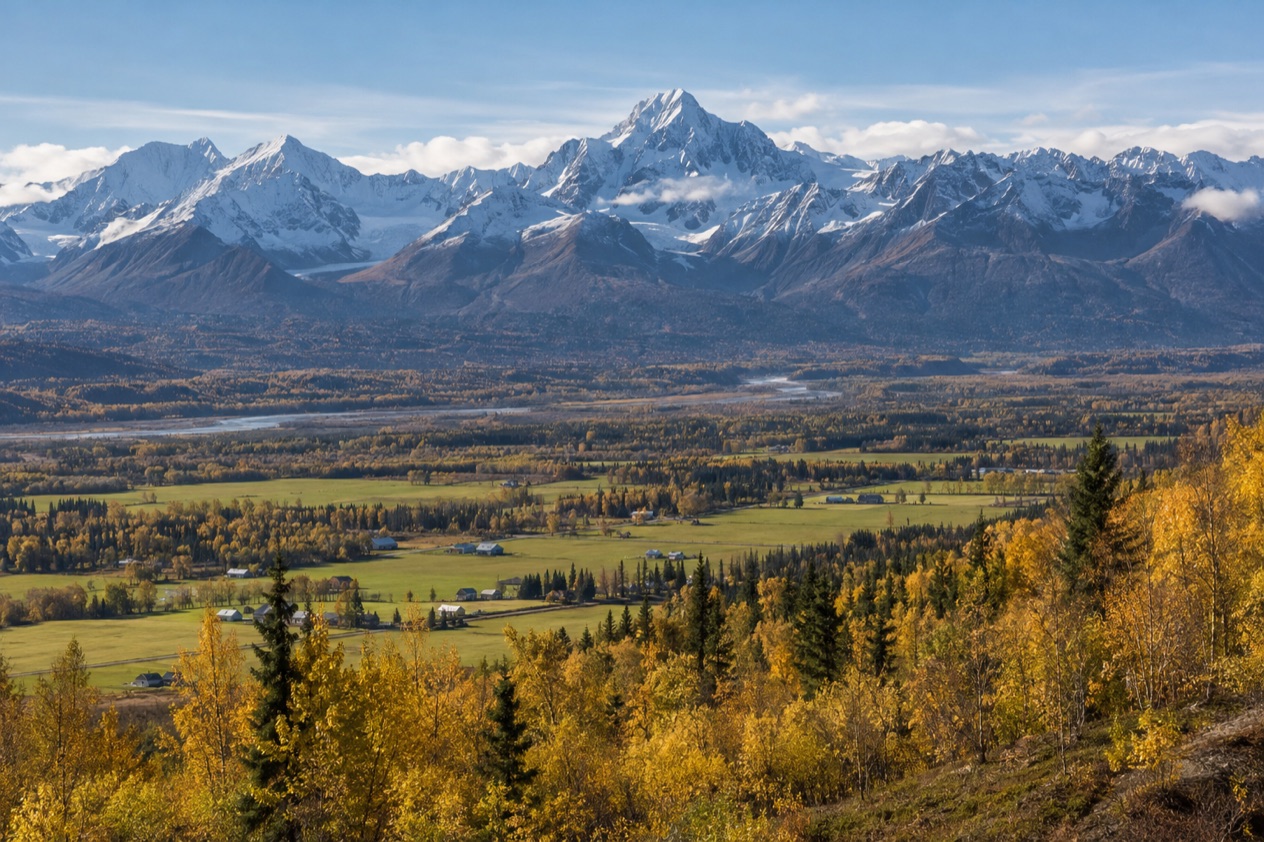
In September, the Matanuska Valley smells of cold earth, woodsmoke and cut vegetables, and the fields around Palmer hold the last heavy crops of the year. Birch leaves start to turn at the edges of the roads, and the mountains above the farms look sharper in the clearer air. Wasilla and Palmer in September are a harvest-and-color month, for travelers who like farm stands, fairground food and crisp days outdoors.
What is the weather like in Wasilla and Palmer in September?
September is cool and mostly bearable, with pleasant afternoons in a jacket, frosty mornings and a fair chance of a wet day or two. The summer warmth is gone, and the days are shortening fast.
| Month | Average high (°F) | Average low (°F) | Precipitation (in) | Days with precipitation | Daylight on the 15th |
|---|---|---|---|---|---|
| August | 64.6 | 48.2 | 2.32 | 6.2 | 16 h 02 min |
| September | 55.8 | 40.8 | 2.08 | 6.0 | 13 h 04 min |
| October | 42.3 | 28.6 | 1.25 | 3.4 | 10 h 11 min |
Mornings start close to freezing in feel, so a hat and gloves are welcome until the sun gets over the mountains. By afternoon, a light fleece or a sweater is usually enough, and you may peel it off on a sunny stretch.
Rain in September comes in passing showers and the occasional gray day, not in long downpours. It tends to fall on only a handful of days, so most of the month is dry enough to plan around outdoor stops. A waterproof shell is more useful than an umbrella, because the valley can be breezy.
The light has changed since summer. Daylight still stretches into the evening, but you notice dusk arriving earlier each week, and the low sun gives the farm fields and the Chugach and Talkeetna ridges a warm, slanted glow. After dark, the sky is finally dark enough to give the northern lights a chance.
What to do in Wasilla and Palmer in September
The great event of the month is the Alaska State Fair in Palmer, the valley’s annual gathering, where world-record-sized cabbages and other vegetables are displayed. The fair belongs to the end of summer, and its last days often reach into early September, so it can be part of an early-month trip. It makes sense in this valley, where farmers settled in the 1930s through a government project and the borough remains one of the few agricultural areas in Alaska.
Think of the fair as a farm show first. You walk past enormous squash and cabbages, flower and canning displays, livestock barns and rows of fried and grilled food stands, with the mountains standing behind the fairgrounds. Even after the fair, the valley’s farm identity is in the air. Roadside stands and local growers sell the late harvest, and the cool weather suits root vegetables, apples where they grow and hearty soups.
Palmer: farm town, fair and murals
Streets of low buildings, a railroad-era feel and a few historic farm structures from the colony days give it a more settled look than the highway strip of Wasilla. Cafés and small shops cluster around the middle of town, and a slow coffee stop fits a September morning when the air is sharp.
Palmer lies 42 miles northeast of Anchorage on the Glenn Highway, so it works as a day out from the city or as a base for the valley. Come in the middle of the day, when the light is warmest and the mountain walls behind town are clear.
It suits travelers who like a small town with farms at its edges, and a half day is plenty for the center. Palmer also houses the National Tsunami Warning Center, a quiet reminder of Alaska’s coastline.
Wasilla: lakes, sled dogs and a working town
Wasilla is the borough’s largest incorporated community, and it feels like a busy hub, with shops and restaurants strung along its main roads. It is also tied to Alaska’s sled-dog culture, since the Iditarod Trail Committee has its headquarters here. In September the dog yards are quiet, but the town’s relationship to mushing is part of the local identity, and the cool season is when talk turns toward winter training.
You may spot waterbirds on calm days, though that is a chance, not a promise. Wasilla suits families and anyone who wants practical stops, meals and gas in the same place as a bit of lake scenery.
Matanuska Glacier from the valley
Matanuska Glacier is a valley glacier 27 miles long and 4 miles wide, and it is the largest glacier accessible by car in the United States. It lies near the Glenn Highway in Glacier View, about 100 miles northeast of Anchorage. The Glenn Highway from Palmer leads toward it, and the road itself passes through some of the valley’s most open country.
What you see is a huge river of blue-gray ice spilling out of the mountains, framed by hills that may carry autumn color. September’s clearer air and lower sun suit photographs, and the cool temperatures mean you want real layers at the viewpoint. This is an outing that takes most of a day from Palmer or Wasilla, so pair it with a long lunch rather than a rush back.
Eklutna Native Historical Park
Eklutna Native Historical Park sits 9 miles south of the Glenn and Parks Highway junction, reached by a right exit on the southbound lane of the Glenn Highway. It is a place to learn about Dena’ina Athabascan history and to take in a quiet landscape. It fits on the way between Anchorage and the Mat-Su Valley, and it gives the day a cultural stop to balance the farms and glaciers.
Visit it on a calm, dry morning, when the air is still and the trees are turning. The setting asks for slow walking and quiet voices, so it suits travelers who want context for the valley beyond the fair and the farms.
Moose are part of the valley’s backdrop, and a September drive may bring a sighting along the edges of fields or lakes. Adult moose range from 800 to 1,600 pounds and can stand almost 6 feet tall, with antlers carried only by the males. Treat any sighting as a chance, and watch them from the car or a respectful spot.
After dark, September opens the aurora season. The northern lights oval covers most of Alaska, and the lights are active over Anchorage from late September through the middle of April. Activity also tends to be stronger around the equinox, but clouds decide everything, so treat a clear night as a bonus. The valley’s fields, away from the brightest city lights, make an open place to look up.
A two-day itinerary for Wasilla and Palmer in September
Day 1 is for Palmer and the farm side of the valley. Start with coffee and a slow breakfast in the center of Palmer while the morning chill lifts, then walk the town’s streets and its historic farm buildings. Late in the morning, move on to the fairgrounds area and the farm stands, where late-season vegetables and fair food make an easy lunch.
In the afternoon, when the light is warmest, head to Eklutna Native Historical Park for a quiet, unhurried visit. Return toward Palmer for an early dinner, and if the sky is clear after dark, step out into a field for a look at the stars.
Late September is when aurora season begins, so a clear night is worth a few minutes outside. Rain card: stay in the cafés and shops of Palmer, or linger over a long meal.
Day 2 turns to Matanuska Glacier and Wasilla. Leave early, because the day is long and the morning light is soft over the highway. Spend the middle of the day at the glacier viewpoint, with layers on, and eat a picnic or a hearty meal at a roadside spot on the return.
Back in Wasilla by late afternoon, stroll around Lake Lucille while the low sun warms the water. Finish with dinner at one of the town’s casual restaurants, where a bowl of something hot suits the cooling evening. If rain sets in, the glacier is still worth seeing from the road, and Wasilla’s indoor stops and restaurants can fill the rest of the day.
Is Wasilla and Palmer busy in September?
It is lively at the start of the month because of the Alaska State Fair in Palmer, and calmer once the fair ends and the valley turns toward fall.
The fair is the one gathering that pulls the valley together, and Palmer is where the energy concentrates while it runs. Wasilla, along the main highway, keeps its steady pace of local errands, meals and travelers passing through. Beyond the fair, September has the feel of a working farm region settling into the end of the growing season.
On the roads and at viewpoints such as Matanuska Glacier, the month feels more open than the height of summer, with the colors and cooler air giving the valley a slower mood. Because the short days start to matter, daylight shapes how busy any given stop feels. Mornings are quiet, middays are warmest, and evenings come early.
What to pack for Wasilla and Palmer in September
September rewards layers, because mornings are cold, afternoons are mild and showers come and go. Pack for farm fields, lake paths and a glacier viewpoint rather than for dinners out.
- A warm hat and gloves, for frosty mornings at the viewpoints.
- A fleece or wool layer, for the cool afternoons and breezes.
- A waterproof jacket, since the rain comes in showers.
- Waterproof walking shoes, for wet fields and lakeside paths.
- Sunglasses, for the low sun on clear days.
- A camera with a good low-light mode, for the evening glow and any aurora chance.
Good to know before you go
Daylight is the thing to plan around, because the days are noticeably shorter than in summer and keep shrinking through the month. Build your drives and outdoor stops into the middle of the day. Palmer sits 42 miles from Anchorage on the Glenn Highway, and Wasilla lies along the same corridor, so most of the valley fits around a flexible base. Matanuska Glacier asks for a longer day, so give it a morning start.
Wasilla and Palmer in September vs August and October
Moving four weeks earlier brings August’s longer, warmer days and the full flow of summer activity. The evenings stretch far later, the afternoons are noticeably milder, and the fair is in full swing. You trade the colors and the sharp fall light for extra daylight, which suits travelers who want the longest possible days outdoors.
Moving four weeks later brings October’s cold, a drier month with much shorter days and mornings well below freezing. The fair is over, the farm stands wind down and the valley turns quiet. In exchange, the dark sky comes earlier, which helps anyone chasing the aurora, since the season is well established by then.
September sits in between. Choose it if you want fall color, a farm-and-fair atmosphere and cool but workable weather. Shift earlier for the warmest days and the longest light, and later for the deepest dark and a quiet, wintry mood.
Is September a good time to visit Wasilla and Palmer?
Yes, for travelers who like cool air, farm country and the first hints of aurora season, and less so for anyone who wants warm, long summer days.
It suits people drawn to the Alaska State Fair, to oversized vegetables and the story of the 1930s farm colony, and to drives with colored hillsides. It also fits photographers, who get low sun and clear air, and anyone using the valley as a calm base next to Anchorage. Travelers who need warm afternoons, or want to count on a day without a shower, may prefer August.
On arrival, start in Palmer, where the farm side of the valley is easiest to read, then plan the glacier day around a clear forecast. Keep one evening free to step outside after dark. September in Wasilla and Palmer is the month when the harvest, the first aurora nights and the mountains in sharp light all arrive within a few weeks of each other.
Sources
- NOAA NCEI, U.S. Climate Normals 1991-2020, monthly (https://www.ncei.noaa.gov/access/services/data/v1?dataset=normals-monthly-1991-2020&stations=USW00025331), station Palmer Muni Ap, elevation 230 feet, checked October 11, 2026
- Computed from the date and the latitude of the place (sunrise equation, solar elevation -0.833 degrees), October 11, 2026
- Alaska Department of Fish and Game, Moose species profile (https://www.adfg.alaska.gov/index.cfm?adfg=moose.main), checked October 11, 2026
- Wikipedia, Moose (https://en.wikipedia.org/wiki/Moose), checked October 11, 2026
- University of Alaska Fairbanks Geophysical Institute, Aurora forecast (https://www.gi.alaska.edu/monitors/aurora-forecast), checked October 11, 2026
- Wikivoyage, Northern lights (https://en.wikivoyage.org/wiki/Northern_lights), checked October 11, 2026
- Wikipedia, Aurora (https://en.wikipedia.org/wiki/Aurora), checked October 11, 2026
- Visit Anchorage, northern lights viewing (https://www.anchorage.net/winter/things-to-do/northern-lights-viewing/), checked October 11, 2026
- Wikipedia, Palmer, Alaska (https://en.wikipedia.org/wiki/Palmer,_Alaska), checked October 11, 2026
- Wikipedia, Mat-Su Valley (https://en.wikipedia.org/wiki/Mat-Su_Valley), checked October 11, 2026
- Wikivoyage, Matanuska-Susitna Borough (https://en.wikivoyage.org/wiki/Matanuska-Susitna_Borough), checked October 11, 2026
- Wikipedia, Matanuska-Susitna Borough, Alaska (https://en.wikipedia.org/wiki/Matanuska-Susitna_Borough,_Alaska), checked October 11, 2026
- Wikipedia, Matanuska Glacier (https://en.wikipedia.org/wiki/Matanuska_Glacier), checked October 11, 2026
- Wikipedia, Climate of Alaska (https://en.wikipedia.org/wiki/Climate_of_Alaska), checked October 11, 2026
To plan your stay
- Things to Do in Wasilla and Palmer: Iditarod Country, Hatcher Pass, Glaciers and the Alaska State Fair
- Where to Stay in Wasilla and Palmer: Parks Highway Base, Farm Country and Valley Towns
- Best Time to Visit Wasilla and Palmer: Summer Daylight, the State Fair, Weather and Seasons
- Wasilla and Palmer in August: Alaska State Fair, Hatcher Pass and Weather