
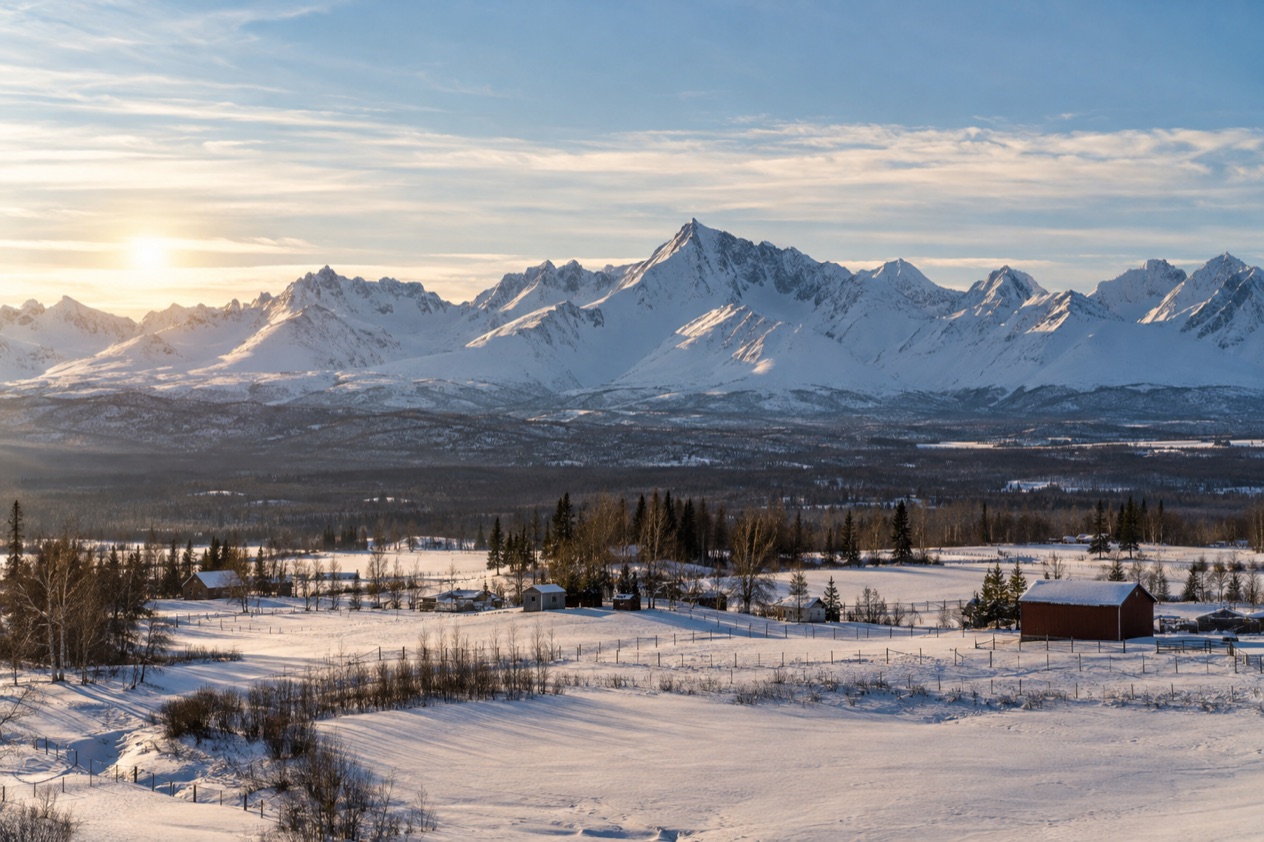
In March, the Mat-Su Valley wakes to hard, bright mornings, with snow squeaking underfoot and the Chugach and Talkeetna mountains standing sharp against the sky. Wasilla and Palmer, the valley’s main towns, offer winter with the light coming back: longer afternoons, a hint of thaw, and nights that may still bring the aurora.
What is the weather like in Wasilla and Palmer in March?
March is still a winter month here, cold and dry, with daytime highs hovering just above freezing and nights that drop well below it.
| Month | Average high (°F) | Average low (°F) | Precipitation (in) | Days with precipitation | Daylight on the 15th |
|---|---|---|---|---|---|
| February | 28.3 | 13.2 | 0.70 | 2.1 | 8 h 54 min |
| March | 33.9 | 17.2 | 0.47 | 1.8 | 11 h 38 min |
| April | 47.8 | 29.8 | 0.30 | 1.2 | 14 h 39 min |
Mornings are the coldest part of the day, so plan on a full set of winter layers for any early start. By afternoon the sun can take the edge off, and on a clear day a walk in the middle of the day feels like the first hint of spring rather than deep winter. Evenings turn sharp again the moment the sun goes behind the mountains.
Very little precipitation falls in March, and it is a count of a couple of days, not a rainy spell. When it comes, it is often snow, since the total includes melted snow. Rain gear is not the issue. What matters is boots with good grip for packed snow and slush, and a warm hat for the hours after sunset.
The light is the real news of the month. The sun climbs higher and the snow glares, which makes the afternoons feel brighter than the thermometer suggests.
What to do in Wasilla and Palmer in March
The big event of the month is the Iditarod Trail Sled Dog Race, one of Alaska’s iconic winter events. The excitement traditionally starts in Anchorage on the first Saturday of March, with teams leaving the ceremonial start on Fourth Avenue at D Street. The Mat-Su Valley gets its share the next day.
The Iditarod restart at Willow
The official restart takes place in Willow, 80 miles north of Anchorage, the day after the ceremonial start. This is where the race stops being a parade and becomes the real thing, with teams heading onto a trail that crosses the Alaska Range and the Bering Sea shore before it ends in Nome. Willow is one of the towns of the Mat-Su Valley, so it fits naturally into a stay in Wasilla or Palmer.
Expect cold hands, barking dogs and a lot of standing around while teams are readied. The race covers 1,049 miles, and watching the first few moments gives you a sense of the scale of what lies ahead. If you cannot be there, the race’s own website offers standings and live broadcasts, which makes it easy to follow the mushers long after you leave.
Palmer and its farming valley
Palmer is the borough seat of the Matanuska-Susitna Borough, on the Glenn Highway northeast of Anchorage. Farmers settled the valley in the 1930s through a government project, and it is still one of the few agricultural areas in Alaska. In March the fields lie under snow, so the pleasure is in seeing the farm country in its quiet season, the barns and fenced pastures framed by mountains.
The Alaska State Fair, where cabbages and other vegetables grow to record sizes, belongs to another season. Even so, the town’s farming story gives context to every drive through the valley. Palmer is also the home of the National Tsunami Warning Center, a reminder that this small town does some very large work.
Northern lights nights
The northern lights oval covers most of Alaska, and the aurora season runs into April, so March nights offer a chance of seeing them from the valley. Activity tends to be stronger around the spring equinox than at midwinter, and for Interior Alaska the likelihood is roughly twice as high at the equinox as at the solstice. Clear skies matter most, and nothing is guaranteed.
With darkness falling at a reasonable hour now, you do not have to stay up until the small hours of the morning to try. Dress for standing still in the cold, and give yourself more than one evening to look.
Two more outings suit the month. Eklutna Native Historical Park lies 9 miles south of the Glenn and Parks Highway junction, on the southbound lane of the Glenn Highway.
Dog sledding around Anchorage typically runs from October through March, so the month is among the last for it. After a day outside, Wasilla and Palmer are towns for a simple hot meal and an early night.
A two-day itinerary for Wasilla and Palmer in March
Day 1. Start in Palmer once the sun is up, since mornings are the coldest hours and a slow start with coffee is wise. Spend the morning looking at the farm country the 1930s settlers built, driving or walking the streets of the borough seat with the mountains close by. Have lunch at a local café, then use the warmest part of the afternoon for a stop at Eklutna Native Historical Park.
As the light drops, head back toward the valley for dinner in a casual spot. After dark, step outside away from town lights and give the sky a chance. March nights can hold the aurora, so a clear evening is worth the cold. If clouds roll in, a warm restaurant and an early night is the better plan.
Day 2. If your trip includes the first weekend of March, spend the morning at Willow for the official Iditarod restart, dressed for standing in the cold. The race is the single best reason to be in the valley this month, and the day is built around it. Stay for the departure of the teams, then warm up over a long lunch in Wasilla.
If the Iditarod weekend does not fall on your dates, give the day to Matanuska Glacier and the Glenn Highway, or follow the race online from a café table. Rain is not the card to plan for, but wind and cold are, so keep indoor stops in mind, such as a museum, a bakery or a coffee shop in Wasilla, as a place to thaw between outings.
Is Wasilla and Palmer busy in March?
March brings a burst of attention to the valley around the Iditarod weekend, and the rest of the month keeps a winter pace.
The Alaska State Fair and other summer draws are far off, so the towns feel like working communities rather than stops on a tour. The restart at Willow draws race followers to the valley on one day. Outside that, you are likely to find roads and cafés on a quieter footing, with the seasonal rhythm slower than in summer.
Dog sledding near Anchorage typically operates from October through March, so the month sits at the end of that season.
What to pack for Wasilla and Palmer in March
March days are cold at both ends, with the afternoon the only warm stretch, and much of your time will be outdoors, whether at the Iditarod restart or watching the sky.
- A warm winter coat, because mornings and evenings stay well below freezing.
- Insulated boots with good grip, for packed snow and slush.
- Hat, gloves and a neck warmer for long stretches at the race or under the night sky.
- Layers you can add or shed, since afternoons feel milder in the sun.
- Sunglasses, for bright light on the snow.
- A thermos or hand warmers for aurora watching, when you stand still for a while.
Good to know before you go
The main event is the Iditarod, whose ceremonial start is in Anchorage on the first Saturday of March, with the official restart at Willow the day after.
Palmer lies on the Glenn Highway northeast of Anchorage, and the Mat-Su Valley includes Wasilla, Big Lake, Houston, Willow, Sutton and Talkeetna. Because the weather is cold and dry, the plan hinges on temperature more than rain. The Matanuska Glacier sits on the Glenn Highway corridor, but its access in March is a matter to confirm before you set out.
Wasilla and Palmer in March vs February and April
Moving the trip a month earlier means a colder, darker valley, with days under nine hours long and no Iditarod to give the month a center. February suits travelers who want deep winter and the aurora in a longer night, but it gives up the extra daylight that makes March outings easier.
Moving it a month later brings a clear change in feel. April days are long, with nearly fifteen hours of light on the 15th, and highs climb well above freezing, so snow starts to give way. The aurora season is winding down, since the sky gets dark later and later. The Iditarod is on the trail toward Nome by then, so the race excitement has left the valley.
Choose March if you want the race, a mix of winter cold and returning light, and a real chance at the aurora. Choose February for the deepest winter, and April for longer days and softer afternoons.
Is March a good time to visit Wasilla and Palmer?
Yes, March is a good time for travelers who like winter with the light coming back and who want a front-row seat to the Iditarod.
It suits people who enjoy cold, clear days outdoors, who want to see where the race restarts, and who are curious about a farming valley in its quiet season. It also suits aurora chasers, since activity tends to rise around the spring equinox. It is less suited to anyone who wants green fields, the Alaska State Fair or the long evenings of midsummer.
On arrival, work out which day the race restarts at Willow and build the rest of the days around it. Then check the sky each evening, since clear nights are the ones that count.
What makes March special here is the overlap of seasons. Snow still covers the fields, teams are heading for Nome, the afternoons feel warmer by the week, and the night sky may still hold the lights.
Sources
- NOAA NCEI, U.S. Climate Normals 1991-2020, monthly (https://www.ncei.noaa.gov/access/services/data/v1?dataset=normals-monthly-1991-2020&stations=USW00025331), station Palmer Muni Ap, elevation 230 feet, checked October 11, 2026
- Computed from the date and the latitude of the place (sunrise equation, solar elevation -0.833 degrees), October 11, 2026
- University of Alaska Fairbanks Geophysical Institute, Aurora forecast (https://www.gi.alaska.edu/monitors/aurora-forecast), checked October 11, 2026
- Wikivoyage, Northern lights (https://en.wikivoyage.org/wiki/Northern_lights), checked October 11, 2026
- Wikipedia, Aurora (https://en.wikipedia.org/wiki/Aurora), checked October 11, 2026
- Visit Anchorage, northern lights viewing (https://www.anchorage.net/winter/things-to-do/northern-lights-viewing/), checked October 11, 2026
- Visit Anchorage, dog sledding (https://www.anchorage.net/winter/things-to-do/dog-sledding/), checked October 11, 2026
- Wikipedia, Dog sled (https://en.wikipedia.org/wiki/Dog_sled), checked October 11, 2026
- National Park Service, Denali National Park & Preserve, plan your visit: kennels (https://www.nps.gov/dena/planyourvisit/kennels.htm), checked October 11, 2026
- National Park Service, Denali National Park & Preserve, plan your visit: winter activities (https://www.nps.gov/dena/planyourvisit/winter-activities.htm), checked October 11, 2026
- Iditarod Trail Committee, the Iditarod (https://www.iditarod.com/), checked October 11, 2026
- Iditarod, about (https://www.iditarod.com/about/), checked October 11, 2026
- Visit Anchorage, Iditarod (https://www.anchorage.net/winter/events/iditarod-sled-dog-race/), checked October 11, 2026
- Wikipedia, Iditarod Trail Sled Dog Race (https://en.wikipedia.org/wiki/Iditarod_Trail_Sled_Dog_Race), checked October 11, 2026
- Wikipedia, Palmer, Alaska (https://en.wikipedia.org/wiki/Palmer,_Alaska), checked October 11, 2026
- Wikipedia, Mat-Su Valley (https://en.wikipedia.org/wiki/Mat-Su_Valley), checked October 11, 2026
- Wikivoyage, Matanuska-Susitna Borough (https://en.wikivoyage.org/wiki/Matanuska-Susitna_Borough), checked October 11, 2026
- Wikipedia, Matanuska-Susitna Borough, Alaska (https://en.wikipedia.org/wiki/Matanuska-Susitna_Borough,_Alaska), checked October 11, 2026
- Wikipedia, Matanuska Glacier (https://en.wikipedia.org/wiki/Matanuska_Glacier), checked October 11, 2026
- Wikipedia, Climate of Alaska (https://en.wikipedia.org/wiki/Climate_of_Alaska), checked October 11, 2026
To plan your stay
- Things to Do in Wasilla and Palmer: Iditarod Country, Hatcher Pass, Glaciers and the Alaska State Fair
- Where to Stay in Wasilla and Palmer: Parks Highway Base, Farm Country and Valley Towns
- Best Time to Visit Wasilla and Palmer: Summer Daylight, the State Fair, Weather and Seasons
- Wasilla and Palmer in February: Weather, Northern Lights Chances and Things to Do