
In January the streets of Utqiagvik lie under a blue-black sky even at midday, and the snow squeaks underfoot with a dry, high sound that only deep cold makes. Headlights drift along the plowed roads, windows glow yellow against the dark, and the frozen Arctic Ocean sits quietly at the edge of town. It is the northernmost city in the United States, and January is its quietest, starkest month, one for travelers who want the polar night itself.
What is the weather like in Utqiagvik in January?
January in Utqiagvik is bitterly cold, dry and dark, with no sunrise at all in the middle of the month.
| Month | Average high (°F) | Average low (°F) | Precipitation (in) | Days with precipitation | Daylight on the 15th |
|---|---|---|---|---|---|
| December | -0.4 | -12.2 | 0.22 | 0.4 | None (polar night) |
| January | -5.2 | -17.8 | 0.14 | 0.2 | None (polar night) |
| February | -5.5 | -18.3 | 0.21 | 0.3 | 6 hours 46 minutes |
The cold does not ease between morning and afternoon. Even the warmest hour of the day stays well below zero, so every trip outside, from the hotel door to a car, is planned around covering skin. Wind off the ocean is the wild card, and it can make an already hard cold feel harsher.
Very little falls from the sky. January is one of the driest months of the year, and a day with any measurable precipitation is the exception. An average January brings about 3.5 inches of snow, light and powdery, which the wind tends to push around rather than pile up. What you see on the ground is mostly old snow, drifted and packed hard.
The light is the real story. With no sun above the horizon, the day is a long blue dusk at best, and a pale glow may show at midday in clear weather. Streetlights, car lights and the stars do the rest. Think of January as one long night, and plan your waking hours around indoor warmth and short, bundled outings.
What to do in Utqiagvik in January
The main event in January is the polar night itself. Breakfast happens in darkness, lunch happens in darkness, and the clock on the wall becomes the only thing separating morning from evening.
Stars are the reward. When the sky is clear, the dark town gives you a view of constellations that most Americans rarely see, with few lights between you and the horizon once you step away from the main streets. On a still night the cold seems to sharpen everything, and the silence is broad enough to hear a snow machine from far off.
Watching for the aurora
The Northern Lights oval covers most of Alaska, and the aurora is visible from areas around the Arctic, so a dark winter sky at this latitude is a reasonable place to hope for a show. The aurora season in Alaska runs well into April, which puts January squarely inside it. It remains a chance, never a promise, and it depends on clear weather and on how active the sun is.
The lights come from charged particles from the sun hitting gases in the upper atmosphere, and they show up as green, and sometimes red and purple, light. Dress for standing still, because watching means long minutes without moving. Step away from street lamps and building lights, give your eyes time to adjust, and keep looking up between stretches of warming up indoors.
Iñupiat culture in the town
Utqiagvik is first of all an Iñupiat community, and the winter is when the town turns inward, to family, food and work done indoors. The Iñupiaq language is spoken by only a small share of the people today, mostly older speakers, which gives language and cultural work in the region a particular weight. Visitors are guests in a place with deep roots in whaling, hunting and the sea ice.
The whalebone arch on the shore is the image people carry home, a reminder of the whale hunt that shapes the town’s calendar and its meals. A visit to the Iñupiat Heritage Center, the town’s museum and cultural center, is a natural way to understand the place before you walk it. Ask before photographing people, homes or hunting gear.
A walk along the frozen coast
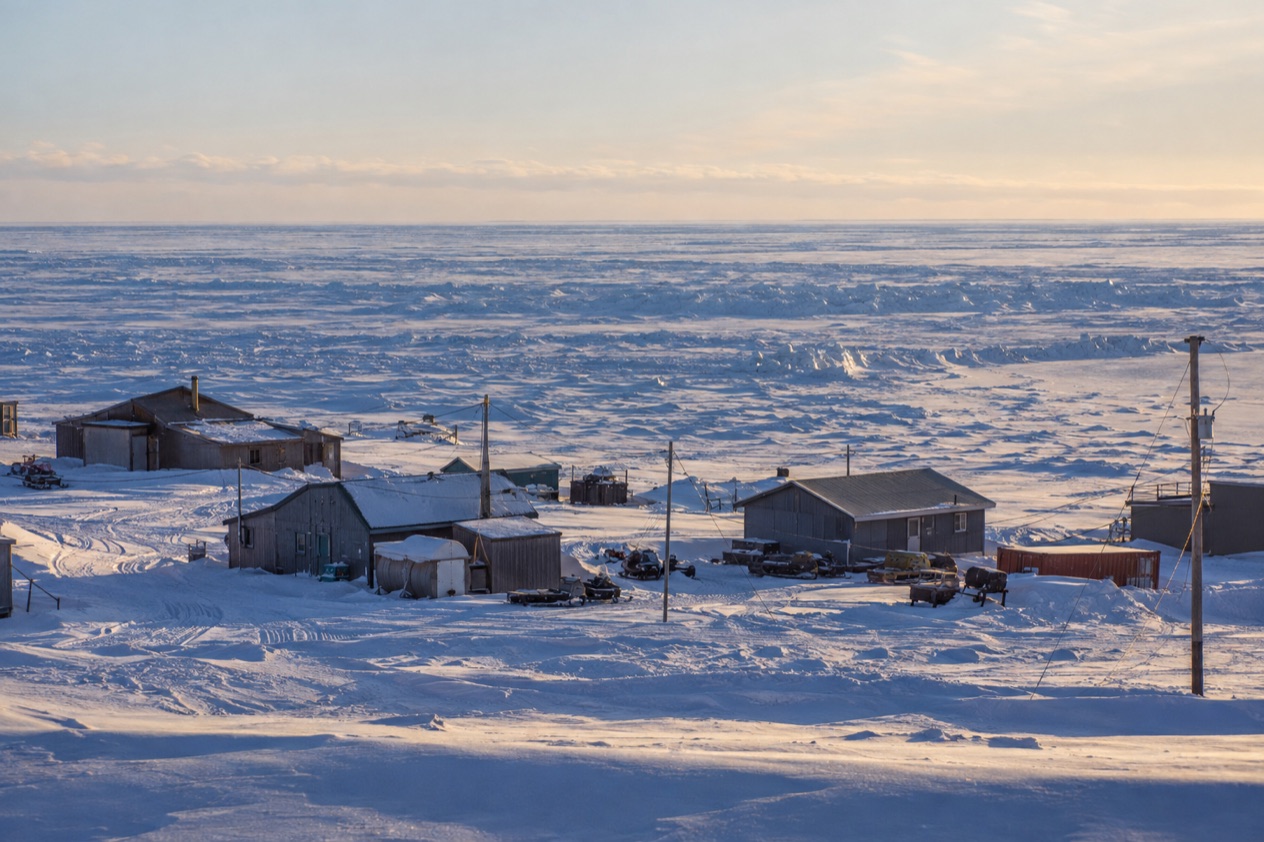
The Arctic Ocean here is usually frozen over in January, a long field of pressed and jumbled ice that meets the land with no beach to speak of. Looking out over it in the blue dusk of the polar night is an unusual sight, especially when the ice catches faint light from the sky. This is a place to look at, not to walk onto, because ice conditions are not something a visitor can judge.
Expect to turn back sooner than you planned, since the cold works quickly on fingers and faces. A warm drink in town afterward is the natural finish.
Food in a place this far from the road system is its own pleasure. The North Slope relies mostly on waterways and small airports for transportation, so what reaches the table is shaped by supply as much as by season. Look for cafés and restaurants where locals eat, and treat any traditional dish you are offered as a gift of the region.
A two-day itinerary for Utqiagvik in January
Day 1 starts late and slowly. Take a long breakfast in a café or in your hotel while the sky is still black, then use the first lull of pale light at midday for a bundled walk through the town to see the streets, the houses raised against the cold and the shoreline. Keep that first outing short and let your body learn the cold.
Spend the afternoon indoors at the Iñupiat Heritage Center, which gives context for everything you passed on the walk. A late lunch in a local restaurant fits here, followed by a rest in your room. After dinner, bundle up again and go out for a first look at the night sky, away from the brightest lights.
Day 2 reverses the rhythm. Sleep in, then head to the coast near the whalebone arch around midday, when any glow in the sky is strongest, and look out over the frozen ocean from the shore. Stay close to the town and keep the walk modest, since the wind can change what the cold feels like within minutes.
Rain is not the weather risk here. If the wind and cold turn the day hostile, spend it in a café, a museum or the lobby of your lodging with a book, and save the outdoors for the evening. If the sky clears after dinner, put on every layer and go out for one more look for the aurora, with no promise of a sighting.
Is Utqiagvik busy in January?
January is a quiet month in Utqiagvik, a time when the town runs at the pace of its own residents rather than that of visitors.
The draws of the month are the polar night and the chance of an aurora, not a festival or a park season, and nothing in the calendar pulls crowds together. Streets are mostly empty by evening, and the cold keeps people indoors for much of the day. Expect a town where a visitor stands out and where conversations in cafés and shops come easily.
With so little happening on the surface, the pace is slow and the atmosphere is intimate. Those who come tend to come on purpose, drawn by the latitude and the darkness, and they find a place that does not stage itself for tourists.
What to pack for Utqiagvik in January
Everything you pack should answer one question: how do you stay warm while standing still in the dark? Think in layers that you can add and shed between buildings and the open air.
- A heavy insulated parka with a hood, for the wind off the frozen coast.
- Insulated, waterproof boots with warm socks, because the ground is packed snow and ice.
- Thermal base layers, top and bottom, for long stretches outside watching the sky.
- Mittens with liners and a face covering, since fingers and cheeks go first.
- A warm hat that covers the ears, worn even for short walks.
- A headlamp or small flashlight with spare batteries, for the hours of darkness.
Good to know before you go
The practical fact of January is that daylight is absent, so plan your days around the clock rather than the sky. Utqiagvik is cut off from the rest of the state’s road system, and the North Slope relies mostly on waterways and small airports, so your arrival and departure depend on flights. Weather can matter for any plan, so keep a day of slack if you can.
Utqiagvik in January vs December and February
Moving the trip four weeks earlier to December gives you the same polar night, with slightly milder air and a bit more snow. The darkness is just as complete, and the holiday season gives the town a different, more domestic feel. If you want the deepest night, December and January are the same story.
February brings the sun back. By the middle of the month there are several hours of daylight, and the town changes character, with people out in the pale light and the sky doing something new each week. The air stays just as cold, so the move is about light, not comfort.
Choose December or January if the polar night is the point of the trip. Choose February if you want to see the landscape in daylight, with the coast and the ice visible, while still keeping the deep winter cold. Anyone who wants a mild climate should not come to Utqiagvik in any of the three.
Is January a good time to visit Utqiagvik?
Yes, for travelers who want the polar night in its purest form and who are happy with a quiet, cold, dark town.
You will love it if you are drawn to the extremes, to stars over a silent frozen coast, to the chance of an aurora and to a place where daily life carries on in the dark. It suits people who read the landscape slowly and who do not need a full schedule of sights. It is a poor match for anyone who wants daylight for photographs, long outdoor walks or a busy program.
On arrival, get warm first and let your body settle before you plan any long outing. Learn the local rhythm over the first day, then step out on a clear evening to look at the sky. January in Utqiagvik is the northernmost city in the country with its sun gone below the horizon, and that is what you come for.
Sources
- NOAA NCEI, U.S. Climate Normals 1991-2020, monthly (https://www.ncei.noaa.gov/access/services/data/v1?dataset=normals-monthly-1991-2020&stations=USW00027502), station Barrow Post Rogers Ap, elevation 31 feet, checked October 11, 2026
- Computed from the date and the latitude of the place (sunrise equation, solar elevation -0.833 degrees), October 11, 2026
- University of Alaska Fairbanks Geophysical Institute, Aurora forecast (https://www.gi.alaska.edu/monitors/aurora-forecast), checked October 11, 2026
- Wikivoyage, Northern lights (https://en.wikivoyage.org/wiki/Northern_lights), checked October 11, 2026
- Wikipedia, Aurora (https://en.wikipedia.org/wiki/Aurora), checked October 11, 2026
- Visit Anchorage, northern lights viewing (https://www.anchorage.net/winter/things-to-do/northern-lights-viewing/), checked October 11, 2026
- Wikipedia, Polar night (https://en.wikipedia.org/wiki/Polar_night), checked October 11, 2026
- Wikipedia, Midnight sun (https://en.wikipedia.org/wiki/Midnight_sun), checked October 11, 2026
- Wikipedia, Alaska North Slope (https://en.wikipedia.org/wiki/Alaska_North_Slope), checked October 11, 2026
- Wikipedia, Inupiat (https://en.wikipedia.org/wiki/Inupiat), checked October 11, 2026
- Wikipedia, Prudhoe Bay, Alaska (https://en.wikipedia.org/wiki/Prudhoe_Bay,_Alaska), checked October 11, 2026
- Wikipedia, Climate of Alaska (https://en.wikipedia.org/wiki/Climate_of_Alaska), checked October 11, 2026