
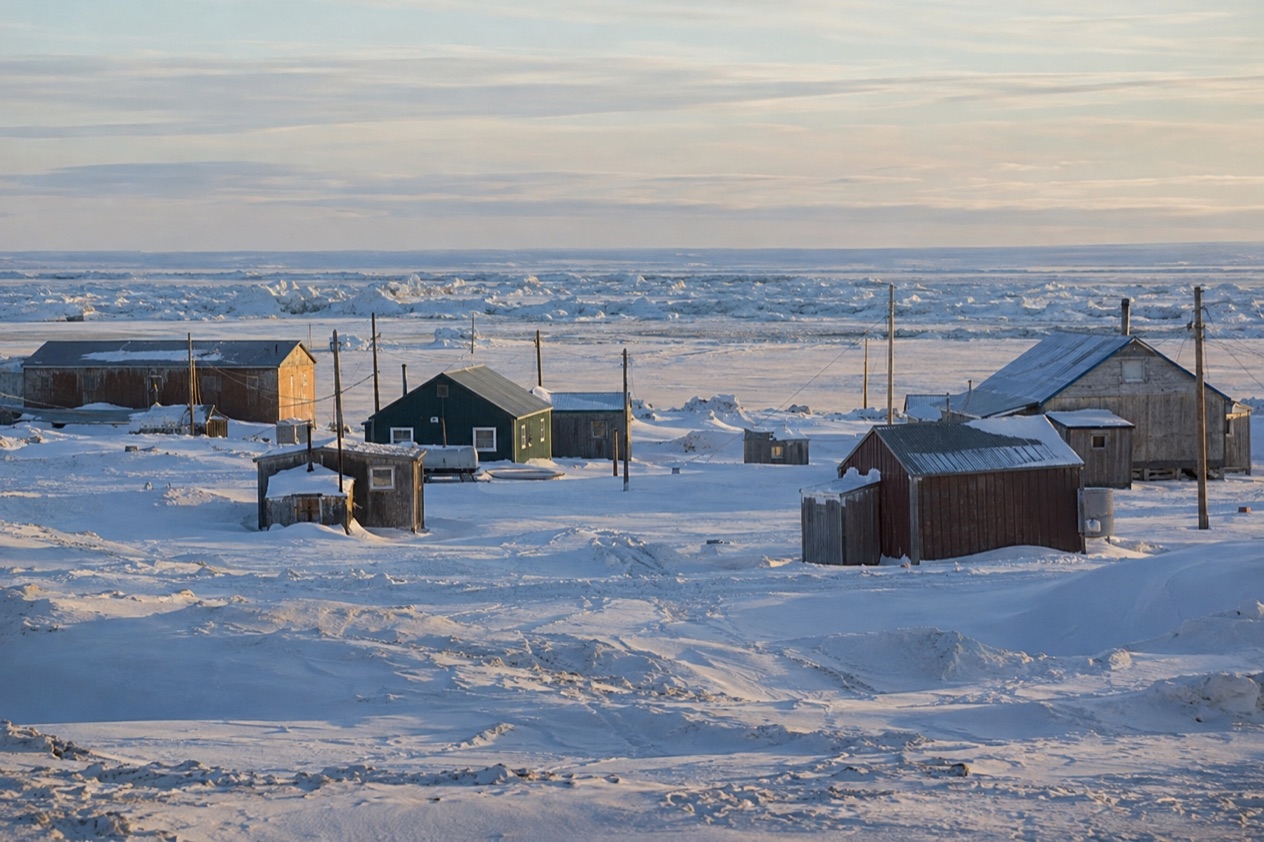
In February, the sun climbs back over Utqiagvik after weeks of polar night, and the low light turns the snow pink and blue along the edge of the Chukchi Sea. Snow machines hum between houses, windows glow early in the afternoon, and people stop to watch the horizon brighten. It is a month for seeing the northernmost city in the United States as the light returns, in deep cold and very dry air.
What is the weather like in Utqiagvik in February?
February in Utqiagvik is bitterly cold and very dry, with sub-zero highs, even colder nights, and almost no days of precipitation, but the daylight is returning fast.
| Month | Average high (°F) | Average low (°F) | Precipitation (in) | Days with precipitation | Daylight on the 15th |
|---|---|---|---|---|---|
| January | -5.2 | -17.8 | 0.14 | 0.2 | No daylight (polar night) |
| February | -5.5 | -18.3 | 0.21 | 0.3 | 6 h 46 min |
| March | -3.8 | -17.2 | 0.18 | 0.4 | 11 h 23 min |
Rain is not part of the picture. What little moisture falls comes as dry snow, about three and a half inches over the whole month, and it often blows along the ground more than it falls.
Mornings start in blue twilight, and evenings come early, so the day feels like a short, bright window between two long dusks. Even at midday, the cold is serious, and layers matter more than any single heavy coat.
The change in light is the real news of the month. At the start of February the sun has only just returned, and by the end of it the days are noticeably longer. The sea is frozen over, so the coast is a white plain rather than open water.
What to do in Utqiagvik in February
The most memorable thing to do in February is simply to watch the sun return. After the polar night, each day brings a little more light, and people in town notice it. A walk toward the shore in the early afternoon shows you the frozen sea, pressure ridges of ice, and a horizon that glows for a while before the light fades again.
Utqiagvik is the largest settlement in the United States north of the Arctic Circle, with about 5,000 people. It sits on the North Slope, which is connected to the rest of Alaska by waterways and small airports rather than by a road system, so the town feels remote and self-contained. Streets are lined with snow machines, sleds and the occasional dog team, and the pace is set by the cold.
The frozen coast and the returning sun
The Chukchi Sea at Utqiagvik is frozen in February, so what you see along the shore is ice rather than waves. Pressure ridges, drifted snow and a flat white horizon fill the view. The light is low and long, even at midday, and it paints the ice in soft pinks and blues for much of the afternoon.
This is the kind of outing that suits the middle of the day, when the sun is up. Dress for wind as much as for cold, because the open coast offers no shelter. You can stay close to town and still feel the scale of the Arctic, with the ice running to the edge of sight.
Town life in deep winter
February is a month when people in Utqiagvik are indoors a good deal, and the town’s rhythm shows it. Snow machines are the usual way to get around, and you see them parked outside homes, stores and community buildings. The mood is practical and warm, with long conversations indoors and a general sense of looking forward to more light.
As a visitor, you can spend time in the places that make a small Arctic town work: a café or restaurant, a store, a community gathering place. Taking it slowly is part of the experience. The cold sets the pace, and a day often includes a long warm break between short outings.
The aurora as a chance
The aurora oval covers most of Alaska, and the northern lights are a natural phenomenon caused by charged particles from the sun striking gas molecules in the upper atmosphere. In February, the long dark hours of the evening give you a chance to see them on a clear night. It is a chance, not a promise, and cloud decides a great deal.
Auroral activity tends to be stronger around the equinoxes than at midwinter, so February is on the way toward a more active period. Step outside away from bright lights, let your eyes adjust, and be ready to wait in the cold, with warm layers on.
A two-day itinerary for Utqiagvik in February
Day 1 begins slowly, since the morning is still twilight. Start with a warm breakfast in town and let the light come up. Around midday, when the sun is up and the day is at its brightest, walk toward the frozen shore and take in the pressure ridges and the flat white horizon.
In the afternoon, return indoors for a long lunch at a local restaurant and a warm-up. As the light fades, get a feel for the town itself, with its snow machines, its stores and its streets. In the evening, if the sky is clear, step outside away from the lights and watch for the aurora, which is a chance rather than a certainty.
Day 2 follows the same logic, with the bright part of the day for outdoor time. Plan a second outing along the coast or another part of town in the early afternoon, when there is the most light, since the day is only a bit under seven hours long in mid-month.
If the weather turns windy or the cold feels too much, spend the day indoors at a café, a community space or your lodging, and go out only for short stretches. Finish with an unhurried dinner and a last look at the sky.
Is Utqiagvik busy in February?
February is a quiet month in Utqiagvik, a deep-winter stretch when the town belongs mostly to its residents. The cold, the short days and the remoteness shape the pace, so you are more likely to find streets with few visitors than crowds.
The town of about 5,000 people is cut off from the rest of the state’s road system, so getting here depends on small airports and not on highways. That isolation is part of what gives winter in Utqiagvik its calm. Whatever you plan, expect a slow, local rhythm rather than a busy tourist scene.
What to pack for Utqiagvik in February
Packing for February in Utqiagvik is about staying warm in sub-zero air and wind, in short outings and long stretches indoors.
- Insulated parka and layers, because highs stay below zero all month.
- Insulated boots and warm socks, for walking on snow and ice.
- Face covering and warm hat, since wind on the open coast makes the cold sharper.
- Insulated mittens or gloves, with thin liners for handling a camera.
- Sunglasses, because the returning sun on snow can be bright.
- Warm layers for evenings outside if you hope to watch for the aurora.
Good to know before you go
In February, the daylight is the main thing to plan around. At mid-month the sun is up for under seven hours, so the bright window is short and best used for outdoor time. Utqiagvik is not on the state road system, so the North Slope is reached through small airports, and the cold, not distance, decides how long you stay out on any given day.
Utqiagvik in February vs January and March
Moving the trip earlier to January puts you in the polar night, when the sun does not rise at all in mid-month. The air is about as cold, and the experience is of long darkness rather than returning light. February gives you a bit of daylight every day, which changes how the town feels.
Moving later to March brings a much longer day, more than eleven hours of light in mid-month, with slightly milder highs and a little more snowfall activity in the air. The sea is still frozen, but the sense of winter is easing toward spring, and the light is brighter for outings. Choose January if the darkness itself is what draws you, February if you want both a taste of the polar night’s aftermath and real daylight, and March if you want longer outdoor days with the cold still firmly in place.
Is February a good time to visit Utqiagvik?
Yes, February is a good time for travelers who want a deep-winter Arctic experience, with real cold, a frozen coast and light coming back day by day. It suits people who are comfortable with serious cold and happy with a quiet, slow-paced town.
It is a poor fit for anyone who wants to spend long hours outdoors comfortably, or who expects a busy program of activities. The days are short and the cold is real, so plans have to bend around both.
On arrival, the first thing to do is get outside in the early afternoon, when the sun is up, and see the frozen shore. Then settle into the town’s slow rhythm. What is special about February here is the light itself: a sun that was gone for weeks is back, and every day it stays a little longer over the ice.
Sources
- NOAA NCEI, U.S. Climate Normals 1991-2020, monthly (https://www.ncei.noaa.gov/access/services/data/v1?dataset=normals-monthly-1991-2020&stations=USW00027502), station Barrow Post Rogers Ap, elevation 31 feet, checked October 11, 2026
- Computed from the date and the latitude of the place (sunrise equation, solar elevation -0.833 degrees), October 11, 2026
- University of Alaska Fairbanks Geophysical Institute, Aurora forecast (https://www.gi.alaska.edu/monitors/aurora-forecast), checked October 11, 2026
- Wikivoyage, Northern lights (https://en.wikivoyage.org/wiki/Northern_lights), checked October 11, 2026
- Wikipedia, Aurora (https://en.wikipedia.org/wiki/Aurora), checked October 11, 2026
- Visit Anchorage, northern lights viewing (https://www.anchorage.net/winter/things-to-do/northern-lights-viewing/), checked October 11, 2026
- Wikipedia, Arctic Circle (https://en.wikipedia.org/wiki/Arctic_Circle), checked October 11, 2026
- Wikipedia, Polar bear (https://en.wikipedia.org/wiki/Polar_bear), checked October 11, 2026
- Wikipedia, Polar night (https://en.wikipedia.org/wiki/Polar_night), checked October 11, 2026
- Wikipedia, Midnight sun (https://en.wikipedia.org/wiki/Midnight_sun), checked October 11, 2026
- Wikipedia, Alaska North Slope (https://en.wikipedia.org/wiki/Alaska_North_Slope), checked October 11, 2026
- Wikipedia, Climate of Alaska (https://en.wikipedia.org/wiki/Climate_of_Alaska), checked October 11, 2026