
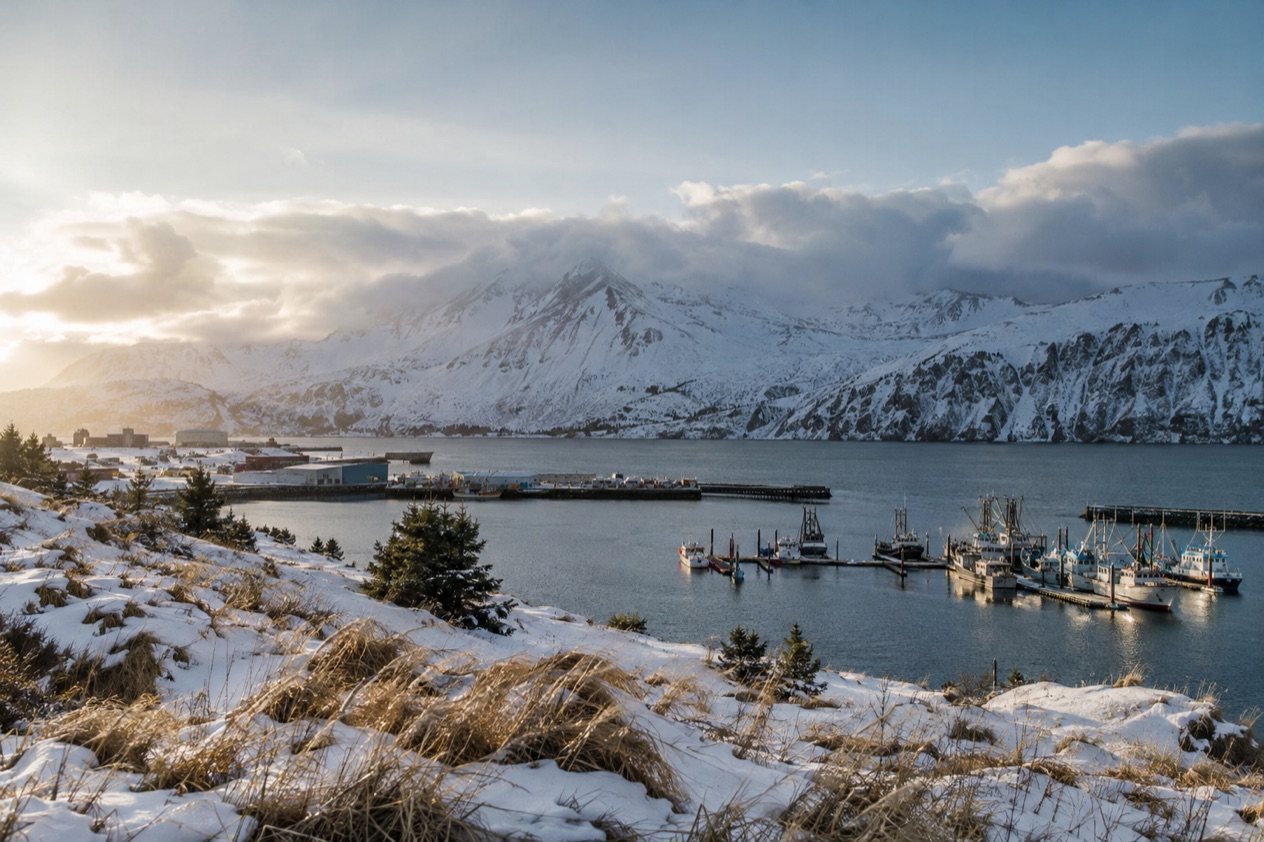
In March, Kodiak is a fishing town still wearing its winter coat. Snow lingers on the slopes above the harbor, gulls and eagles work the docks around the boats, and the light stays long enough to walk after supper. Kodiak is a place of working harbors, island mountains and bear country, and March gives it to you quiet, with plenty of room to look around.
What is the weather like in Kodiak in March?
March in Kodiak is cold, damp and changeable, with temperatures just above freezing in the afternoon and a mix of rain, wet snow and clearing spells.
| Month | Average high (°F) | Average low (°F) | Precipitation (in) | Days with precipitation | Daylight on the 15th |
|---|---|---|---|---|---|
| February | 37.5 | 27.2 | 6.31 | 11.4 | 9 h 23 min |
| March | 38.8 | 27.6 | 4.82 | 9.4 | 11 h 42 min |
| April | 44.7 | 33.6 | 6.14 | 12.7 | 14 h 16 min |
Mornings start frosty, and puddles on the pavement can be skinned with ice before the day warms. Afternoons rise only a little above freezing, so standing at the waterfront feels colder than the thermometer suggests once the wind comes off the bay. Evenings drop back to a hard chill.
Precipitation comes on roughly one day in three, as rain at the water’s edge and as wet snow when it is colder. Snow does fall in March, a foot or so over the month at the airport, and it often melts or turns to slush in town. Gray, low-cloud days are common, but breaks of bright sky happen too, and they light up the white mountains behind the harbor.
The light is the pleasant surprise. Days are nearly equal to the nights by mid-month, so you get a real morning and a real evening to use, a big change from midwinter. Dress in layers, with a waterproof shell on top, and keep a hat and gloves within reach.
What to do in Kodiak in March
March is a month for the town itself: the harbor, the boats, the museums and the cafés, with the island’s wild country as a backdrop. Kodiak is the hub for the whole island, and every commercial ferry and flight between the island’s communities and the outside world passes through the city. That gives the waterfront a steady rhythm even in the quiet season.
Walk the harbors first. Fishing boats sit tied up in rows, nets and gear piled on the docks, and the smell of salt and diesel is everywhere. Sea birds crowd the pilings, and bald eagles often perch on masts and lampposts, looking for scraps. It is an easy way to feel the working life of the town without any plan.
Bear country in late winter
The Kodiak bear lives on the islands of the Kodiak Archipelago, and it is one of the largest bear subspecies on Earth, with adult males weighing 600 to 1,400 pounds. In March most of them are still in their dens. Males begin to come out in early April, and sows with new cubs stay in until late June, so this is the month before the bears return to the landscape.
That shapes how you think about the island. The southwestern two-thirds of Kodiak Island is part of Kodiak National Wildlife Refuge, a huge stretch of wild land where the bears feed on spawning salmon in the right season. In March, you come for the setting and the quiet rather than for sightings, and the bear story is something to learn about in town.
Ferries, flights and the island’s connections
The Alaska Marine Highway ferries tie Kodiak to the mainland. The MV Tustumena carries 210 passengers and serves Kodiak, Homer, Whittier and the Aleutian Islands as far west as Dutch Harbor. The larger MV Kennicott carries 748 passengers on routes between Kodiak, Homer and Whittier.
Even if you are not sailing, the ferry dock is a good place to watch the town’s link to the rest of Alaska at work. Seeing a ship tied up against the winter hills gives you a feel for how far this island sits from the road system.
Cafés, harbor food and slow afternoons
A cold gray afternoon suits a long stop in a café with a hot drink, watching boats come and go. Seafood is the natural thing to order in a fishing town, and a bowl of chowder or a plate of fresh local fish makes sense after a walk in wind and wet snow.
Evenings are for early dinners and quiet streets. The town feels like a place where people know one another, and a visitor in March is easy to spot and often welcomed with a chat about the weather, the boats or the season ahead.
If the sky clears, go back to the waterfront at the end of the day and look at the mountains across the water. Fresh snow on the peaks and still water in the harbor make for the best views of the month, and they cost nothing.
A two-day itinerary for Kodiak in March
Day 1 is for the waterfront. Start with coffee in a harbor-side café once the morning frost has eased, then walk the docks while the fishing boats are busy with the day’s work. Look for eagles and gulls on the pilings, and take your time, since the cold makes a steady pace feel good.
At midday, eat seafood in a casual spot near the water. In the afternoon, use the daylight for a long walk through town and along the shore, then watch the ferry dock and the boats from a bench if the weather allows. Finish with an early dinner and a quiet evening.
Day 2 turns to the island’s story. Spend the morning in a museum or cultural center to learn about the Kodiak bear, the fishing economy and the Native communities of the archipelago. The bears are still denned in March, so this is where you meet them.
After lunch, if the sky is clear, head back outside for a different stretch of shoreline and a last look at the snowy hills, with the longer afternoon light helping. If rain or wet snow sets in, stay inside with another café, a bookshop or a slow meal, and keep the shoreline for the evening break in the clouds.
Is Kodiak busy in March?
No, March is a quiet month in Kodiak, with the town running at its local pace. The city of Kodiak has a population of 5,581, and it is the transport hub for the whole island, so the people you see are mostly residents, fishermen and travelers passing through.
That means space on the waterfront and an easygoing feel in cafés and shops. The wildlife refuge and the bear season belong to later months, when the bears leave their dens and the island’s visitor season picks up.
What to pack for Kodiak in March
Pack for cold, wet and windy days, with the ability to add or remove layers as the weather changes.
- A waterproof jacket, for rain and wet snow at the harbor
- Warm layers such as fleece or wool, for frosty mornings
- Waterproof boots with good grip, for slush and icy patches
- A hat and gloves, since the wind off the water bites
- Binoculars, for eagles and sea birds on the docks
Good to know before you go
Everything that comes to Kodiak by ferry or plane arrives through the city, so it is the base for any trip on the island. Days are close to twelve hours long by mid-March, which gives you a usable morning and evening, but wet snow can make the streets slick, so leave time for slower walking.
Kodiak in March vs February and April
Going a month earlier means a colder, snowier Kodiak with much shorter days. February has more wet days and more snow, and the light fades early, so outdoor walks feel shorter and the town is most wintry.
Going a month later brings milder air and a much longer day. April is when male bears begin to come out of their dens, which adds a layer of interest to the island, though it is also a wetter month, with rain on more days.
If you want the deepest quiet and a winter feel, February suits you. If you want longer light and the first signs of the bears returning, April is the better choice. March sits between them, with a moderate mix of both and the fewest wet days of the three.
Is March a good time to visit Kodiak?
Yes, for travelers who like quiet harbor towns and are happy with cold, changeable weather. March suits people who care more about atmosphere than about big outdoor plans, and who enjoy museums, cafés and a walk by the water.
It is a poor fit for anyone hoping to see bears in the wild, since they are still denned this month, or for anyone who wants mild, settled weather. Choose a later month for that.
On arrival, head to the waterfront first to get your bearings, then decide the rest of the day by the sky. March in Kodiak is the island before its season begins, with the boats at the docks, snow on the hills and the bears still asleep.
Sources
- NOAA NCEI, U.S. Climate Normals 1991-2020, monthly (https://www.ncei.noaa.gov/access/services/data/v1?dataset=normals-monthly-1991-2020&stations=USW00025501), station Kodiak Ap, elevation 80 feet, checked October 11, 2026
- Computed from the date and the latitude of the place (sunrise equation, solar elevation -0.833 degrees), October 11, 2026
- Wikipedia, Kodiak, Alaska (https://en.wikipedia.org/wiki/Kodiak,_Alaska), checked October 11, 2026
- Wikipedia, Kodiak bear (https://en.wikipedia.org/wiki/Kodiak_bear), checked October 11, 2026
- Wikipedia, Kodiak Island (https://en.wikipedia.org/wiki/Kodiak_Island), checked October 11, 2026
- Wikipedia, Brown bear (https://en.wikipedia.org/wiki/Brown_bear), checked October 11, 2026
- Wikipedia, Alaska Peninsula (https://en.wikipedia.org/wiki/Alaska_Peninsula), checked October 11, 2026
- Wikipedia, Climate of Alaska (https://en.wikipedia.org/wiki/Climate_of_Alaska), checked October 11, 2026
To plan your stay
- Things to Do in Kodiak: Brown Bears, Fort Abercrombie, Fresh Seafood and Day Trips
- Kodiak from Anchorage: Flights, Ferry Routes and What to Do on Arrival
- Kodiak Brown Bears: Salmon Season, Frazer River Viewing and Getting to Kodiak Island
- Best Time to Visit Kodiak: Bear Season, Weather by Month and Seasonal Things to Do