
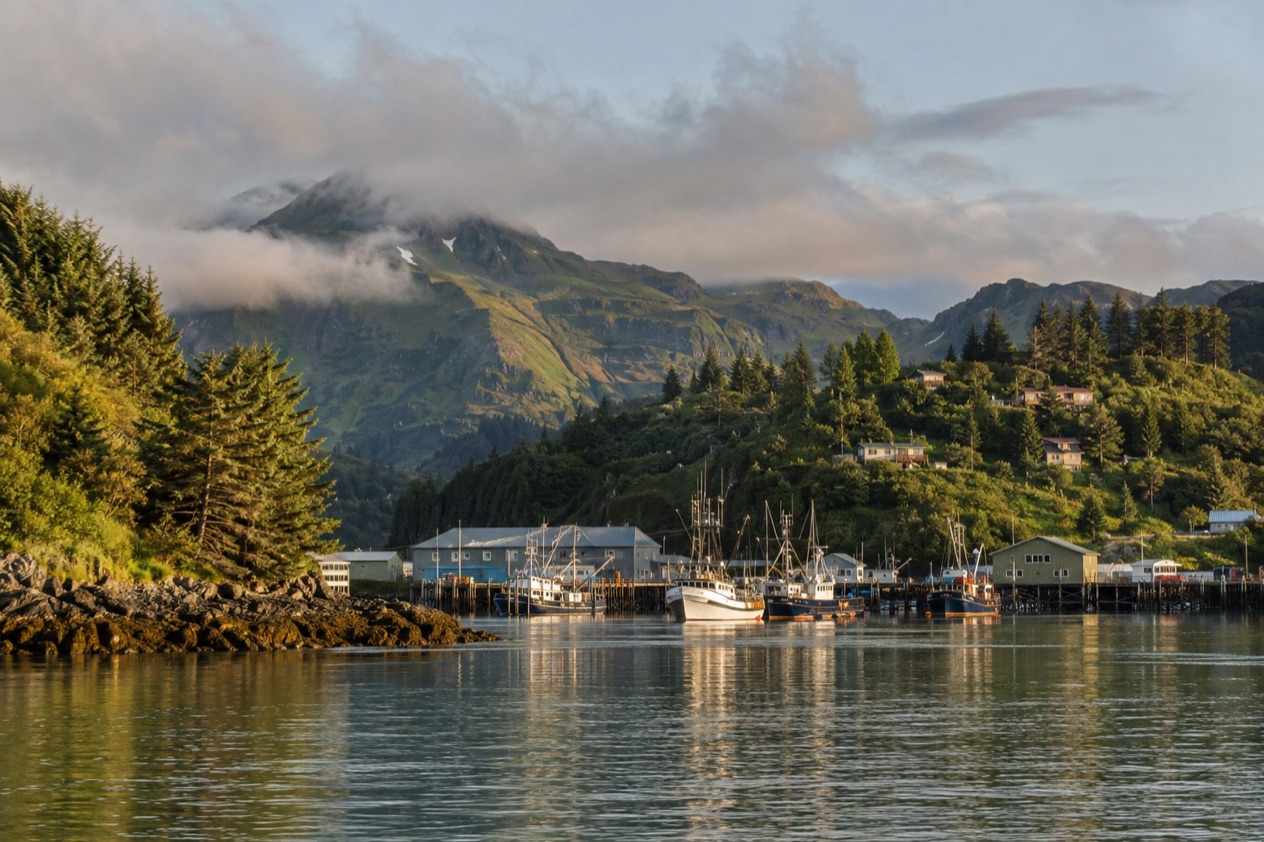
In August, Kodiak smells of diesel, kelp and fish being unloaded at the harbor, and the light lingers over the boats long after dinner. Gulls argue on the pilings, fishing crews hose down decks, and the green mountains behind town sit under low cloud that comes and goes. It is a working island town in a month of long days, mild air and brown bear country, and it suits travelers who like their Alaska salty and unpolished.
What is the weather like in Kodiak in August?
August in Kodiak is cool, damp and mild, a month for a fleece and a rain shell rather than shirtsleeves, with long days that taper noticeably from July.
| Month | Average high (°F) | Average low (°F) | Precipitation (in) | Days with precipitation | Daylight on the 15th |
|---|---|---|---|---|---|
| July | 61.8 | 50.5 | 4.51 | 8.7 | 17 h 30 min |
| August | 62.8 | 50.3 | 4.90 | 8.6 | 15 h 25 min |
| September | 57.1 | 44.2 | 7.55 | 11.5 | 12 h 55 min |
Afternoons reach the low 60s, which is comfortable for walking the waterfront in a light layer but never hot. Mornings and evenings are noticeably cooler, and with the wind coming off the water a hat and a zip-up fleece earn their place in the daypack. Snow is not part of the picture in August.
Rain here is more a habit than an event. Roughly one day in three brings some, often as drizzle, passing showers or a gray morning that lifts by lunch, and a dry stretch can follow a wet one without warning. Plan outdoor hours loosely and keep a waterproof jacket within reach rather than waiting for a perfect forecast.
The light is generous without being endless. Evenings stay bright well past dinner, so a late walk along the harbor is realistic, yet the days are clearly shorter than in midsummer, and the dusk that was nearly absent a month ago starts to return. The water around the island is cold, and nobody comes here to swim.
What to do in Kodiak in August
Kodiak is a fishing town first, and August is a month when you feel it. Boats come and go from the harbor, the canneries and docks are busy, and conversations in cafés turn on salmon, weather and whose boat just came in. Walking the waterfront and watching the working harbor is the easiest introduction to the island.
The city of Kodiak, with a population of 5,581, is the largest community on Kodiak Island. It is small enough to cover on foot in a morning of wandering, with a harbor, a handful of local restaurants, and shops that sell more rain gear than souvenirs. Seafood is the obvious thing to eat, and halibut, salmon and crab turn up on local menus in the kinds of places where the fish was likely landed nearby.
The Kodiak bear
The island gave its name to the Kodiak bear, which lives in the Kodiak Archipelago in southwest Alaska and is one of the largest bear subspecies on earth. Adult males weigh 600 to 1,400 pounds, which is hard to picture until you see a track or a photograph beside a human figure. In parts of coastal Alaska brown bears feed mainly on spawning salmon that come near shore, and that link between fish and bears is the story of this island in late summer.
Bears are a chance, never a promise, and August is far from their denning season, which starts in late October. Anyone spending time outdoors should know the state rule that all human sources of food must be kept secure from bears. That covers coolers, trash and anything with a smell, and it applies as much to a backyard picnic as to a camp.
The harbor, the town and its history
Kodiak has a Russian past, and it shows in the onion-domed Russian Orthodox church that stands out against the town’s low buildings. Local museums tell the story of the Alutiiq people, the Russian fur trade and the island’s long relationship with fishing. A visit on a gray, drizzly August day is time well spent, and the rain stops mattering once you are indoors reading about the island’s history.
Back outside, the small boat harbor is the town’s living room. Fishing boats tie up in rows, crews mend gear on deck, and sea otters and harbor seals sometimes surface among the hulls, though neither keeps a schedule. Bring a thermos, find a bench, and let the harbor entertain you for an hour.
The island beyond town
The southwestern two-thirds of Kodiak Island is part of Kodiak National Wildlife Refuge, a large and wild stretch of the archipelago that most of the island’s bears call home. Seen from town it is a presence rather than a destination, a line of green ridges that climbs into cloud. Travelers come to Kodiak mainly to be near it, and the sense of a wide, roadless wilderness just past the edge of town is part of the island’s pull.
In August the hillsides are at their greenest, and the air smells of spruce, wet grass and salt. Even on a cloudy day the shoreline has plenty to look at, from tide pools and driftwood to eagles perched on snags. Wear boots that handle mud, and keep your food sealed and out of reach of wildlife.
Evenings are the time to eat well and slow down. A bowl of chowder or a plate of fresh fish in a harbor-side dining room, a pint at a local bar and a last walk along the water make a good August night in a town where the light holds on.
A two-day itinerary for Kodiak in August
Day 1 is for the town. Start early with coffee and a pastry from a local café, then walk the waterfront while the harbor is at its busiest, watching boats unload and gulls circle. By late morning, move indoors to the history museum to learn about the Alutiiq and Russian chapters of the island, which is also a sensible plan if the morning turns wet.
Have lunch at a harbor-side spot that serves the local catch, then spend the afternoon around the Russian Orthodox church and the streets near it, browsing small shops as the weather allows. In the evening, light lingers, so linger with it: a fish dinner, then a slow stroll along the water when the boats settle in for the night.
Day 2 is for the island’s edges. After breakfast, head to the shoreline around town with rain gear and sturdy boots, looking for eagles, tide pools and the green hills that rise into cloud. Keep any food sealed and stowed, and treat the wildlife refuge on the island’s southwestern side as a reminder of how big and wild the place is.
If rain settles in, trade the shore for a long café lunch, a second museum hour or time in a bookshop, and pick up the walk when the drizzle thins. Finish with chowder or a plate of salmon and an unhurried evening back at the harbor.
Is Kodiak busy in August?
Kodiak is a town of working boats rather than crowds, and August feels busy because of its fishing life, not because of visitor numbers.
Everything that reaches the island commercially passes through the city of Kodiak by ferryboat or airline, which makes the town the one gateway for visitors and supplies alike. The pace is brisk on the docks and quiet a block or two away.
What to pack for Kodiak in August
Pack for damp, mild days and cool evenings, and for time spent on a working waterfront and out on trails.
- A waterproof jacket and rain pants, because showers can arrive on any day.
- A fleece or warm mid-layer for cool mornings and evenings near the water.
- Waterproof boots with good grip for muddy shoreline and wet hillsides.
- A warm hat and light gloves for wind off the harbor.
- Binoculars for eagles, otters and distant slopes.
- Sealable containers for food, since bear-safe habits start with your snacks.
Good to know before you go
What matters most in August is the weather and the wildlife. Dress in layers, expect some rain, and treat food storage seriously, since Alaska requires people to keep all human sources of food secure from bears.
Getting to Kodiak means arriving by ferryboat or airline, because every commercial link between the island and the outside world runs through the city. Once in town, the waterfront and the main streets sit close together.
Kodiak in August vs July and September
Moving the trip to July gives you the longest days of the three, with evenings that stretch well into the night, and nearly the same mild air. Rain falls on a similar number of days, so the main gain is more light for long evening walks along the harbor.
September is a different feel. It is cooler, noticeably wetter and the days have shortened a lot, so the island turns grayer and moodier. Anyone hoping for dry hours outdoors will find fewer of them, while those who like a quieter, more weathered Kodiak may enjoy the season’s change. Bears begin denning only in late October, so they are still part of the island’s story in September.
August sits between the two. Choose July if you want the most daylight, September if you want to see the island’s seasons turning, and August if you want mild air, long evenings and a balanced middle.
Is August a good time to visit Kodiak?
Yes, August is a good time for travelers who enjoy a working fishing port, cool mild weather and a wild island at their doorstep, and less so for anyone who wants sunshine and swimming.
It will suit people who like harbors, museums, seafood and the feeling of being at the edge of something large. Those who need guaranteed dry days or warm water should look elsewhere, since rain and cool air are part of the deal.
On arrival, start with the waterfront, the museum and a first plate of local fish to get a feel for the town, then let the weather decide how far to go. What is special about August in Kodiak is the combination: green hills at their fullest, a harbor at full work and a home island of the largest bears, all under a light that still holds late into the evening.
Sources
- NOAA NCEI, U.S. Climate Normals 1991-2020, monthly (https://www.ncei.noaa.gov/access/services/data/v1?dataset=normals-monthly-1991-2020&stations=USW00025501), station Kodiak Ap, elevation 80 feet, checked October 11, 2026
- Computed from the date and the latitude of the place (sunrise equation, solar elevation -0.833 degrees), October 11, 2026
- National Park Service, Lake Clark National Park & Preserve, plan your visit: conditions (https://www.nps.gov/lacl/planyourvisit/conditions.htm), checked October 11, 2026
- National Park Service, Katmai National Park & Preserve, plan your visit (https://www.nps.gov/katm/planyourvisit/index.htm), checked October 11, 2026
- Alaska Department of Fish and Game, Living with bears (https://www.adfg.alaska.gov/index.cfm?adfg=livingwithbears.main), checked October 11, 2026
- Wikipedia, Kodiak bear (https://en.wikipedia.org/wiki/Kodiak_bear), checked October 11, 2026
- Wikipedia, Kodiak Island (https://en.wikipedia.org/wiki/Kodiak_Island), checked October 11, 2026
- Wikipedia, Brown bear (https://en.wikipedia.org/wiki/Brown_bear), checked October 11, 2026
- Wikipedia, Alaska Peninsula (https://en.wikipedia.org/wiki/Alaska_Peninsula), checked October 11, 2026
- Wikivoyage, Alaska Peninsula (https://en.wikivoyage.org/wiki/Alaska_Peninsula), checked October 11, 2026
- Wikipedia, Climate of Alaska (https://en.wikipedia.org/wiki/Climate_of_Alaska), checked October 11, 2026
To plan your stay
- Things to Do in Kodiak: Brown Bears, Fort Abercrombie, Fresh Seafood and Day Trips
- Kodiak from Anchorage: Flights, Ferry Routes and What to Do on Arrival
- Kodiak Brown Bears: Salmon Season, Frazer River Viewing and Getting to Kodiak Island
- Best Time to Visit Kodiak: Bear Season, Weather by Month and Seasonal Things to Do