
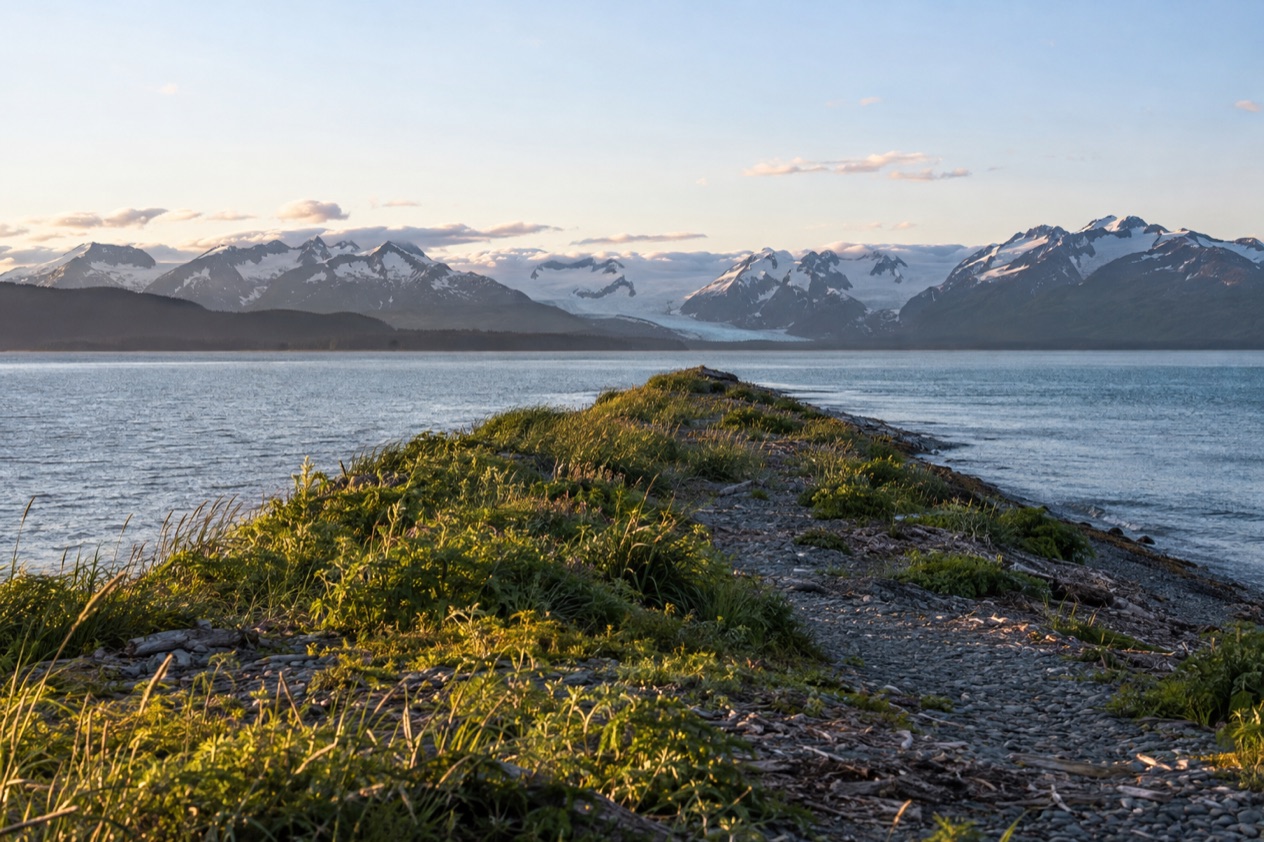
In August, the harbor at Homer smells of salt, diesel and fresh fish, and boats come back to the docks with halibut hanging by their tails. Fireweed is going to seed along the roadsides, the evenings still stay light, and the water of Kachemak Bay turns slate gray under passing clouds. It is the month for fishing, bear viewing and slow days at the end of the road.
What is the weather like in Homer in August?
August in Homer is cool and a little damp, with mild afternoons and chilly mornings, and a bit more rain than July brings.
| Month | Average high (°F) | Average low (°F) | Precipitation (in) | Days with precipitation | Daylight on the 15th |
|---|---|---|---|---|---|
| July | 63.1 | 49.2 | 1.45 | 4.5 | 18 h 01 min |
| August | 62.6 | 48.0 | 2.31 | 7.4 | 15 h 42 min |
| September | 56.7 | 42.3 | 3.28 | 9.3 | 12 h 59 min |
Afternoons sit in the low 60s, which means a fleece or a light jacket rather than a T-shirt. Mornings and nights drop into the 40s, so the first walk to the harbor or a coffee on the Spit calls for a warm layer, and a hat is welcome on the water, where the wind adds a chill.
Rain in August comes as passing showers and some gray, drizzly days rather than long downpours. Over a week-long stay you can expect a few wet spells, so a waterproof shell is more useful than an umbrella, especially on a boat or a trail where wind picks up.
The light is the quiet pleasure of the month. Days are still long enough for a late dinner and a walk afterward, yet the evenings now end with real dusk, and the long glow of midsummer has given way to softer, earlier sunsets over the bay. Nights are dark enough to feel like nights again.
What to do in Homer in August
August in Homer is about the water and what lives around it. The town calls itself the Halibut Fishing Capital of the World, and the harbor on the Spit is where that claim takes shape, with charter boats heading out and the day’s catch being weighed and cleaned on the docks. Even if you never pick up a rod, watching the boats return is an evening ritual.
Fishing out of Homer
Homer is a jumping-off point for the waters of Kachemak Bay, Cook Inlet and the Gulf of Alaska, and across the season anglers can go after king salmon, halibut, lingcod, rockfish and silver salmon. Silver salmon are a late-summer fish, and halibut remains the draw that gives the town its nickname.
A day on a charter is a long, cold, wonderful affair: gray water, seabirds overhead, and the heavy tug of a fish from the deep. Dress in layers and waterproofs, because the breeze on the bay is cooler than the town thermometer suggests. If you would rather not fish, the dockside scene and a plate of fresh halibut at a harbor restaurant make a fine substitute.
Bear viewing by air
Homer is the gateway to bear viewing and the closest town to Katmai National Park and Preserve and Lake Clark National Preserve. Bear viewing runs from June through September, when brown bears gather on coastal sedge flats and streams. In summer they feed on salmon swimming home to spawn, so August can put you in front of bears at work along the water, though sightings are never guaranteed.
Katmai holds important spawning and rearing ground for Bristol Bay sockeye, and Lake Clark’s Crescent Lake is known for strong salmon runs, views of Redoubt Volcano and high bear populations. In Alaska, all human sources of food must be kept secure from bears, a rule worth remembering anywhere you camp or picnic.
The Spit and the town
When you are back on land, the Spit is the place to wander, with fish-and-chips counters, gift shops and the harbor’s constant motion. Gulls and eagles work the water, and the view across the bay to the mountains and glaciers changes with every cloud.
Homer also marks the end of the paved highway system of North America, which gives the town a last-stop feel. Cafés, galleries and bookshops in the old town make good refuges when a shower rolls through, and a bowl of chowder or a salmon sandwich suits the cool air better than anything cold.
The wider Kenai Peninsula, which stretches southwest from the Chugach Mountains, is also fishing country. The Kenai River is renowned for king salmon, and the towns along it keep that culture alive, but for most of August the energy in Homer itself belongs to the bay.
A two-day itinerary for Homer in August
Day 1 is for the harbor. Start with coffee and a warm layer on the Spit while the boats are loading, then spend the morning on the water if you have a fishing charter, or wandering the docks and watching the work if you do not. Lunch is fresh halibut or a bowl of chowder at a harbor-side counter.
In the afternoon, walk the Spit’s shops and shoreline, with the bay and the mountains across the water. Evenings stay light long enough for a slow dinner and a stroll back to the docks to see the late boats come in. If rain sets in, the old-town galleries, bookshops and cafés are the place to wait it out.
Day 2 belongs to the bears, if you have arranged a trip to Katmai or Lake Clark from Homer. Weather can reshape any flight, so keep the day loose.
If you skip the bears, spend the day in town: a slow breakfast, the gallery and café circuit, and an unhurried drive along the shore. Finish with a salmon dinner and one more look at the bay, now darker than it was a month ago.
Is Homer busy in August?
August sits inside the main fishing and bear-viewing season in Homer, so the harbor stays active and the town feels fully awake. Bear viewing runs from June through September, and the charter docks are working at full pace.
The mood is busy but unhurried, a working port with visitors folded in. Mornings on the Spit have the most movement, when boats leave, and evenings bring crowds back to the docks and restaurants. Between those moments the town settles into a calm rhythm, with quiet corners in the old town and along the shore.
What to pack for Homer in August
Think layers for cool mornings, a damp bay and changeable skies.
- A waterproof jacket, for showers on the Spit and spray on a boat
- A fleece or warm mid-layer, since mornings and nights fall into the 40s
- A warm hat and light gloves for the water, where the wind cuts
- Waterproof shoes with grip, for wet docks and muddy trails
- A camera with a zoom lens, for eagles, boats and any bears
- Sealed containers for food, since it must be kept secure from bears
Good to know before you go
August is a month of long but shrinking days, so plan outdoor time with the evening light in mind. Homer sits at the end of the paved highway system, and the bay, the Spit and the town are all within one compact area. Bear trips and fishing charters are the outings to settle first, since they shape the days around them. Keep all food secure from bears wherever you stay or camp.
Homer in August vs July and September
July is a touch warmer and noticeably drier, with far longer light and fewer wet days. If you want long evenings and the best odds of a dry boat day, early summer is the pick, and the bear-viewing season is already underway.
September is cooler and wetter, with much shorter days and the first real autumn feel. Bears are still viewable through the month, and the quieter mood suits travelers who like gray skies and moody light on the bay, but layers matter more than ever.
August sits between them: still comfortable, with light left for dinner and a walk, and rain that comes in showers rather than settling in. Choose July for the driest odds, September for quiet and autumn atmosphere, and August for a balanced mix.
Is August a good time to visit Homer?
Yes, August is a good time for travelers who like cool air, working harbors and wildlife, and who do not mind a few wet hours.
It will suit anglers chasing halibut and salmon, bear watchers heading for Katmai or Lake Clark, and anyone who enjoys a salty, unhurried port town. Those who want sun and warmth, or a dry forecast, may prefer to look elsewhere.
On arrival, head straight for the Spit and the harbor, where the whole month’s story is on display. Watch a boat come in, look across the bay, and let the cool air and the smell of fish set the pace. August in Homer is the season of the catch and of bears at the water, under a sky that is already turning toward autumn.
Sources
- NOAA NCEI, U.S. Climate Normals 1991-2020, monthly (https://www.ncei.noaa.gov/access/services/data/v1?dataset=normals-monthly-1991-2020&stations=USW00025507), station Homer Ap, elevation 64 feet, checked October 11, 2026
- Computed from the date and the latitude of the place (sunrise equation, solar elevation -0.833 degrees), October 11, 2026
- Homer, fishing (https://www.homeralaska.org/fishing/), checked October 11, 2026
- National Park Service, Lake Clark National Park & Preserve, plan your visit: conditions (https://www.nps.gov/lacl/planyourvisit/conditions.htm), checked October 11, 2026
- National Park Service, Katmai National Park & Preserve, plan your visit (https://www.nps.gov/katm/planyourvisit/index.htm), checked October 11, 2026
- Alaska Department of Fish and Game, Living with bears (https://www.adfg.alaska.gov/index.cfm?adfg=livingwithbears.main), checked October 11, 2026
- Homer, bear viewing (https://www.homeralaska.org/things-to-do/outdoors-and-recreation/bear-viewing/), checked October 11, 2026
- Wikipedia, Kenai Peninsula (https://en.wikipedia.org/wiki/Kenai_Peninsula), checked October 11, 2026
- Kenai Peninsula Borough (https://www.kpb.us/), checked October 11, 2026
- Wikipedia, Climate of Alaska (https://en.wikipedia.org/wiki/Climate_of_Alaska), checked October 11, 2026
To plan your stay
- Things to Do in Homer: Halibut Fishing, Bear Viewing, Kachemak Bay and the Spit
- Where to Stay in Homer: the Spit, Town, Lake Shore Drive and Kachemak Bay Views
- Homer from Anchorage: The Sterling Highway, Road Conditions and Making a Day of It
- Know Before You Go to Homer: Weather, Bears, Getting Around and Local Customs