
A floatplane idles on Lake Hood, its engine rattling the dock, and then the water streams off the floats as the nose lifts and Anchorage shrinks into a grid of roofs and lakes. Ahead lie mountains, glacier-fed rivers and ranges that no road crosses. Flightseeing is how Alaska shows its scale, and it starts from Anchorage, from Talkeetna and from other small airfields across the state.
What is flightseeing in Alaska?
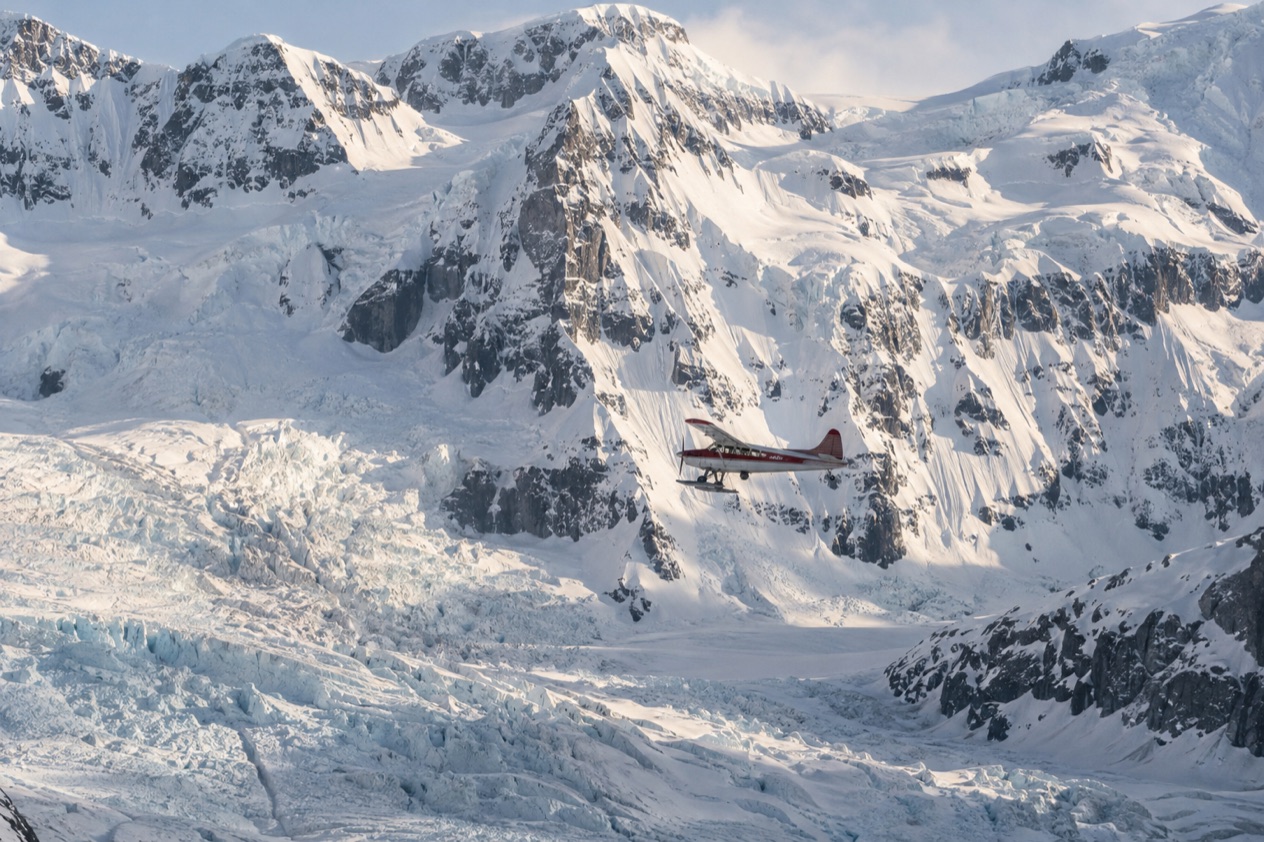
Flightseeing is a sightseeing trip by small aircraft, a floatplane, a fixed-wing plane or a helicopter, that takes you over country you would otherwise only read about. In a state this large and this thinly roaded, the view from the air is often the one that makes sense of the map.
Rivers braid across gravel flats, glaciers wind between ridgelines, and peaks rise out of cloud banks. You sit close to a window, headset on, with the pilot narrating what slides underneath.
It suits travelers who want a big landscape without a big expedition. It also suits anyone who has only a day or two in a town and wants to see what lies beyond it. Photographers like it for the long lines of a mountain range and the textures of ice seen from above. The experience is about looking, listening to the engine and the pilot, and noticing how quickly the terrain changes.
Floatplanes, fixed wing and helicopters
From Anchorage, personalized flightseeing tours and charters are offered by floatplane, fixed wing and helicopter, and they depart year-round. Each aircraft gives a different feel. A floatplane lifts off and lands on water, which makes the start and finish part of the show. A fixed-wing plane covers ground and gives a steady, wide view, while a helicopter moves slowly and can hang over a spot you want to study.
Flights leave from Merrill Field and from Lake Hood, which is the world’s busiest floatplane base, or from nearby Girdwood. Watching the traffic at Lake Hood is entertainment on its own, with small planes taxiing across the water like boats and pilots waving between takeoffs. Alaska has about six times as many pilots per capita as the rest of the United States, and a stroll around the lake makes that figure easy to believe.
The bush flying heritage behind every flight
Bush flying means operating aircraft in remote wilderness without prepared landing strips or runways, and flightseeing grew out of it. Bush planes are fitted with tundra tires, floats or skis so they can work from rough ground, water, snow and ice.
The tradition goes back to the 1920s. In 1924 Carl Ben Eielson received a de Havilland 4 for mail runs to McGrath, and that August Noel Wien made the first successful bush flight, to the mining camp of Livengood.
The trip took under an hour where the winter dog sled trail took several days, and that summer Wien made 34 flights to supply the roughly 250 men there. The first tourist trips by air in the Alaskan bush came in 1947, to Nome and Kotzebue, with Celia Hunter among the first flight attendants.
Where do the flights go?
Flights go mainly toward Denali and the Alaska Range, over the glaciers and fjords of the Kenai Peninsula, and along the Chugach Range, with Anchorage and Talkeetna as the main starting points. Each direction gives a different Alaska. One is a wall of rock and ice, one is a coastline cut by fjords, and one is a long ridge of mountains running toward the water.
Denali and the Alaska Range
Denali is the highest peak in North America, with a summit of 20,310 feet, and it stands in Denali National Park and Preserve in the Alaska Range, northwest of Anchorage. Its Koyukon name has been used for centuries. From the air you can take in the whole mass of the mountain at once, which is hard to do from the ground, where clouds and foothills often hide it.
Flightseeing also reveals the ice that feeds the surrounding valleys. The Kahiltna Glacier flows off the southwest side of the mountain and is the longest glacier in the Alaska Range at 44 miles. You may see crevasse fields, rock-strewn ridges and the thin lines where climbers’ routes cross the snow.
The first verified ascent came on June 7, 1913, and the West Buttress, pioneered by Bradford Washburn in 1951, is the most popular route today. Seeing that terrain from above gives you a sense of what those climbers faced.
Flying from Talkeetna
Talkeetna, at the base of Denali, is a small town where three glacier-fed rivers, the Chulitna, the Susitna and the Talkeetna, come together. Its airport is home to several air taxi companies that provide flightseeing trips and support for mountain climbers, and the town is the base for expeditions to Denali. Tourists come each summer to fish for salmon, raft and go flightseeing.
The town itself is part of the outing. Its core is a Historic District on the National Register, with buildings from the early 1900s. It is not legally a town or city, and its only local government is a cat mayor who lives in the general store.
After a flight you can sit down at The West Rib Cafe and Pub, where the strong Ice Axe Ale is limited to two glasses unless you order a pitcher. Free events take place in town every Friday evening from May 22 through September, according to the Talkeetna Chamber of Commerce calendar.
You can reach Talkeetna by car on the George Parks Highway, the main road between Anchorage and Fairbanks. The Alaska Railroad’s Denali Star also stops at the depot, as do the Aurora Winter Train and the Hurricane Turn.
Kenai Fjords and the coast
Kenai Fjords National Park lies due south of Anchorage on the Kenai Peninsula, and it is the other direction flightseeing takes. Here the story is where mountains meet saltwater, with ice-carved valleys dropping toward the coast. Seen from above, the fjords look like fingers of water pushed deep into the land. You may also spot wildlife along the shoreline, though that is a chance and never a promise.
The Chugach toward Prince William Sound
The Chugach Range stretches 710 miles east from Anchorage toward Prince William Sound and Valdez. Flying along it shows a line of peaks with glaciers tucked into their folds. Girdwood, one of the departure points, sits at the edge of this country. It is a way to see mountains close to the city that most people only glimpse from the highway.
What should you know before you book?
Before you book, know three things: which aircraft you want, where the flight leaves from, and what you hope to see. Tours from Anchorage depart year-round, so the question is rarely whether a flight exists but which kind suits the trip.
Matching the aircraft to the day
A floatplane brings the lake-and-water-landing experience and ties in with the bush flying heritage. A fixed-wing plane suits a long route over mountains or glaciers. A helicopter is the choice for hovering over a feature and looking at it slowly. All three are offered from Anchorage as personalized tours or charters, which means a group can shape the outing instead of taking a fixed route.
The equipment matters too. Bush planes carry tundra tires, floats or skis, so the landing surface can be gravel, water, snow or ice. If a landing is part of what you want, ask the operator which surface the flight uses, and listen to what the pilot says about it.
Choosing where to leave from
Anchorage gives you Merrill Field, Lake Hood and nearby Girdwood. Talkeetna gives you a small airport with several air taxi companies that serve both sightseers and climbers, and a front-row position for Denali. Talkeetna is a stop on the Alaska Railroad’s Denali Star and reachable by car on the George Parks Highway.
If you are staying in Anchorage, the Kenai Fjords and Chugach flights are close by, while Denali flights are the natural reason to go to Talkeetna. A night there lets you pair the flight with the town’s historic main street, a river trip (rafting and kayaking trips leave daily) and, on a summer Friday, the free evening events.
Pairing a flight with Denali National Park
Denali National Park and Preserve is open year-round, and there is just one road in it. Most visitors come in summer, when bus access into the park becomes possible as winter ice and snow melt. Winter visitors can expect solace, tranquility and the challenges of extreme weather. The mountain holds the North American record windchill of -118.1°F, recorded on November 30, 2003 at the Denali weather station.
A flight shows you the range from above, and the park shows you the ground beneath it. The National Park Service offers tips on where to see the mountain and how to photograph wildlife and wilderness. Rangers lead Discovery Hikes off-trail, trail walks and campground talks, and visitors can follow established trails or hike off-trail in the wilderness.
Good to know before you go
Flightseeing departs from Anchorage all year, but Talkeetna’s Friday evening events run only from May 22 through September, and Denali’s bus access opens as the snow melts. A sightseeing flight, a cup of coffee in the Talkeetna Historic District and a stretch of the Parks Highway fit into one trip. Keep the camera ready for the mountains, and listen to your pilot, who will know the country better than any map.
Sources
- Visit Anchorage, flightseeing (https://www.anchorage.net/things-to-do/flightseeing/), checked October 11, 2026
- Wikipedia, Bush flying (https://en.wikipedia.org/wiki/Bush_flying), checked October 11, 2026
- Wikipedia, Talkeetna, Alaska (https://en.wikipedia.org/wiki/Talkeetna,_Alaska), checked October 11, 2026
- Wikivoyage, Talkeetna (https://en.wikivoyage.org/wiki/Talkeetna), checked October 11, 2026
- Talkeetna Chamber of Commerce (https://www.talkeetnachamber.org/), checked October 11, 2026
- Wikipedia, Mount Denali (https://en.wikipedia.org/wiki/Mount_Denali), checked October 11, 2026
- National Park Service, Denali National Park & Preserve, plan your visit: things2do (https://www.nps.gov/dena/planyourvisit/things2do.htm), checked October 11, 2026