
On an Alaska Marine Highway ferry, passengers drift between the lounge and the open deck with a coffee, watching forested shorelines slide past and small-town docks come up out of the mist. On a cruise ship, the day starts with a gangway, a port town waiting at the bottom, and a glacier scheduled for the afternoon.
Both follow the same waters, but they feel like different trips. One is a working link between communities, the other a floating hotel built around sightseeing.
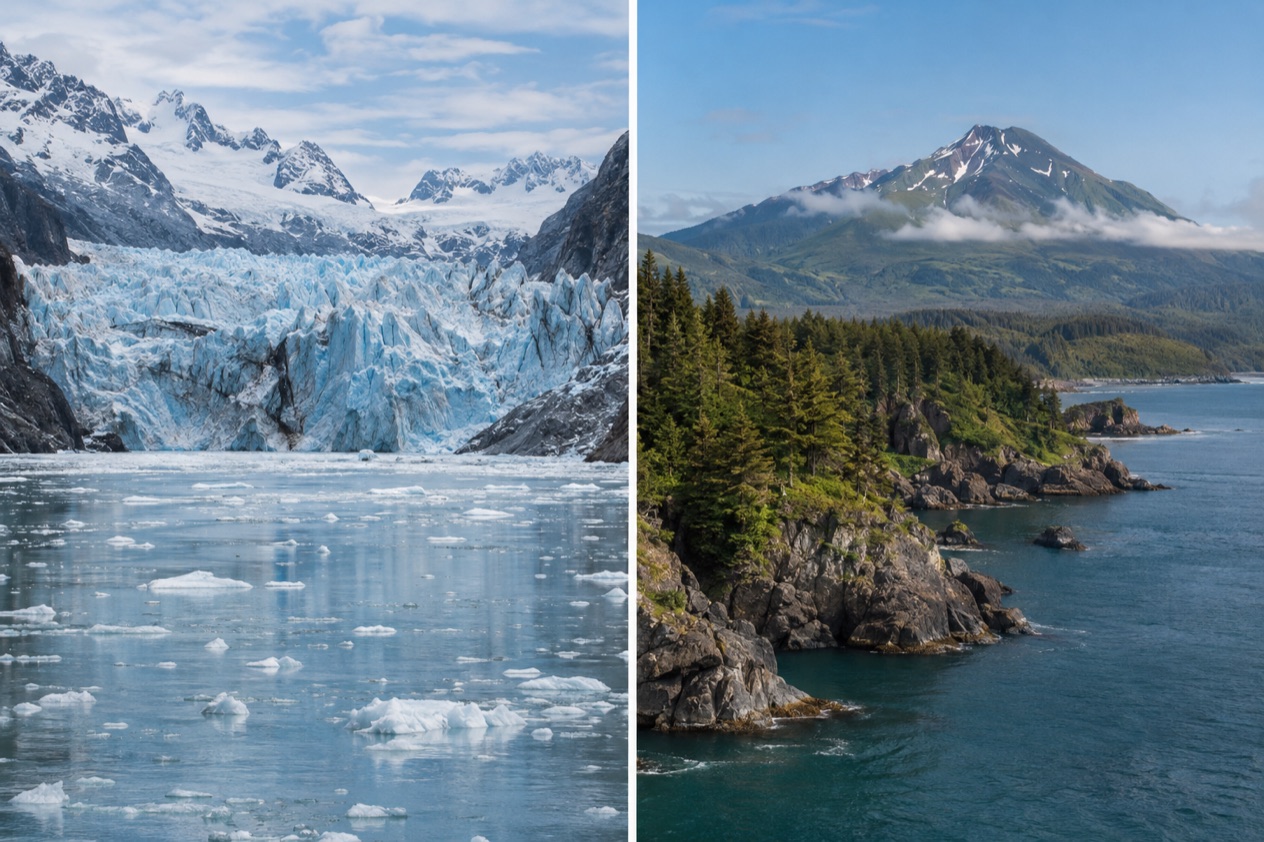
Which is better, the Alaska ferry or an Alaska cruise?
The ferry suits travelers who want to cross Alaska the way residents do, stopping in small towns and making their own plans, while a cruise suits those who want a ready-made route with meals, a cabin and organized excursions in one package. Neither is better in itself. The question is whether you want to travel through Alaska’s coastal communities or be carried past them with everything arranged.
The ferry is public transportation that happens to run through some of the most dramatic coastline in the country. A cruise is a vacation product, and the ship is part of the destination. The table sets the two side by side.
| Category | the Alaska ferry | an Alaska cruise |
|---|---|---|
| Scenery | Sheltered channels, forested islands and mountain shorelines seen from the deck | Glaciers, fjords and mountain backdrops, with a glacier visit built into Holland America sailings |
| Vibe | Practical, unhurried, shared with residents and their vehicles | Resort-style, with dining rooms, entertainment and a set program |
| Things to do | Step off in the towns the route serves and plan your own days | Ship activities plus excursions, and cruisetours that add Denali |
| Wildlife | Watching from the deck, with no guarantee of a sighting | Watching from the deck or on excursions, with no guarantee of a sighting |
| Weather | Year-round service to most Southeast communities | Set by the line’s own program |
| Getting there | Terminals from Bellingham, WA to Dutch Harbor | Departures from Seattle, Vancouver, Whittier or San Diego (Holland America) |
| Best for | Independent travelers, residents, people with vehicles, slow travel | First-time visitors, families and groups who want one itinerary |
Scenery and wildlife
The ferry route follows the Inside Passage, a natural sheltered sea route that runs for more than 1,000 miles from Seattle northwest to Skagway. In Alaska’s part of it, you pass between islands and mountain walls that drop straight into the water, with evergreen forest down to the tide line. Because the channels are narrow, the land is always close, and you can read the shoreline: a cabin on pilings, a fish processing plant, a waterfall dropping from a notch in the rock.
Alaska cruises put the same coastline to a different use. The ship is planned around the big set pieces, and Holland America even promises a Future Cruise Credit if its Alaska cruise does not include a glacier visit. Expect broad decks, a captain’s commentary and a crowd at the rail when ice comes into view. Cruisetours go further inland, so mountain scenery enters the picture beyond the coast.
On both, wildlife is a chance rather than a promise. Whales may surface in the channels, sea otters and sea lions sometimes turn up near rocks and docks, and bald eagles are often seen perched along the shoreline.
Binoculars and patience matter more than the type of vessel. The ferry’s long passages between ports leave plenty of unhurried time for scanning the water, and the open decks suit those who like to stand in the wind and watch.
Who wins? For the feeling of moving through the landscape at the pace of daily life, the ferry. The sheltered passage is the same one the cruise ships use, but you experience it with fewer programmed moments and more quiet. For a guaranteed focus on glaciers and a dramatic mountain finale, the cruise is built to deliver that. The scenery itself is shared, so the real difference is how much is arranged for you.
Things to do
With the ferry, the things to do are the towns. The system serves over 30 communities, and many of them are not reached by road, so a stop is a chance to walk a harbor, find a bakery or a fish shack, and see a place that works mostly for its own residents. Regional hubs such as Ketchikan and Juneau make good bases for day trips and boat outings, and Whittier and Homer open up other corners of the coast.
Because the ferry carries vehicles from motorcycles up to large freight containers, you can also bring your own transport and go further than your feet. That changes the trip. Instead of a single port visit, you can drive off the boat and pick your own trailheads, viewpoints, cafés and local museums, building the days as you go.
A cruise packs the same ground into a rhythm of port days. You step off in a town, usually with excursions on offer: a boat trip toward ice, a wildlife outing, a train or bus ride, a visit to a cultural center or a stroll through the shops along the waterfront. Meals, shows and lounges fill the time at sea, so even the days without a port have a program.
Denali is where the cruise side stretches inland. Holland America’s cruisetours depart from Seattle, Vancouver, Anchorage or Fairbanks and run for a longer span, adding land time to the voyage. Princess operates its own lodges for that purpose. The Denali Princess Wilderness Lodge sits one mile from the park entrance, while the Mt. McKinley Princess Wilderness Lodge is 40 miles from Mt. McKinley and two hours south of the park entrance.
Food leans differently too. On the ferry you eat what the ship’s galley offers and whatever you find in port, which often means salmon, halibut or chowder at a harbor-side counter. On a cruise, dining is part of the product, with set sittings, buffets and specialty restaurants, and the port town becomes an extra, not the main meal.
Weather and the best time to go
The ferry’s calendar is the simpler one to describe. Most Southeast Alaska communities get ferry service year-round, with mainline vessels calling at larger towns and day boats serving smaller ones. That means the ferry is not tied to a single summer window in that region. It also means you can meet the coast in any mood: bright and clear, soft with cloud, or heavy with rain and low mist over the water.
Southeast Alaska is a temperate rainforest, and that shows in the landscape: moss on the trunks, waterfalls after rain, clouds caught on the mountainsides. A gray day on the ferry is not a lost day. The shoreline takes on a quieter look, the ship’s lounge feels warm, and mist around the islands can be as striking as sunshine. The sheltered channels also keep the passage within the protection of the islands.
Cruises depend on each line’s program. Holland America’s Alaska cruises range from 7 to 28 days, and its cruisetours from 9 to 17 days, so the length of your trip decides how much of the coast, and how much of the interior, you see.
A shorter voyage concentrates on the coast, while a longer one or a cruisetour adds more ports and land stays. The weather you meet is the weather of the dates you choose, so match the departure to what you want to see.
Light matters as much as temperature. Long northern days stretch the viewing hours on deck, and short ones compress them. Either way, the practical approach is the same on both sides: choose the sailing for the experience you want, and treat any single day’s weather as part of the scenery rather than a verdict on the trip.
Getting there and getting around
The Alaska Marine Highway is a ferry service run by the state, with headquarters in Ketchikan. Its routes cover 3,500 miles of coastline, from Bellingham, Washington, to Dutch Harbor in the Aleutian Chain, and the system has 32 terminals in Alaska, British Columbia and Washington. Reaching one means traveling to a terminal town, either Bellingham for the southern start or a Southeast port such as Ketchikan or Juneau.
Once aboard, you move by hub. Riders reach communities through regional hubs in Ketchikan, Juneau, Whittier or Homer, sometimes changing vessels to get to a final destination. That makes the ferry something of a puzzle you piece together, and part of the appeal for people who like route-planning. Passengers without vehicles check in two hours before departure in Bellingham and Juneau, and one hour before at every other port.
A cruise reverses the logic. You travel to the departure port, and Holland America’s Alaska cruises depart from Seattle, Vancouver, Whittier or San Diego. Its cruisetours add Anchorage and Fairbanks as departure points because part of the trip is on land. After boarding, the ship moves you from port to port while you stay in the same cabin, so there is no need to piece together connections.
Moving around in port differs as well. Ferry passengers get off in towns on their own schedule, with the freedom to stay longer and take a later vessel, and those with vehicles can drive. Cruise passengers step off into a program of excursions or independent wandering, then return to the ship. The ferry gives you the road, the cruise gives you the hotel.
Who should choose which
Choose the ferry if you like to travel as part of the local scene, with decks, lounges and harbor towns rather than ballrooms. It suits independent planners, people who want to bring a vehicle, and anyone drawn to places that road maps skip. The ferry also rewards a flexible mind: a route puzzle that asks you to stitch hubs together, with time to read, watch the water and talk with residents heading home.
Choose a cruise if you want a single, organized trip with the logistics handled: a cabin, meals, and excursions lined up for each port. It fits first-time visitors, groups with different interests, and anyone who wants a glacier on the schedule and Denali added through a cruisetour. Princess, for one, has been voted Best Cruise Line in Alaska 22 times by the readers of Travel Weekly, a sign of how much of the market sails this way.
Combining the two is possible in spirit even if not in one booking: a ferry stretch through the small towns paired with a cruise or cruisetour for the big set pieces. Each gives something the other cannot. The ferry shows how coastal Alaska lives, and the cruise shows how it presents itself to visitors. Doing both gives the fullest picture, with time for each at its own pace.
Good to know before you go
Southeast Alaska ferry service continues through the year for most communities, while cruise and cruisetour programs follow each line’s own schedule, so match the vessel to the experience you want and the dates you have. Keep a camera and binoculars within reach on deck, treat wildlife as a bonus, and let the passage itself be the point. Whichever you pick, the Inside Passage’s channels and mountains are the same, and 500 miles of Alaska’s portion, about 100 miles across at its widest, are waiting.
Sources
- Alaska Department of Transportation, Alaska Marine Highway System, Alaska Marine Highway System (https://dot.alaska.gov/amhs/index.shtml), checked October 11, 2026
- Alaska Department of Transportation, Alaska Marine Highway System, Route guide (https://dot.alaska.gov/amhs/route.shtml), checked October 11, 2026
- Alaska Department of Transportation, Alaska Marine Highway System, Fleet (https://dot.alaska.gov/amhs/fleet.shtml), checked October 11, 2026
- Princess Cruises, Alaska cruises (https://www.princess.com/en-us/cruise-destinations/alaska-cruises), checked October 11, 2026
- Holland America Line, Alaska cruises (https://www.hollandamerica.com/en/us/cruise-destinations/alaska-cruises), checked October 11, 2026
- Wikipedia, Inside Passage (https://en.wikipedia.org/wiki/Inside_Passage), checked October 11, 2026
- Wikipedia, Alaska Marine Highway (https://en.wikipedia.org/wiki/Alaska_Marine_Highway), checked October 11, 2026