
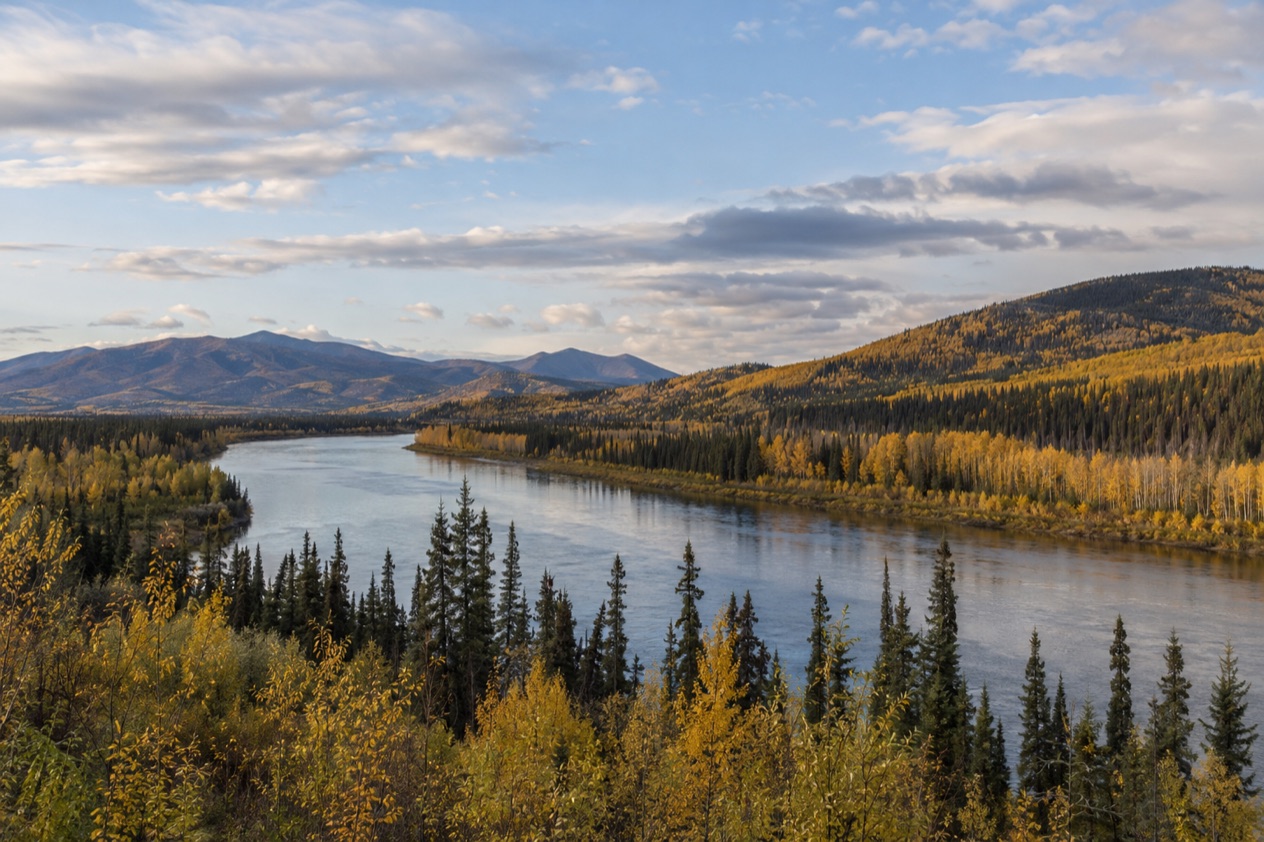
On a September evening in Fairbanks, the birch leaves along the Chena River begin to go yellow, the air smells of woodsmoke and cold earth, and for the first time since spring the sky turns properly dark after supper. The endless light of summer has let go, the aurora season has opened, and the town moves at a crisper pace. September here belongs to northern lights watchers, to walkers who like fall color, and to travelers happy with a warm jacket and a hot drink at the end of the day.
What is the weather like in Fairbanks in September?
September in Fairbanks is cool and crisp, with pleasant afternoons, frosty edges to the mornings and a clear drop toward winter as the weeks pass.
| Month | Average high (°F) | Average low (°F) | Precipitation (in) | Days with precipitation | Daylight on the 15th |
|---|---|---|---|---|---|
| August | 66.4 | 47.6 | 2.10 | 6.1 | 16 h 42 min |
| September | 55.3 | 36.2 | 1.35 | 3.9 | 13 h 13 min |
| October | 34.1 | 18.4 | 0.76 | 2.7 | 9 h 54 min |
Afternoons are mild enough for a walk in a fleece or a light jacket, especially when the sun is out. Mornings and evenings feel like real fall, with nights that sit close to freezing. A first dusting of snow is possible, since an average September brings 2.3 inches of it, though it often melts quickly.
Rain arrives on only a handful of days, usually as passing showers rather than all-day downpours. A waterproof shell is still worth having, because a wet, gray day can follow a perfectly clear one. Dry days tend to bring crisp, clear air, which helps with the stars at night.
The light has changed a great deal since summer. Days are still long enough for a full program of sightseeing, but the sun now sets early enough that you can enjoy real darkness before bedtime. That darkness is what makes the month special for anyone hoping to see the aurora.
What to do in Fairbanks in September
The big event of a Fairbanks September is the return of the dark. From about August 21 the sky is dark enough to see the aurora again, and in September you can combine long daytime outings with late-night sky watching. The aurora is a chance, never a promise, but around the fall equinox auroral activity tends to run stronger than in midsummer or midwinter, and the statistical likelihood over Interior Alaska is roughly twice as high as at the solstices.
Fairbanks is well set up for aurora watchers, with many tours and viewing sites that cater to them. With clear weather and at least three nights in town, seeing the lights is highly likely. Dress for standing still outdoors, bring patience, and step outside a few times through the night.
Moose are the animal visitors hope to see. An adult can stand almost 6 feet tall at the shoulder, and a big bull can carry a rack of antlers grown in a single summer. The Alaskan subspecies is the largest moose race, so give any animal you meet plenty of room.
Food turns heartier as the weather cools. Look for reindeer sausage, bowls of soup, local salmon, sourdough and pastries from small bakeries, along with Alaska craft beer and coffee shops that fill with people warming their hands. Birch syrup and fireweed honey make good edible souvenirs.
Chena Hot Springs
Chena Hot Springs is a hot spring resort 56.5 miles northeast of Fairbanks, near the Chena River State Recreation Area. Two gold mining brothers, Robert and Thomas Swan, founded it more than a century ago, and twelve small cabins were built there for visitors in 1911. Today it is a place to soak in hot mineral water while the air around you turns cool.
Aurora viewing season at the resort runs from late August to mid-April, so September falls inside it. A day in the hot water followed by a late evening outdoors is a natural pairing, because the water feels best when the air is cold.
| Site | Adults | Children |
|---|---|---|
| Chena Hot Springs, Pool House day pass | $20 | $17 |
North Pole and Santa Claus House
The town of North Pole sits about 1,700 miles south of the real geographic pole and 125 miles south of the Arctic Circle, but its streets are decorated for Christmas whatever the month. The main stop is Santa Claus House, a gift shop with a giant fiberglass Santa out front, billed as the world’s largest.
A small group of domesticated reindeer lives just outside the shop, and the shelves inside are full of ornaments and Alaska-made gifts. In September, with fall in the air, the visit feels like a pleasant, slightly silly warm-up for the holidays, and it is an easy place to find gifts.
Ester and the gold rush past
Ester began as a gold mining camp in the early 1900s, with the first claim staked in February 1903 by Latham A. Jones. The Ester Camp Historic District has been on the National Register of Historic Places since May 6, 1987. It lies within the Fairbanks North Star Borough and shows how the Interior was settled.
The old camp buildings, with their weathered wood, look their best in cool, slanting fall light. Bring a camera and walk slowly, then warm up afterward with a hot meal.
A two-day itinerary for Fairbanks in September
Day 1 is about town and its surroundings. Start the morning with coffee and a pastry, then spend the first part of the day at the University of Alaska Museum of the North, a good place to understand the Interior before you head out. By midday, drive to North Pole for Santa Claus House and the reindeer, and have lunch at a casual café or diner.
In the afternoon, while the air is at its warmest, walk through the Ester gold camp, then return to Fairbanks for a hearty dinner of local salmon or reindeer sausage. After dinner, get away from the streetlights and look north and up, because darkness arrives early enough now to make this possible without a very late night.
Day 2 belongs to Chena Hot Springs. Leave after breakfast so you arrive with the whole day ahead, and spend the morning in the Pool House with a view of the fall colors.
Stay on through the evening for aurora watching. September’s longer nights and the equinox boost in activity make it a good month to be outside after dark. If clouds cover the sky, a long soak and a hot dinner still make the day. Come back to Fairbanks the next morning rather than driving late.
Is Fairbanks busy in September?
September is a shoulder month in Fairbanks, a time when the long days of summer have ended and a new kind of visitor arrives for the dark skies.
The aurora is the main reason. Fairbanks is known for aurora viewing, with many tours and sites ready for watchers, and the viewing season here runs from roughly August 21 to April 21. September is among the first months when it is dark enough to see it at all.
What this changes is the pace of the town. Days run on the cool, fall rhythm of walks and museums, while evenings take on a second life as people head out to watch the sky. Evening plans are the ones to arrange first, since aurora outings and the resort at Chena are the heart of the month.
What to pack for Fairbanks in September
Pack for a day that starts near freezing, warms up pleasantly and ends cold again, with a night outside in the middle if the aurora is on your list.
- A warm insulated jacket, for standing still under the night sky.
- Layers such as fleece and long sleeves, for mornings that begin cold and afternoons that warm up.
- A waterproof shell, because showers pass through on a few days.
- A warm hat and gloves, for aurora nights and early starts.
- Waterproof walking shoes, for damp trails and fallen leaves.
- A swimsuit, for the hot springs at Chena.
Good to know before you go
Daylight is what shapes September in Fairbanks. The days are shorter than in summer, so plan outdoor sightseeing for the lighter hours and keep evenings for the sky. Aurora viewing needs darkness, which is why this month works for it and midsummer does not.
Fairbanks itself is spread out, with the main sights scattered around town and in the nearby communities, so plan your days by area. Keep a warm layer in the vehicle in case an outing runs late into the cold evening.
Fairbanks in September vs August and October
Moving the trip four weeks earlier brings you to August, with warmer afternoons, more rain days and a sky that is dark enough for the aurora only from about the 21st. August suits travelers who want to be outdoors in a T-shirt and fleece. The fall colors and the first dark skies are only beginning to arrive.
Moving four weeks later brings you to October, which is a different season. Highs hover around freezing, the days are short, and an average October delivers 8.2 inches of snow. The aurora is still active, but the trails and some outings feel more like winter.
Choose September if you want both worlds, a comfortable day for walking and a dark sky at night. Choose August for the warmest weather, and October if snow and a deep chill are part of the appeal.
Is September a good time to visit Fairbanks?
Yes, September is a very good time for travelers who want fall color and a real chance at the aurora without bundling up for deep winter.
It suits aurora watchers, photographers, hot spring lovers and anyone who likes crisp air and woodsmoke. It is also good for people who want to see the Interior before the snow arrives. It is less ideal for travelers who need warm weather, swimming or the longest possible days.
On arrival, settle your evening plans first, because the best outings depend on clear skies and darkness. Then fill the days with the museum, North Pole, Ester and Chena, working around the weather. What stays with you is the first night when the sky is dark again and the green light may begin to move.
Sources
- NOAA NCEI, U.S. Climate Normals 1991-2020, monthly (https://www.ncei.noaa.gov/access/services/data/v1?dataset=normals-monthly-1991-2020&stations=USW00026411), station Fairbanks Intl Ap, elevation 432 feet, checked October 11, 2026
- Computed from the date and the latitude of the place (sunrise equation, solar elevation -0.833 degrees), October 11, 2026
- Alaska Department of Fish and Game, Moose species profile (https://www.adfg.alaska.gov/index.cfm?adfg=moose.main), checked October 11, 2026
- Wikipedia, Moose (https://en.wikipedia.org/wiki/Moose), checked October 11, 2026
- University of Alaska Fairbanks Geophysical Institute, Aurora forecast (https://www.gi.alaska.edu/monitors/aurora-forecast), checked October 11, 2026
- Wikivoyage, Northern lights (https://en.wikivoyage.org/wiki/Northern_lights), checked October 11, 2026
- Wikipedia, Aurora (https://en.wikipedia.org/wiki/Aurora), checked October 11, 2026
- Visit Anchorage, northern lights viewing (https://www.anchorage.net/winter/things-to-do/northern-lights-viewing/), checked October 11, 2026
- Explore Fairbanks, winter events (https://www.explorefairbanks.com/events/winter-events/), checked October 11, 2026
- Chena Hot Springs Resort, activities (https://www.chenahotsprings.com/activities), checked October 11, 2026
- Alaska Railroad, Train schedules (https://www.alaskarailroad.com/ride-a-train/schedules), checked October 11, 2026
- Alaska Railroad, Denali Star (https://www.alaskarailroad.com/ride-a-train/our-trains/denali-star), checked October 11, 2026
- Wikipedia, Chena Hot Springs (https://en.wikipedia.org/wiki/Chena_Hot_Springs), checked October 11, 2026
- Wikipedia, North Pole, Alaska (https://en.wikipedia.org/wiki/North_Pole,_Alaska), checked October 11, 2026
- Wikipedia, Ester, Alaska (https://en.wikipedia.org/wiki/Ester,_Alaska), checked October 11, 2026
- Wikipedia, Fort Wainwright (https://en.wikipedia.org/wiki/Fort_Wainwright), checked October 11, 2026
- Wikipedia, Climate of Alaska (https://en.wikipedia.org/wiki/Climate_of_Alaska), checked October 11, 2026
To plan your stay
- Things to Do in Fairbanks: Riverboat, Aurora, Chena Hot Springs and Day Trips
- Where to Stay in Fairbanks: Downtown, Birch-Wood Cabins, Chena Hot Springs and Denali Lodges
- Fairbanks from Anchorage: Denali Star Train, Road Conditions, Flights and Stops Along the Way
- Know Before You Go to Fairbanks: Midnight Sun, Aurora Season, Layers and Local Habits