
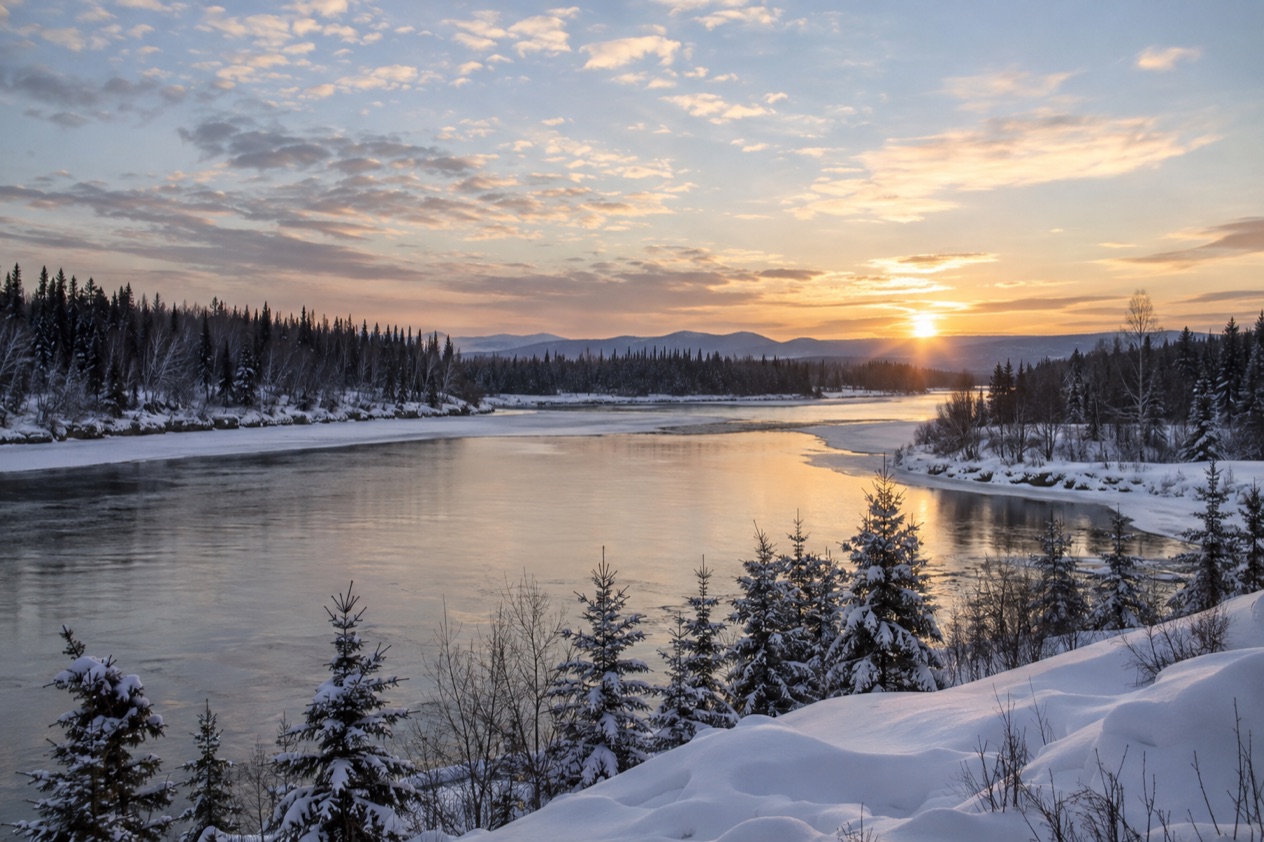
In April, Fairbanks sounds like water. Snowbanks shrink along the curbs, meltwater runs down the gutters, and on the Tanana River people in Nenana are watching a wooden tripod and waiting for the ice to move.
The evenings stretch long and soft, yet the sky can still go dark enough for a late aurora. It is a month for travelers who like to catch a northern town between winter and summer, with hot springs, gold-camp history and a few last nights of northern lights.
What is the weather like in Fairbanks in April?
April in Fairbanks is a month of thaw: afternoons climb above freezing, nights still drop well below it, and almost no rain or snow falls on most days.
| Month | Average high (°F) | Average low (°F) | Precipitation (in) | Days with precipitation | Daylight on the 15th |
|---|---|---|---|---|---|
| March | 24.9 | -3.4 | 0.40 | 0.8 | 11 h 34 min |
| April | 45.6 | 21.7 | 0.34 | 1.2 | 15 h 03 min |
| May | 62.1 | 38.6 | 0.54 | 1.5 | 18 h 32 min |
Mornings start hard and clear, with frozen puddles and crisp air, then the sun does real work by midday. Snow still falls now and then, but it is light and tends to melt quickly. The ground softens in the afternoon, so paths turn muddy and slushy where the sun reaches them, while shaded spots stay icy.
Dry weather is the rule, and a day with rain or snow is the exception. When it comes, it is usually a brief flurry or shower rather than a gray, all-day affair. Layers matter more than a heavy parka, since you may peel off a jacket at lunch and zip up again by supper.
The light is the real change. Darkness still comes late at night, which is why the aurora season is only just closing.
What to do in Fairbanks in April
The month’s signature moment belongs to Nenana, on the Tanana River, where the Nenana Ice Classic is played out. It is an annual contest in which people guess the exact time the river ice will break up, and a wooden tripod placed on the ice marks the moment when it moves.
Tickets cost $3.00 and are sold from February 1 through April 5 throughout Alaska, to buyers 18 or older. Proceeds go to volunteer and non-profit groups, which gives the guessing game a community feel.
Around town, April feels like an exhale. Winter gear is still on, but people stand outside cafés with their faces turned to the sun, and conversations drift toward gardens, boats and road trips. The ice art sculptures that decorate Fairbanks are displayed only until the end of March, so by April they are gone. What replaces them is the sight of the town thawing, with meltwater, bare patches and long shadows.
The aurora is a last-chance affair. The viewing season in Fairbanks runs roughly until April 21, and after that the sky does not get dark enough to see it. Clear nights early in the month give the best odds, and the experts note that auroral activity tends to be stronger around the equinoxes. Treat it as a chance, not a promise: clouds decide.
Chena Hot Springs
Chena Hot Springs is a hot spring resort 56.5 miles northeast of Fairbanks, near the Chena River State Recreation Area. Two gold-mining brothers, Robert and Thomas Swan, started it more than a century ago, and twelve small cabins went up in 1911 to house visitors. Today the draw is soaking in steaming water while the air around you is still cold and the snow lingers at the edges.
Aurora viewing season there runs from late August to mid-April, so early April is among the last chances to pair a soak with a look at the night sky. The resort offers a winter aurora viewing tour, listed in the table. In the afternoon, the pool house suits a slow, steamy break from the thaw outside.
| Site | Admission |
|---|---|
| Chena Hot Springs Pool House day pass | $20 adults, $17 children |
| Chena Hot Springs winter aurora viewing tour | $125 per person, 5 hours, riders at least 2 years old |
North Pole and Santa Claus House
North Pole is a town just outside Fairbanks, and its biggest attraction is Santa Claus House, a gift shop known for the world’s largest fiberglass statue of Santa outside. A small group of domesticated reindeer is kept just outside the shop, which makes it a fun stop for anyone traveling with children or anyone who likes kitsch.
In April the season for lights and tinsel has passed, which gives the stop a quieter, offbeat feel. You come for the statue, the reindeer and the novelty of a town whose street names and holiday cheer carry on all year. Photographs are better in the long, bright afternoon, with melting snow around the red-and-white buildings.
Ester and the gold-camp past
Ester sits in the Fairbanks North Star Borough and began as a gold mining camp in the early 1900s, with the first claim staked in February 1903 by Latham A. Jones. The Ester Camp Historic District is listed on the National Register of Historic Places, so you are looking at a real piece of the region’s mining era.
Walking the old camp in April means thawing ground and bare trees, with the faded wooden buildings standing out against patches of snow. It is a good counterpoint to the hot springs: one stop is about steam and rest, the other about the stubborn people who came north for gold.
A two-day itinerary for Fairbanks in April
Day 1 belongs to Chena Hot Springs. Leave Fairbanks in the morning while the air is still sharp and the roads and river are quiet, and plan to be at the springs by midday. Soak in the Pool House through the sunny afternoon, then eat at the resort or nearby before the light fades. The long evenings give you time to stay for dinner.
If the sky is clear, stay for the late evening and look for the aurora before the season closes in the second half of the month. The resort’s winter aurora viewing tour is one way to do it. If clouds roll in, the pool house is still a fine place to spend the rain-or-snow hours, since the water stays warm whatever the weather.
Day 2 stays closer to town. Have a sit-down lunch at a diner or a café in Fairbanks, where sourdough and local fish are on many menus. Then head to North Pole for Santa Claus House and the reindeer in the afternoon sun.
Finish with an unhurried supper in Fairbanks and a stroll while the light lasts.
Is Fairbanks busy in April?
April is a transition month in Fairbanks, with winter’s aurora crowd thinning and the long summer days not yet arrived. The aurora season is closing, roughly through April 21, and Chena’s viewing season ends in mid-April, so the people chasing the lights get fewer as the month goes on.
The ice art sculptures are gone, and Nenana’s ticket sales close on April 5, so the festival atmosphere around spring breakup is more local than touristic. For travelers, that means the pace of the town is slower and calmer, and you will have more room to wander at your own speed at places like Ester and North Pole.
What to pack for Fairbanks in April
Pack for a day that starts well below freezing and warms up by afternoon, with mud and slush underfoot and a late night chance at the aurora.
- A warm insulated jacket, for cold mornings and for waiting outside at night for the aurora
- Light layers such as fleece, since afternoons warm up in the sun
- Waterproof boots with good grip, for slush, mud and icy shade
- A hat and gloves, because lows stay well below freezing
- Sunglasses, for sun on the remaining snow
- A swimsuit for the Chena Hot Springs pool house
Good to know before you go
Plan around the light and the calendar. The Nenana Ice Classic’s ticket sales close on April 5, so only the breakup watching remains after that. The ice sculptures are over for the year.
Roads and paths can be wet or icy depending on the hour, so allow extra time for the outing to Chena Hot Springs, which lies 56.5 miles northeast of Fairbanks. Book the aurora tour or an evening at the resort first if the lights are your main goal, since that is the part of the trip with an end date.
Fairbanks in April vs March and May
Going four weeks earlier, to March, means a deep-winter feel, with cold that stays bitter and a lot more snow on the ground. The aurora season is in full swing, with the equinox boost to activity, and the ice art sculptures are still on display until the end of the month. Days are noticeably shorter, so there is less daylight for outings. Choose March if the lights and the winter look are your priority.
Going four weeks later, to May, brings warm afternoons and the longest days yet, but the sky no longer gets dark enough for the aurora once the season ends around April 21. The wetness of breakup gives way to green and open ground, and the days feel like summer. Choose May if you want long daylight, mild temperatures and outings without winter gear.
April sits in between. Stay with it if you want to catch the thaw, some late aurora chances and a calmer town. Shift to March for deep winter, or to May for summer light.
Is April a good time to visit Fairbanks?
Yes, for travelers who like a season in motion and don’t mind mud and cold mornings. April suits people who want a soak in hot springs, a last try at the aurora, a look at old gold-camp history and a quieter town with long evenings.
It is a poorer fit for anyone who wants deep snow, ice art or sunshine warm enough for summer clothes. If the aurora is the whole point, an earlier month gives you more nights. On arrival, sort out the Chena Hot Springs outing first, since the aurora season there ends in mid-April.
What makes April in Fairbanks special is the in-between feeling. Winter has not quite let go, yet the sun lingers into the evening, and the whole town seems to be waiting, along with Nenana, for the river ice to move.
Sources
- NOAA NCEI, U.S. Climate Normals 1991-2020, monthly (https://www.ncei.noaa.gov/access/services/data/v1?dataset=normals-monthly-1991-2020&stations=USW00026411), station Fairbanks Intl Ap, elevation 432 feet, checked October 11, 2026
- Computed from the date and the latitude of the place (sunrise equation, solar elevation -0.833 degrees), October 11, 2026
- University of Alaska Fairbanks Geophysical Institute, Aurora forecast (https://www.gi.alaska.edu/monitors/aurora-forecast), checked October 11, 2026
- Wikivoyage, Northern lights (https://en.wikivoyage.org/wiki/Northern_lights), checked October 11, 2026
- Wikipedia, Aurora (https://en.wikipedia.org/wiki/Aurora), checked October 11, 2026
- Visit Anchorage, northern lights viewing (https://www.anchorage.net/winter/things-to-do/northern-lights-viewing/), checked October 11, 2026
- Explore Fairbanks, winter events (https://www.explorefairbanks.com/events/winter-events/), checked October 11, 2026
- Chena Hot Springs Resort, activities (https://www.chenahotsprings.com/activities), checked October 11, 2026
- Nenana Ice Classic (https://www.nenanaakiceclassic.com/), checked October 11, 2026
- Alaska Railroad, Train schedules (https://www.alaskarailroad.com/ride-a-train/schedules), checked October 11, 2026
- Alaska Railroad, Denali Star (https://www.alaskarailroad.com/ride-a-train/our-trains/denali-star), checked October 11, 2026
- Wikipedia, Chena Hot Springs (https://en.wikipedia.org/wiki/Chena_Hot_Springs), checked October 11, 2026
- Wikipedia, North Pole, Alaska (https://en.wikipedia.org/wiki/North_Pole,_Alaska), checked October 11, 2026
- Wikipedia, Ester, Alaska (https://en.wikipedia.org/wiki/Ester,_Alaska), checked October 11, 2026
- Wikipedia, Fort Wainwright (https://en.wikipedia.org/wiki/Fort_Wainwright), checked October 11, 2026
- Wikipedia, Climate of Alaska (https://en.wikipedia.org/wiki/Climate_of_Alaska), checked October 11, 2026
To plan your stay
- Things to Do in Fairbanks: Riverboat, Aurora, Chena Hot Springs and Day Trips
- Where to Stay in Fairbanks: Downtown, Birch-Wood Cabins, Chena Hot Springs and Denali Lodges
- Fairbanks from Anchorage: Denali Star Train, Road Conditions, Flights and Stops Along the Way
- Know Before You Go to Fairbanks: Midnight Sun, Aurora Season, Layers and Local Habits