
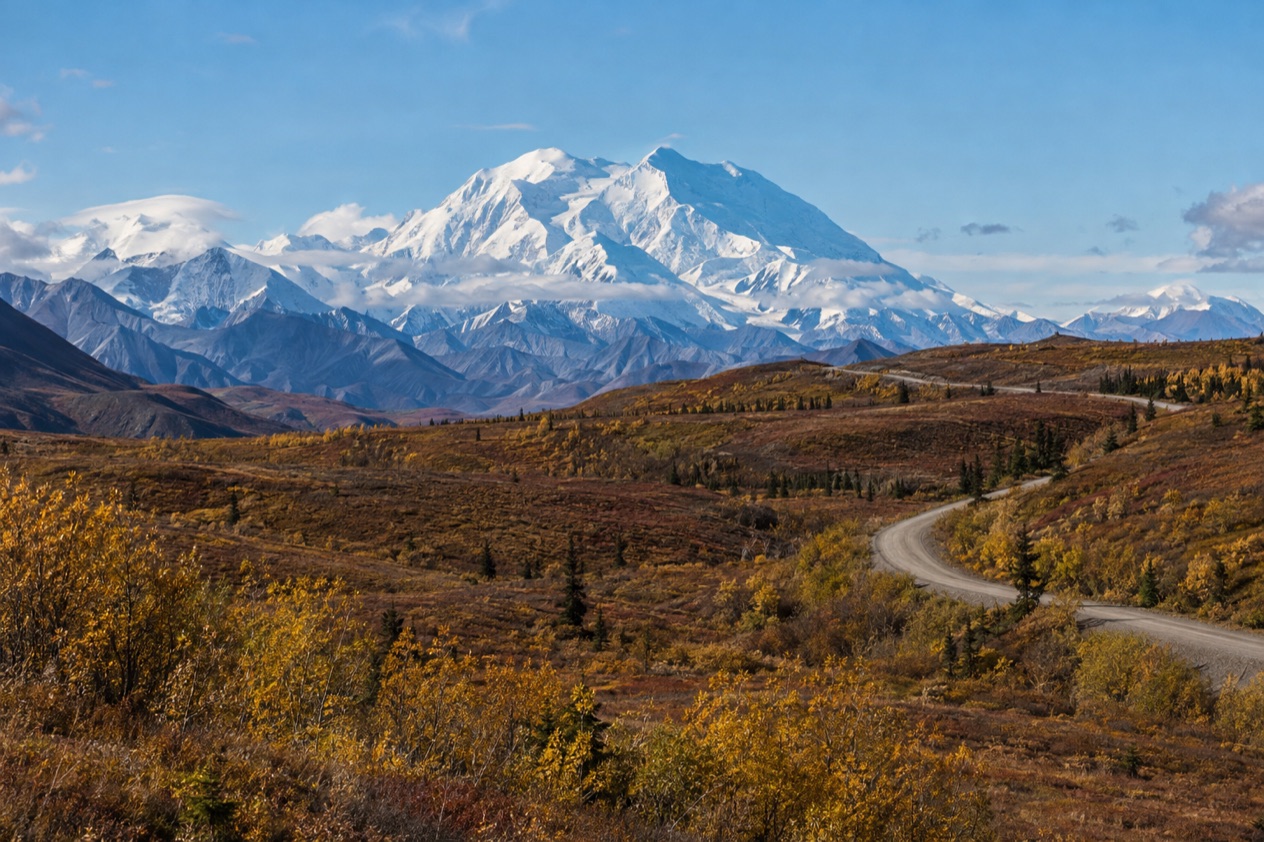
In September the tundra around Denali turns the color of rust and old brass, and the first frost leaves a white fringe on the willows at breakfast. The mountains stand out sharper in the cooler air, and the long summer evenings give way to dusk you can actually notice. This is Denali National Park at the turn of the seasons, a good month for travelers who want fall color, wildlife and a quieter pace.
What is the weather like in Denali National Park in September?
September in Denali is cool and crisp, with pleasant sweater-weather afternoons, mornings that start near freezing and the first real sense that winter is coming.
| Month | Average high (°F) | Average low (°F) | Precipitation (in) | Daylight on the 15th |
|---|---|---|---|---|
| August | 60.1 | 42.8 | 3.94 | 16 hours 24 minutes |
| September | 49.7 | 33.4 | 2.23 | 13 hours 09 minutes |
| October | 32.1 | 17.5 | 1.45 | 10 hours 01 minutes |
Afternoons are the comfortable part of the day, cool enough for a fleece and a windproof layer but fine for hours outdoors if you keep moving. Mornings and evenings are another matter. Frost is common at the start of the day, and once the sun drops behind the ridges the chill arrives quickly, so a warm hat and gloves earn their place in your pocket.
Precipitation falls as rain and melted snow, and it is lighter than in August. Expect a mix of bright, clear stretches and gray days when the cloud sits low and hides the high peaks. A waterproof shell matters more than an umbrella here, since the wind can be steady in open country.
The light is the real change of the month. Days are still generous, but they are shrinking fast, and the evening has a soft, slanting quality that makes the colored tundra glow. Dusk comes early enough that you will notice it, which also opens the door to a night sky that darkens properly after the bright summer.
What to do in Denali National Park in September
Fall color is the headline. The National Park Service places fall at Denali from mid-September until snow accumulates, typically between late September and late October, so the month is a handoff between the last of summer and the first of the quiet season. Hillsides often turn red, orange and gold, and the contrast with the dark spruce and the pale gravel bars makes the whole landscape look painted.
Most organized events at the park occur in summer, from mid-May through mid-September, so early September still has ranger programs and a fuller calendar. After mid-month the park gets plainer and more solitary, and that is part of the appeal for people who come to look rather than to be entertained.
The Park Road and the buses
The Denali Park Road is the spine of any visit, and the bus ride along it is the way most people see the park’s interior. Bus service in the park generally runs from May 20 through mid-September, and transit bus service along the road ends the second Thursday after the Labor Day holiday.
If your dates fall in the first half of September, you can ride into the heart of the park. Later in the month the road is a different, quieter experience.
From the window you watch tundra open out beneath the Alaska Range, with rivers braided across wide valleys and the ground turning to autumn colors. Wildlife may appear at any bend, from caribou and Dall sheep on the slopes to a grizzly foraging on berry-covered hillsides. Nothing is promised, which is part of why people scan the landscape so carefully. Bring binoculars and let the road set the pace.
Mountain views and the high peaks
Denali, the centerpiece of the park, rises to 20,310 feet in the Alaska Range, and it climbs from a sloping plain so that its height from base to summit is among the greatest of any mountain on land. Cooler September air tends to bring clearer stretches, though clouds can still hide the summit for days. When it does appear, the sheer scale takes a moment to register.
Mount Foraker, also in the park, reaches 17,400 feet and stands among the neighbors that give the range its jagged skyline. The Denali Star Train’s route between Anchorage and Fairbanks stops at the park, and on a clear day passengers can see Denali from the train. Fresh snow on the upper slopes in fall makes the peaks stand out against the blue sky.
Wildlife in fall
Moose are one of the animals you may see in Denali, and September is a good moment to look at them. Adult moose range from 800 pounds for a small female to 1,600 pounds for a large male and stand almost 6 feet tall at the shoulder. Only the males carry antlers, and a big bull can grow a rack of 80 pounds in a single summer, so by now the bulls wear their full headgear.
Look for moose along willow flats and the edges of ponds, and for other large animals on open hillsides where the color of the tundra gives them a backdrop. Fall is also when berries ripen, which draws bears to the slopes. Watch from a distance, follow the park’s wildlife rules and treat every sighting as a bonus.
Night skies and the aurora
September brings the first dark nights of the year, which opens up a chance to see the northern lights. The oval where the aurora is most likely covers most of Alaska, and Denali is in the interior of the state. Activity tends to be more intense around the equinox than at the summer or winter solstice, so September has a statistical edge over the bright months of summer.
It remains a chance and not a promise. You need clear skies, patience and a dark spot away from lights. A few minutes outside after dinner can be rewarded with a pale green glow, or with nothing but stars, which are well worth seeing in their own right in this country.
Food and the mood outside the park
After a cold day outdoors, the meals that suit the season are hearty ones: salmon, halibut, reindeer sausage, chowder, sourdough pancakes and a local beer. Berries show up in desserts and jams as the fall harvest ripens. Dining rooms near the park entrance feel quieter as the month goes on, and a table by a window with a view of the colored hills is the right reward after a long day.
A two-day itinerary for Denali National Park in September
Day 1 belongs to the Park Road. Start early with a hot breakfast, since mornings are frosty and the light is crisp, then head into the park on a bus if your dates fall before the service ends. Settle by a window, keep your binoculars handy and let the stops come as they do. The first half of the day is for looking, because wildlife is often more active in the cool morning.
Midday is for a packed lunch in a sheltered spot and layers added or shed as the sun comes and goes. In the afternoon, watch for the high peaks to clear, and take the colors as the light turns slanted. Back at the entrance area, finish with a warm dinner and then step outside after dark, since this is the month when the sky may offer an aurora.
Day 2 is for the park on foot and for the places around the entrance. Choose a walk near the entrance area in the morning, when frost still lines the trail edges and the tundra glows in the low sun. Pause often, since the color is best seen up close, in the leaves of dwarf birch and the berry bushes underfoot.
After lunch, spend the afternoon on the park’s ranger programs if your dates fall before the events wind down in mid-September, and pick up a bit of the park’s natural history. The rain card is simple.
On a wet day, spend the morning in the visitor center with its exhibits, take a long lunch and wait for a break in the clouds. Even in drizzle, the colors look richer when the ground is wet.
Is Denali National Park busy in September?
September is the quieter edge of the busy summer season, and the pace slows as the month moves along.
The organized side of the park is still active early in the month. Bus service generally runs through mid-September, and most organized events at the park run from mid-May through mid-September. Once those end, the park becomes calmer, with fewer programs and a more solitary feel on the road and the trails.
Fall at Denali begins in mid-September and lasts until snow accumulates, so the second half of the month feels like a different place from the first. If you want the full range of services and a lively park, aim for the first part. If you want space and silence, the later part is better, though you give up the bus ride.
What to pack for Denali National Park in September
Pack for cool afternoons, near-freezing mornings and changeable skies, with layers you can add and shed over a day outdoors.
- A warm fleece or insulated jacket, for chilly mornings and evenings by the road.
- A waterproof shell, because precipitation can arrive as rain or wet snow.
- A warm hat and gloves, since nights and early mornings sit near freezing.
- Sturdy, waterproof boots, for damp trails and frosty ground.
- Binoculars, to pick out moose, sheep and caribou across the open tundra.
- A camera with a spare battery, since cold drains them quickly.
Good to know before you go
The calendar matters most in September. Bus service along the Park Road ends the second Thursday after Labor Day, and fall begins in mid-September, so your dates decide what the visit looks like. Daylight is shrinking, so start your outdoor plans early. The Denali Star Train’s route between Anchorage and Fairbanks includes a stop at the park, with a view of Denali from the train on a clear day.
| Service | Hours |
|---|---|
| Ranger by phone | Daily, 9 am to 4 pm, except on major holidays |
Denali National Park in September vs August and October
Moving the trip earlier to August brings warmer days, more rain and much longer evenings. The park’s services and events are in full swing, and the tundra is still green. You trade the fall colors, the first frost and the dark night sky for comfort and a fuller schedule.
Moving later to October is a bigger jump. Days are colder and noticeably shorter, snow is likely to accumulate by late September or October, and the organized summer season is over. The park becomes spare and silent, with an almost wintry stillness, and the aurora sky grows more reliable as the nights lengthen.
Choose August if you want the buses, the programs and the warmest afternoons. Choose October if you want solitude and are comfortable with real cold. September suits those who want a bit of each, with fall color, some services and a first taste of the quiet season.
Is September a good time to visit Denali National Park?
Yes, September is a very good time to visit Denali for travelers who like cool air, fall color and a landscape in transition, and less so for anyone who wants warm weather or a full summer schedule.
It will suit photographers, wildlife watchers and people who like a quieter park. It is less suited to travelers who want to be on the bus well into the second half of the month, since service ends. Those who like to stay close to a warm fire after a day outdoors will be happy.
On arrival, check the bus schedule against your dates first, since it shapes everything else. Then spend your first clear evening looking up. September in Denali is the month when the tundra burns red under the first frost, the high peaks stand sharp against the cold sky, and the nights are finally dark enough to wait for a glow of green.
Sources
- NOAA NCEI, U.S. Climate Normals 1991-2020, monthly (https://www.ncei.noaa.gov/access/services/data/v1?dataset=normals-monthly-1991-2020&stations=USW00096408), station Denali 27 N, elevation 2225 feet, checked October 11, 2026
- Computed from the date and the latitude of the place (sunrise equation, solar elevation -0.833 degrees), October 11, 2026
- Wikipedia, Fat Bear Week (https://en.wikipedia.org/wiki/Fat_Bear_Week), checked October 11, 2026
- Wikipedia, Brooks Falls (https://en.wikipedia.org/wiki/Brooks_Falls), checked October 11, 2026
- National Park Service, Katmai National Park & Preserve, plan your visit: brooks camp (https://www.nps.gov/katm/planyourvisit/brooks-camp.htm), checked October 11, 2026
- Alaska Department of Fish and Game, Moose species profile (https://www.adfg.alaska.gov/index.cfm?adfg=moose.main), checked October 11, 2026
- Wikipedia, Moose (https://en.wikipedia.org/wiki/Moose), checked October 11, 2026
- University of Alaska Fairbanks Geophysical Institute, Aurora forecast (https://www.gi.alaska.edu/monitors/aurora-forecast), checked October 11, 2026
- Wikivoyage, Northern lights (https://en.wikivoyage.org/wiki/Northern_lights), checked October 11, 2026
- Wikipedia, Aurora (https://en.wikipedia.org/wiki/Aurora), checked October 11, 2026
- Visit Anchorage, northern lights viewing (https://www.anchorage.net/winter/things-to-do/northern-lights-viewing/), checked October 11, 2026
- National Park Service, Denali National Park & Preserve, plan your visit: shoulder season (https://www.nps.gov/dena/planyourvisit/shoulder-season.htm), checked October 11, 2026
- Alaska Railroad, Train schedules (https://www.alaskarailroad.com/ride-a-train/schedules), checked October 11, 2026
- Alaska Railroad, Denali Star (https://www.alaskarailroad.com/ride-a-train/our-trains/denali-star), checked October 11, 2026
- Wikipedia, Mount Foraker (https://en.wikipedia.org/wiki/Mount_Foraker), checked October 11, 2026
- Wikipedia, Alaska Range (https://en.wikipedia.org/wiki/Alaska_Range), checked October 11, 2026
- Wikipedia, Mount McKinley (https://en.wikipedia.org/wiki/Mount_McKinley), checked October 11, 2026
- National Park Service, Denali National Park & Preserve, plan your visit: calendar (https://www.nps.gov/dena/planyourvisit/calendar.htm), checked October 11, 2026
- Wikipedia, Climate of Alaska (https://en.wikipedia.org/wiki/Climate_of_Alaska), checked October 11, 2026
To plan your stay
- Things to Do in Denali National Park: Park Road Rides, Sled Dogs, Trails and Where to Eat
- Where to Stay in Denali National Park: Park Entrance, Healy, Backcountry Lodges and Campgrounds
- Denali National Park from Anchorage: the Parks Highway, the Denali Star Train and Park Shuttles
- Know Before You Go to Denali National Park: Fees, Bus Season, Weather and Bears