
The Alaska Marine Highway System publishes its timetable through a handful of online tools, and the schedule is built around a few regional hubs and two long mainline routes. What follows explains how to read it, which routes matter for a summer trip, and where to look.
How is the Alaska ferry schedule organized?
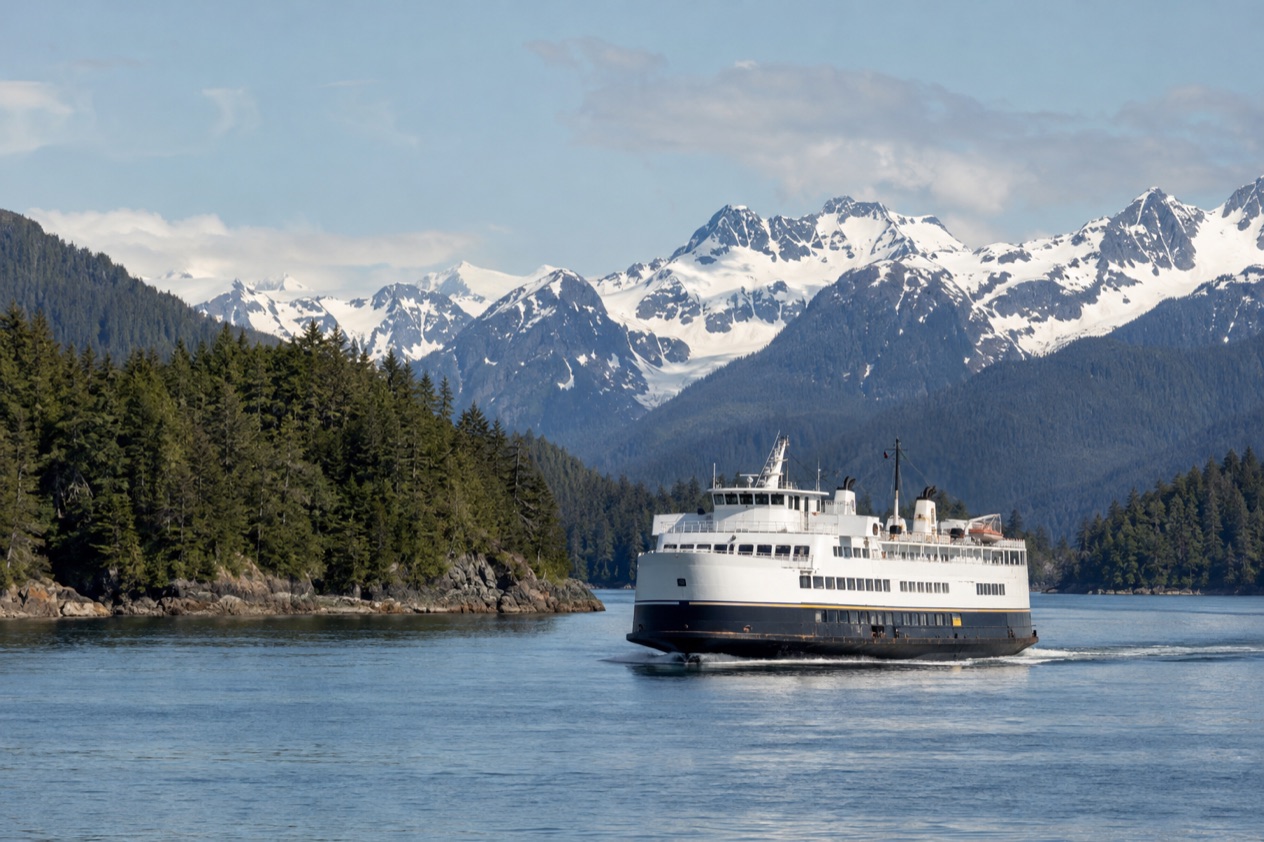
The schedule is organized by region, vessel and month, with the ferries linking more than 30 communities along a coastline that stretches from Bellingham, Washington, to Dutch Harbor in the Aleutian Chain.
Travelers do not sail from one end to the other. Riders reach their destination through regional hubs, which are Ketchikan, Juneau, Whittier and Homer, and they may change between one or more vessels to get there. Think of the hub as the place where you switch from a long run to the local boat that serves your final stop.
Mainline vessels and day boats
Most communities in Southeast Alaska receive ferry service year-round. Mainline vessels serve the larger communities, while day boats supply regularly scheduled service to the smaller ones. That split explains why a town like Skagway or Sitka shows up on the long routes, and why a place such as Kake or Tenakee is tied to a shorter run out of Juneau.
The distances are real. A sample running time from Bellingham to Ketchikan is 38 hours, which tells you the mainline is a journey in itself, with the ship as part of the trip and not only a way of getting across.
Reading arrivals and departures
Both the Sailing Calendar and the Colored Schedule Grids use the same typographic code. Arrivals appear in plain text and departures in bold. Once you know that, a row of times reads quickly: the bold entry is when the ship leaves the port, and the plain one is when it comes in.
The Colored Schedule Grids show the schedule for a region or a vessel by month and display the entire sailing route, so you can follow one ship from its first port to its last. Each vessel has its own color, which helps when several ships share one grid. You can sort the grids by month or by schedule.
Check-in and what you carry
Passengers without vehicles check in 2 hours before departure in Bellingham and Juneau. At every other port, the check-in is 1 hour before departure. Walk-on passengers may bring up to 100 pounds of hand-carried baggage.
Pets stay on the car deck, either in an approved carrier or in a vehicle with an adult passenger. Kayaks and canoes may travel aboard, and small inflatable boats are allowed if they weigh less than 300 pounds and stay within 18 feet in length and 3 feet in width.
Which routes run in summer?
The routes that matter most for a summer trip are the two Southeast Alaska mainline runs, plus a set of scheduled service routes out of Juneau and Gustavus.
The two Southeast mainline routes
One mainline route runs from Bellingham to Ketchikan, Wrangell, Petersburg, Juneau, Haines, Skagway and Sitka. A second starts in Ketchikan and goes to Wrangell, Petersburg, Sitka, Juneau, Haines and Skagway. Together they tie the Inside Passage towns into one chain, which is why the ferry works as a way to see the region as well as to move through it.
Some terminals sit in town and some do not. The Skagway terminal is centrally located at Mile 0 of the Klondike Highway. In Petersburg the terminal is on South Nordic Drive, 2 miles from town, and in Sitka it is on Halibut Point Road, 7 miles from town. Yakutat’s terminal is centrally located in town, and so is Whittier’s, on West Camp Road.
Short scheduled routes out of Juneau
Scheduled service routes in Southeast Alaska include Juneau to Angoon, Juneau to Haines, Juneau to Kake, Juneau to Pelican, Juneau to Tenakee and Juneau to Skagway. Gustavus to Hoonah is listed as well. These are the runs that connect small communities to the hub, and they are the ones to look up if your destination is not on the mainline.
Metlakatla is reached through the Ketchikan terminal, which you can contact at (907) 228-6886. For Sand Point, reservations go through the central AMHS number, (800) 642-0066.
Prince Rupert
Prince Rupert, British Columbia, has a terminal centrally located in town at 2100 Park Avenue, but service there has been interrupted. The summer 2024 schedule had no vessel equipped to serve it because of international service regulations and crewing shortages. The proposed winter 2026/27 schedule also does not call at Prince Rupert. If a trip you are planning depends on that stop, look at the current schedule before building anything around it.
Where do you find the current schedule?
The current schedule lives on the Alaska Marine Highway System website, in two main tools: the Sailing Calendar and the Colored Schedule Grids, with a Sailing Search as a backup. Each answers a slightly different question, so it helps to know which to open first.
The Sailing Calendar
The Sailing Calendar shows ferry schedules in a monthly calendar format. You can sort the entries by month, port or vessel, which is handy when you know your ship or your town but not the date. Click any entry and a pop-up window opens with the full schedule for that sailing.
It suits the traveler who has a rough window in mind and wants to see what departs when. Remember that arrivals are in plain text and departures in bold.
Colored Schedule Grids
The Colored Schedule Grids look at the same information from the vessel’s side. They show the schedule for a region or a vessel by month and lay out the entire sailing route. Every vessel has its own color, and the grids can be sorted by month or by schedule. This is the tool for tracing a multi-stop journey, such as the run from Bellingham up the Inside Passage, because you see every port of call in one view rather than one sailing at a time.
Sailing Search
If the calendar does not give you what you need, the Sailing Search tool lets you enter a desired port and travel date. For questions about a specific terminal, the central AMHS reservations number is (800) 642-0066, and the Ketchikan terminal can be reached at (907) 228-6886 for Metlakatla.
Good to know before you go
The Alaska Marine Highway accepts only U.S. currency for goods or services, though credit cards drawn on foreign banks are accepted. Crewmembers are State of Alaska employees and are prohibited by state law from accepting tips, so there is nothing to leave at the end of the trip. Keep the check-in times in mind when you plan the morning of a sailing, especially in Bellingham and Juneau, where passengers without vehicles arrive earlier than at other ports.
Sources
- Alaska Department of Transportation, Alaska Marine Highway System, Schedules (https://dot.alaska.gov/amhs/schedules.shtml), checked October 11, 2026
- Alaska Department of Transportation, Alaska Marine Highway System, Route guide (https://dot.alaska.gov/amhs/route.shtml), checked October 11, 2026
- Alaska Department of Transportation, Alaska Marine Highway System, System map (https://dot.alaska.gov/amhs/map.shtml), checked October 11, 2026
- Alaska Department of Transportation, Alaska Marine Highway System, Alaska Marine Highway System (https://dot.alaska.gov/amhs/index.shtml), checked October 11, 2026