
A dive boat idles over a ring of dark blue water far out on Lighthouse Reef, and the divers on the gunwale sit with their fins in their hands, looking down into a hole that seems to have no floor. Belize is built for this kind of morning, with a barrier reef, three offshore atolls and a Caribbean sea that stays warm all year. This is a page for divers planning where to go, what to look for underwater and what to sort out before the first tank.
Where can you dive in Belize?
You can dive along the Belize Barrier Reef and at its three offshore atolls, Turneffe Atoll, Lighthouse Reef and Glover’s Reef, each with its own character. Resorts on the mainland and the cayes reach them by boat, and a dive resort such as Hamanasi Adventure and Dive Resort, a PADI 5-Star Resort in Hopkins, lists the Southern Barrier Reef, Glover’s Reef, Turneffe, the Elbow, Lighthouse Reef, the Blue Hole and Half Moon Caye among its dive sites.
Lighthouse Reef and the Great Blue Hole
Lighthouse Reef is a long, narrow atoll southeast of Belize City, with a shallow sandy lagoon inside and the Great Blue Hole near its center. It is considered one of the best developed and healthiest reefs in the Caribbean, and that reputation shows once you leave the sinkhole behind. Named sites include Half Moon Caye Wall, Long Caye Aquarium, Silver Caves, Tres Cocos and West Point.
The Blue Hole Natural Monument includes no land and has no visitor facilities other than mooring buoys for dive boats. Its primary focus is diving the sinkhole, and visitors generally pair it with Half Moon Caye in the same itinerary. That pairing makes for a day of contrasts, a deep, hushed descent followed by the walls and coral gardens around the caye.
Turneffe Atoll
Turneffe is the largest coral atoll in Belize, southeast of Ambergris Caye and Caye Caulker and a short run out from Belize City. Beyond the reef itself you find flats, creeks, lagoons and more than 150 mangrove islands, which give the atoll a softer, greener look from the boat than its neighbors.
It was declared a marine reserve in 2012, and the Turneffe Atoll Sustainability Association co-manages it day to day. The reserve is an important nursery ground for Queen conch, Caribbean spiny lobster and many reef fishes, so the shallows hold young life as well as the bigger animals on the outer reef. Divers staying on the cayes or in Belize City can look at Turneffe as the nearest of the three atolls.
Glover’s Reef
Glover’s Reef lies off the southern coast, east of Dangriga, an oval atoll whose lagoon is dotted with around 850 patch reefs and pinnacles. It harbors one of the greatest diversities of reef types in the western Caribbean, and the cays along its rim include Northeast Cay, Long Cay, Middle Cay and Southwest Cay.
The marine reserve was established in 1993 and is part of the World Heritage Site designated by UNESCO. Southern bases such as Hopkins list Glover’s among their regular dive destinations, which makes it the atoll that fits a trip to the south of the country.
What is there to see?
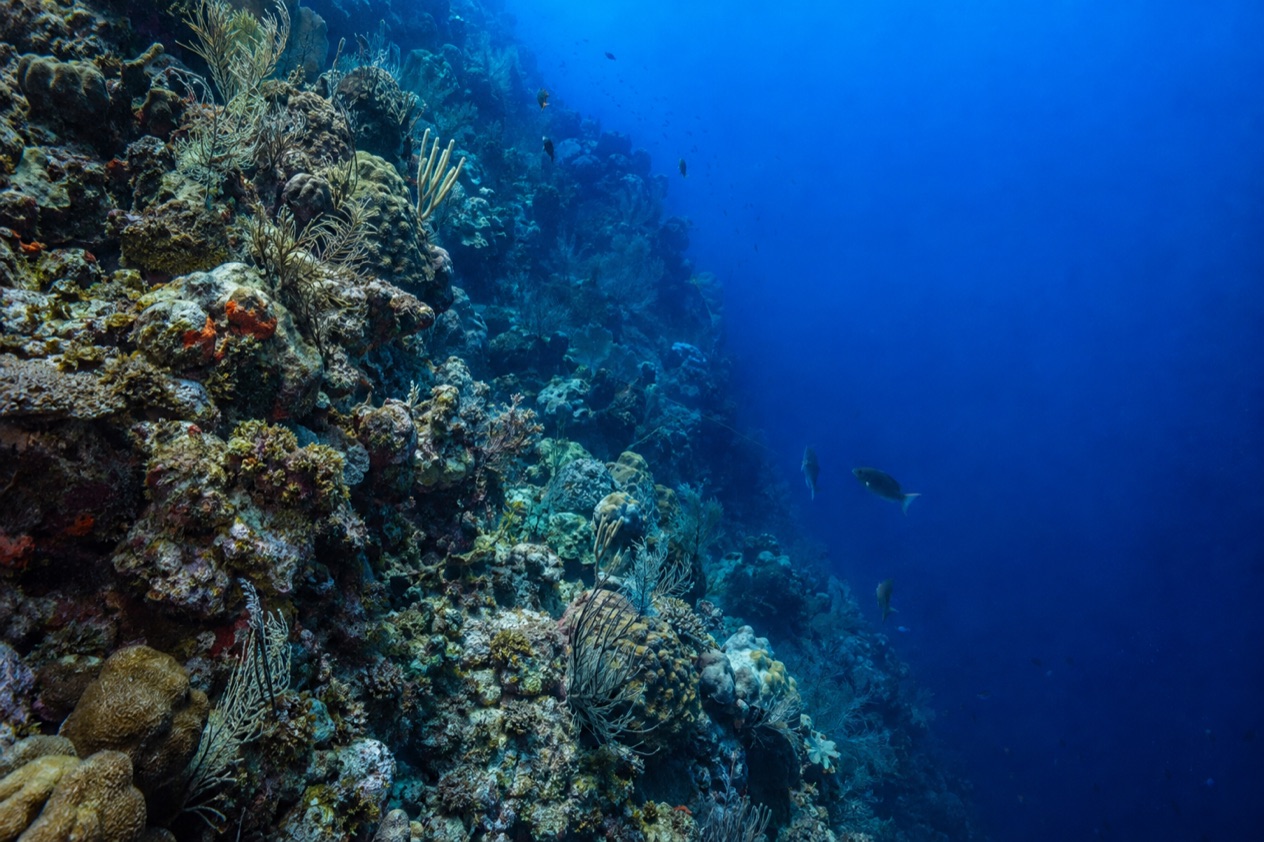
Underwater Belize offers a sinkhole with ancient stalactites, walls and coral gardens, spawning grounds and a long list of fish, turtles and sharks. The Great Blue Hole is the headline, but the atolls hold more than one reason to roll off the boat.
Inside the Great Blue Hole
The sinkhole is nearly perfectly circular, about 1,043 feet across and 407 feet deep. It formed as typical karst limestone before sea levels rose, in at least four stages, and that history left ledges at 69 feet, 161 feet and 299 feet. The stalactites hanging in the hole grew when the cavern stood dry, and analysis dates their formation to between 153,000 and 15,000 years ago.
A submarine expedition in December 2018 found a layer of hydrogen sulfide at about 300 feet, below which the water is dark, anoxic and devoid of life. Occasional visitors to the hole include great hammerhead sharks, an endangered species, as well as lemon, bull and black tip sharks. Treat the sharks as a chance, not a promise.
Reef life at Turneffe
Turneffe is home to more than 500 species of fish and 65 species of stony corals, along with sea turtles, manatees, dolphins and seabirds. Reef, back reef flats, seagrass beds, creeks and lagoons sit side by side, so a single outing can move from open reef to a mangrove edge. At least three known fish spawning aggregation sites have been identified on the atoll.
Glover’s Reef and its groupers
At the northeastern end of Glover’s Reef lies a large spawning site for the endangered Nassau grouper, one of only two viable sites remaining for the species. The lagoon’s maze of pinnacles and patch reefs rises close to the surface, and the variety of reef types from wall to patch makes the diving feel different from one stop to the next.
Half Moon Caye above the water
Half Moon Caye has a rookery of magnificent frigatebirds and a nesting colony of about 4000 red-footed boobies, plus a rare surviving atoll siricote forest on its western half. Lighthouse Reef also shelters the American crocodile, hawksbill, loggerhead and green sea turtles, the Belize endemic leaf-toed gecko and Allison’s anole, all of them listed as endangered or threatened.
What should divers know?
Divers should know that the water is warm, the Blue Hole is deep and the best gear and training arrangements are worth settling with a dive operator before the boat leaves. Sea surface near San Pedro on Ambergris Caye averages 81.4°F in January and 86.5°F in October, while near Placencia it reaches 81.0°F in January and 87.1°F in October.
Water temperature through the year
| Month | Near San Pedro (°F) | Near Placencia (°F) |
|---|---|---|
| January | 81.4 | 81.0 |
| April | 82.6 | 84.3 |
| July | 85.7 | 86.4 |
| October | 86.5 | 87.1 |
These are the surface readings, and the deeper water inside the Blue Hole is another matter, since the sinkhole reaches far below the reef. The warm surface suits a thin wetsuit, and at Hamanasi a 3mm wetsuit, short or long, rents for US$15 per day.
Gear and Nitrox
Dive resorts rent equipment by the day, and the list at Hamanasi gives a sense of what to expect. Nitrox fills are priced by the tank and depend on certification.
| Item at Hamanasi | Price |
|---|---|
| Mask, snorkel and fins | US$15 per day |
| Regulator with dive computer | US$20 per day |
| 3mm wetsuit, short or long | US$15 per day |
| Nitrox fill, prior Enriched Air certification | US$15 per tank |
| Nitrox fill, after certifying through Hamanasi | US$10 per tank |
The Blue Hole as a dive
Treat the Great Blue Hole with respect. The bodies of two divers were found at the bottom in 2018, out of three believed to have gone missing there, and the expedition reported them to Belizean authorities. The ledges at 69, 161 and 299 feet mark the depths where the walls change, and the hydrogen sulfide layer sits near 300 feet.
Dive boats tie up to the mooring buoys, since the site has no other visitor facilities. Because the monument includes no land, everything you need has to come with the boat, so settle gear, certification and dive plans with your operator beforehand.
Good to know before you go
The U.S. State Department rates Belize Level 2, “Exercise increased caution”, because of crime, and says the south side of Belize City has historically had the highest concentration of violent crime.
The Atlantic hurricane season runs from June 1 to November 30, which covers the warmest months of the sea. The Turneffe Atoll Marine Reserve management team can be reached at +501-670-8272 for questions about the reserve. Gear and Nitrox prices above are those of one resort, so confirm what your own operator charges.
Sources
- Wikipedia, Great Blue Hole (https://en.wikipedia.org/wiki/Great_Blue_Hole), checked October 11, 2026
- Belize Audubon Society, Blue Hole Natural Monument (https://belizeaudubon.org/bhnm/), checked October 11, 2026
- Wikipedia, Turneffe Atoll (https://en.wikipedia.org/wiki/Turneffe_Atoll), checked October 11, 2026
- Belize Fisheries Department, Turneffe Atoll Marine Reserve (https://fisheries.gov.bz/tamr/), checked October 11, 2026
- Wikipedia, Glover's Reef (https://en.wikipedia.org/wiki/Glover's_Reef), checked October 11, 2026
- Belize Fisheries Department, Glover's Reef Marine Reserve (https://fisheries.gov.bz/grmr/), checked October 11, 2026
- Hamanasi Adventure and Dive Resort, diving (https://www.hamanasi.com/belize-diving/), checked October 11, 2026
- Wikipedia, Lighthouse Reef (https://en.wikipedia.org/wiki/Lighthouse_Reef), checked October 11, 2026
- Open-Meteo Marine API, average 2015-2024, checked October 11, 2026
- U.S. Department of State, Belize Travel Advisory, Level 2, March 11, 2026 (https://travel.state.gov/), checked October 11, 2026
- NOAA National Hurricane Center, Climatology (https://www.nhc.noaa.gov/climo/), checked October 11, 2026