
Out past the channel markers, the engine goes quiet, the sails fill, and the only sounds left are the rigging, the water along the hull and a pelican landing on the bow. Belize suits this kind of slow travel, with a long barrier reef, small sandy cayes and atolls that sit far out in the Caribbean Sea. Sailing here means days spent hopping between islands, anchoring near coral and eating whatever the galley produces.
What is sailing like in Belize?
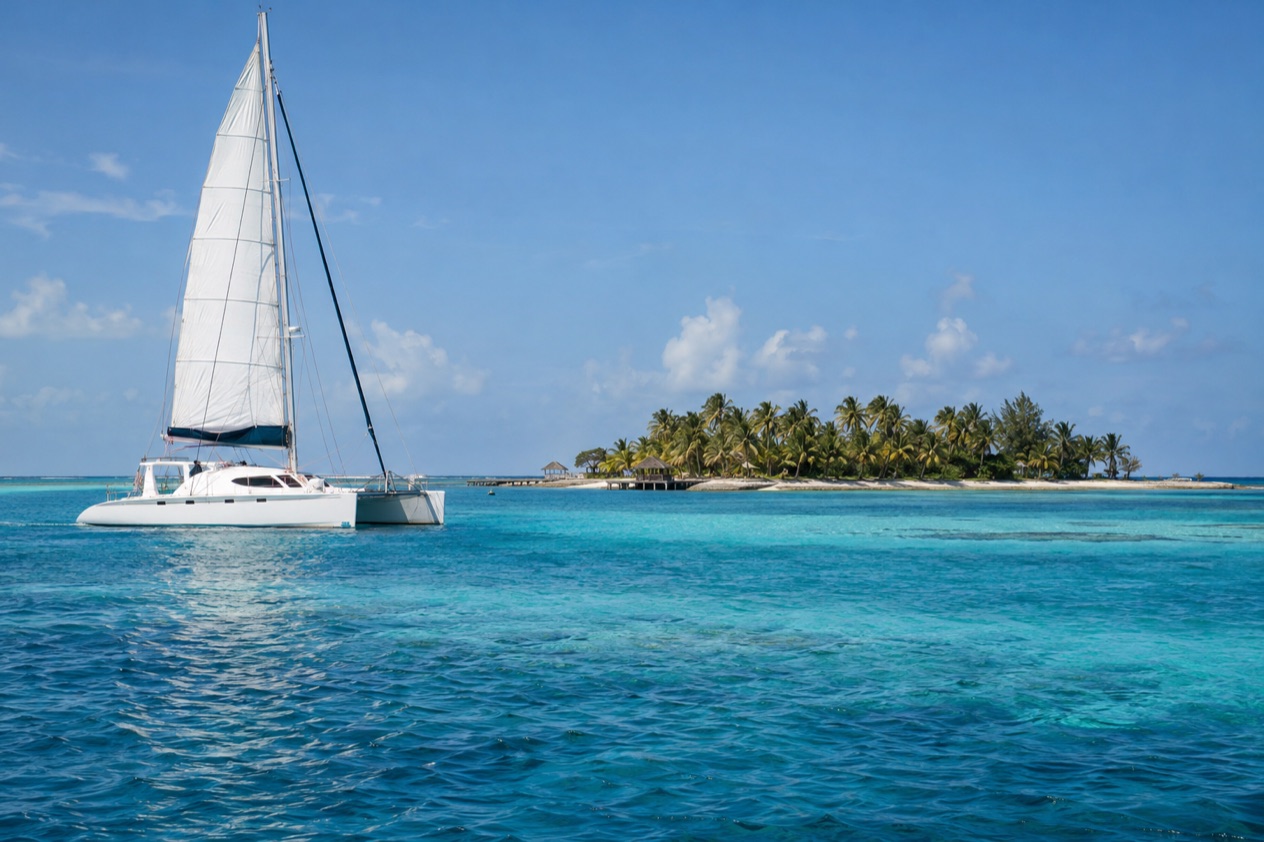
Sailing in Belize is island hopping at an unhurried pace, with a reef on one side, a low green caye on the other and plenty of time to get in the water. Most days follow the same easy pattern: raise the sails, glide to a snorkeling stop, anchor for lunch, then move on to a quiet spot for the night. The pleasure is in the rhythm more than in any one stop.
A catamaran changes how the trip feels. The two hulls sit flat on the water, the deck is wide, and there is room to stretch out on the netting at the front while the coast slides by. Monohulls lean and move more, and some travelers prefer that sense of sailing. Either way, the boats are the means of reaching places that day trippers from the mainland rarely see.
A day under sail
Picture a morning departure from a marina, with coffee on deck and the mainland shrinking behind you. The water changes from murky green near shore to pale turquoise over the sand and then a deep blue along the reef edge.
Afternoons tend to be for sitting on a caye with a drink, walking a strip of beach or simply reading in the shade of the sail. By evening the boat is anchored, the sky goes orange over the water, and dinner is cooked on board or ashore. It is a trip for people who like being outdoors, in no hurry and happy to go where the wind allows.
What you see along the way
The reef is the main attraction, and it is protected. The Belize Barrier Reef Reserve System is a World Heritage-listed site, and Glover’s Reef Marine Reserve is one of seven protected areas that together form it. Looking at coral and fish from the surface is the heart of a sailing trip here.
Above water, expect frigate birds and pelicans, small palm-fringed cayes and sometimes a fishing skiff working a flat. Because the fisheries rules are strict, many of the creatures you meet are ones you are meant to leave alone, and that is part of why the water stays so interesting to look into.
The hurricane season
The Atlantic hurricane season runs from June 1 to November 30, and sailors plan around it. Weather is the main thing that shapes where a boat can go on a given week, so itineraries are flexible by nature, and a captain may change the route for conditions.
Where do the trips go?
Each has a different character, from a historic island close to the mainland to a remote oval ring of reef with hundreds of coral heads inside it.
St. George’s Caye
St. George’s Caye lies eight miles east of Belize City, in the Caribbean Sea, which makes it a natural first stop for a sailing route. It has real history: it was settled as a town in 1650, it was the largest settlement in what was then British Honduras, and it was Belize’s first capital in the 1700s. Spanish sailors once called it Cayo Cocina, or Kitchen Cay.
The island is also where British settlers fought and defeated a small Spanish fleet in September 1798, and Belize marks the Battle of St. George’s Caye as a national holiday every September 10. St. George’s Caye Resort focuses on diving, sailing and snorkeling, so the island fits a sailing trip well. The British Army once ran an adventure training establishment here, offering diving and sailing, but it closed in the late 20th century.
Glover’s Reef
Glover’s Reef is a partially submerged atoll, roughly 28 miles off the southern coast. It is an oval about 20 miles long and 7.5 miles wide, and the lagoon inside is dotted with around 850 reef patches and pinnacles that rise to the surface. The reef holds one of the greatest diversities of reef types in the western Caribbean.
The main cays include Northeast Cay, Long Cay, Middle Cay and Southwest Cay, along with Amounme Point Cay. The area is a marine reserve, established in 1993, covering about 86,653 acres. At its northeastern end lies a large spawning site for the endangered Nassau grouper, one of only two viable sites left for the species, and a Wilderness Zone is closed to visitors. A visit here is about looking, floating and respecting those limits.
Thatch Caye and the southern coast
Thatch Caye Resort sits off the coast of Dangriga, and it has yacht moorings, which makes it a stopping point for boats working down the coast. Visitors can enjoy a complimentary happy hour snack and WiFi with the purchase of a cocktail, a pleasant thing to do after a day under sail.
Placencia, further south, is the other hub, with four marinas in town for visiting yachts. Together with Dangriga’s cayes, it gives sailors a stretch of coast to explore without going far out to sea.
What do you need to know before you book?
Before booking, know that boats entering Belize’s waters go through SailClear, that marinas charge by the foot, and that strict fishing and wildlife rules apply to everyone on board. If you bring your own vessel, these points matter directly.
Clearing in with SailClear
Since August 1, 2022, SailClear has been mandatory for all pleasure craft and yacht operators wanting to enter Belize’s territorial waters, including Belizeans who depart and return. It is equipped at four ports of entry: Radisson Fort George Marina and Old Belize (Kukumba Beach) Marina in Belize City, Amigos de Mar in San Pedro on Ambergris Caye, and Roberts Grove Marina in Placencia.
Shipping documents for arriving vessels can be submitted electronically. For ships scheduled to enter on weekends and holidays, documents may be submitted at the Belize Port Authority’s Main Headquarters, and arrangements must be made by 4:00 pm of the preceding work day. Private yachts pay a pilotage waiver fee based on size, shown in the table.
| Vessel size (gross tons) | Pilotage waiver fee (BZ$) |
|---|---|
| More than 50 up to 100 | 150.00 |
| More than 100 up to 500 | 250.00 |
| More than 500 up to 2000 | 500.00 |
| More than 2000 | 750.00 |
Marinas and daily rates
Marinas charge a daily rate per foot of boat length, and each has a limit on how many vessels and how large they can take. The two in Belize City and the four in Placencia are the ones named for visiting yachts.
| Marina | Place | Max vessels | Max size (ft) | Daily rate per foot (BZ$) |
|---|---|---|---|---|
| Kukumba Beach Marina | Belize City | 75 in water, 200 dry storage | 100 | 1.98 |
| Radisson Fort George Marina | Belize City | 5 | 100 | 5.00 |
| The Moorings | Placencia | 25 | 50 | 4.50 |
| Placencia marina | Placencia | 25 | 200 | 5 |
| Thunder Birds Marina | Placencia | 20 | 60 | 2.25 |
| Roberts Grove Marina | Placencia | 15 | 60 | 3.50 |
Fishing and wildlife rules
Belize protects its reef through fisheries rules, and they apply to people on boats. The closed season for lobster runs from March 1 to June 30, for Nassau grouper from December 1 to March 31, and for conch from July 1 to September 30 or until the catch quota is met. Shark meat and fins have a closed season from May 1 to October 31.
Some species are protected all year. Parrotfish and tangs may not be taken, bought, sold or possessed. Bonefish, tarpon and permit may only be caught and released.
Whale sharks and nurse sharks may not be taken or killed, all marine turtles are protected, and taking any type of coral is illegal except licensed black coral. In Glover’s Reef Marine Reserve, the Seasonal Closure Zone is closed to all fishing from the start of December to the end of February.
If you stay at Thatch Caye
Guests at Thatch Caye Resort must notify the resort by 5 p.m. the day before to join curated tours such as snorkeling, diving or reef fishing. Dining reservations require calling ahead 24 hours in advance. Sailors planning a stop on the mooring should keep both in mind when setting the day’s route.
Good to know before you go
The U.S. State Department rates Belize Level 2, “Exercise increased caution”, because of crime, and says the south side of Belize City has historically had the highest concentration of violent crime.
Prices for marinas and pilotage waivers are in Belize dollars, so keep that currency in mind when comparing costs. The Atlantic hurricane season runs from June 1 to November 30, and a captain will adjust a route to the weather. Rules on lobster, conch, grouper and sharks change with the calendar, so respect the season you are in and leave coral, turtles and nesting sites alone.
Sources
- Belize Tourism Board, Nautical tourism (https://www.belizetourismboard.org/tourism-resources/nautical-tourism/), checked October 11, 2026
- Wikipedia, St. George's Caye (https://en.wikipedia.org/wiki/St._George's_Caye), checked October 11, 2026
- Wikipedia, Glover's Reef (https://en.wikipedia.org/wiki/Glover's_Reef), checked October 11, 2026
- Thatch Caye Resort, yacht moorings (https://www.thatchcaye.com/yacht-moorings), checked October 11, 2026
- Belize Fisheries Department, Regulations (https://fisheries.gov.bz/regulations/), checked October 11, 2026
- U.S. Department of State, Belize Travel Advisory, Level 2, March 11, 2026 (https://travel.state.gov/), checked October 11, 2026
- NOAA National Hurricane Center, Climatology (https://www.nhc.noaa.gov/climo/), checked October 11, 2026