
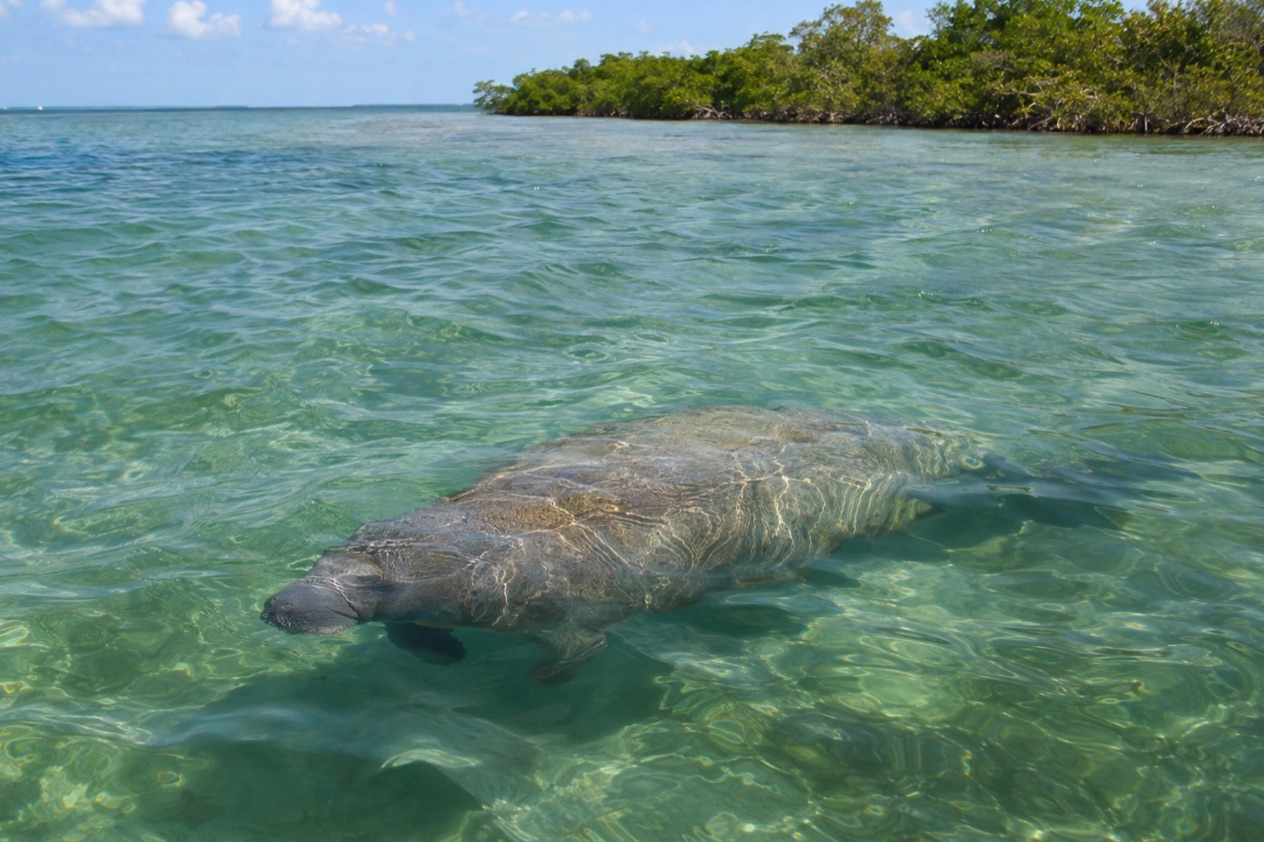
A manatee surfaces without much fuss: a soft exhale, a whiskered snout, a broad gray back rolling through brackish water the color of tea. In Belize, that quiet moment happens in lagoons, creek mouths and mangrove channels along the coast. Gales Point, Placencia Lagoon and Turneffe Atoll are the places to look, and October sits inside the Atlantic hurricane season, so plans stay loose.
Where can you see manatees in Belize?
Gales Point Manatee is the clearest answer, a village on a peninsula in the Southern Lagoon, which is a manatee reserve. Placencia Lagoon and Turneffe Atoll also hold manatees, so the animals live along much of the coast, in the calm, sheltered parts of it.
Seeing one is a chance, never a promise. Manatees are shy, they spend long stretches under the surface, and a sighting often amounts to a nose, a ripple or a back breaking the water for a second. That suits people who like patient, quiet watching more than a show.
Gales Point Manatee and the Southern Lagoon
Gales Point sits in Belize District, where most of the village’s people live on a thin peninsula pushed out into the Southern Lagoon. The village is small, with a census count of under three hundred in 2010, and the lagoon around it is brackish. It connects directly to the Caribbean Sea through the Manatee Bar River, which is part of why the water here suits the animals.
Manatee Lodge, at the end of the point, offers manatee spotting trips along with hikes and snorkeling at nearby islands and cayes in the Caribbean Sea. Methos Campsite, near the end of the point, is where you can camp if you want to wake up beside the lagoon. Mornings and evenings on the water are when you listen for the breath before you see anything.
The village has its own culture worth a look. The Sambai, a traditional dance from Gales Point Manatee, takes place during the full moon cycle, and in about 1944 the village became the first in Belize to have a village council. Ask locally whether a Sambai gathering coincides with your stay.
Placencia Lagoon
On the Placencia Peninsula, in the Stann Creek District, the lagoon is a world of mangrove forests, wetlands and sea grass beds. Manatees share it with dolphins and rays, and the shallow edges are where you can paddle quietly by canoe or kayak, the way birders do. Juvenile tarpon, snook and barracuda are also fished here.
Placencia Village is the peninsula’s southern end and is served by Placencia Airport. The peninsula stretches 18 miles, from Riversdale and Maya Beach down through Seine Bight to the village. Staying here combines lagoon time with snorkeling, diving, kayaking and the village restaurants and art galleries.
Turneffe Atoll
Turneffe is the largest coral atoll in Belize, off the coast from Belize City, and it is a marine reserve. Its network of flats, creeks and lagoons is dotted with more than 150 mangrove islands, and manatees are among the wildlife that live there with sea turtles, dolphins and seabirds.
Here the manatee is one part of a bigger picture. More than 500 species of fish and 65 species of stony corals share the atoll, so a day on the water can bring far more than the animal you came for. Mauger Caye, with its lighthouse, marks the northern end.
What does the sanctuary protect?
The Gales Point Wild Life Sanctuary protects a wildlife reserve of 14 square miles around the Southern Lagoon, with the manatee as its emblem. The brackish lagoon, its link to the sea through the Manatee Bar River and the peninsula village all belong to that same habitat.
Behind it stands a national framework. In Belize, wildlife is legally defined as any undomesticated mammal, reptile, bird or amphibian, along with any egg, nest, part or product of it. The Forest Department, under the Ministry of Forestry, Fisheries and Sustainable Development, enforces the Wildlife Protection Act.
A habitat of lagoons and mangroves
Manatees depend on shallow, sheltered water with plants to eat. Sea grass beds and mangrove edges, like those in Placencia Lagoon, are exactly that kind of place. At Turneffe, the flats, creeks and lagoons play the same role, and the reserve was officially declared a marine reserve on November 22, 2012.
Since October 2013, the Turneffe Atoll Sustainability Association has co-managed the reserve’s day-to-day operations with the Fisheries Department. Fish spawning aggregation sites have been identified there as well, so the protection reaches well beyond a single species.
A country with threatened species
The National List of Critical Native Species includes 11 critically endangered species, 31 endangered species and 63 vulnerable ones. Forest cover fell from 74.4% in 1980 to 60.3% in 2014, which gives the protected areas more weight.
The Wildlife Conservation Program of the Forest Department works toward Belize’s obligations under the Convention on Biological Diversity. Belize is also a party to CITES, which limits trade in threatened wildlife. The department has agreements with groups such as Wildtracks, the Belize Zoo, Friends for Conservation and Development and Sea to Shore Alliance.
What should you know before you go?
Go expecting a quiet outing on the water, and expect that the animal may stay hidden. Choose a base that fits your appetite for the rest of the trip, because the lagoons are only one slice of what each place offers.
Choosing a base
Gales Point is the most direct choice if the manatee is the point of the trip. Manatee Lodge runs manatee spotting trips, and Methos Campsite is the camping option near the end of the point. It is a small village, so the focus stays on the lagoon.
Placencia suits travelers who want a wider menu. Besides the lagoon, the village offers kayaking, snorkeling, diving, saltwater fly fishing and light tackle fishing. Whale shark watching happens during the full moons between April and July, and Cockscomb Basin Wildlife Sanctuary is a day trip from Placencia.
Turneffe fits those drawn to the reef. The atoll is one of three in the Belize Barrier Reef, with Glover’s Reef and Lighthouse Reef.
Timing and the hurricane season
The Atlantic hurricane season runs from June 1 to November 30, so October falls inside it. In Placencia, Hurricane Iris struck on October 8, 2001, with 145 mph winds and damaged nearly 95% of the village’s buildings, a reminder that the coast has lived with these storms.
Watching manatees is a matter of stillness. Keep voices low, let the boat or kayak drift, and treat any sighting as a gift. Wildlife is protected by law, so look and photograph rather than touch or chase.
Add a day trip
From the Placencia Peninsula, the Maya ruins of Nim Li Punit and Lubaantun in the Toledo District are a day trip. Mayflower Archaeological Reserve holds three post-classic Maya ruins, Mayflower, T’au Witz and Maintzunun, as well as waterfalls.
In Belize District, the Belize Zoo, the Crooked Tree and Monkey Bay Wildlife Sanctuaries and the ruins of Altun Ha offer more wildlife and history. Placencia also hosts the Lobster Fest and the Peninsula Arts Festival, and the village celebrates Easter Week.
Good to know before you go
The U.S. State Department rates Belize Level 2, “Exercise increased caution”, because of crime, and says the south side of Belize City has historically had the highest concentration of violent crime.
Belize District observes Central Standard Time, UTC -6. The hurricane season continues through the end of November, so keep plans flexible for lagoon and boat outings in October. Gales Point is a village of a few hundred people, so bring what you need for the stay.
Sources
- Wikipedia, Gales Point (https://en.wikipedia.org/wiki/Gales_Point), checked October 11, 2026
- Wikipedia, Wildlife of Belize (https://en.wikipedia.org/wiki/Wildlife_of_Belize), checked October 11, 2026
- Wikipedia, Belize District (https://en.wikipedia.org/wiki/Belize_District), checked October 11, 2026
- Wikipedia, Turneffe Atoll (https://en.wikipedia.org/wiki/Turneffe_Atoll), checked October 11, 2026
- Wikipedia, Placencia (https://en.wikipedia.org/wiki/Placencia), checked October 11, 2026
- U.S. Department of State, Belize Travel Advisory, Level 2, March 11, 2026 (https://travel.state.gov/), checked October 11, 2026
- NOAA National Hurricane Center, Climatology (https://www.nhc.noaa.gov/climo/), checked October 11, 2026