
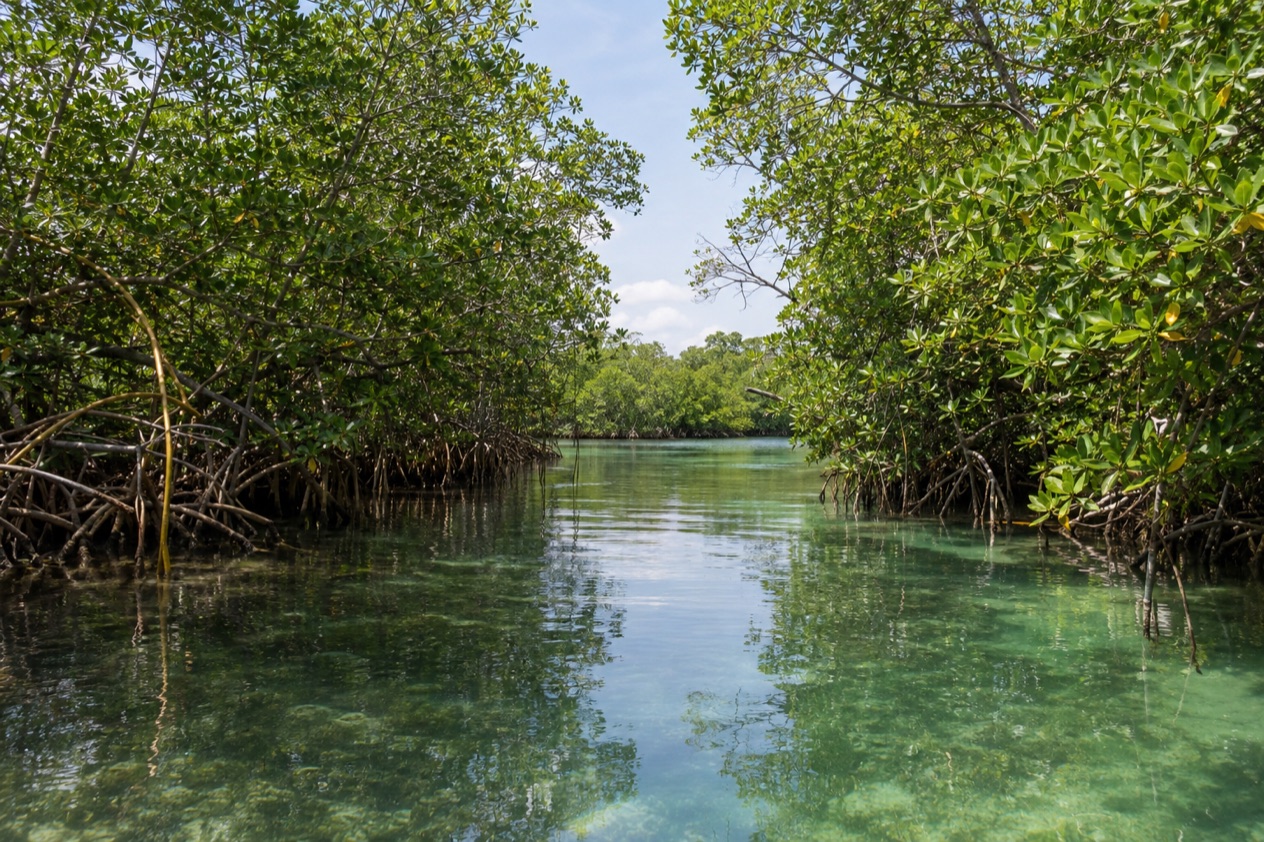
A canoe slides away from a riverbank lodge, and within a few strokes the only sounds are paddles dipping, water against the hull and birds calling from the trees overhead. An iguana sits motionless on a branch above the current. In Belize this kind of quiet unfolds on jungle rivers, coastal lagoons and the mouth of a river that meets the Caribbean, and it is open to anyone who wants to paddle through it.
Where can you kayak in Belize?
You can paddle on the Macal River in the Cayo District, up the Monkey River in the Toledo District, and around the lagoons of Crooked Tree Wildlife Sanctuary, and each one gives a different kind of day on the water. The Macal is a forest river, Monkey River is a river that ends at the sea, and Crooked Tree is a wide wetland of lagoons and creeks.
The Macal River from Chaa Creek
Chaa Creek sits near San Ignacio in the Cayo District, and the lodge rents canoes for the Macal River. You can paddle upstream as far as you like, then let the current carry you back to the lodge. It is an unhurried way to spend a morning, with the river doing half the work on the return and the banks drifting past at the pace of the water.
There is also a downstream option to San Ignacio, which takes about two hours and ends near the Hawkesworth Bridge. A shuttle picks you up there for the drive back to the lodge, and that return is included in the canoe tour. If you want lunch in town, the Guava Limb Cafe in San Ignacio is the stop, and the concierge can call ahead for you.
Canoe tours leave daily, at 9:00am and 1:00pm, and last 2 to 3 hours. You can paddle on your own or travel with a professional naturalist guide, which suits anyone who would rather spend the trip looking at the banks than reading the river.
| Outing | Departs | Duration | Fee |
|---|---|---|---|
| Chaa Creek canoe tour | Daily, 9:00am and 1:00pm | 2 to 3 hours | US$45 per person, plus 12.5% tax |
Monkey River
Monkey River Town is a small village in the Toledo District, on the southern shore of the river mouth where it meets the Caribbean Sea. About 200 people lived there at the 2011 estimate, and fishing and ecotourism are the main work. A road from the Southern Highway was built through orange groves and jungle in the late 1980s, though much travel here is still by sea.
Guides are easy to find in the village to take visitors up the river to see howler monkeys and other wildlife. Two small hotels sit in the village, and a nearby fishing resort is reached by a five-minute sea trip, so you can base yourself right at the water’s edge.
Crooked Tree Wildlife Sanctuary
The sanctuary protects 16,000 acres of lagoons, creeks, logwood swamp, broadleaf forest and pine savanna, and it was set aside above all for the thousands of waterbirds that migrate to and through it each year. It lies 3 miles off the Phillip Goldson Highway, and buses run from Belize City to Crooked Tree village Monday to Saturday.
It was declared Belize’s first Ramsar site in 1998 and was the first wildlife sanctuary gazetted by the government, which tells you how long people have cared about this wetland. It is the place to think about when your idea of a paddle is slow water, open sky and a lot of looking.
What do you see on a paddle?
You see birds first, then reptiles and monkeys, and the particular animals depend on which river or lagoon you choose. Each place has its own cast, and a few of them come with a season attached.
Birds and iguanas on the Macal
Paddlers on the Macal River from Chaa Creek can see tropical birds and Green Iguanas along the banks. The iguanas are often easy to miss until one shifts on a branch, so keep your eyes on the overhanging trees as you drift. Scanning the shoreline is half the pleasure of a river with no engine noise.
You may also take a refreshing swim during the trip. Bring what the lodge suggests: a hat, sunscreen, water, insect repellent and a camera, with shorts, swim wear and water sandals to wear. That is a practical kit for a morning that mixes paddling and getting wet.
Howler monkeys on Monkey River
The black howler monkey population along the Monkey River was greatly reduced when Hurricane Iris came ashore at Monkey River Town on October 9, 2001, as a Category Four storm. It has since come back strongly, and several troupes can be seen along the river, which is now a popular ecotourism draw. Hearing a troupe is often what announces them before you spot a single animal.
Researchers from the University of Calgary study the monkeys year-round at Monkey River Town, so the animals are well known to the people who work the river. The guides in the village take visitors upriver for exactly this reason, to see howlers and other wildlife in the trees.
Waterbirds, jabirus and hickatee at Crooked Tree
Crooked Tree is a place for waterbirds, and the calendar matters here. Jabiru storks arrive in November to nest in the lowland pine savannas. After the young fledge, in April and May, birds from the northern and central parts of Belize gather at the Crooked Tree lagoons, so those months can bring a crowd of birds to the water.
The sanctuary also protects globally endangered species, among them the Central American river turtle, locally called the hickatee, the Yucatán black howler monkey and the yellow-headed amazon. The jabiru has been on Belize’s list of protected animals since 1973. A quiet boat slipping along a lagoon edge is a good way to look for them, though no sighting is ever promised.
What should you know before you go?
Know which river you are paddling, what to wear and bring, and when the birds and the weather are likely to suit you. The details differ by place, so plan around the one you choose.
What to wear and bring
For the Chaa Creek canoe trip the recommended dress is shorts, swim wear and water sandals. Guests should bring a hat, sunscreen, water, insect repellent and a camera. That is a light, wet-friendly outfit that fits the chance of a swim on the Macal.
If you plan to stop in San Ignacio on the downstream trip, ask the concierge to call the Guava Limb Cafe ahead of time. The shuttle waits near the Hawkesworth Bridge to take you back, and it is part of the tour.
Choosing the season
If birds drive your plans, think about Crooked Tree between November, when jabirus arrive to nest, and April and May, when birds gather at the lagoons. The Atlantic hurricane season runs from June 1 to November 30, so a trip in that stretch falls inside it. Monkey River Town took a direct hit from Hurricane Iris in 2001, a reminder that the coast lies in the path of the Atlantic season.
The village has since rebuilt, and a recent government project installed a seawall that halted erosion on the southern foreshore. Hopkins, on the coast between the Maya Mountains and the Caribbean Sea and close to the Sittee River, is a Garifuna community of 1,610 people at the 2010 census, and it sits in the same Central Standard Time as the rest of Belize.
Paddling alone or with a guide
At Chaa Creek you choose: paddle on your own, or relax with a professional naturalist guide who can point out what you would otherwise pass. At Monkey River, guides are easy to find in the village, and going with one is the way the river is usually visited for the howlers. Crooked Tree is a protected sanctuary, and the point of it is the birds, so slow and quiet suits it.
Good to know before you go
The U.S. State Department rates Belize Level 2, “Exercise increased caution”, because of crime, and says the south side of Belize City has historically had the highest concentration of violent crime.
The Chaa Creek canoe tour is priced in U.S. dollars and carries a 12.5% tax on top, so budget for that when you plan the day. The Atlantic hurricane season runs from June 1 to November 30, which matters when you pick your dates for a coastal river like the Monkey.
Sources
- Chaa Creek, canoe tours (https://chaacreek.com/activity/canoe-tours/), checked October 11, 2026
- Wikipedia, Monkey River Town (https://en.wikipedia.org/wiki/Monkey_River_Town), checked October 11, 2026
- Wikipedia, Crooked Tree Wildlife Sanctuary (https://en.wikipedia.org/wiki/Crooked_Tree_Wildlife_Sanctuary), checked October 11, 2026
- Wikipedia, Hopkins, Belize (https://en.wikipedia.org/wiki/Hopkins,_Belize), checked October 11, 2026
- U.S. Department of State, Belize Travel Advisory, Level 2, March 11, 2026 (https://travel.state.gov/), checked October 11, 2026
- NOAA National Hurricane Center, Climatology (https://www.nhc.noaa.gov/climo/), checked October 11, 2026