
Under the dripping canopy of the Cockscomb Basin, the trail goes quiet except for the creek and the odd rustle in the leaf litter. Somewhere in that forest a jaguar may be moving, and you read the ground for tracks as carefully as you scan the trees. The world’s first jaguar preserve sits in southern Belize, and it is where travelers come to walk jaguar country, with a few other wildcats waiting at a zoo near the highway.
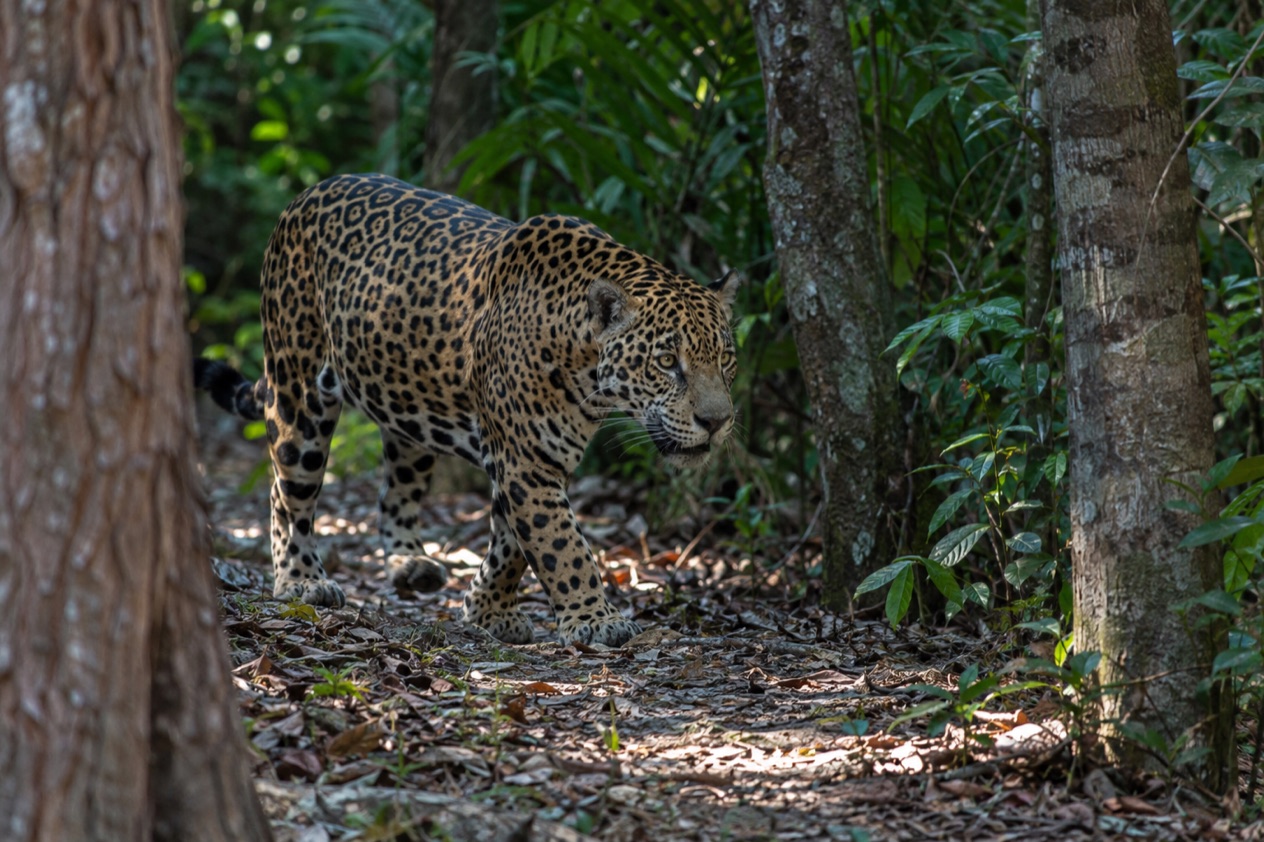
Can you see a jaguar in Belize?
Yes, you can see a jaguar in Belize, but how depends on where you go: in the wild it is a chance and never a promise, while at The Belize Zoo you can meet one up close. The two experiences are very different, and many travelers do both. One gives you the forest and the possibility, the other gives you a face and a pair of eyes.
In the wild at Cockscomb Basin
Cockscomb Basin Wildlife Sanctuary is known worldwide as the premier habitat for the jaguar, and the cats are most often found in the West Basin wilderness. That does not mean you will meet one on a morning walk. Jaguars are wary, and what most hikers bring home are tracks pressed into mud along a creek bank, a scrape on a trail edge, or simply the feeling of walking through a place where the animal lives.
The sanctuary is crossed by a low-intensity trail system built for visitors and for the scientists who study the forest. Walking it, you hear howler monkeys, you may spot a keel-billed toucan (the national bird of Belize), and you pass through forest that was logged for cedar and mahogany until the mid-1980s and has since grown back. Go for the whole forest, not for a single animal, and the day will be a good one whether or not a cat appears.
A night hike in jaguar country
After dark the forest changes. Hamanasi, the resort at Hopkins, lists a Jaguar Preserve Night Hike among its scheduled rainforest adventures, alongside a daytime visit to Cockscomb Basin Wildlife Sanctuary and Jaguar Preserve. Both are part of the Reef & Rainforest Package, so guests staying on that package do not pay extra for them.
A night walk is about listening and shining a light into the understory. You may catch the glint of eyes, hear frogs calling from the creek or see insects you would miss by day. A jaguar remains a possibility, not a feature of the program, and the people who enjoy these hikes most are those happy to meet whatever the night offers.
Wildcats up close at The Belize Zoo
All five wildcat species found in Belize live at The Belize Zoo: jaguar, puma, ocelot, margay and jaguarundi. Seeing them side by side shows how different they are, from the heavy-shouldered jaguar to the slender, long-tailed jaguarundi. The zoo also offers a special experience with a jaguar, a chance to stand close to an animal you would almost never meet that way in the forest.
The zoo is more than cats. Its animals include the Central American tapir, Belize’s national animal, as well as howler and spider monkeys, kinkajou, paca, anteater and coatimundi. Common local snakes such as the imperial boa and the fer-de-lance are on display, and the Critically Endangered Hicatee turtle lives here too. After dark, nocturnal tours bring red-eyed treefrogs, veined treefrogs and Gulf Coast toads into the beam of your flashlight.
For travelers with children, or for anyone who wants a guaranteed look at the animals of the forest, the zoo is the natural companion to a Cockscomb day. Bird lovers get a bonus, since wild birds have been recorded on the grounds in great variety, almost 280 species in eBird checklists.
Where is the jaguar reserve?
The jaguar reserve is Cockscomb Basin Wildlife Sanctuary, in the Stann Creek District of south-central Belize, off the Southern Highway about 20 miles south of Dangriga Town. It is recognized internationally as the world’s first jaguar preserve, designated a wildlife sanctuary in 1984 and established in 1986 as the first protected area for the jaguar. The Belize Forest Department and the Belize Audubon Society run it together.
The name comes from the Cockscomb Mountain ridge, whose jagged line looks like a rooster’s comb when you see it from the Caribbean coastal plain. Inside, the sanctuary covers about 136 square miles and is made of two adjacent basins: the West Basin, drained by the Swasey Branch, and the East Basin, the upper watershed of South Stann Creek. Elevations climb from creek level to the summit of Victoria Peak, which gives the place its mix of lowland forest and mountain slopes.
Getting to Cockscomb Basin
By vehicle, you turn off the Southern Highway at Maya Center Village, about 20 minutes after joining the Southern Highway from the Hummingbird Highway. The village is also where the entrance fee is collected. From there the actual protected area is six miles down an unpaved road, so allow for that last stretch to feel different from the highway.
Without a vehicle you have several options. Buses from Belize City to Punta Gorda Town can stop at Maya Center Village on request, and the ride takes about 3.5 hours.
A local taxi from Maya Center Village to the sanctuary costs BZD 40.00 one way. Flights from Belize City to Dangriga Town run on Maya Island Air or Tropic Air and take approximately 20 minutes, after which a taxi to the sanctuary costs about USD 75.
Staying inside the sanctuary
You can sleep in the sanctuary itself, which puts you in the forest at the edges of the day when animals are on the move. Four kinds of lodging are available.
The Balum Naj cabin sleeps a maximum of six people in two rooms, one with a double bed and the other with a bunk and a single bed. The Mujan Naj, also called the Bird House, sleeps a maximum of four, with one bedroom holding a double bed and the other two twin beds.
For larger groups there is the Rustic Cabin, which accommodates a maximum of eight people in four rooms with two single beds in each. The dormitory sleeps thirty people in five separate rooms, each with three bunk beds. Families, friends traveling together and small research or school groups will find a shape that fits.
Around the reserve
Cockscomb is not the only protected ground nearby. Victoria Peak Natural Monument is reached through the sanctuary, and together the two protect an estimated 21 ecosystems, 19 on land and 2 in water. Evidence of Maya habitation in the basin goes back as early as 10,000 BCE, and the first modern exploration on record was by British expeditions up South Stann Creek in 1888.
Staying on the coast at Hopkins puts you near the reserve and the sea in the same trip. Hamanasi lists, besides Cockscomb, a Mayflower Jungle & Waterfall Hike, a Cave & Jungle Adventure, Jungle River Canoeing and a Magical Mayan History Tour. Red Bank Birding is offered seasonally, and the Monkey River Adventure and Bocawina Jungle Ziplining can be added as extras.
What should you know before you go?
Know the opening hours, the fees, and that a jaguar sighting is never guaranteed, and then plan around the forest rather than around one animal. The sanctuary and its neighbor Victoria Peak work on different calendars, so it helps to see both at a glance.
| Site | Open | Admission |
|---|---|---|
| Cockscomb Basin Wildlife Sanctuary | 8:00am to 4:30pm | BZD 10 for non-nationals, BZD 2.50 for Belizean nationals |
| Victoria Peak Natural Monument | Visiting season February 1 to May 31 | BZD 10 per day for non-nationals |
Walking the sanctuary well
Think of the visit as a walk in a living forest. Because the trail system is low-intensity, the paths feel like part of the woods and not like a built park, and the quiet is part of the experience. Keep your voice low, stop often, and look at the ground as much as at the branches, since tracks, fallen fruit and the movement of birds tell you what has passed.
Light and patience matter more than gear. Watching a creek bank for ten minutes will show you more than walking fast, and the forest rewards those who sit still. A jaguar sighting, if it comes, is a gift on top of the rest, and the toucans, monkeys and butterflies are a consolation that rarely feels like one.
Victoria Peak
Victoria Peak is the highest point in its natural monument, at 3,675 feet, and it was declared a Natural Monument on May 2, 1998. The visiting season runs from February 1st to May 31st, and the way in is through Cockscomb Basin Wildlife Sanctuary. Management passed to the Belize Audubon Society in an agreement with the Government of Belize signed on February 6, 1999.
To book a hike to the peak and find a qualified tour guide, you email [email protected]. This is a serious mountain outing meant for those who have planned it in advance, so treat it as its own trip rather than an add-on to a sanctuary day.
Wildlife and its protection
In Belize, wildlife is legally defined as any undomesticated mammal, reptile, bird or amphibian, along with any egg, nest, part or product of one. The Forest Department, under the Ministry of Forestry, Fisheries and Sustainable Development, enforces the Wildlife Protection Act. Belize is also a party to CITES, which limits trade in threatened wildlife.
The pressure on habitat is real. Forest cover declined from 74.4% in 1980 to 60.3% in 2014, and the National List of Critical Native Species includes 11 critically endangered, 31 endangered and 63 vulnerable species. That is why a place like Cockscomb matters, and why the Forest Department works with rescue groups such as Wildtracks, Belize Bird Rescue and the Belize Zoo.
Good to know before you go
The U.S. State Department rates Belize Level 2, “Exercise increased caution”, because of crime, and says the south side of Belize City has historically had the highest concentration of violent crime.
Fees at the sanctuary and the peak are charged in Belize dollars (BZD), so it helps to have that currency in mind when you pay at Maya Center Village. The Atlantic hurricane season runs from June 1 to November 30, a stretch of the calendar worth weighing when you choose your dates for a forest trip. Jaguar encounters in the wild stay a matter of chance, so plan a good day on the trails and a visit to the zoo as your sure thing.
Sources
- Belize Audubon Society, Cockscomb Basin Wildlife Sanctuary (https://belizeaudubon.org/cbws/), checked October 11, 2026
- Wikipedia, Cockscomb Basin Wildlife Sanctuary (https://en.wikipedia.org/wiki/Cockscomb_Basin_Wildlife_Sanctuary), checked October 11, 2026
- Wikipedia, Wildlife of Belize (https://en.wikipedia.org/wiki/Wildlife_of_Belize), checked October 11, 2026
- The Belize Zoo, The animals (https://www.belizezoo.org/the-animals/), checked October 11, 2026
- Belize Audubon Society, Victoria Peak Natural Monument (https://belizeaudubon.org/vpnm/), checked October 11, 2026
- Hamanasi Adventure and Dive Resort, rainforest adventures (https://www.hamanasi.com/belize-rainforest-adventures/), checked October 11, 2026
- U.S. Department of State, Belize Travel Advisory, Level 2, March 11, 2026 (https://travel.state.gov/), checked October 11, 2026
- NOAA National Hurricane Center, Climatology (https://www.nhc.noaa.gov/climo/), checked October 11, 2026