
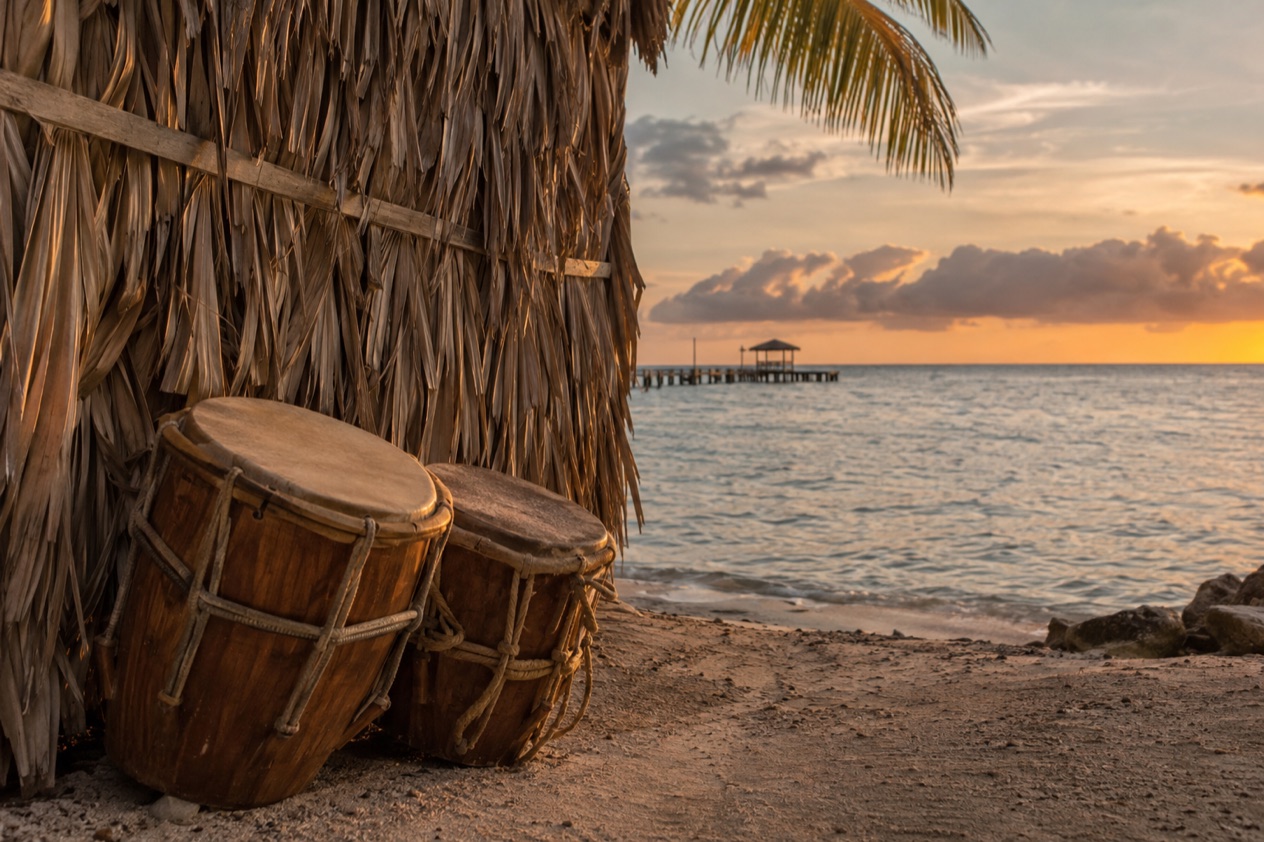
In Dangriga the drums start before the town is fully awake, a low, rolling pattern that carries down the streets toward the water where the North Stann Creek River meets the sea. Dancers, singers and drummers turn the town into a stage, and the songs are sung in a language you will hear nowhere else in the country. Garifuna culture lives in southern Belize, and it is most vivid around November 19, when Dangriga celebrates its heritage.
Who are the Garifuna?
The Garifuna are a people of African and Amerindian descent who speak their own language, the Garifuna language, and who settled on the Caribbean coast of Belize after being exiled from the Grenadines by the British. Their story is the one the holiday of Settlement Day retells every year, and it explains why so much of what you hear, taste and see in the south feels different from the rest of the country.
Dangriga was settled before 1832 by Garinagu, sometimes called Black Caribs, who came from Honduras. Its name is a Garifuna word meaning “standing waters,” a fitting description for a town set at the mouth of a river. A study of Garinagu in the Stann Creek area in 1983 estimated that their ancestry was about four-fifths African, with Amerindian and European roots making up the rest, which matches the blend you hear in the music: African drumming, call and response, and a language with Amerindian roots.
Language, dance and music
In 2001 UNESCO proclaimed the language, dance and music of the Garifuna a Masterpiece of the Oral and Intangible Heritage of Humanity. That recognition describes what visitors actually encounter: songs passed down by ear, dances built around drums, and a language spoken at home and in the street. Traditional dancers can be seen in Dangriga, and listening to a drum ensemble is often the moment the culture clicks for a first-time visitor.
Garifuna music has also had a modern revival. Andy Palacio, Mohobub Flores and Aurelio Martinez are among the musicians who brought it to wider audiences. Palacio’s album Watina and the collection Umalali: The Garifuna Women’s Project were both released on the Belizean label Stonetree Records, and they are good listening before or after a trip, especially the women’s voices on Umalali.
Villages along the coast
By 1981 around 65,000 Garifuna were living in fifty-four fishing villages in Belize, and the sea still shapes daily life in the communities along the coast. Hopkins is one of them. It was created in 1942 to replace the village of Newtown, which a hurricane had devastated further up the coast, and in 2010 more than two-thirds of its 1,610 residents were Garifuna.
Hopkins sits between the Maya Mountains and the Cockscomb Range inland and the Caribbean Sea on its shore, close to the Sittee River. The setting is a reminder that Garifuna life here has always been tied to water, fish and the forest behind the village.
Where can visitors meet Garifuna culture?
The best place to start is Dangriga, the largest settlement in southern Belize and the capital of the Stann Creek District. It is commonly called the culture capital of Belize because of its influence on punta music and other forms of Garifuna culture, and punta rock itself, the Caribbean dance music with its pulsing drums and electric guitars, is said to have originated here.
Dangriga
Dangriga is a town of wooden houses, small shops and a waterfront where boats come and go. Traditional Garifuna dancers can be seen here, and the music of punta spills from bars and sound systems. Declared a town on February 15, 1895, it has a long history as the center of Garifuna life in Belize, and walking its streets, you hear the language as often as English.
Dangriga Airport (Pelican Beach Airstrip) is served by Maya Island Air and Tropic Air several times daily, with flights to Belize City, Placencia and Punta Gorda. By road, the Hummingbird Highway is the main route from Belmopan.
It is paved along its entire length and known for its scenery as it cuts through the Belizean mountains. Stops along the way include Blue Hole National Park, Barquidier Waterfall, Kropf’s Bakery and Casita de Amour, so the drive can become part of the trip.
Hopkins
Hopkins is a smaller Garifuna village on the coast, where the sea is the front yard and the mountains fill the horizon behind. Its Garifuna majority makes it another place to hear the language and see everyday village life. A visit pairs well with Dangriga, since the two share the same stretch of coast and the same cultural roots.
It adds a Maya chapter to a trip that is mostly about Garifuna heritage.
Cayes and rainforest from Dangriga
Dangriga is also a mainland access point to cayes in southern Belize, including Tobacco Caye and Royal Belize. Boats depart from the main dock in Dangriga, across from the River Front Cafe, with frequent service to Tobacco Caye, where volleyball and snorkeling are on offer away from everyone.
Inland, Cockscomb Basin Wildlife Sanctuary lies southwest of Dangriga. Buses leave Dangriga every two hours or so for the Maya Centre, with morning departures at 5:30 AM and 7:45 AM from the bus station, and the ride takes 40 minutes.
A guide is recommended for finding wildlife, and since getting one at the Maya Centre is difficult in low season, it is best to arrange one from Dangriga. Lodging and camping are possible at the park headquarters.
When is Garifuna Settlement Day?
Garifuna Settlement Day falls every year on November 19, and it is a public holiday in Belize. If the date lands on a Sunday, the following Monday is observed as the bank and public holiday. The day celebrates the settlement of the Garifuna people in Belize after they were exiled from the Grenadines by the British.
The celebrations in Dangriga
The major festivities take place in Dangriga, with parades, street music and traditional dancing. The town is the heart of the holiday, and drums, singing and dancing give the streets a festival mood. It is a day to watch, listen and take in a culture that is celebrated openly, in its own language and on its own ground.
Because the main events are in Dangriga, that is where anyone hoping to see the holiday at its center should head. The town’s role as the culture capital of Belize makes the date feel less like an event staged for visitors and more like a community celebrating itself.
How the holiday came to be
The holiday was created in 1941 by Belizean civil rights activist Thomas Vincent Ramos. In 1943 it was recognized as a public holiday in the southern districts, and in 1977 it was declared a national holiday. That history is part of what you see in the parades: a local observance that grew into a celebration for the whole country.
November sits at the very end of the Atlantic hurricane season, which runs from June 1 to November 30, so a trip around the holiday falls within the official season. The date is a public holiday and bank holiday, so the day has a national, not only a local, flavor.
Good to know before you go
The U.S. State Department rates Belize Level 2, “Exercise increased caution”, because of crime, and says the south side of Belize City has historically had the highest concentration of violent crime.
Dangriga is a Garifuna town in the Stann Creek District, and November 19 is a public holiday, so banks are closed on the day. Hopkins is in the UTC-6 time zone, which is Central Standard Time. The Atlantic hurricane season runs from June 1 to November 30, which covers the days around Settlement Day.
Sources
- Wikipedia, Garifuna (https://en.wikipedia.org/wiki/Garifuna), checked October 11, 2026
- Wikipedia, Dangriga (https://en.wikipedia.org/wiki/Dangriga), checked October 11, 2026
- Wikipedia, Hopkins, Belize (https://en.wikipedia.org/wiki/Hopkins,_Belize), checked October 11, 2026
- Wikivoyage, Dangriga (https://en.wikivoyage.org/wiki/Dangriga), checked October 11, 2026
- U.S. Department of State, Belize Travel Advisory, Level 2, March 11, 2026 (https://travel.state.gov/), checked October 11, 2026
- NOAA National Hurricane Center, Climatology (https://www.nhc.noaa.gov/climo/), checked October 11, 2026