
At dawn in Sarteneja, wooden sloops lean at their moorings while men sort traps and coil line on the shore, and the whole village seems to run on the rhythm of the sea. Out on the shallow flats beyond the reef, an angler stands motionless in a skiff, watching a shadow slide over pale sand. Belize fishing covers both worlds, the working catch of lobster, conch and finfish and the quiet, catch-and-release chase of bonefish, tarpon and permit, and each follows its own calendar.
What kinds of fishing are there in Belize?
Belize has two main kinds of fishing: the commercial fishery that feeds the coast, built around lobster, conch and finfish, and the sport fishing of the flats, where the prize species are released alive. Between them sits the everyday fishing of cayes and villages, lines over the side of a boat and the catch of the day on a plate. Which one you meet depends on where you stand and what month it is, because closed seasons decide what is being landed.
The working fishery of Sarteneja
Sarteneja is the largest fishing community in Belize and the second largest village. It sits on the Sarteneja Peninsula, about forty miles by road from Orange Walk Town, and its economy rests mainly on lobster, conch and finfish. Founded by Mestizo refugees from the Caste War of Yucatán, the village still speaks mostly Spanish, with English close behind.
What sets Sarteneja apart is its boatyards. It is one of the very last places in the Caribbean where wooden fishing boats and sailboats are designed and built entirely by hand, and a walk along the shore shows hulls in every stage, from bare ribs to fresh paint.
Evaristo Verde, known as Barich, is remembered as one of its best known builders. The Easter Regatta, held on Easter Sunday when much of the fleet is home from the fishing season break, is when those boats race under sail.
Fishing by the calendar
Belize closes its fisheries in turns, and the pattern gives each part of the year a flavor. Lobster rests through spring and early summer, conch rests through the summer months, and Nassau grouper is protected from early winter into spring. Shark meat and fins are off limits from May through October. In early October, as the conch season reopens, conch fritters and ceviche return to menus and the village docks get busy again.
For a visitor, this means a seafood menu that shifts with the season. Lobster is the great treat when it is open, grilled whole or in a creamy sauce, while conch turns up in soups, fritters and ceviche, and snapper and other finfish fill in the gaps. The rains typically last through November, and hurricane season runs through the same months, so fall is a time when boats stay close to shore and weather decides the day.
Sport fishing on the flats and reef
Sport fishing in Belize centers on three species: bonefish, tarpon and permit. All three are protected, may only be caught and released, and cannot be kept. That single rule shapes the whole experience. You do not go out to fill a cooler, you go for the take, the fight and the moment the fish swims off.
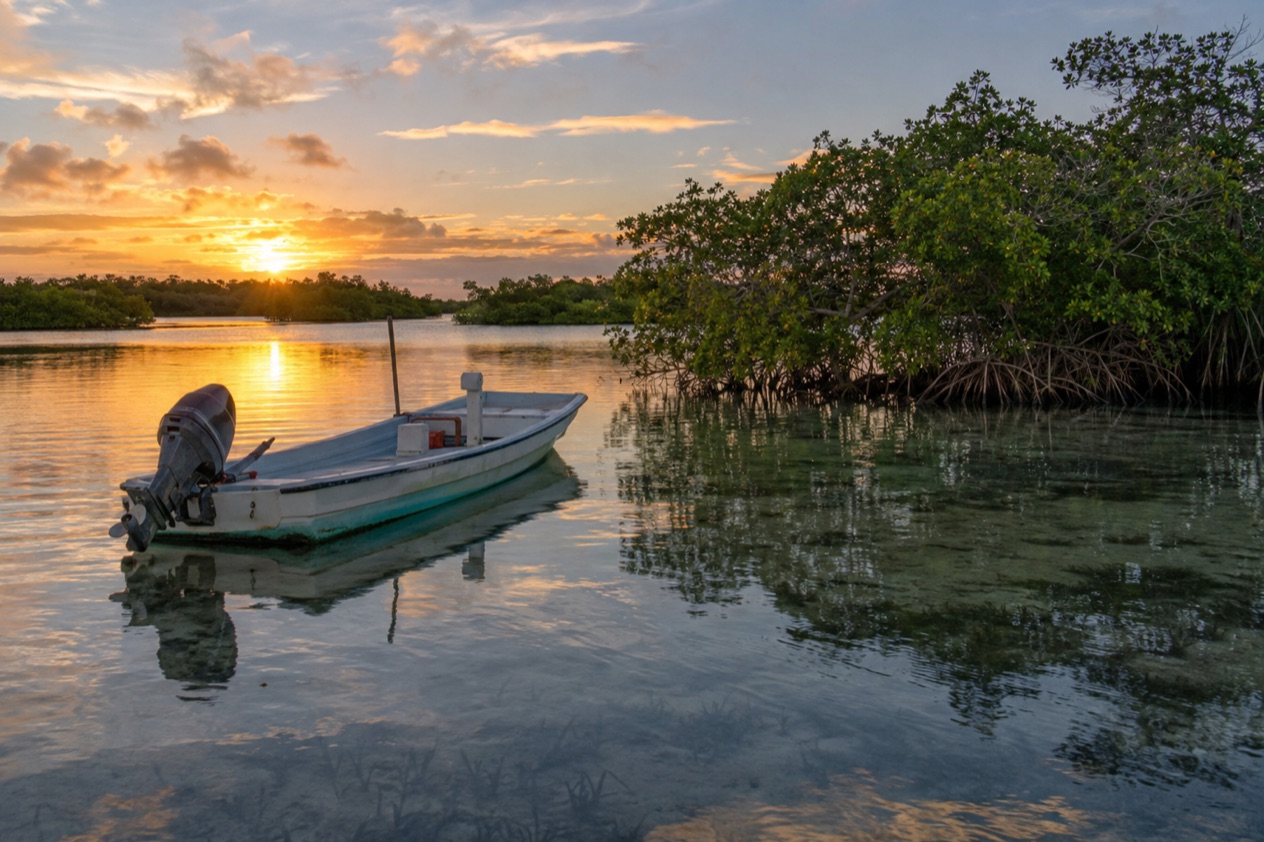
The setting is the shallow water inside the barrier reef, the second-largest coral reef system in the world and a UNESCO World Heritage Site. Mangrove shorelines, sandy flats and the channels between cayes make up the fishing grounds, and the backdrop is often nothing but sky, water and the green line of the mangroves. It is a quiet kind of fishing, suited to anyone who enjoys patience and watching the water.
Where do people go fly fishing?
People fly fish in Belize on the shallow flats, mangrove edges and lagoons inside the barrier reef, mostly around the cayes and the coastal waters of the mainland. The target is bonefish, tarpon and permit, and every one of them is caught and released. The country is small, but its coast offers a range of settings, from open sand flats to tangled mangrove creeks.
Flats around the cayes and atolls
The cayes and atolls, such as Ambergris Caye and Turneffe Atoll, are where fly anglers look for wide, shallow flats. The method is sight fishing. A guide poles the skiff slowly, you stand on the bow, and you scan the water for the flick of a tail or a moving shadow before you cast. Polarized glasses and a calm, unhurried cast are the tools of the trade.
Permit are harder to fool, and a permit taken on a fly is a story worth telling.
All three must be released, and possession is illegal, so the photo and the memory are what you take home. This is fishing for people who like a challenge and do not mind a day of looking, casting and sometimes missing.
Mangrove lagoons and the mainland coast
Tarpon, the silver giants, are fish of the lagoons, mangrove creeks and river mouths, where they roll at the surface and move through the brown, tea-colored water. Placencia, with its lagoon behind a long peninsula, and the waters off the south of the country are places anglers think of for this kind of fishing. Hooking a tarpon means a jump, a run and often a long fight, and then a careful release.
The rainy season typically lasts through November, and the dry season runs from February to May. Rain and wind change the water, and hurricanes can bring coastal flooding, especially in the south, from June to November. Plan with the weather in mind, and keep the schedule loose enough to let a guide choose the day and the tide.
Doing it well
A few habits make a fly fishing day better. Keep a low profile in the skiff, cast softly, and wet your hands before touching a fish you plan to release. Leave the fish in the water as much as possible, and let it swim away strong. Fishing the same waters as the villages is also a chance to see herons, frigatebirds and the occasional ray cruising the flats.
Nearby reef and island stays make it easy to pair fishing with other days on the water. Thatch Caye Resort, for example, lies inside the northern boundary of the South Water Marine Reserve, on a small island off Dangriga, and gives a taste of how the protected waters of the reef feel from a caye.
What rules apply to visitors?
Belize protects its marine life with closed seasons, size limits and outright bans on certain species, and anyone fishing or buying seafood falls under them. Bonefish, tarpon and permit are catch and release only. Other species are protected by law, and the rest of the catch is governed by the calendar and by size.
Closed seasons and size limits
The closed seasons apply across Belize. Lobster rests in spring and early summer, grouper in winter, conch in the summer months, and shark meat and fins from May through October. When a season is closed, taking the species is not allowed, and the size rules apply when it is open.
| Species | Closed season | Size and weight rules |
|---|---|---|
| Lobster | March 1 to June 30 | Carapace at least 3 inches, tail at least 4 ounces |
| Nassau grouper | December 1 to March 31 | Total length between 20 and 30 inches |
| Conch | July 1 to September 30, or when the catch quota is met | Shell at least 7 inches, market clean weight at least 3 ounces, fillet at least 2.75 ounces |
| Shark meat and fins | May 1 to October 31 | Taking, buying, selling, possessing and exporting are all closed |
Fish landed as fillet must keep a skin patch of at least 2 inches by 1 inch, so that the species can be identified. Florida stone crab needs a special license from the Fisheries Administrator, and its traps must have an escape gap and a biodegradable panel.
Species you cannot take
Some animals are protected outright. Taking or killing whale sharks and nurse sharks is illegal, and so is taking, buying, selling or possessing any parrotfish or tang, the grazers that keep coral clean. All marine turtles are protected, which means no interfering with nests, no possessing turtles or their products, and no buying articles made of turtle shell.
Coral of every type is covered as well. It is illegal to take, buy, sell or possess it, with the sole exception of black coral, which may be traded only with a license from the Fisheries Administrator. For a traveler, that means leaving coral souvenirs and shell jewelry of protected species on the shelf, whatever the market stall offers.
Licenses for commercial fishing
Commercial fishing requires a valid Fisherfolk and Fishing Vessel License, and every license expires on December 31. Belizean applicants must be at least 18, show identification and proof of residency, and show proof of sale in Belize.
The owner or master of a vessel needs a valid commercial fisherfolk license, and the vessel needs a seaworthiness certificate from the Belize Port Authority. Commercial vessels carry color coding for their fishing areas, and captains submit catch log data.
| License | Fee (BZ$ per year) |
|---|---|
| Fisherfolk License | 25 |
| Cook License | 25 |
| Vessel License, under 20 feet | 15 |
| Vessel License, over 20 feet | 25 |
| Replacement License (police report required) | 10 |
Good to know before you go
The U.S. State Department rates Belize Level 2, “Exercise increased caution”, because of crime, and says the south side of Belize City has historically had the highest concentration of violent crime.
Money is in Belize dollars, and ATMs at the Belize Bank, Scotiabank and Atlantic Bank accept Mastercard. Tipping is customary in Belize, with ten to fifteen percent standard and left to your discretion, which is worth remembering for a boat captain or guide after a good day.
The Atlantic hurricane season runs from June 1 to November 30, and coastal flooding, especially in the south, is a real possibility in those months, so weather can reshape any day on the water. On cayes, sand flies and mosquitoes tend to appear when the breeze drops.
Sources
- Belize Fisheries Department, Regulations (https://fisheries.gov.bz/regulations/), checked October 11, 2026
- Belize Fisheries Department, Licenses (https://fisheries.gov.bz/licenses/), checked October 11, 2026
- Wikipedia, Belize (https://en.wikipedia.org/wiki/Belize), checked October 11, 2026
- Wikivoyage, Belize (https://en.wikivoyage.org/wiki/Belize), checked October 11, 2026
- Wikipedia, Sarteneja (https://en.wikipedia.org/wiki/Sarteneja), checked October 11, 2026
- Thatch Caye Resort, FAQ (https://www.thatchcaye.com/faq), checked October 11, 2026
- U.S. Department of State, Belize Travel Advisory, Level 2, March 11, 2026 (https://travel.state.gov/), checked October 11, 2026
- NOAA National Hurricane Center, Climatology (https://www.nhc.noaa.gov/climo/), checked October 11, 2026