
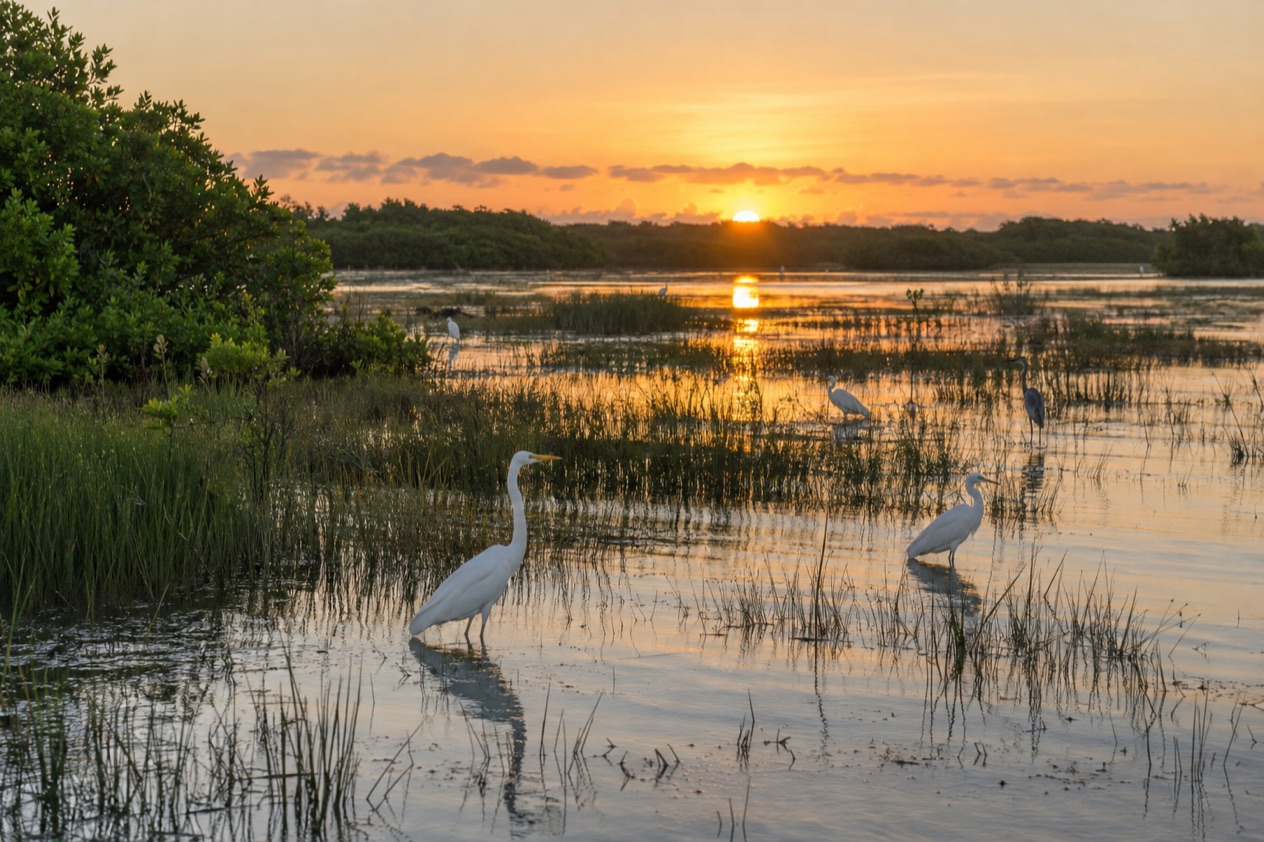
The dirt road to Crooked Tree runs out between savanna and water, and long before the village appears, white egrets are standing in the ditches and a hawk is sitting on a fence post. Then the lagoon opens up on both sides, wide and flat, with wading birds working the shallows. Crooked Tree Wildlife Sanctuary is a visit built around birds, water and a quiet village at the end of the road.
Is visiting Crooked Tree Wildlife Sanctuary worth it?
Yes, if you like birds, open water and slow, quiet landscapes, and less so if you want a checklist of monuments or a beach. The sanctuary was set up to protect the thousands of waterbirds that migrate to and through the area every year, and that purpose shapes everything you see, from the lagoon edges to the pine savanna beyond.
What sets it apart from other nature stops in Belize is its scale and its wetland character. The Crooked Tree Lagoon system is the largest wetland in Belize, a mosaic of lagoons, creeks, logwood swamps, broadleaf forest and pine savanna. Many parks in the country are about forest and caves.
Here the horizon is wide and the water is the main attraction. It is also considered one of the best birding destinations in Belize, especially in the dry season, when receding waters concentrate fish and bring in wading birds such as the Jabiru Stork.
It also has a place in the country’s conservation story. It was the first wildlife sanctuary the Government of Belize designated, and later the first Belizean site listed under the Ramsar wetlands convention. If the idea of standing in a place that started that story appeals to you, the visit carries a little extra meaning. Non-birders can enjoy it too, simply for the light over the water and the unhurried village life.
What to see at Crooked Tree Wildlife Sanctuary
The lagoons and their wading birds
The lagoons are the heart of the sanctuary. Herons, egrets, ibises and other waders stand along the edges and in the shallows, and the shape of the visit depends on the water level. When the water recedes in the dry season, fish are concentrated in smaller pools, and the birds gather to feed.
Belize as a whole is home to almost 600 bird species, and the wetlands here are one of the habitats where birders look. Watch the margins where open water meets floating vegetation, and scan the fence posts and dead branches for perched raptors. A pair of binoculars turns a pleasant view into a real wildlife encounter.
Jabiru storks
The Jabiru is the bird most people associate with Crooked Tree. It is a very large stork, standing tall over the marsh, with a black head and a bright red band at the neck. Jabiru storks arrive in November to nest in the lowland pine savannas of the sanctuary, and the species was added to Belize’s list of protected animals in 1973.
After the young fledge, in April and May, birds from the northern and central parts of Belize congregate at the Crooked Tree lagoons. That makes late spring a time when you may see several together, and sightings are a chance, never a promise.
Threatened wildlife beyond the birds
The sanctuary protects at least 11 threatened species. Among them are the Central American river turtle, known locally as the hickatee and listed as critically endangered, the Yucatan black howler monkey, and the yellow-headed parrot, both endangered.
You may hear howlers before you see them, since their deep roars carry over the treetops. Parrots are most often spotted in flight or in the broadleaf forest. Turtles are the shy ones of the group and are rarely seen by a casual visitor.
Pine savanna, swamp and forest
Away from the open water, the sanctuary spreads across logwood swamp, broadleaf forest and pine savanna.
The savanna is also where the Jabiru nests, so even a look at the pine-dotted flats has its reward. The drive in from the highway passes through some of this country, and it is worth keeping your eyes open from the first mile.
Hours, tickets and rules
The sanctuary is open through the day, from morning into late afternoon, and the entrance fee is set at two levels, one for Belizean nationals and a higher one for non-nationals. The sanctuary covers an estimated 37,985 acres of wetland, so the fee buys access to a very large protected area rather than a single site.
| Site | Open | Admission |
|---|---|---|
| Crooked Tree Wildlife Sanctuary | 8:00am to 4:30pm | BZD 2 (Belizean nationals), BZD 8 (non-nationals) |
The sanctuary is a protected area whose main goal is to safeguard waterbirds, and visiting it means entering a place managed for wildlife first. What is clear is that the sanctuary is a refuge, and a quiet, unhurried approach suits it.
How to get to Crooked Tree Wildlife Sanctuary
The sanctuary lies 33 miles north of Belize City and straddles the boundary between the Belize and Orange Walk districts. It is reached from the Phillip Goldson Highway, the former Northern Highway, and from the main highway it is an additional 3 miles on a dirt road to the village of Crooked Tree.
By bus, regular services running between Belize City and Orange Walk stop at Crooked Tree junction. From there it is a 3-mile walk into the village, so onward transportation should be arranged. Bus services are also available from Belize City to Crooked Tree village, Monday to Saturday.
Belize City and Orange Walk are the two bases on either side of the junction. The dirt road is part of the experience: it takes you out of the highway traffic and into the wetland landscape, and birds are often visible along the way.
When to visit Crooked Tree Wildlife Sanctuary
The dry season is the time birders single out. As waters recede, fish concentrate and wading birds follow them, including the Jabiru Stork. Jabirus arrive in November to nest, and in April and May, once the young have fledged, birds from the north and center of the country gather at the lagoons.
The sanctuary opens at 8:00am and closes at 4:30pm, so the visit fits within those hours. Birds are often most active in the early part of any day, and the opening time lets you be there for the morning.
Several counting events tie into the calendar. The Urban Bird Watch takes place on weekends in October and November, October Big Day falls on October 9, the Christmas Bird Count runs from December 14 to January 5, the Central American Waterbird Census runs between mid-January and mid-February, and the Great Backyard Bird Count falls in mid-February. These are events across Belize, and they signal how much attention the winter birds receive.
The Atlantic hurricane season runs from June 1 to November 30, which covers the months when the Jabirus are arriving to nest. Those planning a trip for November should keep that in mind when choosing dates.
Tips for your visit
- Bring binoculars, since the wading birds and raptors are often at a distance.
- Plan around the opening hours, from 8:00am to 4:30pm.
- Arrange onward transportation if you arrive by bus at the junction, because the village is a 3-mile walk.
- Take the dirt road slowly and watch the ditches and fence posts for birds.
Think of the visit as a slow one. The sanctuary rewards patience: standing still at the edge of a lagoon and watching what comes to feed is the whole point. A bird guide book helps, given that Belize has almost 600 species and the wetlands attract many of them.
Crooked Tree sits on the Phillip Goldson Highway, between Belize City and Orange Walk, so it pairs naturally with a journey along that road. For families, children who enjoy spotting animals often like the game of finding the biggest bird, which is usually the Jabiru. Mobility needs are worth thinking about, since the village is reached by a dirt road and the bus stops 3 miles away at the junction.
Good to know before you go
The U.S. State Department rates Belize Level 2, “Exercise increased caution”, because of crime, and says the south side of Belize City has historically had the highest concentration of violent crime.
The entrance fee is quoted in Belize dollars (BZD 2 for Belizean nationals, BZD 8 for non-nationals), so it helps to have small bills for the gate. The Atlantic hurricane season runs from June 1 to November 30, and the sanctuary’s wetland setting is a reminder that water levels and weather shape the experience here more than almost anywhere in the country.
Sources
- Belize Audubon Society, Crooked Tree Wildlife Sanctuary (https://belizeaudubon.org/ctws/), checked October 11, 2026
- Wikipedia, Crooked Tree Wildlife Sanctuary (https://en.wikipedia.org/wiki/Crooked_Tree_Wildlife_Sanctuary), checked October 11, 2026
- Belize Audubon Society, Birding (https://belizeaudubon.org/birding/), checked October 11, 2026
- U.S. Department of State, Belize Travel Advisory, Level 2, March 11, 2026 (https://travel.state.gov/), checked October 11, 2026
- NOAA National Hurricane Center, Climatology (https://www.nhc.noaa.gov/climo/), checked October 11, 2026